Act I
The volunteer supervisor ripped the last winter coat from the girl’s arms just as she whispered, “Please. My mom is freezing at home.”
Fifteen-year-old Emily Carter clutched the coat against her chest, her snow-wet hair hanging across her face. Behind her, the old church’s relief hall was crowded with families waiting for blankets, gloves, and warm clothing. Outside, heavy snow swept across the steps, burying the sidewalk beneath a layer of white.
“Let go,” the supervisor snapped.
Emily tightened her grip.
The coat was old-fashioned and slightly oversized, with thick brown buttons and a faded blue lining. It wasn’t beautiful, and it wasn’t expensive. But it was the warmest coat left on the table, and her mother needed it more than anyone Emily knew.
Her mother, Laura, had been sick for months. Since losing her job at a local laundry, Laura had struggled to afford heating, groceries, and the medication she needed. Their apartment’s radiator had stopped working properly weeks earlier, and the landlord had promised repairs that never came.
Emily had spent the previous afternoon walking between donation centers, hoping to find something warm enough to protect her mother through the winter.
The church giveaway was her last hope.
Now a woman wearing a volunteer supervisor’s badge stood between Emily and the only coat that might help.
“One coat per family,” the supervisor announced loudly, making sure everyone nearby heard her. “You already received a blanket.”
“That blanket has holes in it,” Emily said. “And my mom can’t stop shaking at night.”
The supervisor’s expression hardened.
“That’s not my problem.”
Emily stared at her, stunned.
The woman was forty-five, neatly dressed in a white shirt and dark trousers, with a clipboard tucked beneath one arm. She had spent the morning directing volunteers, assigning donation bags, and telling people where to stand.
She seemed to enjoy being in control.
When Emily had first approached the table, the supervisor had looked at her thin jacket and worn shoes with immediate suspicion. She had asked whether Emily had already received anything, then accused her of trying to take more than her share.
Emily had tried to explain.
The woman had decided that the explanation didn’t matter.
“Please,” Emily said again. “I’ll take anything else. Just let me have that one.”
The supervisor yanked the coat harder.
Emily bent forward, wrapping both arms around it.
Then the woman kicked her hard in the back.
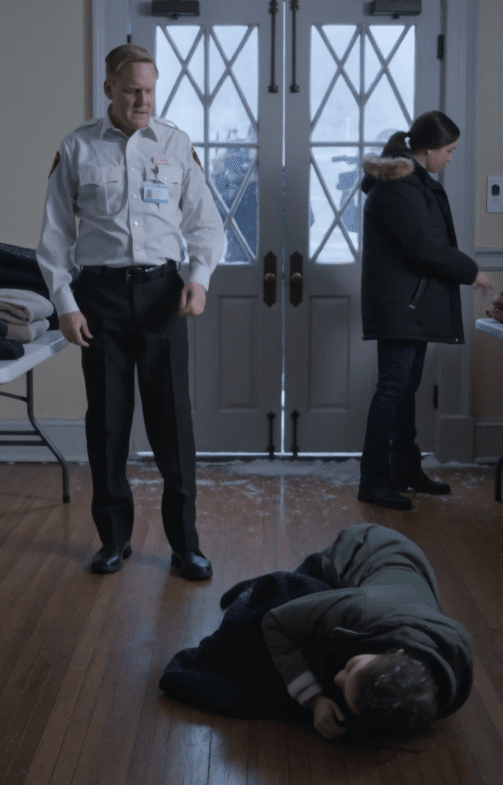
Emily fell face-first onto the wooden church floor, still desperately clutching the coat. The fabric dragged through melting snow near the doorway, and her forearm scraped against the boards.
A thin trace of blood appeared on the scrape.
The coat slipped from her hands.
For a moment, Emily couldn’t move. Pain tightened her face, and her breath came in short, frightened bursts. She curled onto her side, one arm protecting her back while the other reached for the coat.
The supervisor stepped closer.
Two more forceful kicks struck Emily’s back and side before she could get up.
A woman in the crowd gasped.
Someone dropped a paper cup.
Several people covered their mouths, staring at the scene as if they couldn’t believe it was happening inside a church.
Emily finally managed to pull the coat against her chest again.
“Please,” she whispered, tears gathering in her eyes. “My mom is freezing at home.”
The supervisor looked down at her.
“Trash. One coat per family.”
Emily’s lips trembled.
The woman leaned closer, her voice sharp enough to carry across the hall.
“Rules don’t care about your mother.”
No one moved.
The church’s wooden pews stood along the far wall. Tables overflowed with donated sweaters and children’s boots. A small media team had been recording the relief event, capturing volunteers handing out supplies and families expressing gratitude.
Now their cameras were pointed toward the confrontation.
The supervisor noticed the attention and lifted her chin, as if the presence of witnesses somehow strengthened her authority.
“People come here expecting charity,” she said. “They don’t get to take whatever they want.”
Emily lowered her head.
She wasn’t trying to take whatever she wanted.
She was trying to keep her mother warm.
Then the heavy church doors burst open.
A blast of wind drove snow across the entrance. Behind it came a tall man in a black suit and long overcoat, accompanied by two security guards and several members of the media team.
He stopped the moment he saw the girl on the floor.
His gaze moved from Emily’s scraped arm to the coat pressed against her chest.
Then he looked at the supervisor.
His expression became frighteningly calm.
One of the security guards moved to shield Emily while the other called for medical assistance.
The man turned toward the church’s leadership team.
“Pull every dollar I gave this place.”
The words landed harder than a shout.
The supervisor’s face went blank.
She had spent the entire morning enforcing rules as if she owned the room.
She had no idea that the man standing in the doorway had funded the relief program, paid for the coats on the tables, and personally approved the church’s largest charitable grant in years.
And he had just watched her turn his donation into a weapon against the very people it was supposed to help.
“Every dollar?” she whispered.
For the first time that afternoon, she looked afraid.
Because the last coat wasn’t the only thing about to be taken away.
Act II
The man’s name was Richard Hale.
At sixty, he was one of the most influential business owners in the city, known for building a successful network of manufacturing companies and funding projects that supported struggling families. His name appeared on hospital wings, scholarship programs, and community centers.
But the church’s winter relief program had always been personal to him.
Richard had grown up in a small apartment with a mother who worked nights cleaning office buildings. His father had left when he was young, and there were winters when the heating bill was more than the family could manage.
He remembered sleeping in two sweaters beneath a blanket that barely covered his feet.
He remembered his mother pretending she wasn’t cold so that he could have the thicker coat.
Most of all, he remembered the embarrassment of standing in a charity line while adults discussed his family as if they weren’t there.
One winter, when Richard was eleven, a woman at a donation center had refused to give his mother a coat because she believed another family deserved it more.
His mother hadn’t argued.
She had simply taken his hand and walked away.
That evening, she wrapped a towel around his feet before putting him to bed.
Years later, after Richard had become wealthy, he began funding winter relief programs. He wanted families to receive help without being made to feel small for needing it.
He insisted that the organizations he supported provide clear distribution rules, adequate supplies, and respectful treatment.
He didn’t expect every event to run perfectly.
He did expect people to remember why the work mattered.
That was why he had chosen St. Andrew’s Church for its winter relief program. The church had served the neighborhood for generations, and its volunteers had helped hundreds of families through difficult winters.
Its leaders had promised that Richard’s donation would provide coats, blankets, and emergency heating assistance to households in need.
The first reports had been encouraging.
Families had received supplies. Volunteers had worked long hours. The church had sent photographs showing crowded tables and smiling recipients.
Richard had approved additional funding.
He had never imagined that a girl would be kicked to the floor for trying to take home a coat for her sick mother.
Now he crossed the hall without looking at the cameras.
“What’s your name?” he asked the girl gently.
Emily hesitated.
“Emily.”
“I’m Richard. Can you tell me where you’re hurt?”
“My back,” she whispered. “And my arm.”
“Don’t try to stand until someone has checked you.”
His security guard crouched nearby, speaking calmly while another staff member contacted emergency services. Richard made sure the supervisor stayed away from Emily.
He did not shout at the woman.
He did not need to.
The silence around them was already saying what the room had been afraid to say before: what had happened was indefensible.
Richard removed his overcoat and placed it around Emily’s shoulders.
She stared at the expensive fabric.
“I’m going to get it dirty,” she murmured.
Richard’s expression softened.
“It’s a coat. It’s supposed to keep someone warm.”
For the first time since the attack, Emily looked directly at him.
He asked whether she had someone who could be contacted.
“My mom,” she answered quickly. “She’s home alone.”
“What’s her name?”
“Laura Carter.”
Richard nodded to his assistant, who began arranging for the appropriate emergency support and a safe way to contact Laura.
Then he looked at the coat.
“Is this the one you came for?”
Emily nodded.
“I don’t care if it’s old. I just need her to stop being cold.”
Richard glanced toward the tables.
Dozens of coats were neatly arranged by size. Some were new, others gently used. A volunteer had carefully folded scarves into piles beside children’s gloves.
There should have been enough for the people who had arrived.
But the supervisor had claimed Emily had already received her share.
Richard turned toward the event coordinator.
“Who made the decision that she couldn’t have this coat?”
The coordinator looked toward the supervisor.
“She did.”
The supervisor immediately stepped forward.
“Mr. Hale, there has been a misunderstanding. We’re trying to make sure everyone gets something. If people take extra items, we won’t have enough for the families who arrive later.”
Richard listened without interrupting.
It was a reasonable concern in principle. A relief program needed rules, and supplies could run out.
But rules were supposed to distribute help fairly.
They were not permission to assault a child.
“You could have explained the limit,” he said. “You could have offered another option. You could have called the coordinator.”
The woman tightened her grip on her clipboard.
“She refused to listen.”
Emily looked down.
“I asked her,” she whispered. “I told her why I needed it.”
Richard turned back toward the supervisor.
“And then you kicked her.”
The woman said nothing.
Several witnesses lowered their eyes. Others watched her, waiting for an explanation that could not change what they had seen.
Richard asked the church director to join them immediately.
Then he made another request.
He wanted every record associated with the relief program preserved: donation inventories, distribution logs, purchase receipts, staffing records, and communications concerning the event.
The media team lowered its cameras toward the relief table as security made room around Emily.
The supervisor looked at the tables, then at Richard.
“You can’t just cancel the entire program because of one incident.”
Richard’s voice remained quiet.
“I can suspend my funding while I find out what my money is supporting.”
Her mouth opened, but no words came.
She had assumed that Richard would care most about the event’s reputation.
She was beginning to understand that he cared more about what had happened inside it.
And when the church director arrived with a folder of financial reports, Richard discovered that the problem might extend far beyond one volunteer’s cruelty.
Act III
The church director, Reverend Thomas Bell, had been preparing to address the media team when Richard asked him to close the office door.
Thomas was a thoughtful man in his late fifties who had spent decades serving the congregation. He looked genuinely shaken by Emily’s injuries, and he immediately arranged for another volunteer to accompany her while she received medical attention.
But when Richard asked about the program’s finances, Thomas became guarded.
“The donations have been used for the relief work,” he said. “We’ve distributed hundreds of items.”
“Then the records should make that clear.”
“They do.”
“Good. Let’s review them.”
Richard’s assistant opened a laptop and brought up the latest inventory report. The church had received money for winter coats, blankets, emergency groceries, and heating assistance.
The report listed the number of items purchased, the number distributed, and the number remaining.
At first glance, the figures looked reasonable.
Then Richard asked to see the receipts.
Several purchases were listed under a general administrative category. The amounts were not automatically evidence of wrongdoing, but they were too vague to confirm what had been bought or delivered.
He asked for the distribution logs.
Some entries were complete. Others recorded only a household’s initials or the number of items handed out, without enough detail to reconcile the totals with the inventory.
Thomas frowned as he reviewed the documents.
“Our volunteers have been working under tremendous pressure,” he said. “The records aren’t always perfect.”
“I understand that,” Richard replied. “But we need to know whether the supplies reached the people they were intended for.”
The supervisor stood near the door, growing increasingly restless.
“This has nothing to do with me,” she said. “I manage the volunteers. I don’t handle the money.”
Richard turned toward her.
“Then you should have no problem with an independent review.”
She folded her arms.
“You’re making this sound like a scandal.”
“I’m trying to determine whether the program is operating properly.”
Richard’s assistant began compiling the available documents. She identified discrepancies between some of the purchase totals and the recorded inventory, along with several administrative expenses that needed clearer documentation.
Nothing in the preliminary review established that money had been stolen.
But the records were incomplete enough that nobody could confidently rule out mismanagement.
Richard’s expression hardened.
His donation had been intended to provide warmth to families who could not afford winter clothing. If the program’s accounting was unreliable, he needed to know why before another dollar was transferred.
He also wanted to know how the distribution system had allowed a supervisor to decide, in front of witnesses, that a desperate child deserved humiliation instead of help.
“Who trained the volunteers?” he asked.
Thomas looked toward the supervisor.
“She oversees the distribution team.”
“And who oversees her?”
“I do.”
Richard nodded slowly.
“Then this is not just a volunteer problem. It’s a leadership problem.”
The words struck Thomas harder than the accusation of poor recordkeeping.
He had trusted the supervisor because she was efficient. She arrived early, kept the lines moving, and rarely allowed disputes to delay distribution.
She had been praised for maintaining order.
Nobody had asked what her methods looked like to the families standing on the other side of the table.
Richard requested the volunteer handbook and the written policies governing the distribution of donated items.
The handbook emphasized fairness, dignity, and equal treatment. It specifically instructed volunteers to refer disputed cases to a coordinator rather than making unilateral decisions about a family’s eligibility.
The supervisor had violated that policy when she attacked Emily.
The church director read the relevant section twice.
Then he looked at her.
“Why didn’t you call me?”
“She was trying to take another coat,” the supervisor replied.
“Why didn’t you call me?” he repeated.
She glanced away.
For a moment, the hall seemed quieter than it had been during the assault.
The supervisor had no satisfying answer.
Richard asked for her name badge and instructed the church to remove her from all relief duties pending a formal investigation. The church director agreed, making clear that the decision was temporary while the facts and any applicable disciplinary procedures were reviewed.
Then Richard turned back to the financial records.
He authorized an independent audit of the donation program and suspended further discretionary funding until the audit could establish how the money had been spent and whether the promised supplies had been delivered.
The church would continue to provide immediate emergency assistance using verified resources, but it would no longer receive automatic transfers from Richard’s foundation.
He also asked that the audit examine whether any families had been wrongly denied assistance under the supervisor’s management.
It was a serious decision.
The church relied on donations to support its outreach programs, and the winter relief fund had become one of its largest annual efforts.
But Richard refused to let the fear of losing funding become an excuse for avoiding scrutiny.
“If the records are correct,” he said, “the audit will show that. If they’re not, we need to know what happened and fix it.”
Thomas lowered his eyes.
“I understand.”
Richard hoped he did.
Because the next question was harder.
He asked how many coats had been available at the beginning of the event, how many had been distributed, and why Emily had been told that she had already received too much.
The supervisor claimed that the final coat had been reserved for another household.
But the distribution sheet contained no name beside it.
A volunteer confirmed that the coat had been placed on the table for whoever needed it most after the remaining sizes had been distributed.
Another witness said Emily had arrived late because she had spent the morning trying to find transportation through the snow.
No one had told her that she was ineligible.
No one had warned her that the coat was reserved.
The supervisor had simply decided that Emily’s explanation was not good enough.
Richard looked at the empty space on the distribution sheet.
One coat.
One frightened child.
One woman who had mistaken authority for ownership.
And an organization that had allowed its rules to become more visible than its purpose.
Richard turned to his assistant.
“Make sure the audit includes every distribution decision made by this team. I want to know whether this was an isolated incident or part of a wider pattern.”
The assistant nodded.
Across the hall, Emily was being helped into a warm room while emergency personnel assessed her injuries.
She had no idea that the incident had exposed questions about the entire relief program.
She only knew that she had come looking for a coat and had ended up on the floor, holding it as if it were the last thing connecting her to her mother.
Richard looked toward the doorway through which the girl had been taken.
His decision had been made.
But he still had one promise to keep.
He had to make sure that Emily’s mother would not spend another freezing night waiting for help that should already have arrived.
Act IV
Laura Carter was sitting beside a small electric heater when the knock came at her apartment door.
She had spent the afternoon worrying about Emily.
The girl had promised to return before dark, but the snow had grown heavier, and the buses were running behind schedule. Laura had called her phone several times without getting an answer.
She was about to call the church when a woman introduced herself as Claire, Richard Hale’s assistant.
Behind Claire stood a community outreach worker carrying a bag of groceries and a new blanket.
Laura immediately became frightened.
“What’s happened to my daughter?”
Claire explained that Emily had been injured at the church giveaway and was receiving medical attention. She reassured Laura that the girl was conscious and that arrangements were being made for them to reunite safely.
Laura gripped the doorframe.
“Was she hurt badly?”
“She has pain in her back and an injury to her arm. Medical professionals are assessing her now. We’ll take you to her as soon as it’s safe.”
Laura covered her mouth.
For several seconds, she could not speak.
Then she whispered, “She went there for me.”
Claire didn’t know what to say.
Laura stepped away from the door and sat down heavily.
She had been sick for months, and every day she struggled to hide how frightened she was about their future. Emily had insisted on helping, even when Laura begged her to focus on school.
Now the child she had tried to protect was hurt because she had gone looking for something warm enough to keep her mother alive through the winter.
Claire sat beside her and waited until she was ready to leave.
When Laura reached the church, she found Emily resting beneath a blanket in a small office near the hall.
The moment their eyes met, Emily began to cry.
“Mom.”
Laura hurried to her.
“Oh, sweetheart.”
She held Emily’s face between her hands, searching for signs of pain.
“I’m sorry,” Emily whispered.
Laura stared at her.
“Sorry for what?”
“I couldn’t get the coat without making trouble.”
Laura’s expression crumpled.
“You were trying to help me.”
Emily nodded, tears slipping down her cheeks.
“I didn’t want you to be cold anymore.”
Laura pulled her close, careful of her injuries.
“You are my daughter,” she whispered. “You don’t have to earn the right to be safe.”
Emily buried her face against her mother’s shoulder.
Across the room, Richard watched quietly.
He had heard many speeches about charity. He had attended fundraising dinners where people applauded after hearing statistics about families helped and coats distributed.
But there was nothing abstract about the sight of Laura holding her injured daughter.
The money had been raised for moments like this.
The supplies had been purchased for families like theirs.
And yet the person responsible for distributing them had treated a child’s desperation as an offense.
Richard approached only after Laura had time to comfort Emily.
He introduced himself and explained that he had funded the winter relief program. He apologized for what had happened and told Laura that the incident was being investigated.
Laura looked at him with exhaustion and disbelief.
“Why would anyone do that to her?”
Richard took a breath.
“I don’t have an answer that would make it acceptable.”
He told her that the church had removed the supervisor from her duties pending review, that the program’s finances were being independently audited, and that the organization would examine whether other families had been denied help improperly.
He also explained that his foundation would work with qualified local partners to make sure families facing urgent cold-weather risks could access assistance while the review continued.
Laura listened, her hand resting protectively on Emily’s shoulder.
“Will there still be coats for other children?”
The question surprised him.
She had every reason to be angry. Her daughter had been hurt, and her family had been made to feel unwelcome at a place they had approached for help.
Yet her first concern was whether other children would be left outside in the cold.
“Yes,” Richard said. “We will make sure emergency assistance continues through verified channels while we investigate what went wrong.”
Laura nodded slowly.
“Then please don’t let this happen to another girl.”
Richard met her eyes.
“I won’t ignore it.”
He knew that promise would require more than a dramatic announcement.
The audit would take time. The church would have to account for its records. The foundation would need to review its oversight procedures and ensure that future grants included clear reporting requirements.
He also knew that an organization could change its paperwork without changing its culture.
So he required the church to establish a formal process for handling distribution disputes, provide additional volunteer training, and create a way for families to raise concerns without being humiliated in public.
An independent reviewer would assess the changes before the foundation considered restoring full funding.
The financial review later confirmed that the program’s records were inadequate in several areas. Some purchases were supported by receipts, while other entries required correction or additional documentation. The audit identified administrative failures that had made it difficult to reconcile all the funds with the inventory distributed.
The findings did not establish that every discrepancy was intentional, but they did require the church to correct its records and strengthen its financial controls.
The supervisor’s conduct was investigated separately.
Witness accounts confirmed the assault, and the available footage supported the accounts of those who had seen it. The church terminated her volunteer appointment after completing its review and referred the matter to the appropriate authorities.
Richard did not demand that the church publicly shame her.
He demanded that it take responsibility for what had happened.
Meanwhile, his foundation helped arrange immediate winter supplies for Laura and Emily through a partner organization that could verify their needs and provide assistance without exposing them to another public confrontation.
Laura received warm clothing, a properly functioning portable heater suitable for their circumstances, and information about local services that could help with her ongoing medical and housing needs.
Emily received medical follow-up and time to recover.
For the first time in months, Laura could sit beneath a warm blanket without worrying that her daughter had to brave another snowstorm to find one.
But the most significant consequence of the church incident came when the foundation’s audit prompted a broader review of its charitable partnerships.
Richard had previously relied heavily on photographs, summary reports, and assurances from organizations he funded.
Now he required clearer inventory records, independent verification of major expenses, and documented procedures for treating recipients with dignity.
He did not want charity to become a public performance where donors were celebrated while struggling families were left to defend their right to receive help.
The change would affect dozens of programs.
And it began with a fifteen-year-old girl who had refused to let go of a coat.
Act V
Three weeks later, snow still covered the church steps, but the relief hall felt different.
The tables had been reorganized. Coats were sorted by size, and each station had a clearly identified volunteer responsible for answering questions and referring difficult cases to a coordinator.
A notice near the entrance explained how families could request additional assistance if someone in their household had a medical condition or urgent need.
Nobody was required to explain their circumstances in front of a crowd.
Nobody was told to prove their suffering before being treated respectfully.
The changes had come after difficult meetings, financial reviews, and uncomfortable conversations about responsibility.
The church director had apologized publicly for the incident and acknowledged that the organization had failed to protect a child who came seeking help.
The independent audit had led to corrections in the program’s records and stronger controls over how donated funds were tracked. The foundation continued to monitor the corrective measures before deciding how future funding would be allocated.
Not every problem had been solved.
The church still needed to rebuild trust, and the wider investigation into the supervisor’s conduct continued through the appropriate channels.
But the relief program was no longer operating on the assumption that good intentions were enough.
On the morning of the next giveaway, Emily returned with Laura.
She wore a thick navy-blue coat that reached almost to her knees. The sleeves were slightly long, and the collar brushed her chin when she turned her head.
It was warm.
That was all she cared about.
Laura walked beside her, moving more slowly than the other visitors but smiling more than she had in months.
At the entrance, a volunteer greeted them.
“Good morning. We’re glad you’re here.”
Emily hesitated.
The memory of the previous visit remained vivid: the supervisor’s hand gripping the coat, the hard wooden floor, the gasps from the crowd, and the humiliation of trying to explain why her mother needed help.
The volunteer noticed her hesitation.
“You can take your time,” she said gently. “If you need something specific, we’ll do our best to help.”
Emily looked at Laura.
Her mother squeezed her hand.
They entered together.
At the back of the hall, Richard Hale was speaking with the church director about the new procedures. He had chosen not to make the event a celebration of his intervention. He wanted the families to receive what they needed without feeling that their struggles existed to enhance a donor’s reputation.
When he saw Emily, he excused himself and approached her.
“How’s your arm?”
“Much better,” Emily answered.
“And your back?”
“Better too.”
Richard nodded.
“I’m glad.”
Emily looked toward the coat tables.
“Are there enough this time?”
Richard followed her gaze.
“We’ve arranged additional supplies through the partner organizations. And if something runs short, the volunteers have instructions to find another way to help.”
Emily considered that.
Then she asked the question she had carried with her since the day of the assault.
“Did I do something wrong?”
Richard went still.
It was a simple question, but it revealed the damage that the incident had left behind. Even after receiving care, even after being reunited with her mother, Emily was still wondering whether her attempt to help had somehow made her responsible for what happened.
“No,” he said firmly. “You asked for help for your mother. Nobody had the right to hurt you for that.”
Emily lowered her eyes.
“I thought maybe I should’ve just left the coat.”
Richard crouched slightly so he could speak to her without towering over her.
“You were trying to keep someone you love warm. The person who hurt you made that choice. You did not make it for them.”
Emily swallowed.
Then she nodded.
It was not a magical cure for the memory. She would still remember the fall, the pain, and the sound of the crowd going silent.
But she no longer had to carry the blame.
Laura stood beside her, tears gathering in her eyes.
Richard turned toward the relief tables, where volunteers were helping another family choose warm clothing for their children.
He had once believed that the most important part of charity was the amount of money given.
Now he understood that money was only the beginning.
A donation could purchase a thousand coats, but it could not guarantee that the person handing them out understood compassion. A beautiful report could describe a successful program, but it could not prove that every person who needed help had been treated with dignity.
That required attention.
It required accountability.
And sometimes it required someone with the power to act to stop, look at the person in front of them, and refuse to accept cruelty as normal.
The last winter coat had exposed a failure that no polished photograph could hide.
It had forced a church to confront its own procedures, a donor to examine his oversight, and a community to reconsider what it meant to help people who had nowhere else to turn.
But for Emily, the real victory was smaller.
It was her mother’s hands no longer trembling from the cold.
It was walking into a relief hall without feeling ashamed.
It was knowing that asking for help did not make her less worthy of respect.
As they left the church that afternoon, Laura adjusted the collar of Emily’s new coat.
“Warm enough?” she asked.
Emily smiled.
“Very.”
Laura kissed her forehead.
Outside, snow drifted quietly across the steps. The world was still cold, and their lives were not suddenly free of hardship.
But they walked home together, warm against the wind.
Behind them, the church doors remained open.
And inside, the coats were finally being given to the people they had been meant for all along.