Act I
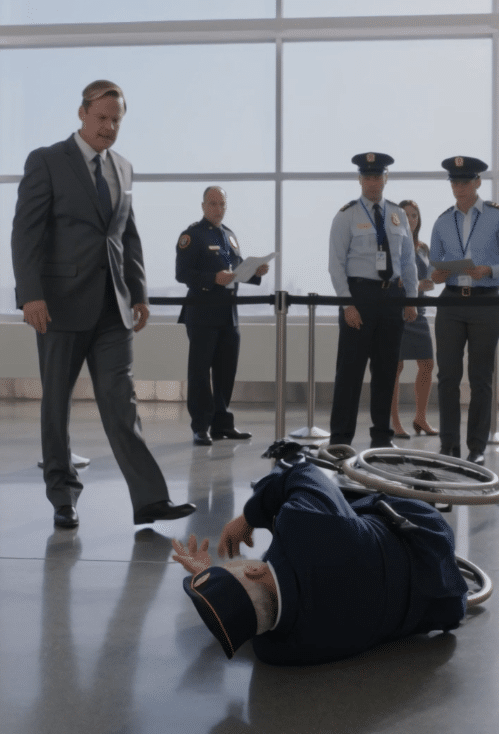
The wheelchair hit the airport floor so hard that the sound echoed through the check-in hall.
One moment, the seventy-five-year-old veteran was reaching into his small lap bag for his VA papers. The next, his wheelchair had been kicked sideways by a man in a tailored gray suit, sending him tumbling onto the polished floor beneath the cold white lights.
His faded navy jacket twisted beneath him. His veteran cap rolled toward the feet of a family standing nearby. Papers flew across the tiles, sliding beneath suitcases and shoes, while his bag fell open and spilled its contents.
A thin line of blood appeared along his forearm where it had scraped the floor.
The veteran gasped and tried to push himself up. Pain tightened his face, but his eyes were fixed on the scattered papers.
“My papers are right here.”
The man in the gray suit looked down at him without a trace of remorse.
“Trash. Business class is waiting.”
His name was Richard Vance, a forty-four-year-old corporate executive who had grown accustomed to having inconveniences removed before they had time to irritate him. He traveled business class, carried an expensive leather suitcase, and spoke to service workers as though their purpose in life was to anticipate his needs.
That morning, the inconvenience was an elderly man in a wheelchair who had taken a few extra seconds to find his travel assistance documents.
Richard had already complained twice about the line. He had checked his watch, sighed loudly, and demanded that an airline employee open another counter. When the employee explained that assistance paperwork required verification, Richard’s irritation had turned into contempt.
He had looked at the veteran’s wheelchair and decided the man was the problem.
Now, instead of stepping away, Richard moved closer.
The veteran reached for a folder near the leg of a passenger. His fingers shook as he tried to pull it toward himself.
Richard kicked him again.
The old man curled in pain, struggling to protect his ribs as the second blow landed. Then came a third, delivered while he lay helplessly on the floor.
A woman near the counter covered her mouth. A businessman lowered his phone, horrified by what he was witnessing. Somewhere behind them, a child began to cry.
Nobody moved quickly enough.
The veteran tried to gather the papers with one hand, but they kept slipping away. His breathing came in short, uneven bursts. The embarrassment in his eyes was unmistakable—not because he had done anything wrong, but because hundreds of strangers were watching him struggle to reclaim the dignity that had just been torn away.
Richard straightened his jacket.
“Wheel yourself out of the line.”
The words carried farther than he intended.
An airline employee began to step forward, but Richard turned on him with an expression that made the younger man hesitate. Richard had spent years making people afraid of losing something by challenging him. A contract. A promotion. A valuable customer.
He expected the same calculation to work here.
Then a door marked for restricted airport personnel burst open.
A man in a black suit strode into the check-in hall, followed by airport security and a uniformed military officer. His expression was controlled, but his eyes went immediately to the veteran on the floor.
He crossed the distance without wasting a second.
“Give him room,” he ordered.
Security moved between Richard and the injured man. One officer knelt beside the veteran while another began clearing the area. The military officer carefully collected the scattered VA papers, keeping them turned away from the cameras and curious passengers.
The man in the black suit crouched beside the wheelchair.
“Sir, can you hear me? We’re going to get you help.”
The veteran looked up, bewildered.
The newcomer rose and turned toward the check-in counters.
“Hold the flight.”
Every conversation stopped.
Richard’s mouth opened slightly. His hand tightened around the handle of his luxury suitcase.
He had assumed the only consequence of delaying the line would be an angry complaint from another passenger. He had not considered that the man he had kicked might be the reason an entire airport operation was about to change.
He stared at the security officers surrounding the veteran.
Then he looked at the man in black.
“For him?”
For the first time that morning, Richard Vance seemed unsure whether the world still worked the way he thought it did.
And he was about to discover just how wrong he had been.
Act II
The man who had ordered the flight held was Daniel Brooks, the airport’s director of operations.
At fifty-nine, Daniel had spent nearly three decades managing terminals, security procedures, emergency responses, and the complicated machinery that kept thousands of travelers moving through an airport every day. He was known for being composed under pressure, the kind of executive who could coordinate a terminal evacuation without raising his voice.
He was also a former Army officer.
The uniformed man walking beside him was Colonel James Walker, a senior military liaison who had arrived at the airport that morning for a scheduled meeting concerning a new program for transporting wounded service members and veterans.
Neither man had expected their visit to begin with an assault.
Daniel had been reviewing a security matter in the restricted operations area when a security supervisor alerted him to a violent incident at the check-in counters. The initial report mentioned an elderly veteran, a wheelchair, and a passenger who had allegedly attacked him.
Daniel had asked for the nearest available security team and moved immediately.
He recognized the veteran before reaching him.
His name was Walter Hayes.
Twenty years earlier, Walter had served in a military medical evacuation unit during an overseas deployment. Daniel had been a younger officer assigned to coordinate transportation between medical facilities and regional command posts. Their paths had crossed during a difficult period when damaged vehicles, unpredictable routes, and limited resources forced exhausted teams to make impossible decisions.
Daniel remembered Walter as a quiet man who rarely spoke about his own work.
He remembered him staying behind after a long evacuation to help a frightened young soldier find his family. He remembered Walter refusing special treatment after an injury, insisting that another man needed the available assistance more urgently.
Most of all, Daniel remembered the day Walter had returned a set of identification papers to a young service member who had lost nearly everything during an emergency transfer.
“Paperwork looks small until it’s the only thing proving who you are,” Walter had told him.
Daniel had never forgotten the sentence.
After leaving active service, Walter had struggled to adjust to civilian life. His injuries limited his mobility, and a series of financial setbacks gradually narrowed his choices. He had worked in maintenance, repaired small engines when his hands allowed it, and spent years trying to remain independent.
Then his wife, Evelyn, died after a long illness.
Without her pension and the stability they had built together, Walter fell behind on rent. A dispute over housing assistance delayed his move into a more suitable residence. Temporary arrangements collapsed one after another, and he eventually found himself staying with acquaintances while waiting for his benefits and housing paperwork to be resolved.
The airport trip was supposed to mark a turning point.
Walter had been invited to attend a veterans’ remembrance ceremony in another state, where several former members of his unit planned to reunite. A veterans’ assistance organization had arranged his transportation and coordinated wheelchair support, but the final travel authorization required the original VA documents he had brought in his lap bag.
He had arrived early.
He had checked his ticket twice.
He had apologized when he needed an extra moment to retrieve his papers.
And he had still been treated as though his existence were an insult to someone else’s schedule.
As airport staff helped him onto a medical chair, Daniel remained beside him until a paramedic arrived. He did not immediately turn to Richard or begin demanding explanations.
Walter came first.
“I’m sorry,” Walter whispered, looking at the papers in the military officer’s hands. “I didn’t mean to hold everybody up.”
Daniel’s expression hardened.
“Mr. Hayes, you have nothing to apologize for.”
Walter glanced toward the waiting passengers.
“They all had places to be.”
“So did you.”
The simplicity of the answer seemed to unsettle him more than any grand speech could have.
Colonel Walker crouched beside the recovered papers and checked that the folder was intact. He recognized the travel authorization and confirmed that the military liaison office had been expecting Walter’s arrival.
The colonel looked toward Daniel.
“This is the man they sent us to meet?”
Daniel nodded.
“Yes.”
Richard heard the exchange but misunderstood its significance. He assumed the two officials were discussing an ordinary appointment and that the incident would soon be reduced to a brief security report.
He adjusted his cufflinks and stepped forward.
“Look, I don’t know what he told you, but the line was blocked. I have a flight to catch, and nobody explained why business-class passengers were being delayed.”
Daniel turned toward him.
“You kicked an elderly man out of his wheelchair.”
Richard gave a dismissive laugh.
“It wasn’t like that.”
“Several cameras recorded it.”
Richard glanced toward the security cameras above the counters. His confidence flickered, then returned in a more defensive form.
“Then review the footage. You’ll see the whole situation.”
Daniel studied him for a moment.
“We intend to.”
Richard expected a threat, perhaps a demand for identification or a lecture about airport behavior. What he received instead was a calm instruction to remain where he was while security documented the incident.
That irritated him more than an argument would have.
He was accustomed to controlling conversations. He was not accustomed to being told that his opinion was no longer the most important thing in the room.
Still, Richard believed this was a temporary embarrassment. He could explain himself, board his flight, and return to the world where people answered his calls.
Then Colonel Walker looked again at Walter’s papers.
He recognized the name on the travel authorization and quietly asked Daniel whether the director had seen the accompanying letter.
Daniel had not.
The colonel unfolded it carefully.
And the expression on his face made Daniel realize that Walter’s journey had far greater significance than a seat on a commercial flight.
Act III
The letter had been issued by a military historical foundation working with the Department of Veterans Affairs and several former service members. It confirmed that Walter Hayes had been invited to participate in a formal remembrance ceremony honoring members of a medical evacuation unit whose actions had never been fully documented in the public record.
The ceremony was not a political event or a celebrity gathering. It was the culmination of years of research by veterans, historians, and families who had struggled to establish the full story of a particular evacuation operation.
Walter was one of the few surviving people who could provide firsthand testimony.
For decades, he had avoided public recognition. He disliked ceremonies that turned service into spectacle, and he rarely discussed the men he had lost. But when researchers contacted him about a set of incomplete records, he agreed to help because the missing names belonged to people who had once trusted him with their lives.
One of those men was Sergeant Michael Turner.
Michael had been a young medic during the evacuation, known for carrying a small notebook in which he recorded the names of wounded soldiers he helped. When the unit came under pressure, Michael had remained behind to assist men who could not be moved quickly.
He had never returned to the main transport point.
The official record listed him as missing, but the surviving documents disagreed about when he had last been seen. A transfer entry placed him at a temporary medical station. Another report suggested that the entry might have been copied from a different roster.
Michael’s family had spent years trying to establish what happened.
Walter had been present during the evacuation. He remembered Michael helping a wounded soldier into a transport vehicle and then turning back toward the temporary station.
He had not seen Michael again.
That memory had troubled Walter for years, not because he believed he could have changed the outcome, but because the official record had left so much unanswered. When researchers began reviewing the unit’s files, Walter agreed to help them reconstruct the sequence of events.
The ceremony would bring together surviving veterans and family members to acknowledge the men whose service had been overlooked.
Walter’s testimony was important because it could distinguish what he had personally witnessed from what had later been written into the record.
His VA papers were not merely documents that allowed him to receive travel assistance. They contained the authorization, identification, and supporting information required to coordinate his participation in the event.
Without them, the arrangements could have been delayed.
But the papers had survived the attack.
Colonel Walker handed the letter to Daniel, who read it in silence. The airport director’s face remained composed, yet the anger in his eyes became unmistakable.
The passenger who had kicked Walter to save a few seconds had not simply assaulted an elderly traveler.
He had attacked a man on his way to help restore the names and stories of people who had served alongside him.
Still, Daniel understood that Walter’s importance did not depend on the ceremony, the research, or the attention that might follow. The assault was wrong whether Walter was a celebrated veteran or an unknown man traveling alone.
The letter explained the context.
It did not create his dignity.
That already belonged to him.
While paramedics examined Walter, Daniel ordered airport security to preserve all available footage and record witness statements. He requested that the airline maintain the relevant check-in records and that the incident be handled through the proper law-enforcement channels.
He also instructed his staff to arrange Walter’s medical assessment and travel assistance without making him repeat his story to a succession of strangers.
Richard listened from several feet away, his irritation growing as he realized that the incident was becoming more serious than he had anticipated.
“Is all of this really necessary?” he demanded. “I have a meeting waiting for me.”
Daniel didn’t look at him.
“Then you should have thought about that before you assaulted someone.”
Richard’s face flushed.
“I did not assault him. He was in the way, and I moved the chair.”
A security supervisor answered before Daniel could.
“The footage shows you kicking it.”
Richard fell silent.
His eyes shifted toward the cameras again. He was beginning to understand that the event could not be reshaped by his usual tactics. There were too many witnesses, too many recordings, and too many officials who had no interest in protecting his reputation.
But he still clung to the belief that his status would shield him.
He had spent years building a life around access: priority boarding, private lounges, executive introductions, and the unspoken assumption that inconvenience was something other people were supposed to absorb.
He looked at Walter, now seated safely beside the paramedics.
“What does any of this have to do with holding my flight?”
Daniel finally faced him.
“Because an emergency is unfolding, and my staff are handling it. Your schedule is not the priority.”
Richard scoffed.
“You can’t stop an entire flight because one man fell.”
Daniel’s expression remained steady.
“No. But I can make sure an assault is dealt with properly, and I can make sure the people responsible for this airport do not ignore it.”
He turned away.
That was when Richard saw the colonel speaking quietly with Walter. The officer had taken a seat beside him, listening rather than talking. Walter was explaining something about Michael Turner, using the names on the papers to clarify which records he remembered.
There was no grand ceremony in that moment.
No applause. No crowd cheering.
Just a wounded old man being heard.
Richard looked around and discovered that nobody was looking at him with admiration anymore.
The witnesses had seen what he had done. The staff had documented it. Security was waiting for the next instruction.
And Daniel Brooks had no intention of letting the matter vanish when the check-in line started moving again.
Yet the most consequential decision had not been made.
Daniel stepped aside with the airport security chief and the airline’s duty manager. They reviewed the immediate operational requirements and confirmed that Walter’s medical care, the preservation of evidence, and the investigation could proceed without allowing Richard to dictate the response.
Then Daniel made a call to the airport’s executive command center.
What he requested would affect more than one passenger.
And Richard, who had spent the morning demanding that the world hurry for him, was about to learn what happened when the people in charge stopped hurrying to protect him.
Act IV
The airport director’s call triggered a carefully coordinated response.
Security preserved the footage from the check-in area, collected the names of witnesses, and documented the condition of the wheelchair and the scattered belongings. The airline recorded the disruption and began reviewing its own procedures for assisting passengers with disabilities.
Law enforcement was notified, and Richard was instructed to remain available while the incident was assessed.
His flight was held briefly while staff dealt with the immediate emergency and confirmed the operational plan. The decision was not a theatrical punishment designed to embarrass him. It was a practical measure taken while security personnel managed a violent incident in a crowded public area.
But to Richard, it felt like an attack on everything he believed about himself.
He called his executive assistant.
“Get me the airline’s regional manager,” he snapped. “Now.”
The assistant asked what had happened.
“I don’t have time to explain this.”
He ended the call before she could answer.
Then he contacted a colleague who had once helped arrange a private terminal transfer. That call went unanswered. He tried another number, then another, growing more frantic each time a message went to voicemail.
Meanwhile, Daniel stayed with Walter until the paramedics had completed their assessment.
Walter’s injuries required medical attention, and the staff were careful not to move him unnecessarily. His wheelchair was checked before anyone attempted to use it again. The VA papers were returned to a secure folder, and an airport employee retrieved his veteran cap from beneath a nearby counter.
When she handed it to him, Walter held it in both hands.
“Thank you,” he said.
The employee looked embarrassed.
“You shouldn’t have had to go through that.”
Walter nodded, but his expression suggested he had heard similar apologies before. What mattered now was whether the people who offered them would still remember him after the crowd dispersed.
Daniel seemed to understand.
He asked an airport liaison officer to remain assigned to Walter throughout the next steps. He also made sure the travel assistance organization was contacted directly, so Walter would not have to navigate a maze of phone calls while recovering from the assault.
Colonel Walker remained nearby, offering to accompany Walter to the medical facility and help coordinate the trip once doctors confirmed that he could travel safely.
Walter hesitated.
“I don’t want everyone missing their work because of me.”
The colonel gave a small, tired smile.
“Mr. Hayes, this is our work.”
The answer silenced him.
For much of his life, Walter had measured his worth by how little trouble he caused other people. He had learned to hide pain, apologize for delays, and insist that he could manage even when he clearly needed help.
The attack had exposed that habit as cruelly as it had exposed Richard’s entitlement.
Walter had been trying to make himself smaller so that other people could move faster.
Now, for once, the people around him were willing to slow down.
Richard, by contrast, was discovering that speed and importance were not the same thing.
A senior airline representative eventually arrived and spoke with Daniel and the security chief. The representative confirmed that Richard’s travel arrangements would be handled according to company policy, but no employee would be permitted to interfere with the investigation or use his status to dismiss the assault.
Richard demanded to speak with the airport director.
Daniel agreed.
They stood several feet away from Walter, with security present and the check-in hall quiet around them.
“You’ve made your point,” Richard said. “Can we get back to business now?”
Daniel regarded him steadily.
“What point do you think I’ve made?”
“That this place has rules.”
“Yes,” Daniel replied. “It does.”
“Then I assume you understand that I have rights, too.”
“You do.”
Richard appeared momentarily relieved.
Daniel continued.
“And so does the man you kicked out of his wheelchair.”
The relief vanished.
Richard glanced toward Walter, then back at Daniel.
“You’re acting as if I attacked some kind of national hero.”
“No,” Daniel said. “I’m acting as if you attacked a seventy-five-year-old man who was trying to complete a routine check-in.”
Richard opened his mouth, but Daniel raised a hand.
“His service record doesn’t make the assault wrong. It was already wrong before I knew his name.”
The words landed harder than a threat.
For the first time, Richard understood that the veteran’s military history would not be his only problem. He could not escape accountability by arguing that Walter was ordinary, obscure, or unimportant. The facts of the incident stood on their own.
Daniel instructed the security team to continue following the established process. Richard’s access to the restricted travel arrangements was reviewed, and the airline began its own assessment of whether his behavior violated its passenger conduct policies.
No one promised him a particular legal outcome. That would be for investigators and the appropriate authorities to determine.
But nobody was going to erase what happened.
The witnesses who had initially stood frozen began providing statements. The airline employee who had hesitated came forward and described what she had seen. A passenger offered a recording from a phone held near the check-in line.
Each account filled in another part of the same sequence.
Richard had complained.
He had kicked the wheelchair.
He had attacked Walter while he lay on the floor.
And he had continued humiliating him after the veteran tried to gather his papers.
The evidence did not become less clear because Richard was wealthy.
It became clearer because several people had finally decided to speak.
As the morning moved forward, Walter’s medical team confirmed the next steps in his care. His travel arrangements would be reconsidered once he was medically cleared, and the veterans’ organization offered to coordinate an alternative if he could not safely board the original flight.
Daniel promised that the airport would cooperate with those arrangements.
Then he crouched beside Walter one more time.
“The flight is not more important than you,” he said. “Neither is anyone’s title, ticket, or bank account.”
Walter looked down at the folder resting in his lap.
For a moment, he seemed unable to answer.
Finally, he whispered, “I was only trying to get there.”
“I know.”
Across the hall, Richard stood alone beside his expensive suitcase, surrounded by the consequences he had spent his life believing could be delegated to someone else.
He had asked for priority.
Now everyone could see what he had done with it.
But there was still one last journey Walter needed to make—and the reason he had fought so hard to reach the airport had not changed.
Act V
Walter was cleared to leave the hospital later that day, though his doctors advised him to rest before traveling. The airport’s assistance team worked with the veterans’ organization to arrange a revised itinerary, ensuring that his wheelchair, medical needs, and travel documents would be handled properly.
No one asked him to pretend the assault had been a minor inconvenience.
No one told him to forgive Richard to make the story more comfortable for everyone else.
Instead, Walter was given time to recover and the freedom to decide what he wanted to do next.
At first, he considered canceling the trip.
The thought of passing through another terminal, sitting among strangers, and watching people glance at his wheelchair made his stomach tighten. He had spent years learning how to manage his pain without inviting attention. After the assault, even ordinary movements reminded him of the moment he had struck the floor.
Daniel visited him before the revised departure.
“You don’t have to go,” the director said. “Not for anyone else.”
Walter looked at the folder on the bedside table.
Inside were his VA papers, the invitation to the remembrance ceremony, and a handwritten note from Colonel Walker confirming that the organizers would welcome him whenever he was ready.
Walter touched the edge of the note.
“I told those families I’d try to come.”
“You did.”
“And some of them have been waiting a long time.”
Daniel sat quietly.
He knew better than to turn Walter’s decision into a lesson about courage. The veteran had already spent enough of his life being expected to endure things without complaint.
After a long silence, Walter nodded.
“I want to go.”
This time, the journey was organized around his needs. A representative from the veterans’ assistance organization met him at the terminal entrance. His wheelchair was checked, his papers were verified privately, and a staff member accompanied him through the process without rushing him.
The check-in hall looked almost exactly as it had on the morning of the assault.
The same counters stood beneath the same bright lights. Suitcases rolled across the polished floor. Announcements echoed from overhead speakers. Travelers glanced at their watches and moved toward their gates.
But Walter no longer stood alone in the line, trying to apologize for the time he needed.
The airport director had ordered a review of how staff responded when disabled passengers were threatened or assaulted. The purpose was not to create a special privilege for veterans, but to ensure that employees knew how to protect vulnerable travelers and preserve evidence when violence occurred.
Daniel also requested that the airport’s public-facing procedures make it easier for passengers who needed assistance to receive it without being forced to explain their circumstances to a crowd.
The changes would take time. Training, policies, and accountability could not undo what had happened beneath the check-in lights.
But the incident would not be dismissed as an unfortunate interruption.
Richard’s case proceeded through the appropriate channels, with the recordings and witness statements forming part of the evidence. The airline conducted its own review, and his conduct became a matter of documented concern rather than a private complaint that could be buried by a phone call.
The outcome would be determined by the relevant authorities and policies. Daniel did not need to promise revenge or make a spectacle of the process.
The truth had already done something Richard could not control.
It had stripped away his ability to pretend that his status made him untouchable.
A few days later, Walter arrived at the remembrance ceremony.
The room was smaller than the grand military halls he had seen on television. Rows of chairs faced a simple display of photographs, unit insignia, and recovered documents. Families stood near the walls, holding pictures of relatives whose names had survived in letters and fading records.
Colonel Walker met Walter at the entrance.
“You made it,” he said.
Walter smiled faintly.
“Eventually.”
The colonel accompanied him to the front row, where a place had been reserved. Walter’s name appeared on the program not as a celebrity guest or a symbol of suffering, but as a surviving member of the unit whose testimony had helped the researchers understand the incomplete records.
When the ceremony began, the organizers spoke about the difficulty of reconstructing military history from damaged files and conflicting reports. They explained that the review had distinguished confirmed facts from unanswered questions, and that the work would continue where evidence remained incomplete.
Then they displayed a photograph of Sergeant Michael Turner.
Walter’s hands tightened on the arms of his chair.
The photograph showed a young man with an open smile and a medic’s bag slung over one shoulder. He looked far too young to have become a name in a decades-old investigation.
A member of Michael’s family stood to speak.
She described the stories passed down through generations, the unanswered questions, and the frustration of never knowing exactly what had happened during the evacuation. She did not claim that every mystery had been solved.
But she thanked the veterans who had preserved what they remembered.
“Records can tell us where someone was assigned,” she said. “They can tell us when a report was filed. But they cannot always tell us who stayed behind, who turned back, or who refused to leave another person alone.”
Walter bowed his head.
He remembered Michael’s voice, his worn gloves, and the way he had checked the names in his notebook before every transfer. He remembered the uncertainty of the evacuation and the terrible feeling of moving forward without knowing who would make it back.
For years, those memories had lived inside him without a place to go.
Now, other people were listening.
After the ceremony, several family members approached Walter. They asked about the men in the photographs and shared stories from letters that had been kept in drawers for decades. One woman showed him a picture of her father standing beside a transport vehicle that looked almost identical to the one in Walter’s photograph.
They spent an hour comparing details.
Nobody treated him as an inconvenience.
Nobody asked him to move faster.
When he grew tired, they helped arrange a quiet place where he could rest. When he wanted to continue talking, they listened.
It was not a perfect ending. The years of loss had not disappeared, and the investigation into the incomplete records remained unfinished. Walter still faced the practical challenges of rebuilding his life, and the airport assault would remain a painful memory.
But he had gained something he had not expected when he first reached into his lap bag that morning.
He had found a community willing to remember him while he was still alive.
Months later, Daniel Brooks received a letter from Walter.
It was brief, written in careful handwriting on plain paper.
Walter thanked him for the way he had handled the emergency, but he made no mention of the delayed flight or the public attention. Instead, he wrote about the people he had met at the ceremony and the names that had finally been spoken aloud.
At the bottom, he had added one sentence.
For a long time, I thought asking for help meant I had become a burden. You reminded me that needing help doesn’t make a person worth less.
Daniel kept the letter in his office.
He did not frame it or display it for visitors. He placed it in a drawer beside a photograph from his own years in uniform, where he could read it privately when the pressures of the airport threatened to reduce people to passenger counts and departure times.
He knew what Walter had taught him.
An airport was designed to move people efficiently. But efficiency was never supposed to mean that a human being could be discarded when he slowed the line.
And a uniform, a title, a business-class ticket, or a bank account could never make cruelty respectable.
Richard Vance had believed that a few seconds mattered more than an old man’s dignity.
He had looked at Walter’s wheelchair and seen a delay.
He had looked at his VA papers and seen an inconvenience.
He had looked at a veteran struggling on the floor and believed no one important would care.
He was wrong.
When Daniel Brooks ordered the flight held, he was not declaring that Walter deserved more respect because of his past. He was making it clear that the veteran deserved respect because he was a human being—and that the airport would not sacrifice his safety to satisfy someone else’s impatience.
Walter eventually traveled again.
He carried his papers in a secure folder, his veteran cap resting on his lap. Before boarding, he paused beside the window and watched the aircraft waiting beyond the glass, its lights glowing through the morning haze.
A staff member asked whether he was ready.
Walter looked down at the folder, then toward the gate.
“Yes,” he said.
This time, he did not apologize for taking a moment.
And as the airport doors closed behind him, the man who had once been kicked onto the floor for slowing a line moved forward at his own pace—with his dignity intact, his journey still ahead of him, and no need to prove to anyone that he belonged.