Act I
“Trash. You ruined our picture.”
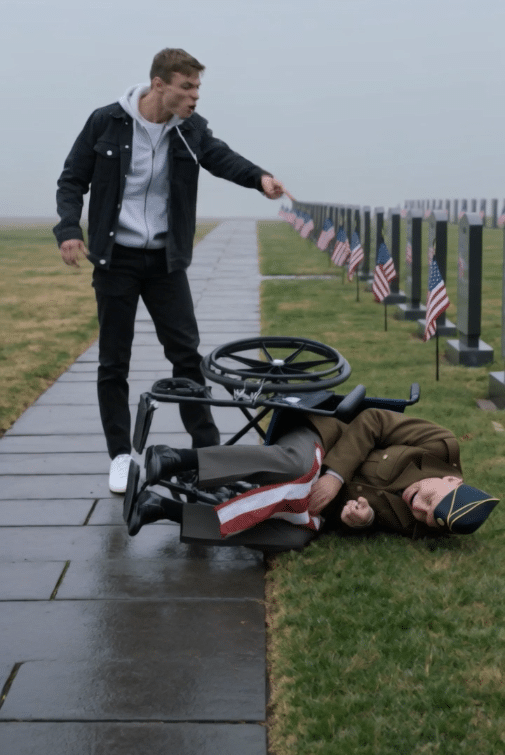
The young man in the black jacket stood over the elderly veteran as if he had just removed a piece of litter from the entrance to the cemetery.
Behind him, his friends lowered their phones. Their perfect photograph was ruined, and apparently, that was the greatest tragedy any of them could imagine.
The seventy-eight-year-old veteran lay on the wet stone path, struggling to breathe. His wheelchair had toppled onto its side, his old olive jacket was soaked with morning mist, and his veteran cap had rolled several feet away.
But he wasn’t looking at his injuries.
He was reaching for the American flag lying in the damp grass.
It was carefully folded into a neat triangle, its edges aligned with the precision of someone who had spent a lifetime understanding what that flag represented. He had carried it in his lap that morning because he intended to leave it at the memorial for the men who had never made it home.
Now the flag was lying in the mud.
The veteran stretched out his trembling hand, wincing as pain shot through his arm. A thin trace of blood marked the place where his forearm had scraped the stone.
“Please,” he whispered, his voice breaking. “That flag is for my brothers.”
The young man looked down at him and laughed without humor.
“Your old war can wait.”
A woman standing near the cemetery gate covered her mouth. An older couple froze beside a row of small American flags, while several visitors exchanged horrified glances.
Nobody had expected to witness this.
The young man, twenty-four-year-old Brandon Pierce, had arrived with three friends to take photographs outside the military cemetery before a scheduled memorial service. He wore a spotless white hoodie beneath a black designer jacket, and his hair had been carefully arranged for the camera.
The morning fog had given the cemetery entrance the dramatic appearance he wanted.
Then he noticed the old veteran in the wheelchair.
The wheelchair was parked near the edge of the path. The veteran had been sitting quietly, holding the folded flag on his lap while he waited for the cemetery staff to open the inner gate.
Brandon had told him to move because he was ruining the background.
The veteran had politely explained that he needed a moment.
That answer had been enough to ignite Brandon’s anger.
He had shoved the wheelchair, sending the flag sliding into the grass. Then he had kicked the chair with such force that it tipped sideways, throwing the elderly man onto the stone path.
Even after the veteran fell, Brandon had not stopped.
He stepped over the overturned wheelchair and delivered two more kicks to the old man’s back and side while the crowd watched in disbelief.
Now the veteran was curled in pain, trying to protect the flag with one hand while using the other to pull himself forward.
Brandon stared at him with open contempt.
“Seriously? You’re still reaching for that thing?”
The veteran looked up.
His eyes were wet, but not entirely from the mist.
“You don’t understand,” he said.
Brandon crouched slightly, bringing his face closer.
“No, old man. You don’t understand. People are trying to take pictures here.”
He gestured toward his friends, who were now standing several feet away. One of them had lowered his phone completely. Another looked as though he wanted to leave but was afraid to move.
The veteran swallowed hard.
He was seventy-eight years old. His legs could no longer carry him through the cemetery, so he had learned to navigate its paths with a wheelchair. His hands were stiff in the cold, and his body ached whenever the weather changed.
Yet he had dressed carefully that morning.
He had brushed the lint from his old olive jacket, polished the small veteran pin on his cap, and wrapped the folded flag in a clean cloth before leaving home.
He had not come to be photographed.
He had come to remember.
Brandon had seen none of that.
To him, the old man was an inconvenience who had failed to move quickly enough.
The veteran reached the flag at last, his fingers brushing its damp edge.
Brandon’s shoe came down beside his hand.
“Stay down,” he snapped.
A sharp silence fell over the cemetery entrance.
Then, through the fog, the low rumble of powerful engines began to grow louder.
Several black military SUVs appeared beyond the gate.
Their headlights cut through the mist as the convoy approached, and the vehicles stopped almost simultaneously along the curb.
Doors opened.
Uniformed escorts stepped out.
And from the center vehicle emerged a senior military officer whose expression changed the instant he saw the flag lying in the grass.
He did not look at Brandon first.
He went straight toward the fallen veteran.
What happened next would turn a morning of public humiliation into a moment nobody standing at that gate would ever forget.
Act II
The veteran’s name was Thomas Bennett.
For most of his life, Thomas had been the kind of man who kept his promises even when keeping them cost him something.
He had grown up in a small Midwestern town where people measured character by whether someone showed up when needed. His father had worked with his hands, his mother had volunteered at the local church, and the family had never possessed much money.
But they had possessed a fierce sense of responsibility.
When Thomas enlisted as a young man, his father had shaken his hand rather than hugged him.
“Come back with your head held high,” the older man had said.
Thomas had carried those words with him through years of service.
He had also carried the memories of the men who served beside him.
Some had been loud and reckless, forever competing to see who could tell the worst joke at the worst possible time. Others were quiet, dependable men who remembered birthdays, shared cigarettes, and somehow made even the most exhausting days feel survivable.
They had argued over food, complained about orders, and dreamed about what they would do when they finally returned home.
They had been young enough to believe that there would always be another morning.
Not all of them had received one.
Thomas rarely spoke about the details. He had learned that people often wanted a dramatic story when what he remembered most vividly were ordinary things: a friend’s laugh, a photograph folded into a pocket, the sound of someone calling his name across a crowded room.
After returning home, he tried to build the life he had promised his family he would live.
He married a woman named Margaret, raised a daughter, worked for years as a maintenance supervisor, and became the man neighbors called when a porch step broke or a car refused to start.
He never thought of himself as extraordinary.
He had done his job. He had survived. He had helped where he could.
That was enough.
Then age began taking things from him one at a time.
His mobility deteriorated after a series of medical complications, and eventually, a wheelchair became necessary for longer trips. Margaret passed away several years later, leaving behind a house full of memories and a silence Thomas struggled to get used to.
His daughter lived several states away with her own family. She called regularly, but Thomas hated worrying her, so he often told her that everything was fine.
He had become very good at making loneliness sound like independence.
The folded flag was one of the few things he had never allowed himself to put away.
It had come into his possession years earlier through a veterans’ memorial organization. The flag had been prepared for a ceremony honoring members of his former unit, and Thomas had kept it carefully preserved after the event.
For him, it was never simply a piece of fabric.
It represented the men whose names he still spoke aloud when he was alone.
Every year, he visited the cemetery on the morning of the memorial service. He arrived early, before the crowds, because he wanted a few quiet minutes to remember his friends without a microphone or a ceremony directing his thoughts.
That morning, he had planned to place the flag near the memorial stone and sit there until the service began.
He had even written a small note on a piece of cream-colored paper.
It contained five names.
Five men he could still picture clearly.
Five friends whose families had grown older while their sons, husbands, and brothers remained forever young in photographs.
Thomas had folded the note and tucked it inside his jacket pocket.
He intended to read it privately before the ceremony.
Instead, he had found himself on the ground, surrounded by strangers, with a young man treating his memories as an obstacle to a photograph.
Brandon Pierce had grown up in a world that rewarded attention.
His father owned a successful chain of car dealerships, and Brandon had never needed to worry about rent, tuition, or the consequences of a bad decision lasting longer than a few phone calls.
He had learned that almost every inconvenience could be solved by someone else.
If a restaurant made him wait, his father complained to the manager. If he damaged something, the bill disappeared into a family account. If he insulted someone, a gift or an apology arranged by another person often made the problem vanish.
Brandon had never learned the difference between being forgiven and being held accountable.
His social media accounts were filled with photographs of luxury trips, expensive clothing, and carefully arranged moments of apparent success. He liked locations that made him look important and people who reinforced the image.
The military cemetery had seemed like another perfect backdrop.
He had wanted the solemnity of the place without any obligation to understand it.
When Thomas refused to move, Brandon interpreted the refusal as disrespect.
When the old man tried to explain, Brandon heard an excuse.
And when the wheelchair tipped and the flag fell, he saw an opportunity to demonstrate that he could do whatever he wanted without consequence.
But Brandon had made one crucial mistake.
He had assumed that because Thomas was alone, nobody would care what happened to him.
He had no idea how many people were connected to the old veteran’s past.
And he certainly did not know the identity of the officer stepping through the fog toward the fallen flag.
Act III
Major General Robert Hayes had spent more than four decades in military service.
At sixty-one, he had reached a position that demanded calm judgment under pressure. He had attended ceremonies where national leaders delivered speeches, met families whose grief could not be eased by any official promise, and stood beside soldiers whose lives had changed in ways that no promotion or medal could repair.
He had learned to recognize the difference between respect that was performed for an audience and respect that remained when nobody was watching.
The distinction mattered to him.
That morning, he was traveling to the cemetery for a memorial ceremony honoring fallen service members. Two uniformed escorts accompanied him, and the convoy had been moving toward the entrance when the driver noticed a crowd gathered beside the gate.
Then Hayes saw the overturned wheelchair.
He saw an elderly man on the stone path.
And he saw the American flag lying in the damp grass.
His expression hardened.
“Stop here.”
The driver brought the SUV to a halt.
Hayes stepped out before the vehicle had fully settled. His polished shoes struck the wet pavement as he moved toward the gate, the fog swirling around the dark vehicles behind him.
The first thing he noticed was the veteran’s hand reaching toward the flag.
The second was the young man standing over him.
Hayes had not yet heard what had been said. He did not know the history of the confrontation, and he had no intention of making assumptions about every detail before it could be established.
But he could see that the old man was injured.
He could see that the wheelchair had been overturned.
And he could see that the flag had been left in the grass while the people nearby stood frozen.
The general changed direction slightly, moving between Brandon and Thomas.
One escort hurried to assist with securing the immediate area, while the other knelt near Thomas and asked whether he could hear him.
“Sir, can you tell me where you’re hurt?”
Thomas tried to answer, but pain interrupted him.
Hayes looked down at the flag.
Then he bent and lifted it from the damp grass with both hands, taking care to preserve its careful folds.
He held it close to his chest for a moment.
It was a small gesture, but everyone watching understood that it was deliberate.
He was not treating the flag as an accessory or a prop. He was treating it as something that deserved care.
Only then did he turn toward Brandon.
“Pick up that flag with respect.”
The command was quiet.
It did not need to be loud.
Brandon stared at the general’s uniform, then at the two escorts standing near the fallen veteran. His friends had gone completely still. One had moved his phone behind his back, while another was staring at the ground.
“What?” Brandon asked.
Hayes did not repeat himself.
Instead, he handed the folded flag to one of the escorts, who kept it safely elevated and away from the wet grass.
“Make sure this is protected,” the general said.
Then he turned his attention back to Thomas.
“Can you hear me, sir?”
Thomas nodded faintly.
“My chair,” he whispered.
“We’ll take care of that. Right now, I want to make sure you’re safe.”
The general crouched beside him, keeping his movements deliberate and giving the medical responders room to assess his condition. He did not attempt to pull Thomas upright or force him to move before they understood the extent of his injuries.
For the first time since the attack, Thomas seemed to realize that nobody was asking him to defend himself.
The escort beside him spoke gently.
“Help is coming, sir. Just stay with us.”
Thomas closed his eyes briefly.
“I was trying to get the flag,” he murmured.
“I know,” Hayes replied.
The general looked at the folded triangle resting safely in the escort’s hands.
“It’s safe now.”
Those words seemed to reach Thomas more deeply than anything else anyone had said.
His face tightened, and he turned away, ashamed of the tears gathering in his eyes.
Hayes had seen that expression before.
He had seen it in veterans who apologized for needing a wheelchair, in families who felt guilty for asking questions, and in soldiers who believed their suffering had become an inconvenience to everyone around them.
He knew that an injured person could be made to feel responsible for the cruelty inflicted upon him.
He would not allow that to happen here.
The general rose slowly.
Brandon watched him with growing uncertainty.
Until that moment, he had believed the situation could still be controlled. He could explain that the veteran had been blocking the photographs. He could claim that things had happened too quickly. He could remind everyone that he had no intention of causing a scene.
But Hayes was not interested in the appearance of the morning.
He was interested in what had actually happened.
And as the first emergency responders approached the gate, several witnesses began stepping forward to describe what they had seen.
Brandon’s carefully constructed version of events was already beginning to unravel.
Act IV
The cemetery entrance had become almost unnaturally quiet.
The fog drifted between the black SUVs, softening their outlines. Small American flags trembled beside the stone path, and the memorial guests stood in a loose semicircle around the scene.
Thomas was receiving medical attention while one of the escorts stayed beside him. His wheelchair had been moved out of the immediate path, and the folded flag was being protected from the damp ground.
General Hayes stood a short distance away.
Brandon looked at the uniform again.
“Sir, I think there’s been a misunderstanding,” he began.
Hayes regarded him steadily.
“Then explain what happened.”
Brandon glanced at his friends.
“He was in the way. We were taking a picture, and I asked him to move.”
“And when he didn’t move quickly enough?”
Brandon shifted his weight.
“I was trying to get him out of the shot.”
The general’s expression did not change.
“By overturning his wheelchair?”
Brandon’s mouth opened, then closed.
A woman near the gate spoke before he could answer.
“He didn’t just push the chair. He kicked it.”
Another witness nodded.
“Then he kicked the man after he fell.”
Brandon turned toward them.
“You don’t know what you’re talking about.”
“I saw it,” the woman replied. “We all saw it.”
One of his friends looked as though he might speak, but Brandon shot him a warning glance.
The general noticed.
“So did your friends,” Hayes said.
Brandon tried to laugh.
“This is ridiculous. You’re making it sound like I attacked someone for no reason. He was blocking the picture.”
Hayes stepped closer.
“You believe a photograph gives you the right to decide whether an elderly man deserves to remain in his wheelchair?”
“That’s not what I said.”
“Then tell me what you meant.”
Brandon could not find an answer that made him sound reasonable.
The problem was not that he lacked words. He had spent years learning how to talk his way out of trouble. He knew how to sound offended, how to accuse others of overreacting, and how to turn a legitimate complaint into an argument about his own inconvenience.
But every explanation he attempted returned to the same point.
He had wanted a picture.
Thomas had been in the way.
And Brandon had decided that the old man could be moved by force.
The general looked toward the veteran, who was now being helped onto a stretcher for further evaluation.
“Do you know why he came here this morning?” Hayes asked.
Brandon said nothing.
“He came to remember people he lost. He brought that flag for the men who never had the chance to grow old.”
The general paused.
“You came here for a photograph. He came here for his friends.”
The words settled over the crowd.
Brandon looked toward the stretcher, but Thomas was not watching him. The veteran’s attention remained on the folded flag, now held securely by the escort.
That should have been the end of it.
Instead, Brandon made another mistake.
He glanced at the general and said, “With all due respect, it’s just a flag.”
The silence that followed was absolute.
Even his friends seemed to recoil from him.
Hayes did not raise his voice. He did not threaten Brandon with his rank or promise consequences he had no authority to impose.
He simply looked at the young man for several seconds.
Then he answered.
“To you, perhaps. But you don’t get to decide what it means to someone else.”
Brandon’s face reddened.
“You can’t arrest me just because you don’t like what happened.”
“I’m not here to decide your legal fate,” Hayes replied. “That will be determined through the proper process. But I will not stand here and allow you to pretend this was an innocent disagreement.”
He gestured toward the witnesses.
“They saw what you did. They heard what you said. And they can tell their story without your permission.”
A uniformed escort stepped forward to provide the responding authorities with the relevant details. The witnesses were asked to give statements, and Brandon was instructed to remain available while the incident was investigated.
Nobody struck him.
Nobody shoved him into the mud.
Nobody treated him with the contempt he had shown Thomas.
Instead, the crowd watched as he stood alone in the place where he had expected to be admired.
His friends slowly moved away from him.
One refused to meet his eyes. Another finally admitted that he had recorded part of the confrontation on his phone. When the recording was reviewed, it captured Brandon’s deliberate actions and his dismissive comments after Thomas fell.
The evidence contradicted any suggestion that the veteran had simply lost control of his wheelchair.
Brandon looked at the phone, then at the witnesses.
For the first time, he seemed to understand that the people around him were not an audience he could direct.
They were witnesses to something he had done.
And the general was not the only person who would remember it.
As Thomas was prepared for transport to receive further medical evaluation, Hayes approached the stretcher one last time.
“Sir,” he said gently, “would you like us to keep the flag with you?”
Thomas nodded.
“If you don’t mind.”
“Of course.”
The escort placed the carefully folded flag where it could remain secure.
Thomas looked at it for several seconds.
Then he looked up at Hayes.
“I didn’t want to cause trouble at the ceremony.”
The general’s expression softened.
“You haven’t caused any trouble, Sergeant.”
Thomas blinked.
He had not heard anyone address him that way in years.
Hayes glanced at the old veteran’s jacket, where a small, faded insignia was almost hidden by the worn fabric.
“May I ask which unit you served with?”
Thomas gave him the name.
The general went still.
It was a unit he knew well, not merely from historical records, but from a story that had followed him through much of his own military career.
And when Thomas mentioned the five names written on the note in his jacket, Hayes realized that the old man was connected to a chapter of military history he had spent years trying to honor.
The flag in the escort’s hands was no longer simply a symbol of remembrance.
It was about to reveal why General Hayes had come to that cemetery with a personal reason for being there.
Act V
The emergency responders completed their assessment and transported Thomas for further medical evaluation.
General Hayes accompanied the group to the ambulance entrance, ensuring that the folded flag remained protected throughout the transfer. He did not abandon the veteran once the crowd’s attention shifted elsewhere.
Before Thomas was taken inside, the general asked a question that seemed to surprise him.
“Were you with Captain Michael Lawson’s unit?”
Thomas looked up sharply.
For the first time that morning, his expression changed for a reason unrelated to pain.
“You knew Mike?”
Hayes nodded.
“I knew his name long before I ever met you.”
He explained that Captain Lawson had been among the service members whose actions had become part of the unit’s official history. Years earlier, during a dangerous operation, Lawson and several members of his team had protected others at considerable personal risk.
The full story was complicated, and the public record did not capture everything that had happened. But Hayes had spent years speaking with surviving service members and studying the decisions that had shaped that chapter.
He had come to understand that the official accounts were often built from the memories of people who had never wanted recognition for themselves.
Thomas had been one of those people.
“I wasn’t the brave one,” Thomas said quietly. “Mike was. So were the others.”
Hayes shook his head.
“That isn’t how the people who served with you remember it.”
Thomas looked down at the flag.
For decades, he had carried the names of his fallen friends without expecting anyone else to remember them. He had attended memorial services, sent cards to surviving relatives, and quietly checked on the families who had struggled after their loss.
He had never considered these actions heroic.
They were promises.
He had made them when the men were alive, and he intended to keep them for as long as he could.
Hayes understood that now.
The general had seen the names on the note Thomas carried and recognized two of them immediately. He had been researching the unit for a memorial project intended to preserve the personal accounts of service members whose contributions had been overshadowed by the larger events surrounding them.
Thomas possessed something the project desperately needed: the memories of a man who had known those soldiers not as names on a wall, but as friends.
Hayes asked whether Thomas would consider sharing those memories when he had recovered.
Thomas hesitated.
“No one wants to hear an old man’s stories.”
The general looked at him.
“I do.”
Thomas’s lips trembled.
For years, he had worried that the details were disappearing. He sometimes struggled to remember a date or the name of a town, but he could still picture the men clearly. He remembered how they laughed, what they argued about, and the small acts of kindness that never appeared in official reports.
He had assumed those memories would vanish with him.
Now someone was asking him to preserve them.
“I’d like that,” he whispered.
Hayes extended his hand, and Thomas took it.
There was no grand speech. No photographer was called forward. No one asked Thomas to pose beside the general for a commemorative picture.
The moment belonged to them.
And for Thomas, that made it more meaningful than anything that had happened at the gate.
The investigation into Brandon’s conduct continued after the memorial service. Witness statements and video evidence were collected, and the incident was handled through the appropriate authorities. Any criminal or civil consequences would depend on the findings and the applicable law, not on the general’s personal feelings.
Hayes made that distinction clear.
His rank did not place him above the legal process, and it did not give him the power to dictate a court’s decision.
But it did give him the opportunity to ensure that the incident was not dismissed as a trivial disagreement between strangers.
He also made sure the cemetery’s staff knew what had happened and that Thomas received support while recovering.
Brandon, meanwhile, discovered that the photograph he had tried so desperately to perfect had become the least important thing about that morning.
The recording of his behavior circulated among the people who had witnessed the incident. His friends faced questions about why they had stood by while an elderly man was attacked. Some admitted that they had been afraid to challenge Brandon, while others struggled to explain why they had continued filming.
His family attempted to keep the matter from becoming a public spectacle, but money and connections could not change what the evidence showed.
Brandon had wanted a clean image.
Instead, he had exposed the ugliness of his own character.
Weeks later, Thomas returned to the cemetery.
His injuries had required time to recover from, and he moved more cautiously than before. His wheelchair had been repaired, his cap had been cleaned, and the folded flag had been carefully restored to its proper condition.
The morning was clear.
Small American flags lined the path, and visitors gathered quietly near the memorial stones. A few military personnel stood at attention while families searched for names carved into the granite.
Thomas arrived early, as he always had.
This time, General Hayes was waiting near the gate.
He greeted Thomas without ceremony and walked beside him toward the memorial. An escort carried the folded flag until they reached the place where Thomas wished to leave it.
Thomas paused.
He looked at the names engraved in the stone, then drew the small note from his jacket pocket.
Five names.
Five friends.
He read them softly, one by one.
When he finished, he placed the note beside the flag and bowed his head.
The general stood quietly nearby.
He did not interrupt the silence or turn the moment into a speech. He understood that remembrance was not something that needed to be performed for an audience.
After a while, Thomas looked up.
“Thank you for coming back,” he said.
Hayes answered without hesitation.
“Thank you for remembering them.”
Thomas studied the flag.
For a moment, he thought again about the young man at the gate, the overturned wheelchair, and the strangers who had watched him struggle to reach the thing he treasured most.
He remembered the shame he had felt when he fell.
He remembered apologizing for causing trouble when he had been the one hurt.
But he also remembered the general bending to lift the flag from the grass, treating it with care before demanding anything from anyone else.
That was the moment he wanted to keep.
Not the violence.
Not the humiliation.
The moment someone had finally stopped treating him as an inconvenience and recognized the human being in front of them.
Thomas placed his hand over the folded flag.
“My brothers would have liked you,” he told Hayes.
The general lowered his head.
“I would have been honored to know them.”
The cemetery remained quiet around them.
There would be no photograph of Thomas being thrown from his wheelchair that he could look at without remembering the pain. There would be no explanation that could make Brandon’s actions acceptable.
But the old veteran had not lost what he came to protect.
His friends would be remembered. Their names would be preserved, their stories would be heard, and the flag would remain a symbol of the promises he had made to them.
Brandon had looked at an elderly man in a wheelchair and seen a ruined picture.
General Hayes had looked at the same man and seen a lifetime of service, grief, loyalty, and courage.
The difference between them was never the uniform, the rank, or the power to command a crowd.
It was the ability to recognize that another person’s dignity did not depend on how useful, young, strong, or important they appeared.
And as Thomas sat beside the memorial, his hand resting near the folded American flag, the morning fog finally lifted from the stone path.
The names remained.
The memories remained.
And the man who had tried to push an old veteran out of the picture had learned, too late, that some things in life were never his to move aside.