Act I
“Trash. Your service doesn’t buy this shelter.”
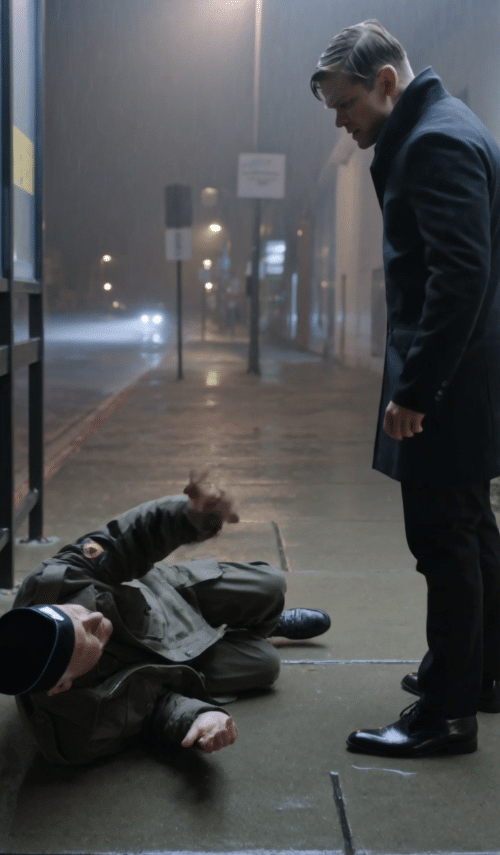
The words cut through the pounding rain just as the wealthy man in the black cashmere coat delivered another brutal kick to the old veteran lying on the concrete.
The elderly man curled instinctively around his chest, struggling to breathe. His worn army jacket was soaked through, his black veteran cap had fallen beside a puddle, and his prosthetic leg had struck the pavement with a hard, unforgiving thud.
A few feet away, the small medicine bag he had been clutching against his chest slid across the wet ground. It spun once before landing in a puddle, its contents threatened by the rain pouring from the shelter’s broken edge.
“Please…” the veteran gasped, reaching toward it with a trembling hand. “Those are my VA meds.”
The wealthy man looked down at him as though he had just heard something amusing.
He was forty, impeccably dressed, and wearing a watch that probably cost more than the veteran received in a month. His polished shoes remained almost untouched by the rain beneath the shelter, while the old man’s clothes clung to his body.
“Crawl back to the hospital,” he sneered.
The veteran tried to push himself up, but pain shot through his side. His arm shook beneath his weight, and he sank back onto the concrete, his face twisting with a mixture of agony and humiliation.
He had survived things this stranger could never imagine. He had endured nights when the sound of distant explosions made sleep impossible, years when old injuries reminded him of everything he had sacrificed, and the quiet loneliness that sometimes followed a man home long after his uniform was put away.
Yet somehow, in this moment, none of that mattered to the man standing over him.
The attacker stepped closer and kicked him again, then once more into his side. The veteran recoiled, drawing his arms inward to protect himself, while a thin trace of blood appeared where his elbow had scraped the concrete.
Around them, several commuters stared in horror.
A woman covered her mouth. A young man took a step forward, then froze when the aggressor turned his furious gaze toward the crowd. An older commuter whispered something under his breath but remained beneath the shelter’s far edge.
Nobody moved.
The veteran noticed them. He saw their shocked faces, their averted eyes, and their hands gripping phones they seemed suddenly afraid to use.
He had never asked anyone to call him a hero. He had never expected a parade every time he entered a room.
All he had wanted that night was a dry place to sit while he waited for the bus home.
And the medicine bag.
That bag contained the prescriptions he had collected after an exhausting appointment at the VA hospital across the street. Replacing them would take time he did not have, and some of the medication was essential to managing the injuries that had followed him for decades.
He dragged himself toward the puddle.
The wealthy man blocked his path with one polished shoe.
“Did you hear me?” he demanded. “Move.”
The veteran looked up. Rainwater ran down his weathered face, collecting beneath the brim of his fallen cap.
“I’m just waiting for the bus,” he whispered.
“Then wait somewhere else.”
The man’s contempt was so absolute that the words seemed to empty the shelter of air. He genuinely believed that money entitled him to decide who deserved protection from the weather, and that an old man with a prosthetic leg had no right to occupy the same few square feet of dry concrete.
What he did not know was that someone was about to arrive who would recognize the veteran immediately.
And that person would not ask the wealthy man for permission to help him.
Act II
For nearly three decades, Daniel Mercer had carried his injuries quietly.
At seventy-two, he lived alone in a modest apartment on the edge of the city, in a building where the elevator worked only when it felt like cooperating. His kitchen table held more prescription bottles than family photographs, and the chair beside his window had developed a permanent indentation from the hours he spent sitting there after his morning walks.
He had once been a young soldier who believed that courage meant refusing to complain.
Now he understood that courage sometimes meant asking for help, even when the request left a bitter taste in his mouth.
That afternoon, he had spent several hours at the VA hospital undergoing a routine evaluation. His prosthetic leg had been causing more discomfort than usual, and his physician had adjusted his treatment plan. By the time the appointment ended, he was exhausted.
He could have called a rideshare, but the cost would have meant cutting something else from his already limited budget. The bus was familiar, affordable, and close enough to the hospital entrance that he could manage the walk.
Daniel had made the same trip dozens of times.
He knew the security guard who greeted him at the entrance. He knew which vending machine occasionally swallowed dollar bills. He even knew the nurse who always reminded him to take his medications with food, despite his insistence that he had heard the advice a thousand times.
What he did not know was how close he had come to losing the one thing he could not afford to replace that night.
The wealthy man, meanwhile, had spent his life learning a very different lesson.
His name was Richard Hale, a prominent real estate investor whose name appeared on charity invitations, commercial property brochures, and the donor wall of several local institutions. He was accustomed to people stepping aside when he approached.
His wealth had purchased him access to exclusive clubs, private entrances, and rooms where disagreements were settled with a phone call. Over time, he had mistaken that access for a natural hierarchy in which everyone else existed to accommodate him.
That evening, Richard had left a meeting at a nearby private medical facility and was waiting for his driver to bring the car around. The rain had become heavier, and the small bus shelter offered the nearest available cover.
Daniel was already there.
Richard had looked at the veteran’s worn clothes, his damaged gait, and the medicine bag resting in his lap. Rather than see an elderly man trying to stay warm, he saw an inconvenience.
He had ordered Daniel to move.
When Daniel explained that he could not stand comfortably in the rain, Richard’s expression hardened. The refusal offended him more than any insult could have.
He was not accustomed to being told no by anyone, least of all someone he considered beneath him.
The first kick had been deliberate. The others had followed because no one had stopped him.
Now, as Daniel struggled to reach his medicine, Richard glanced at the watching commuters with the irritated expression of a man annoyed that his private business had attracted an audience.
“What are you all staring at?” he snapped.
Nobody answered.
A young woman near the bus stop looked down at her phone. Her fingers hovered above the screen, but she could not decide whether to call emergency services or record what was happening.
An older man shifted his weight, his face tight with shame. He had served in the military himself, though decades earlier, and something about Daniel’s desperate attempt to shield the medicine bag made his stomach turn.
He remembered the promises people made to veterans during election seasons, at memorial services, and beneath flags on national holidays.
Respect. Honor. Never forget.
Those words were easy to say in warm rooms.
Here, beneath a cold streetlight, an injured veteran was lying in the rain while strangers watched a wealthy man treat him as disposable.
Richard bent forward slightly.
“Look at you,” he said. “You expect everyone to feel sorry for you because you wore a uniform?”
Daniel’s fingers closed around the edge of his fallen cap.
For a moment, he looked as though he might answer. Then he swallowed, his jaw trembling as he turned his attention back toward the medicine bag.
He had spent years learning which battles were worth fighting.
This man was not worth the breath.
But the consequences of Richard’s cruelty were about to reach far beyond that bus shelter.
Because across the street, the hospital’s chief physician was finishing a late meeting when he received a message that would change the course of the evening.
And when he looked out at the rain, he recognized the old man on the ground.
Act III
Dr. Samuel Whitmore had spent more than thirty years treating veterans.
At sixty, he had become the chief physician of the VA hospital, a position that required him to balance medical judgment, administrative pressure, and the constant demand for resources that never seemed sufficient.
His office contained framed photographs of medical teams, awards from professional organizations, and letters from former patients who had written to tell him they were doing better.
But the photograph he kept closest to his desk was an old, slightly faded image of a military medical unit taken decades earlier.
Samuel was not a veteran himself. He had been a young physician when he first encountered the long aftermath of war, and he had learned early that injuries did not end when a patient left the operating room.
Some wounds remained visible. Others appeared in the careful way a man climbed stairs, the sudden silence that followed a loud noise, or the pride that made him apologize for needing assistance.
Daniel Mercer was one of the patients Samuel had come to know over the years.
Their relationship had begun when Daniel was referred for complications involving his prosthetic leg. The first appointment had been difficult. Daniel had insisted that his pain was manageable, that he could take care of himself, and that the hospital should focus on patients who needed more help.
Samuel had listened without arguing.
Then he had asked Daniel to explain what an ordinary day looked like.
The answer had been a revelation.
Daniel had described the careful calculations behind every trip outside, the stairs he avoided, the medications he sometimes stretched when unexpected bills arrived, and the quiet embarrassment of asking for transportation assistance.
He never dramatized his circumstances. In fact, he seemed determined to make them sound smaller than they were.
Samuel recognized the pattern. Many patients who had spent their lives being dependable struggled to accept that they were allowed to depend on someone else.
Over time, Daniel began trusting him.
He attended appointments when he could. He followed the treatment plan, even when it was inconvenient, and he remembered the names of the nurses who cared for him. When another patient in the waiting room became agitated, Daniel had once spent twenty minutes talking him down, simply because he recognized the fear beneath the anger.
He was not a celebrity. He had no powerful relatives or wealthy benefactors.
He was an elderly man trying to preserve his independence.
That afternoon, Samuel had personally reviewed Daniel’s latest treatment notes. The medication he had collected was part of a carefully coordinated plan, and the chief physician knew how difficult it could be for patients to navigate replacement prescriptions after a loss or disruption.
He also knew Daniel had been struggling physically.
When the evening meeting ended, Samuel had asked his driver to take him toward the hospital’s staff entrance. His medical assistant, Elena Ruiz, was accompanying him with several patient documents that needed his signature.
They were only minutes from the entrance when the driver braked sharply.
Through the rain-streaked window, Samuel saw a crowd gathered beside the bus shelter.
At first, he noticed only the movement: a man in a black coat standing over someone on the ground, commuters pressed against the shelter’s narrow walls, and an old black cap lying near a puddle.
Then he saw the prosthetic leg.
His expression changed.
“Stop the car.”
The driver pulled to the curb.
Samuel was already reaching for the door when he recognized Daniel’s jacket. He had seen that jacket in his office, draped across the back of a chair while Daniel adjusted his prosthetic leg. He remembered the worn seams near the cuffs and the small repair Daniel had made himself.
For a fraction of a second, Samuel could not make sense of what he was seeing.
Then Daniel tried to lift his head.
The physician saw the pain on his face.
He saw the medicine bag lying in the puddle.
And he saw Richard Hale standing above him with the cold, irritated expression of someone who believed he had done nothing wrong.
Samuel stepped into the rain.
Water splashed against his shoes as he crossed the pavement, his long navy coat whipping behind him. He did not stop to ask the crowd for an explanation. He did not approach Richard first.
He went straight to Daniel.
The veteran’s eyes moved toward him, unfocused with pain and exhaustion.
“Doctor?” Daniel whispered.
Samuel crouched beside him, carefully assessed his condition, and reached for the medicine bag. He lifted it from the puddle, holding it away from the wet ground as he looked at Daniel.
“I’m here,” he said quietly. “Don’t try to get up.”
Then he turned toward the black sedan.
“Get him into my car. Now.”
The order was calm, but it carried a kind of authority that silenced the entire shelter.
Elena hurried forward and opened the rear door. The driver stepped between Richard and the veteran, preventing the wealthy man from approaching.
Richard stared at the physician.
Something in Samuel’s face told him that this was no ordinary bystander. This was a man who had arrived with a purpose, and who would not be intimidated by an expensive coat or a threatening voice.
Richard’s confidence faltered.
He glanced at Daniel, then back at Samuel.
“Wait,” he said. “He’s your patient?”
For the first time that night, Richard Hale looked afraid.
But he still did not understand what he had just set in motion.
Act IV
Samuel did not answer Richard’s question.
Not immediately.
His attention remained on Daniel, whose breathing was shallow and whose face tightened whenever he tried to shift his weight. The physician gave Elena precise instructions while the driver kept the path to the sedan clear.
“Support his head and shoulders. Don’t pull on the prosthetic. We’ll assess him properly as soon as he’s inside.”
Elena knelt beside Daniel and introduced herself, though she knew he had seen her at the hospital before. She spoke gently, explaining every movement before helping him reposition.
Daniel tried to apologize.
“I’m sorry,” he murmured. “I didn’t mean to cause trouble.”
Samuel stopped what he was doing and looked directly at him.
“Daniel, you have nothing to apologize for.”
The words were simple, but Daniel’s expression changed as though he had heard something he had been waiting years to believe.
His eyes filled with tears he tried to blink away.
The doctor helped coordinate the transfer into the car, taking care not to place unnecessary pressure on Daniel’s injured side. The wet medicine bag was secured separately, and Elena checked that the prescriptions remained identifiable.
Only after Daniel was safely inside did Samuel straighten and face Richard.
The rain continued to hammer the shelter roof.
Richard adjusted his cuff, attempting to recover the composure that had served him so well in boardrooms and private clubs.
“I think there’s been a misunderstanding,” he began.
Samuel looked at the veteran’s fallen cap, the wet concrete, and the place where Daniel had been lying.
“A misunderstanding?”
Richard’s jaw tightened.
“He was taking up the entire shelter. I asked him to move, and he became difficult.”
A woman standing nearby made a small, disbelieving sound.
The older commuter who had remained silent finally spoke.
“He didn’t become difficult. You kicked him.”
Richard turned toward him.
“Stay out of this.”
“No,” the man replied, his voice shaking but audible. “I think I’ve stayed out of it long enough.”
The young woman with the phone looked down at her screen. She had begun recording before Samuel arrived. Her hands were still trembling, but the footage had captured Richard’s approach, the assault, and his words about Daniel’s military service.
Another witness stepped forward.
Then another.
The silence that had protected Richard was beginning to collapse.
Samuel held out his hand toward the young woman.
“Please preserve that recording. The responding authorities may need it.”
She nodded.
Richard’s eyes moved from the phone to Samuel’s navy coat. Recognition began to dawn on him, though not quickly enough to explain the sudden unease spreading across his face.
He knew the hospital.
He had attended fundraising events there. His company had once discussed a commercial development project near the medical campus, and he remembered that senior administrators had raised concerns about the proposal.
But Samuel Whitmore was not a man whose attention could be redirected with a donation or a polished explanation.
“I don’t know who you think you are,” Richard said, trying to sound indignant.
Samuel took one measured step closer.
“I’m the physician who just found an injured patient on the ground while you stood over him.”
Richard opened his mouth.
Samuel continued.
“You can explain your version of events to the police. You can explain why you decided that an elderly man deserved to be kicked because he needed shelter. And you can explain why you continued after he told you that the bag contained his medication.”
The words landed harder than a shout.
For once, Richard had no immediate response.
He glanced toward the sedan, where Elena was checking Daniel’s condition. The veteran had turned his face toward the window, trying to hide his distress from the people outside.
That image unsettled Richard more than the witnesses did.
Daniel was not looking at him with hatred.
He was looking away.
There was something deeply uncomfortable about being denied even the attention of someone he had deliberately humiliated.
Richard had expected tears, pleading, perhaps an angry outburst that would allow him to portray himself as the reasonable party. Instead, the old man had retreated into the quiet dignity Richard had tried to destroy.
Samuel followed his gaze.
“You want to know why I recognized him?” the physician asked.
Richard said nothing.
“Because I’ve treated him for years. I know his medical history, his injuries, and how hard he works to remain independent. I know how carefully he follows his treatment plan, even when his circumstances make it difficult.”
He paused.
“And I know that he would never have asked you for anything more than the space to sit until his bus arrived.”
Richard swallowed.
Samuel’s voice remained controlled.
“You saw an old man with a prosthetic leg and decided he had no value. That was your mistake. His value was never yours to determine.”
Behind them, the first distant sound of an approaching emergency vehicle rose above the rain.
A witness had called for assistance, and another had contacted the police. The young woman saved her recording while the older commuter offered to provide a statement.
Richard looked toward the street, suddenly aware that the crowd was no longer looking away.
He had spent years cultivating an image of success. He had built a life around the belief that reputation could soften any mistake and money could create distance between his actions and their consequences.
Now, in front of a VA hospital, surrounded by ordinary people who had witnessed his cruelty, that distance was disappearing.
Samuel turned back toward the sedan.
He had no interest in delivering a speech for the crowd. Daniel needed medical attention, and the physician intended to make sure he received it.
But before he reached the door, Richard spoke again.
“Doctor, listen. I’m sure we can settle this privately.”
Samuel stopped.
For a moment, the only sound was rain striking metal.
Then he looked over his shoulder.
“There is nothing private about what you did to him.”
Richard’s face lost its color.
And the next words Samuel delivered would make it clear that the wealthy man had misunderstood not only the veteran, but the entire situation.
Act V
Daniel spent the night under medical observation.
The assault had left him in significant pain, and his doctors needed to rule out serious complications, particularly given his age and the force of the attack. His elbow was cleaned and dressed, his injuries were documented, and his medication regimen was reviewed to ensure that the damaged bag had not compromised his treatment.
Samuel stayed long enough to see that Daniel was settled.
When the immediate assessments were complete, he returned to the bedside with a cup of water and Daniel’s black veteran cap, which a hospital employee had recovered from the bus stop.
Daniel accepted the cap with both hands.
“I should have moved,” he said quietly.
Samuel pulled a chair beside the bed.
“No.”
Daniel stared down at the cap.
“I could have avoided all of it.”
“Maybe you could have walked into the rain. Maybe you could have waited somewhere else. But none of that would have made what he did acceptable.”
Daniel’s shoulders rose with a long, unsteady breath.
For years, he had survived by finding ways to make difficult situations easier for other people. If someone was impatient, he tried not to take up too much time. If a clerk was rude, he reminded himself that everyone had a bad day. If asking for help made him feel small, he told himself that other people had it worse.
It was a habit born from discipline, but it had gradually become a burden.
Samuel seemed to understand.
“You served your country,” he said. “But you don’t have to earn the right to be treated like a human being. You already have that right.”
Daniel’s eyes filled.
He turned toward the window, embarrassed by his own tears, but Samuel did not look away or try to hurry him through the moment.
Outside, the rain had begun to weaken.
For the first time that evening, Daniel was somewhere he did not have to defend his right to exist.
The legal consequences unfolded over the days that followed.
The witnesses provided statements, and the recording from the bus stop became important evidence in the investigation. Richard could no longer claim that the encounter had been a simple disagreement or an accidental collision.
The footage showed him approaching Daniel, initiating the assault, and continuing to threaten and humiliate him while the veteran lay on the ground.
His words were equally revealing.
“Trash. Your service doesn’t buy this shelter.”
“Crawl back to the hospital.”
They were not comments made in the heat of a moment that had spiraled beyond his control. They were expressions of the contempt he had chosen to display when he believed no one important was watching.
The police investigated the incident, and Richard faced criminal proceedings arising from the assault. His attorney sought to limit the damage, but the existence of multiple witnesses and the recording made a simple denial impossible.
His professional life also began to change.
People who had once admired his confidence began asking harder questions about the man behind it. Business associates distanced themselves. Invitations disappeared. A charitable organization whose board had welcomed his donations announced that his relationship with the institution would be reviewed.
Money could pay for legal representation.
It could not erase the video.
Nor could it compel the people who had witnessed Daniel lying in the rain to forget what they had seen.
Richard eventually had to confront a reality he had spent much of his life avoiding: power might allow a person to control a room, but it could not guarantee that the room would continue to respect him.
Samuel, meanwhile, made sure Daniel’s recovery did not end when the immediate injuries had been treated.
The hospital’s care team reviewed his transportation needs and helped him understand the available support services. His prescriptions were replaced where necessary, and arrangements were made to reduce the obstacles that had made his routine appointments so exhausting.
Samuel was careful not to treat Daniel as helpless.
He asked what would make daily life easier, listened to the answers, and helped coordinate practical solutions. Daniel remained the person making decisions about his own life.
That mattered to him almost as much as the treatment itself.
Several weeks later, Daniel returned to the hospital for a follow-up appointment.
He walked more slowly than before, leaning on his cane as he crossed the lobby. His old army jacket had been cleaned, though the repaired seams remained visible. The black veteran cap sat firmly on his head.
Samuel met him near the entrance.
“How are you feeling?”
“Better,” Daniel replied. “Still sore. Still stubborn.”
Samuel laughed.
“Some things don’t need treatment.”
They walked together toward the clinic, passing a wall where photographs of veterans and medical staff commemorated years of service. Daniel stopped briefly before one of the photographs.
He had never thought of himself as extraordinary.
He had done his duty, returned home, and tried to build a life from what remained. His injuries were part of that life, but they were not the whole of it. Neither was the humiliation he had endured beneath the bus shelter.
For a long time, he had believed that dignity was something a person had to protect by never appearing weak.
That night had taught him something different.
Dignity could survive a fall. It could survive pain, fear, and the terrible moment when strangers watched without helping. It could even survive being treated as worthless by someone who had never taken the time to understand another human being.
What it could not do was make cruelty harmless.
That required people to stand up, to speak honestly, and to refuse to let wealth determine whose suffering mattered.
Daniel turned away from the photograph.
“Doctor,” he said, “I keep thinking about that night.”
Samuel waited.
“I wasn’t afraid of him as much as I was afraid of losing those medications. I thought about how long it would take to fix everything if the bag was ruined.”
He paused, his fingers tightening around the handle of his cane.
“And then you showed up.”
Samuel shook his head gently.
“You deserved help before I arrived.”
Daniel looked at him for a long moment.
Perhaps that was the lesson he had needed most. The physician’s arrival had changed the balance of power, but it had not created Daniel’s worth. It had simply made it impossible for the crowd to keep pretending they could not see him.
Outside, buses passed along the wet street, their headlights reflecting in the pavement. People hurried beneath umbrellas, each carrying private worries and unfinished stories.
Somewhere in the city, Richard Hale was learning that the consequences of one cruel decision could follow him far longer than he had imagined.
And somewhere behind the hospital windows, Daniel Mercer was beginning to recover—not only from the injuries inflicted on him, but from the belief that asking for help made him a burden.
He had gone to the VA that day for medication.
He had returned home with something he had not expected to find: proof that his life mattered to people who knew him, and that his service had never been the price of his dignity.
The rain had soaked his jacket, his shoes, and the medicine bag he had tried so desperately to protect.
But it had not washed away who he was.
And the man who had kicked him into the rain would spend a long time discovering that the old veteran he had dismissed as trash was never the one who needed to be ashamed.