Act I
“We need space to save him.”
Dr. Emily Carter stood at the entrance to the resuscitation room, one hand braced against the door as nurses worked urgently behind her. Monitor alarms sounded through the bright white hallway, medical equipment rattled past, and the sign marked Emergency Staff Only hung above the entrance.
Mark Ellison refused to move.
His relative was inside, fighting for his life, and Mark had decided that being family gave him the right to remain wherever he wanted. Emily had already explained that the team needed room to work. Every person blocking the doorway delayed movement, crowded the staff, and made an already critical situation harder to manage.
She stepped forward, directing the waiting family members away from the entrance.
Mark’s expression twisted with anger.
Then he attacked her.
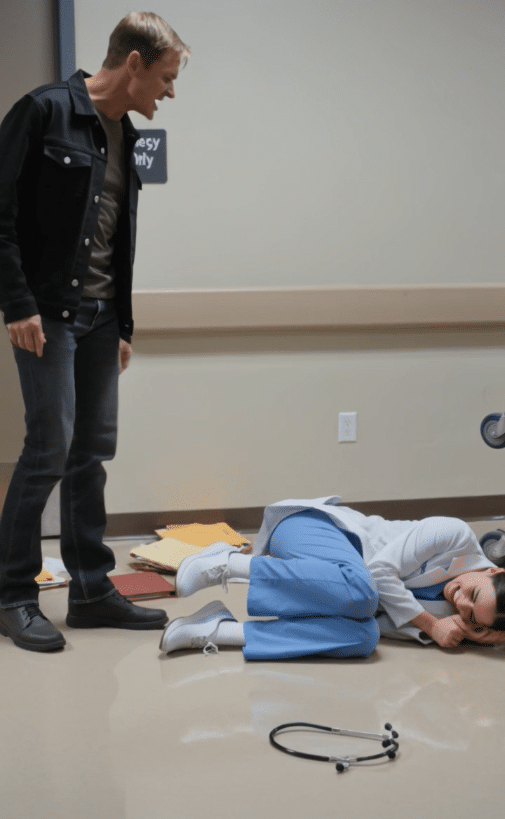
His boot slammed into Emily’s chest, throwing her backward into the equipment cart beside the hallway wall. Patient files scattered across the floor, her stethoscope slid away, and her elbow struck the metal edge of the cart.
A thin trace of blood appeared at the impact point.
The hallway erupted in gasps.
A nurse stopped short with a stack of supplies in her hands. Two family members pressed themselves against the wall, their faces drained of color. Behind the closed resuscitation room door, the monitor continued to beep.
Emily struggled to breathe through the pain.
Even on the floor, her eyes kept turning toward the treatment room.
“We need space to save him.”
Her voice was strained, but her attention remained on the patient.
Mark stood over her.
“Trash. Don’t shut my family out.”
He stepped closer and delivered two more forceful kicks into her back and side while she was down beside the cart. The impact made Emily curl instinctively around herself. Her coat twisted beneath her, and her breathing became short and uneven.
The people watching could hardly believe what they were seeing.
This was a hospital hallway. A doctor was trying to save someone’s life behind a closed door, and a family member had attacked her because she wouldn’t let him interfere.
Mark didn’t appear ashamed.
He looked down at Emily as if she were the person who had caused the problem.
“You work when I tell you.”
The words carried down the corridor, louder than the alarm sounds behind the resuscitation room door.
Emily tried to lift herself, then stopped as pain forced her back against the floor. She kept turning her head toward the patient, as though she could somehow protect the treatment happening inside simply by refusing to forget it.
Mark had mistaken her professional restraint for submission.
He thought that because she had stayed calm, she could be bullied into giving him what he wanted.
Then the administration corridor door burst open.
A woman in a white coat over a navy suit strode into the hallway, accompanied by the emergency department chief, hospital security, and hospital counsel.
Director Helen Price took in the scattered files, the injured doctor, and the man standing over her.
Her expression hardened.
And her first order made Mark realize that the hospital was no longer treating him as an angry relative who needed to be placated.
Act II
Mark Ellison had arrived at the hospital frightened.
Someone in his family was critically ill, and the sight of medical staff rushing through the emergency department had left him feeling helpless. He wanted answers, access, and reassurance that everything possible was being done.
Those feelings were understandable.
What happened next was not.
Mark had begun treating his fear as permission to control everyone around him. When nurses moved quickly past him, he demanded to know where they were going. When staff explained that they could not stop to answer questions during resuscitation, he interpreted their urgency as disrespect.
The more the situation slipped beyond his control, the more aggressively he tried to take it back.
By the time Emily reached the doorway, Mark had stopped listening to what the medical team needed. He heard only that he was being told to leave.
To him, that felt like exclusion from his own family’s crisis.
But the resuscitation room wasn’t a place where one person’s fear could override the needs of a patient. The medical team required clear access to the bed, equipment, and one another. Crowding the entrance could obstruct treatment at precisely the moment when seconds mattered.
Emily Carter understood that distinction.
At thirty-eight, she had spent years working in emergency medicine, where she routinely had to make difficult decisions under intense pressure. She knew that frightened relatives sometimes shouted, demanded explanations, or struggled to accept how little control they had over what was happening.
She did not expect them to be calm all the time.
She did expect them to let her team work.
Her instruction had been direct and necessary: the hallway and treatment room entrance needed to be cleared so the resuscitation could continue without obstruction.
Mark refused.
When Emily held the boundary, he attacked her.
Now she lay beside the equipment cart while the hallway filled with frightened silence. The patient files were scattered around her, and her stethoscope lay several feet away. Nurses and waiting family members had stepped back along the wall, shocked by the sudden violence.
Nobody had intervened.
The assault had happened too quickly, and Mark’s aggression had made the people nearby afraid of becoming targets themselves.
Behind the resuscitation room door, the medical team continued working.
That was the detail Emily could not stop thinking about.
Her body hurt, her breathing was difficult, and she could barely move without grimacing. Yet her attention kept returning to the patient whose treatment had prompted the confrontation in the first place.
Mark had wanted to force her to acknowledge his authority.
Instead, he had taken an emergency department doctor away from the immediate work she had been trying to coordinate.
Then Director Helen Price arrived with the emergency department chief, security, and hospital counsel.
The director didn’t need a long explanation to recognize that the hallway was no longer under ordinary control. She saw the scattered records, the injured physician, and the family member standing where he had no reason to be.
Security moved toward Emily, establishing a barrier between her and Mark. The emergency department chief turned toward the resuscitation room, while hospital counsel opened a folder.
Helen’s attention remained steady.
She had arrived at a moment when both the patient and the staff needed the hallway secured.
And she was about to make that priority unmistakable.
Act III
“Clear the hall. Get his name.”
Director Helen Price delivered the order without raising her voice.
Hospital security immediately moved into position, forming a barrier in front of Emily and preventing Mark from approaching her again. The emergency department chief headed toward the resuscitation room to coordinate with the team inside, while hospital counsel opened a folder and began preparing to document the incident.
The change was immediate.
A few moments earlier, Mark had acted as though the hallway belonged to him. He had refused a doctor’s instruction, attacked her, and stood over her while she struggled on the floor.
Now trained security personnel were controlling the space around Emily, and the hospital’s senior leadership had taken charge.
Mark looked from one person to another.
He had expected staff to keep negotiating with him. He had expected the familiar exchange in which an upset relative demanded attention and everyone else tried to calm him down.
Instead, Helen had issued two clear instructions.
Clear the hall.
Get his name.
The second command seemed to disturb him more than the first.
Hospital counsel was no longer simply observing the situation. The legal representative had opened a folder, and the instruction to identify Mark signaled that the incident was being formally documented.
The scattered patient files remained on the floor.
Emily was still beside the equipment cart, visibly in pain. Security maintained its barrier while the medical staff focused on protecting her and restoring order around the treatment area.
Helen did not rush toward Mark to argue with him.
Her first responsibility was to make the hallway safe again. The injured doctor needed space, the resuscitation room needed an unobstructed entrance, and the staff needed to continue their work without another confrontation.
Mark had made those priorities impossible to ignore.
He glanced toward the treatment room door.
The monitors were still sounding behind it. Nurses continued moving through the emergency department, but the hallway around him had fallen into an unusual stillness.
The people who had watched the assault were no longer moving around him or trying to placate him. They had stepped aside as security and hospital leadership took control.
Mark shifted his weight.
He was beginning to understand that this was not another argument he could win by getting louder.
Helen’s command had changed the nature of the encounter. The hospital was no longer focused on persuading him to cooperate with a routine request. It was responding to an assault on a physician during an active medical emergency.
The distinction was impossible to miss.
Mark had attacked the person trying to keep the treatment area clear.
Now the hospital was protecting her.
And the director wanted his identity recorded.
Act IV
Mark stared at the security officers.
Their presence changed the hallway more completely than any argument could have. They stood between him and Emily, creating a firm boundary that he could no longer ignore or force aside.
Hospital counsel held the open folder.
The emergency department chief had moved toward the resuscitation room, where the team continued treating the patient. The director remained in the corridor, watching as staff secured the area and attended to the injured doctor.
Nobody was shouting at Mark.
Nobody was trying to compete with his anger.
That seemed to leave him with nothing to push against.
“You work when I tell you.”
Only moments earlier, he had spoken those words while standing over Emily. He had behaved as though her medical judgment was a personal service he could command, and as though her refusal to let him enter the treatment space was an insult he was entitled to punish.
Now his demand sounded hollow in the silent hallway.
Emily had not refused to help his family member.
She had been trying to create the space necessary to save him.
Mark’s fear might have explained why he was desperate for control, but it could not justify attacking the doctor responsible for coordinating emergency care.
Helen Price appeared to understand that distinction completely.
She did not treat his behavior as an unfortunate misunderstanding that could be erased with an apology. Her immediate concern was the safety of her staff and the restoration of an orderly treatment environment.
Security kept the barrier in place.
Emily remained near the cart, breathing carefully and grimacing from the pain. Even as staff focused on her, her attention kept returning to the resuscitation room door.
The patient’s crisis had not disappeared because Mark had created another one.
The hospital still had to care for the person inside. Nurses still needed to move through the department. Equipment and medical records still had to be handled, and the hallway could not remain a place where staff feared being attacked for following emergency procedures.
The director’s order addressed the immediate problem.
Clear the hall.
Get his name.
Mark looked at the folder in hospital counsel’s hands.
He seemed to be trying to understand what it meant that the hospital was formally identifying him. His earlier confidence had depended on the belief that everyone would eventually bend to his demands because his family member was a patient.
But patient status did not give him ownership of the hallway.
It did not grant him authority over the doctor.
And it did not permit him to turn a resuscitation into a confrontation.
The hospital’s response was now visible in every detail: the security barrier, the director’s controlled posture, the department chief moving to protect the treatment area, and counsel preparing to document what had happened.
Mark’s anger began to waver.
He had wanted the staff to recognize his authority.
Instead, he was being required to identify himself while the institution he had tried to intimidate took control of the situation.
For the first time, he seemed uncertain about what would happen next.
Act V
“My name?”
Mark’s question came out sharply, but the confidence behind it had begun to falter.
He stared at Helen Price as though he could not understand why the hospital director would want his identity recorded. His eyes shifted toward the open legal folder, then toward the security officers standing between him and Emily.
The hallway behind him was stark and nearly silent.
The scattered files lay beside the equipment cart. Emily remained on the floor, her white coat twisted from the impact, one arm held close to her body. Security maintained the barrier while the emergency department chief continued toward the resuscitation room.
The monitors were still beeping behind the closed door.
The patient still needed care.
That had been the reason Emily had asked everyone to step back. She had needed room for the medical team to work, not obedience for its own sake. The boundary she enforced was part of the effort to protect the person whose life was in danger.
Mark had refused to accept it.
He had turned a doctor’s instruction into a personal confrontation, then attacked her when she would not surrender the treatment space.
Now the hospital director was making sure the immediate area was controlled, the injured physician was protected, and Mark’s identity was documented.
There was no shouting match.
No dramatic speech about how important the hospital was.
Helen’s authority showed in the precision of her response. Security had protected Emily before the director turned her attention to the man responsible. The emergency department chief had returned focus to the patient, and hospital counsel was prepared to record the incident.
Mark looked toward the resuscitation room.
For a moment, his expression suggested that he wanted to return to the reason he had come to the hospital—to his family member, to the fear that had driven him into the corridor, to the emergency he had been unable to control.
But the people around him could not pretend that the assault had not happened.
Emily had been trying to save a life when he kicked her.
She had continued to focus on the patient even after he knocked her into the equipment cart and struck her again while she was down.
The staff had witnessed it. The hospital’s senior leadership had arrived. And the director had issued a direct order to clear the hall and get his name.
Mark’s anger had not vanished, but alarm was now visible beneath it.
He looked at the legal folder again.
He looked at the security barrier.
Then he looked at Helen, whose expression remained severe and controlled.
He had entered the emergency department believing that his fear gave him the right to control everyone around him. He had treated a physician’s professional boundary as a challenge and responded with violence.
Now he was being asked to account for himself.
The hallway remained still as he struggled to process the change.
“My name?”
This time, the words sounded less like an objection than a question from someone who had only just realized that the situation was no longer under his control.
Hard cut.