Act I
“Why can’t mine go in with theirs?”
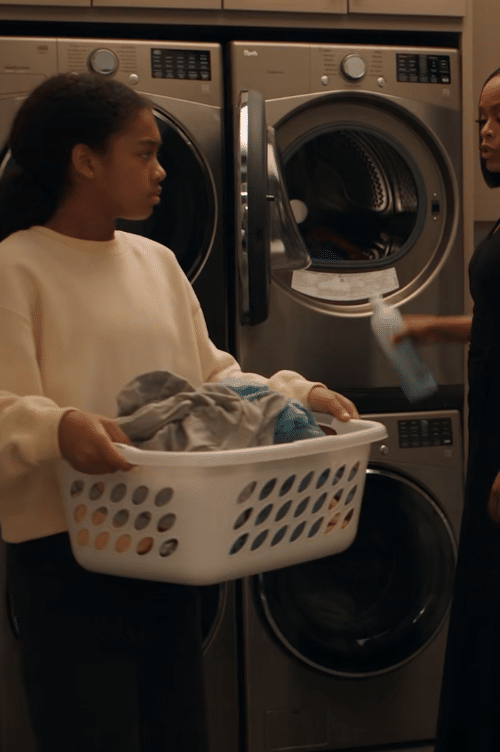
Nia stood beside the washing machine with a small armful of clothes pressed against her chest. The drum was only partially filled with Ava and Caleb’s laundry. There was room for more than enough of Nia’s things.
She had assumed that was the point of doing laundry together.
Before she could place another shirt inside, her stepmother reached into the machine and pulled Nia’s clothes back out. She dropped them into a separate basin beside the utility sink, treating the garments as though they had been put in the wrong place.
Nia stared at the basin.
“Why can’t mine go in with theirs?”
Her stepmother turned toward her, perfectly composed in her black dress and gold necklace.
“Because that machine is for this family’s clothes.”
For a moment, Nia didn’t move.
It wasn’t the washing machine that hurt. It wasn’t even the inconvenience of having to wash her clothes separately. It was the way her stepmother had said this family, as if the words drew a line across the laundry room—and Nia was standing on the wrong side of it.
She glanced toward the clothes still inside the machine.
Ava’s shirts. Caleb’s hoodie. Their everyday clothes, mixed together without a second thought.
Then she looked down at her own things in the basin.
Her stepmother picked up a bottle of ordinary hand-washing soap and placed it beside the sink.
“Use the sink. Your things don’t belong mixed with my children’s.”
Nia’s fingers tightened around the fabric she was holding.
She wanted to ask what made her different. She wanted to know why the rules changed whenever her stepmother was in charge and her father wasn’t there to hear them.
Instead, she lowered her eyes and carried the basin toward the sink.
Behind her, the washing machine stood open, its drum still half-empty.
And Nia was about to discover that the empty space wasn’t the only thing her stepmother had been keeping from her.
Act II
Nia had grown used to noticing the small differences.
They rarely looked serious enough to explain to her father without feeling as though she were complaining. A family could have routines, she told herself. A household could have preferences. Not every unfair moment needed to become an argument.
But this was different.
She set the basin beside the utility sink and began sorting her clothes. Her stepmother had given her the soap, so Nia tried to follow the instruction without making the situation worse.
The room smelled faintly of detergent. Warm overhead lights reflected off the polished fronts of the washer and dryer, and neatly arranged containers lined the shelves above them.
Everything looked organized.
That was what made the separation feel so deliberate.
There was no shortage of equipment. There was no shortage of space. Nia could see the empty portion of the washer from where she stood, and nothing about the load inside explained why her clothes couldn’t be added.
She was being asked to do the work differently because her belongings were hers.
Ava entered the laundry room a moment later. She had come to collect something from the shelves, but stopped when she saw Nia beside the sink.
For a second, she assumed there had been a practical reason for the separate basin.
Then she looked at the washing machine.
The drum was nowhere near full.
Ava looked back at Nia, who was quietly preparing to wash her clothes by hand. The contrast was impossible to miss: Ava and Caleb’s laundry had been given the convenience of the machine, while Nia had been directed to the sink.
Ava turned toward her mother.
“Mom, there’s room in the machine.”
Her stepmother barely looked up.
“Then use it for your second load. Nia can manage.”
Ava fell silent.
The answer didn’t address the amount of space available. It didn’t explain why Nia’s clothes had to be removed in the first place. It simply made the separation sound like a rule nobody was permitted to question.
Ava looked at Nia.
Her sister wasn’t asking for someone to do her laundry. She wasn’t refusing to help around the house. She had been willing to put her clothes into the washer alongside theirs, and she was now quietly accepting a task that should never have required an argument.
Ava felt a familiar discomfort settle over her.
She knew what it meant when her mother spoke in that final, dismissive tone. It meant the conversation was supposed to be over, regardless of whether the answer made sense.
But the half-empty washer made the truth difficult to ignore.
This wasn’t about space.
And it wasn’t about getting the laundry finished efficiently.
Someone had decided that Nia’s clothes didn’t belong with theirs.
Then footsteps sounded in the hallway, and Marcus appeared in the doorway.
Act III
Marcus took in the scene without speaking.
He saw the washer containing Ava and Caleb’s clothes. He saw Nia beside the utility sink with her separate basin. He saw the bottle of soap and the clothes she had been preparing to wash by hand.
His eyes moved from one side of the room to the other.
“Why is Nia washing everything by hand?”
His wife turned toward him.
Her expression changed almost imperceptibly. The coldness she had shown Nia gave way to a more reasonable look, the kind someone might use to explain an innocent misunderstanding.
“She said the machine damages her clothes.”
Marcus looked at Nia.
The answer surprised him because it didn’t match what he had just witnessed. He had walked into a room where his daughter was washing her clothes separately, even though the washer had room, and his wife was presenting the arrangement as Nia’s own choice.
Nia lifted her head.
“She says my clothes don’t belong with theirs.”
The words were quiet, but Marcus heard every one.
His wife immediately interrupted.
“She misunderstood one simple rule.”
Marcus looked back at the machine.
A simple rule should have been easy to explain. It should have made practical sense. It should not have required removing a child’s clothes from a washer that had plenty of room, then sending her to the sink while everyone else’s laundry continued as normal.
He studied his wife’s face, searching for an explanation that would reconcile what he had seen with what she was claiming.
She offered none.
Ava stood near the washer, visibly disturbed. She had already pointed out the empty space, and her mother’s response had only made the distinction more obvious.
Marcus turned toward Nia again.
She wasn’t exaggerating her complaint or trying to turn him against her stepmother. She was describing exactly what had happened.
Her clothes had been removed.
She had been told to wash them separately.
And when she questioned the reason, she had been told that her belongings didn’t belong with her stepmother’s children.
Marcus felt suspicion replace his initial confusion.
He had thought he was looking at an awkward household disagreement. Now he wondered whether the scene in front of him was only one part of something larger.
Caleb, who had been quiet until then, glanced toward the cabinet beside the washer.
He knew something his father hadn’t yet seen.
For days, he had noticed Nia’s clothes being removed from the shared laundry. He had seen them disappear from the washer and end up behind the cabinet door, separated from the rest of the family’s belongings.
He hadn’t fully understood why it was happening.
But he knew it wasn’t just a one-time mistake.
Caleb walked toward the cabinet.
Marcus watched him, and his wife suddenly became very still.
The boy reached for the handle.
When he opened the door, the explanation his mother had offered was about to fall apart.
Act IV
Several laundry bags sat inside the cabinet.
They weren’t empty. Each contained Nia’s clothing, gathered and kept apart from the family laundry. There were enough bags to make it clear that this had happened more than once, and the clothes had been set aside over multiple days.
Caleb stood beside the open cabinet.
“Mom keeps taking Nia’s clothes out.”
Marcus stared at the bags.
For a moment, the laundry room seemed to shrink around him. The washer, the sink, the shelves, and the carefully arranged supplies were still exactly where they had been, but the room no longer looked like a place where a family simply handled its chores.
It looked like a place where someone had created a routine designed to keep one child separate.
Marcus stepped closer to the cabinet.
He didn’t touch the bags immediately. He looked at them, then at the washing machine, as if trying to understand how the two could exist in the same room.
There was room in the washer.
There had always been room in the washer.
Yet Nia’s clothes had repeatedly been removed and stored elsewhere while Ava and Caleb’s laundry went through the machine.
Ava approached the cabinet, her expression tightening when she noticed a paper schedule attached to the inside of the door.
She leaned in to read it.
The schedule listed Ava’s laundry days.
It listed Caleb’s laundry days.
Nia’s name was nowhere on it.
Ava stared at the paper, then looked toward her mother.
The omission was small enough to hide in plain sight. A list of chores could look ordinary to anyone who glanced at it quickly. It might even pass as household organization.
But beside the bags of Nia’s clothes, the meaning was difficult to miss.
The family had a schedule for Ava.
The family had a schedule for Caleb.
Nia had been left out.
Marcus studied the schedule himself. His eyes moved over the names and assigned days, then returned to the bags inside the cabinet.
He remembered the explanation his wife had given him only moments earlier: Nia supposedly believed the washing machine damaged her clothes.
But the schedule suggested that Nia had never been included in the arrangement at all. The bags showed that her clothes had been repeatedly removed. And the washer’s remaining space made it impossible to claim that there simply hadn’t been room.
His wife stood nearby, no longer looking quite so confident.
The practical explanation she had offered was gone. In its place was a pattern that had been hidden behind a cabinet door and disguised as an ordinary household routine.
Marcus looked at Nia.
She stood beside the basin, quiet and still. She had not needed to persuade him with an elaborate account. The room itself had shown him what words alone might have struggled to convey.
Ava’s face reflected the same realization.
Caleb had opened the cabinet because he wanted his father to understand what had been happening. Now the bags and the schedule were visible to everyone.
There was no way to turn them back into an innocent misunderstanding.
Marcus slowly closed his hand around the edge of the cabinet door.
Then he turned toward his wife.
Act V
“You separated her from the family down to her laundry?”
Marcus didn’t raise his voice.
He didn’t need to.
The question landed in the center of the laundry room, surrounded by the evidence his wife had left behind. The bags sat inside the open cabinet. The schedule listed Ava and Caleb but omitted Nia. The washer remained partially filled, with enough room to accommodate the clothes that had been taken out.
Every detail contradicted the idea that Nia had simply chosen to wash her things by hand.
His wife stared at him.
Her mouth opened slightly, but no answer followed. The confident expression she had worn while instructing Nia to use the sink had disappeared.
Marcus waited.
He wanted an explanation that accounted for the bags, the repeated removals, and the schedule. He wanted to understand why his daughter had been assigned a separate place for her laundry when there was no practical reason to keep it separate.
But his wife couldn’t bring herself to answer.
Ava looked at her mother with open disappointment. Caleb stood beside the cabinet, no longer hiding what he had noticed. Nia remained near the basin, her hands resting quietly against its edge.
She had not asked for a confrontation.
She had asked why her clothes couldn’t go in the same machine as everyone else’s.
The answer she received had been that her belongings did not belong mixed with her stepmother’s children. When Marcus arrived, that explanation had been replaced with a claim that Nia had chosen to wash her clothes by hand.
Now the evidence showed that the separation had continued across multiple days.
The schedule made the exclusion visible.
The bags made the repetition undeniable.
And the half-empty washer exposed the excuse for what it was.
Marcus kept his eyes on his wife, waiting for her to respond to the question she had left hanging between them.
She remained frozen, her eyes widened and her expression collapsed under the weight of what the room revealed.
Nia said nothing.
Neither did Ava or Caleb.
The washing machine stood open behind them, still holding the clothes that had been permitted to share its space.
Inside the cabinet, Nia’s laundry remained separated in bags, alongside a schedule that had made room for everyone except her.
Marcus waited one final moment.
His wife still couldn’t answer.
Hard cut.