Act I — The Uniform That Could Wait
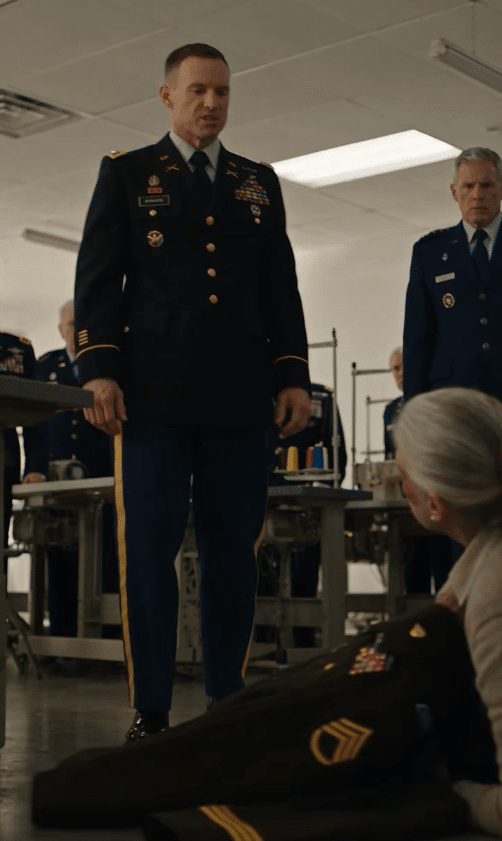
The veterans’ sewing room was crowded with folded military uniforms, tangled thread, and jackets waiting to be repaired before wounded service members returned home. At a long table near the window, a sixty-seven-year-old woman worked quietly at her sewing machine, wearing a simple cardigan and a faded volunteer apron.
Her silver hair was tied back neatly. A row of jackets sat beside her, each marked with a small paper tag identifying its owner.
A uniformed aide approached with a pristine service uniform draped over his arm. Behind him stood a forty-eight-year-old Colonel, his expression already sour.
“Colonel, she says these jackets come first.”
The woman continued threading her needle.
“They belong to men leaving the hospital today.”
The Colonel glanced at the wounded veterans’ jackets as though they were little more than discarded laundry.
“My uniform needs to be ready for tomorrow morning,” he said. “Move those.”
She finally looked up.
“They’ve waited long enough.”
The aide shifted uncomfortably, but the Colonel stepped closer to the table. Several volunteers stopped sewing, sensing the confrontation about to unfold.
Act II — A Colonel’s Temper
The Colonel seized one of the jackets from her hands and yanked it away.
“Did you hear me?”
Before she could answer, he slapped her hard across the face.
The impact sent her tumbling beside the sewing table. A spool of thread rolled across the floor, followed by a pair of scissors that clattered against a chair leg. Her cheek reddened and began to swell, and a faint trace of blood appeared at the corner of her mouth.
A veteran near the doorway started to rise, but another volunteer caught his arm. Everyone seemed frozen between outrage and disbelief.
The Colonel stood over the fallen woman. He kicked her twice in the torso, then swept several finished jackets off the table. They landed in a heap on the floor, their carefully folded sleeves spread across the concrete.
The woman drew a painful breath.
She didn’t plead with him. She didn’t ask why.
Instead, she reached for the nearest jacket and began gathering the others, one at a time.
The Colonel watched her with contempt.
“Seamstresses don’t decide whose uniform matters.”
She pressed a hand briefly against her injured cheek, then returned to collecting the jackets.
“Apparently,” she replied quietly, “someone has to.”
The aide’s expression changed. The Colonel didn’t notice.
Act III — The Pilot at the Door
The woman struggled to her feet, using the sewing table for support. Her movements were slower now, and every breath seemed to cost her something, but she carefully placed the wounded veterans’ jackets back on the table.
She straightened the paper tags and checked that none had been torn.
The Colonel adjusted his cuffs, satisfied that he had restored the proper order of things.
Then a man appeared in the doorway.
He was sixty-nine, with silver hair, a weathered face, and a flight jacket worn soft from years of use. He had entered the room with the relaxed expression of a retired pilot visiting an old community workshop.
That expression vanished when he saw the woman.
He stopped so abruptly that the man behind him nearly walked into his back.
For several seconds, the retired pilot simply stared. His eyes moved from her swollen cheek to the volunteer apron, then settled on her face.
Recognition struck him like a physical blow.
“Black Falcon… is that you?”
The woman paused with a jacket in her hands.
She slowly turned toward him.
Something passed between them—an acknowledgment too deep for strangers, too immediate to be mistaken for coincidence.
Behind the retired pilot, a fifty-two-year-old Wing Colonel heard the name.
His posture stiffened.
The color drained from his face.
He looked at the injured woman, then at the retired pilot, as though the room had suddenly become a place where every careless word carried consequences.
Act IV — The Warning Nobody Expected
The Wing Colonel stepped forward, his voice suddenly low and urgent.
“Colonel… stop. Don’t touch her again.”
The younger Colonel turned toward him, offended.
“Excuse me?”
The Wing Colonel didn’t look away from the woman.
His expression had changed from surprise to unmistakable alarm. His jaw was tight, and his shoulders remained rigid beneath his uniform.
The retired pilot stood motionless near the doorway, still watching the woman with a mixture of disbelief and respect.
The Colonel who had struck her followed their gaze.
Then he laughed.
“Black Falcon? This woman?”
He gestured toward her apron and the scattered jackets on the floor.
“She’s a volunteer with a sewing machine.”
Nobody joined his laughter.
The aide who had demanded priority for the Colonel’s uniform lowered his eyes. The other volunteers remained silent, and the Wing Colonel looked as though he was trying to prevent a disaster that had already begun.
The woman finished arranging the jackets.
She pressed a crease from one sleeve with her palm, then turned toward the Colonel.
Her cheek was swollen. The corner of her mouth was marked with a faint trace of blood. Yet her gaze was steady, and there was nothing frightened in her expression.
She looked directly at the retired pilot.
“He wasn’t laughing the last time he said it.”
The pilot’s expression tightened.
The Wing Colonel went completely still.
The Colonel’s smile faltered, though he struggled to keep the contempt in his voice.
“What exactly is that supposed to mean?”
The woman offered no explanation.
She simply returned the final jacket to its place.
Act V — The Name He Should Have Recognized
The sewing room seemed to shrink around the Colonel.
He looked at the retired pilot, whose face had lost every trace of casual friendliness. Then he turned to the Wing Colonel.
The Wing Colonel wasn’t smiling. He wasn’t merely surprised, either.
He looked genuinely afraid of what the Colonel had done.
The older woman stood beside the table, one hand resting on the wounded veterans’ jackets. Her breathing remained measured, although the pain was still visible in the way she held herself.
She made no demand for an apology.
She didn’t announce her former rank. She didn’t threaten to make a call or promise that someone would answer for the assault.
She didn’t need to.
The retired pilot continued to watch her as though an old chapter of his life had just opened in front of him. The Wing Colonel kept his eyes fixed on her, his warning hanging unanswered in the air.
The younger Colonel’s confidence began to disintegrate.
His mouth opened, but no words came. His gaze flickered between the two military men and the woman he had dismissed as an insignificant volunteer.
Then recognition began to surface.
His face paled. His jaw tightened, and his eyes widened as the nickname he had laughed at took on a meaning he could no longer ignore.
The camera pushes closer until only the Colonel’s face remains.
His mocking expression disappears. His breath catches.
“Black Falcon…?”