Act I — The Seat Beside the Stage
“Admiral, he refuses to move from the senior-family section.”
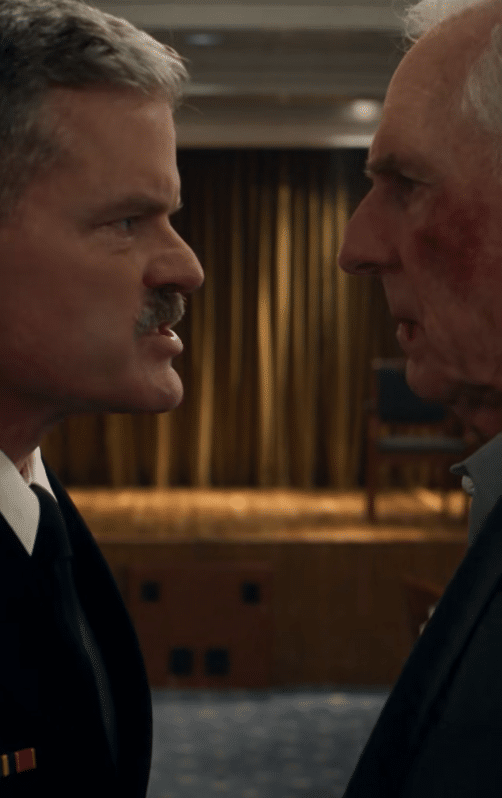
The young naval aide stood beside the reserved seating area, addressing a Rear Admiral in immaculate dress uniform. Around them, naval flags hung behind the stage, senior officers mingled over drinks, and guests settled into their assigned seats for the formal reception.
At the center of the dispute sat a seventy-five-year-old man in a simple civilian suit, white shirt, and dark tie. His silver hair was neatly combed, and his hands rested calmly on his knees. He looked like an ordinary elderly guest who had arrived early and followed the instructions given to him.
The Rear Admiral stopped in front of him.
“Do you understand where you’re sitting?”
The old man looked up.
“My seat is where they placed it.”
The aide glanced at the seating card, then back at the Rear Admiral. He had apparently expected the elderly guest to apologize and move the moment an officer objected.
Instead, the man remained seated.
The Rear Admiral’s expression hardened.
“I’m telling you to get up.”
The old man met his eyes without raising his voice.
“Then perhaps you should ask whoever assigned the seats.”
Several nearby officers stopped talking. The Rear Admiral had not expected to be challenged in front of his colleagues, least of all by a civilian who appeared to have no idea how much authority his uniform represented.
Act II — A Public Lesson in Humiliation
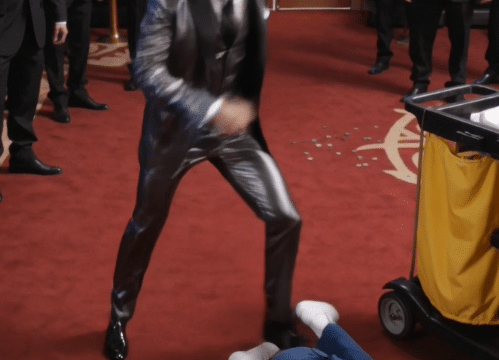
The Rear Admiral seized the elderly man’s arm and yanked him out of the chair.
Before the man could regain his balance, the officer punched him hard across the cheek. The elderly guest fell beside the chairs, his face turning red as a faint trace of blood appeared at the corner of his mouth.
A sharp gasp traveled through the reception hall.
The Rear Admiral stood over him, his expression cold and contemptuous. He followed with two forceful kicks to the man’s torso, then pointed toward the back of the room.
“Get out of my section.”
No one moved to help. Officers watched in stunned silence, while the young aide stood rigidly beside the overturned chair.
The elderly man drew a painful breath and slowly pushed himself upright without assistance. His cheek was swelling, but he didn’t plead or reach for anyone’s hand.
He straightened his jacket.
Then he adjusted his tie.
The Rear Admiral looked almost offended that the man had refused to show fear.
“Old civilians don’t sit beside admirals.”
The insult carried across the nearby tables. A few guests lowered their eyes, unwilling to become the next target of the officer’s anger.
The old man looked directly at him.
He didn’t explain why he had been assigned the seat. He didn’t tell the Rear Admiral to check the seating list.
He simply stood there, hurt but composed, as if the officer’s behavior had confirmed something he already suspected.
Act III — Admiral Hayes Is Looking for Someone
Footsteps sounded from the corridor behind the stage.
A naval aide in formal service uniform hurried into the reception hall, scanning the room with growing urgency. He passed two officers, turned toward the senior-family seating area, and abruptly stopped when he saw the elderly man standing beside the chairs.
His expression changed.
He looked at the old man’s swollen cheek, then turned toward the Rear Admiral.
“Sir…” His voice was careful, but the urgency was unmistakable. “Admiral Hayes asked why his father hasn’t been brought backstage.”
The words seemed to stop the entire room.
The young aide’s face went blank. Several officers looked up from their conversations. Even the guests at the nearest table turned toward the elderly civilian.
The Rear Admiral barely reacted at first.
He glanced at the newcomer as though the aide had interrupted an important disciplinary matter.
“Which Hayes?”
The staff aide didn’t smile. He didn’t repeat himself or offer a lengthy explanation. He simply stood there, waiting for the Rear Admiral to understand what he had just been told.
The elderly man remained silent.
He had not mentioned a son. He had not used a name to protect himself from the assault. He had allowed the Rear Admiral to make every decision without offering a single hint about his family.
Now, with one sentence, the aide had changed the meaning of the entire confrontation.
Act IV — The Orders on His Desk
The old man slowly brushed a wrinkle from his jacket.
Then he looked at the Rear Admiral.
“The one whose orders are on your desk.”
The words were quiet, almost conversational.
But the Rear Admiral’s expression tightened.
He stared at the elderly man, then at the aide who had delivered the message. The name Hayes had suddenly become more than a name. It connected the man standing before him to the authority behind the orders governing his own work.
The aide who had started the confrontation took a small step backward.
“Sir, I didn’t know—”
The Rear Admiral silenced him with a sharp glance, though his own certainty was already beginning to falter.
The elderly guest said nothing more.
He didn’t announce his son’s rank. He didn’t describe the command he held or explain why the staff had been instructed to bring him backstage. He merely stood beside the chair from which he had been dragged, his injured face revealing the cost of the Rear Admiral’s arrogance.
The staff aide remained beside them, visibly uncomfortable.
“Admiral Hayes is waiting,” he said.
The Rear Admiral’s eyes shifted toward the stage entrance.
For the first time, he seemed to realize that the man he had treated as an unwanted civilian was not simply a misplaced guest. He was the father of someone whose orders the Rear Admiral was expected to follow.
Around them, the reception hall fell silent.
The officers who had watched the assault now understood why the aide had hurried into the room with such urgency. The Rear Admiral, however, was still trying to reconcile the elderly man’s ordinary appearance with the name he had just heard.
The old man straightened his tie one final time.
He waited.
Act V — Admiral Hayes…?
The Rear Admiral looked toward the backstage corridor, then back at the elderly guest.
His face began to lose color.
He remembered the orders waiting on his desk. He remembered the name attached to them. And he finally understood that the consequences of what he had done might extend far beyond an uncomfortable scene at a formal reception.
The young aide stood motionless, no longer willing to defend the officer who had demanded that the old man move.
The elderly man didn’t threaten anyone. He didn’t ask for an apology. He simply remained beside the reserved chair, his cheek swollen and his dark tie slightly crooked.
The staff aide waited for a response.
No one spoke.
The Rear Admiral’s jaw tightened as he looked at the civilian again. The same man he had dragged from his seat now stood before him with the quiet dignity of someone who had never needed a uniform to establish his place in the room.
The Rear Admiral swallowed.
His eyes widened slightly, and the confidence that had carried him through the confrontation finally collapsed.
“Admiral Hayes…?”