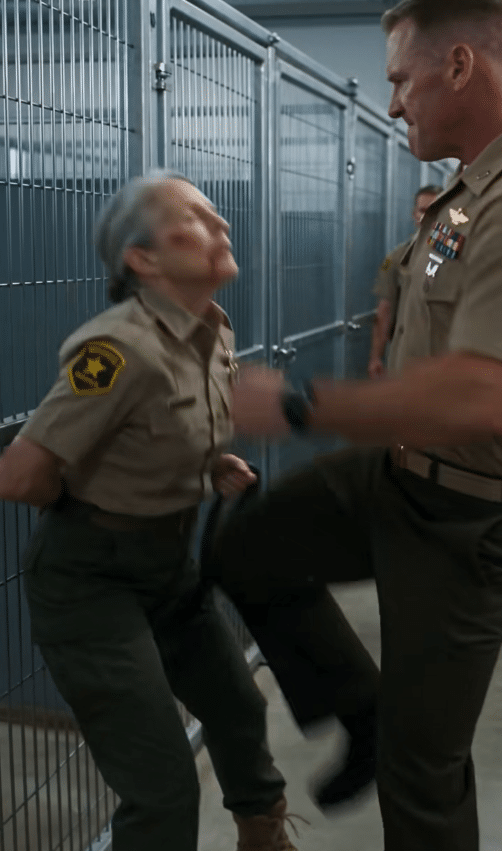
Act I — The Dog Wasn’t Cleared for Adoption
“Colonel, she says you’re not cleared to take the dog.”
The young aide stood beside a kennel gate, watching a furious Colonel confront a silver-haired woman holding an adoption clipboard. Behind her, a retired military K9 paced inside the fenced enclosure, its leash secured firmly in her hand.
The woman was sixty-three, dressed in a volunteer polo, durable work pants, and worn boots. She looked like any other volunteer at the adoption center, except for the calm authority in her eyes.
The Colonel held out his hand.
“Give me the leash.”
She didn’t move.
“Not until the review is complete.”
The Colonel glanced at the clipboard, then back at her as if he couldn’t believe a civilian had dared to refuse him. The dog was famous among the center’s staff, a retired military K9 whose adoption required a formal review before any new handler could take responsibility for it.
“I’ve already told you I’m taking him,” the Colonel snapped.
The woman kept one hand on the leash and the other on the paperwork.
“And I’ve already told you the review isn’t finished.”
His aide gave a dismissive laugh.
The Colonel’s expression hardened.
Act II — A Uniform Doesn’t Give You Ownership
The Colonel ripped the clipboard from her hands and threw it onto the concrete.
Before the woman could step back, he slapped her hard across the face. She stumbled sideways and struck the kennel fence, her cheek turning red as a faint trace of blood appeared at the corner of her mouth.
The volunteers froze.
The Colonel followed her down with two forceful kicks to her torso, then seized the leash and tried to pull the dog toward the gate.
The woman gasped in pain, but her fingers tightened around the leash.
The dog pulled back, confused by the sudden violence. Its nails scraped against the concrete as the Colonel tugged harder.
“Let go!” he shouted.
The woman braced herself against the fence, struggling to stay upright. Her cheek was swelling, and every breath hurt, but she refused to let the dog be dragged away before the adoption was approved.
The Colonel leaned over her.
“Kennel women don’t deny colonels.”
His aide stood nearby, his earlier smirk still visible, though he now glanced nervously toward the other staff members.
The woman looked up at the Colonel with cold, unwavering eyes.
She said nothing.
She simply kept hold of the leash.
Act III — The Scar Beneath Her Sleeve
The Colonel yanked the leash again.
As the woman twisted to protect the dog, her sleeve rode above her wrist. Beneath it lay an old, jagged scar, accompanied by a small code marked against her skin.
It was an unusual detail, easy to mistake for an old injury and even easier to overlook.
But an older man standing near the kennel entrance saw it clearly.
He was a retired military dog handler, sixty-one, with gray hair, a weathered face, and a leash pouch hanging from his work belt. He had spent years working with military K9 teams before coming to the center to help retired dogs adjust to civilian life.
The moment he saw the scar and the code, his face went pale.
His shoulders stiffened. His gaze moved from the woman’s wrist to her face, and the recognition in his eyes was immediate.
“Colonel…” His voice was suddenly quiet. “I’d let go of that leash.”
The Colonel turned toward him, irritated.
“What?”
The handler didn’t repeat himself. He stared at the exposed wrist as if he had just witnessed something he never expected to see again.
The aide’s smirk vanished.
The Colonel looked down at the woman’s arm and gave a contemptuous laugh.
“Because of a scar?”
The woman slowly steadied herself against the fence. Her breathing was painful, but her grip on the leash remained firm.
She looked at the retired handler.
“He remembers who pulled his team out.”
Act IV — A Memory Nobody Wanted to Revisit
The words changed the atmosphere around the kennel.
The retired handler stood motionless. His face remained pale, and his eyes never left the woman’s wrist. He didn’t explain the code. He didn’t mention a mission or identify the person whose name might be connected to it.
He simply looked at the Colonel and waited.
For the first time, the Colonel seemed uncertain.
“What team?” he demanded.
The handler said nothing.
The dog stopped pulling. It stood close to the woman, ears raised, watching the men with an alertness that made the silence feel even heavier.
The woman carefully gathered the leash into her injured hand and kept herself between the Colonel and the animal.
“You wanted to take him without the review,” she said quietly. “You were told no.”
The Colonel’s jaw tightened.
“Do you know who you’re talking to?”
The woman met his stare.
“Do you?”
His aide shifted backward. One of the volunteers lowered her eyes, while another stared at the old handler, waiting for him to explain why a tiny mark on a woman’s wrist had frightened him more than the Colonel’s uniform.
But the handler offered no explanation.
He looked as though he remembered a moment when someone had gone into danger and brought others back out.
And the woman standing against the fence appeared to be the person he had never forgotten.
The Colonel looked at the scar again.
This time, he didn’t laugh.
Act V — Who Pulled Them Out?
The Colonel’s eyes moved from the old scar to the small code beside it.
Then he looked at the retired handler.
The older man remained rigid, his expression carrying a recognition that the Colonel could no longer dismiss as simple respect for a veteran. Whatever the scar represented, the handler knew its meaning—and he knew exactly who stood before them.
The Colonel’s confidence began to fracture.
His aide stopped moving. The volunteers remained silent. The woman stood beside the kennel fence, injured but composed, her hand still protecting the leash.
She had not demanded respect.
She had not threatened anyone.
She had simply refused to let a military dog leave before the proper review was complete.
Now the Colonel was looking at her as if that refusal had become the least important part of the encounter.
His breathing caught. His jaw tightened, and his eyes widened as the handler’s warning finally began to make sense.
The woman didn’t explain who she had once been.
The handler didn’t reveal what the code meant.
The Colonel could only stare at the memory written on her wrist, realizing that the woman he had just assaulted might be connected to a mission his own career had taught him never to forget.
His voice fell to a whisper.
“Pulled them out…?”