Act I — Rank Doesn’t Erase the Rules
“Sir, he won’t release it without the paperwork.”
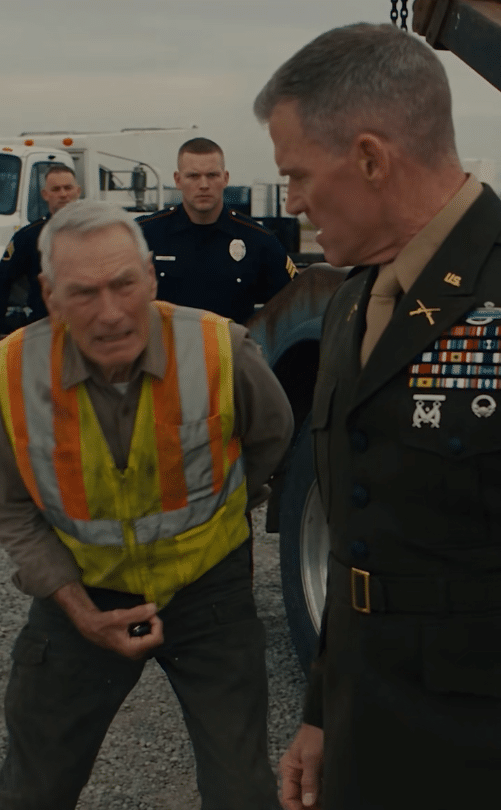
The young aide stood beside the impounded staff vehicle, his arms folded as a furious Brigadier General approached the towing office. Behind them, tow trucks rumbled across the yard, chains rattled against steel, and military police watched from beside the vehicle lane.
The man blocking the General’s path looked nothing like someone worth arguing with. At seventy, he had silver hair, a faded work shirt, a reflective vest, and grease-stained boots. He was the owner of the towing service, and he held the release paperwork with the steady patience of someone who had enforced the same rules for decades.
The General jabbed a finger toward his vehicle.
“Do you have any idea who I am?”
The old man didn’t move.
“Rank doesn’t erase a blocked emergency lane.”
For a moment, the yard seemed to go quiet. The aide glanced at the General, almost daring him to react. The old man simply held out the paperwork, waiting for the signature and payment required to release the vehicle.
The General stared at him as if the refusal were a personal insult.
Act II — The Cost of Disrespecting Rank
The General snatched the paperwork from the old man’s hand and tore it in half.
Before anyone could speak, he drove a hard punch into the man’s face.
The old man crashed backward against the side of a tow truck and fell to the concrete. His cheek reddened almost immediately, and a faint trace of blood appeared at the corner of his mouth. Around him, workers froze. One military policeman took a half step forward, then stopped when the General turned his furious stare toward the yard.
The General kicked the fallen man twice in the torso.
“Give me the keys!” he barked.
The old man sucked in a painful breath. His fingers tightened around the keys, refusing to release them even as he struggled to brace himself against the truck.
“Give them to me!” the General shouted again.
The old man looked up at him, his face twisted with pain but his eyes perfectly steady.
“No.”
The single word seemed to enrage the General more than any insult could have.
He stepped over the torn paperwork and stood above the injured man, enjoying the silence his uniform had imposed on everyone around him.
“Tow-yard trash doesn’t hold a general’s vehicle.”
His aide gave a nervous, approving nod, as if the General had finally put an insolent civilian in his place.
But the old man never begged. He never apologized. He kept the keys clenched in his fist.
Act III — The Ring
Using the tow truck for support, the old man slowly pushed himself upright. Every movement hurt. He kept one hand against the vehicle and the other closed around the keys, determined to finish the release procedure on his terms.
That was when the reflective vest shifted.
His bracing hand turned outward, exposing a dark ring on one finger. It looked plain at first glance, nearly black beneath the yard’s harsh overhead lights. Only a tiny military insignia was visible on its surface.
A Military Police Sergeant standing beside the tow-truck lane saw it.
His expression changed instantly.
The color drained from his face. His shoulders stiffened, and his gaze locked on the ring as though he had just recognized something he had spent years hoping never to encounter.
“General…” His voice dropped. “Maybe don’t touch him again.”
The Brigadier General turned toward him, annoyed.
“What did you say?”
The sergeant didn’t answer. He kept staring at the old man’s hand.
The aide’s smirk began to disappear. Even the workers who had been avoiding eye contact now watched the sergeant, sensing that something had changed without understanding what it was.
The General followed their gazes to the ring.
Then he laughed.
“It’s a ring.”
He said it loudly enough for everyone to hear, trying to reclaim the authority that had begun slipping away from him.
The old man straightened as far as his bruised body allowed. His fingers remained wrapped around the keys, but he made no effort to hide the ring.
He looked directly at the sergeant.
“He knows who wore the other one.”
Act IV — The Silence After the Warning
Nobody moved.
The sergeant’s face had gone pale enough to make the flush of the General’s anger seem almost unnatural. He stood rigidly beside the lane, his hands motionless near his duty belt. He neither confirmed the old man’s words nor attempted to explain them.
That silence was worse than an accusation.
The General’s smile faltered.
He looked at the sergeant, then at the dark ring. This time, he examined it carefully. The tiny insignia caught a strip of light, revealing details he had dismissed a moment earlier.
He looked back at the sergeant.
“What’s wrong with you?” he demanded, but the question came out less forcefully than he intended.
The sergeant swallowed. His eyes never left the ring.
The aide shifted backward, suddenly uncertain whether he should remain beside his superior or distance himself from what was happening. Around the yard, conversations died. Even the rattling chain hooks seemed loud in the silence.
The old man said nothing more.
He didn’t announce his former rank. He didn’t threaten to make phone calls. He didn’t demand an apology or point out the consequences of the assault.
He simply stood beside the tow truck, visibly hurt, holding the keys to a vehicle that still had not been legally released.
The General had expected fear.
Instead, he had found recognition.
And whatever the sergeant recognized, it was enough to make a uniformed general hesitate.
Act V — The Other One
The Brigadier General stared at the ring again.
His jaw tightened. The smugness drained from his face, replaced by a look he struggled to suppress. He searched the sergeant’s expression for reassurance, but the man offered none.
The old man remained still, his swollen cheek shining beneath the yard lights. He looked neither triumphant nor surprised. He seemed to be waiting for the General to understand something that had been obvious to everyone else for far too long.
The General’s eyes widened slightly.
He looked at the ring, then back at the sergeant. His breathing caught, and for the first time since arriving, he seemed unsure what his next move should be.
The sergeant didn’t explain.
He didn’t need to.
The General’s face tightened as the implication began to settle in. His aide stood frozen behind him. The workers remained silent. And the old man still held the keys.
Then the General whispered the only words he could manage.
“The other one…?”