Act I — “You Can Wait Behind Them”
“Colonel, she says these boxes are for families in line.”
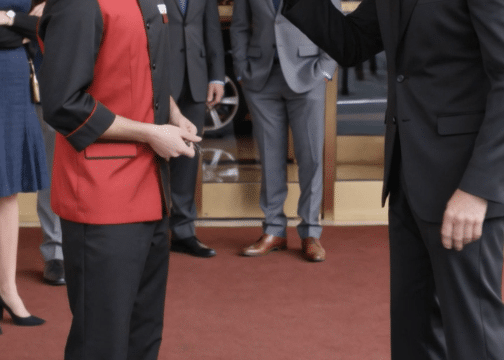
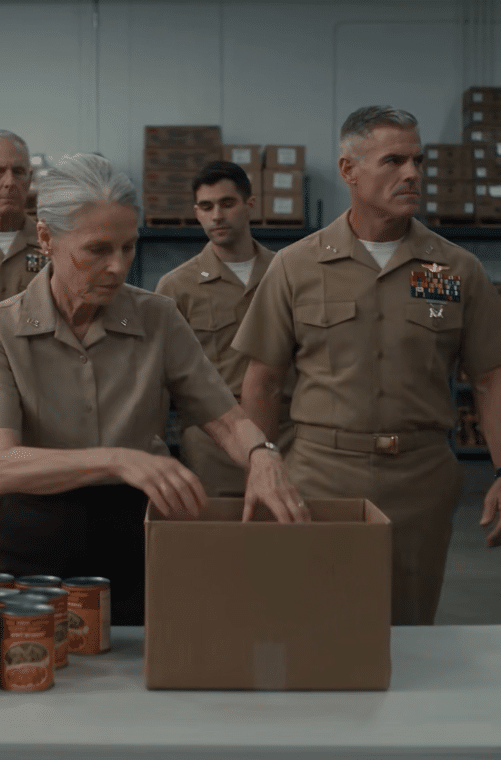
The young aide pointed toward a woman standing behind a volunteer table at a military-family food bank. Shelves of canned goods lined the walls, cardboard supply boxes filled the tables, and military families waited patiently for their turn.
Colonel Richard Hayes, fifty-one, glanced at the queue with open irritation. His service uniform was immaculate, his posture rigid, and his expression suggested that waiting alongside ordinary families was an insult to his rank.
The woman in the volunteer vest was sixty-six. Her silver hair was tied neatly behind her head, and her plain clothes carried the marks of a morning spent moving supplies.
She held a packed food box against her waist and looked at the colonel without hostility.
“You can wait behind them.”
Hayes stared at her as though she had spoken a language he couldn’t understand. He was a colonel in the United States military. She was a volunteer handing out groceries.
In his mind, that settled the matter.
He expected her to step aside, apologize, and give him whatever he wanted.
Instead, she turned toward the families still waiting for food.
That small act of indifference infuriated him more than an argument ever could.
Act II — The Price of Making a Colonel Wait
Hayes ripped the food box from her hands and threw it onto the floor.
Cans scattered across the walkway. Before the woman could respond, he slapped her hard across the face.
She fell beside the supply shelves, one hand catching the floor as her cheek reddened. A faint trace of blood appeared at the corner of her mouth.
The colonel didn’t stop there.
He kicked her twice in the torso, then stepped back and looked down at her with undisguised contempt.
Around them, volunteers froze. Parents pulled their children closer, and several waiting veterans stared in disbelief. The young aide who had brought Hayes over stood motionless, his earlier confidence disappearing as the scene unfolded.
The woman took a painful breath.
She could have screamed. She could have begged him to stop. She could have demanded that someone call security.
Instead, she noticed the cans scattered across the walkway.
Children were standing in line behind her. Someone could trip over the fallen groceries.
Even with pain tightening her face, she began moving the cans out of their path.
Hayes watched her with a mocking expression.
“Volunteers don’t make colonels wait for scraps.”
His voice carried across the room.
The woman continued clearing the walkway. Her cheek was swollen, and her breathing was unsteady, but she never lowered her eyes in submission.
She had been attacked for enforcing a simple rule: families who had waited their turn deserved to receive their food first.
And the colonel still believed he was the one who had been disrespected.
Act III — The Pendant Nobody Was Supposed to Notice
As the woman reached across the floor to move another can, the collar of her shirt shifted.
A small pendant slipped free.
It hung from a modest chain, its surface darkened by years of wear. At its center was a recessed red military seal.
The woman barely seemed to notice it.
But across the room, the food bank’s director stopped moving.
Sergeant Major Thomas Whitaker, a sixty-four-year-old retired serviceman, had spent years working among military personnel and their families. He now supervised the food bank, keeping its shelves stocked and ensuring that every family received what it needed.
The moment he saw the pendant, his face went pale.
He stared at the red seal, then at the woman beside the scattered groceries. His posture stiffened, and the expression in his eyes changed from concern to unmistakable alarm.
He knew that symbol.
Or, more precisely, he knew enough about it to understand that Hayes should never have treated its owner this way.
Whitaker stepped toward them.
“Colonel… please don’t do another thing.”
Hayes turned sharply.
He had expected the director to complain about the mess or apologize for allowing a volunteer to challenge him. Instead, the older man looked genuinely frightened.
The colonel glanced at the pendant.
Then he laughed.
Act IV — “You’re Scared of Jewelry?”
“You’re scared of jewelry?”
Hayes delivered the question with a contemptuous smile. He looked at the pendant as though it were an inexpensive trinket that had somehow convinced an old man to embarrass himself.
Whitaker didn’t answer.
His eyes remained fixed on the red seal. He stood with his shoulders rigid, his expression grave, and his attention divided between the pendant and the woman wearing it.
The aide noticed.
The smirk on his face faded as he realized the retired sergeant major wasn’t playing along with the colonel’s mockery.
Meanwhile, the woman finished clearing the last can from the walkway.
She slowly rose, wincing as she straightened. Her cheek was red and swollen, and the faint trace at her lip remained visible. She made no attempt to hide her pain, but she showed no fear of the man standing in front of her.
Then she closed her fingers around the pendant.
“He remembers the day it was handed to me.”
Hayes’s smile faltered.
The woman hadn’t explained what the pendant represented. She hadn’t announced a former rank or listed the accomplishments of her military career.
She had simply reminded him that the director knew its history.
And Whitaker’s expression suggested that the history was far more significant than Hayes wanted to believe.
The colonel looked at the older man, waiting for him to laugh, deny it, or offer some harmless explanation.
Nothing came.
For the first time, Hayes seemed to understand that he might have mistaken a hidden piece of military history for ordinary jewelry.
But he still didn’t know whose history it was.
Act V — The Red Seal
The room grew quiet.
Hayes looked down at the pendant again. Its recessed red seal caught the overhead light, revealing details he had dismissed only moments earlier.
He searched Whitaker’s face for reassurance.
The retired sergeant major gave him none.
The aide stood beside the supply table, silent now. The families waiting for groceries watched from behind the volunteer line, while the woman remained beside the shelves, composed despite the pain she had endured.
She didn’t demand an apology.
She didn’t threaten to call a commanding officer or promise that Hayes would regret what he had done.
Her silence left the colonel alone with the evidence of his own behavior.
He had assaulted a woman because she refused to let him cut ahead of families waiting for food. He had humiliated her in front of children, veterans, and volunteers who had come to help their community.
And now a retired sergeant major was looking at a small red seal as though it carried a warning that Hayes had been too arrogant to recognize.
The colonel’s expression changed.
First, the smile disappeared.
Then his eyes narrowed, studying the pendant with sudden concentration. His breathing became shallow, and the confidence in his posture began to collapse.
He looked back at Whitaker.
The director remained silent.
Hayes finally turned his attention to the seal once more, as if hoping that another look might reveal the answer before he had to ask the question.
His voice dropped.
“That seal…?”
The camera held on his face.
His eyes widened, and the color drained from his cheeks. The man who had just thrown a food box across the floor and struck an elderly volunteer now looked as though he had stumbled into a history far larger than his own authority.
The woman stood beside the shelves, waiting for the next family to receive its food.
She had not told him who she was.
She had not needed to.
And the retired sergeant major knew exactly why that little red seal mattered.