Act I — The Man Who Didn’t Belong
“General, that man refuses to leave the family table.”
Captain Michael Reeves spoke quietly beside Major General Richard Hayes, directing his attention toward an elderly civilian standing beside a reserved chair at the front of the grand military banquet hall.
Crystal chandeliers illuminated the ballroom. American flags and service banners framed the stage, while senior officers and their families gathered around tables marked for distinguished guests. At the center of the dispute stood a seventy-two-year-old man in a simple gray suit, his silver hair neatly combed and his expression completely composed.
“I was told to sit here,” the old man replied.
Hayes looked him over, taking in the plain suit, dark tie, and absence of military insignia. He saw no decorations, no uniform, and no visible indication that the stranger deserved a place among the families of senior command.
To Hayes, that was enough.
He had spent decades climbing the military hierarchy, and he believed a person’s importance should be obvious the moment they entered a room. The elderly man’s quiet refusal to move felt like a deliberate challenge to everything Hayes believed about rank.
Around them, conversations continued beneath the chandeliers, unaware that one small seating dispute was about to expose the character of a man who had grown far too comfortable abusing his authority.
Act II — A Place Card, a Fist, and a Room Full of Witnesses
Hayes seized the place card from the table and crushed it in his fist.
Then he yanked the reserved chair away.
The elderly man stood his ground. He did not shout, threaten anyone, or attempt to invoke a title. He simply refused to abandon the seat he had been instructed to occupy.
That was when Hayes punched him across the cheek.
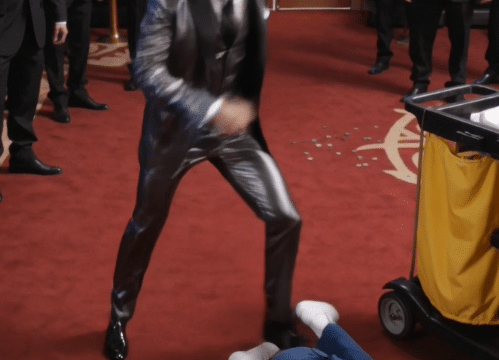
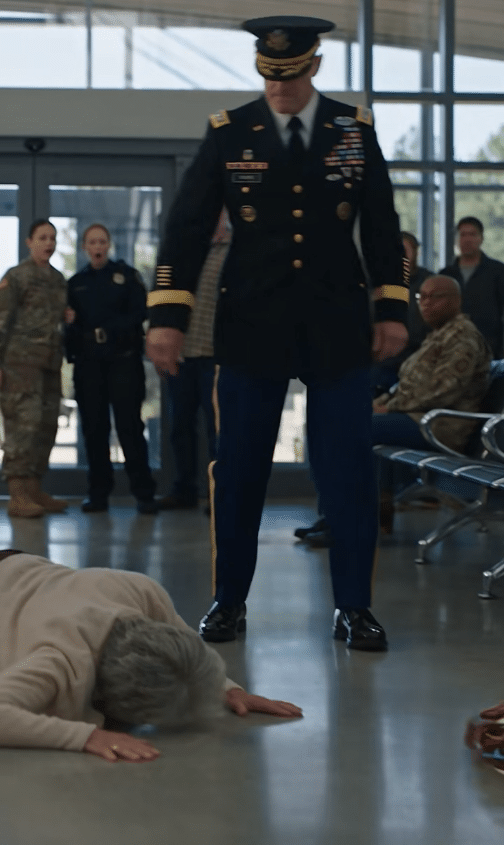
The impact drove the old man against the edge of the table. A sharp gasp swept through the nearest guests as his cheek reddened and a thin trace of blood appeared at the corner of his mouth. Before anyone could process what had happened, Hayes kicked the chair into his legs, sending him painfully to the floor.
Captain Reeves froze.
Officers who had faced dangerous situations in uniform stared in disbelief. Banquet staff stopped moving, and several spouses covered their mouths. Yet no one stepped forward to intervene.
Hayes stood over the fallen civilian, his expression hard with contempt.
“Old civilians don’t sit with command families.”
The words were almost worse than the assault. He had reduced a man he knew nothing about to an unwanted guest, someone whose dignity could be discarded as easily as a crushed place card.
The elderly father slowly pushed himself upright.
Pain showed in the way he moved. He touched his swollen cheek, wiped the faint trace from his lip, and straightened his gray jacket. He neither begged nor demanded an apology.
Instead, he met Hayes’s eyes with a steady, unsettling calm.
For a moment, the general seemed irritated that his victim had failed to behave like one.
He expected humiliation to produce submission.
He had no idea what quiet dignity was about to cost him.
Act III — The Question From the Stage
The elderly man remained beside the reserved table.
Hayes adjusted his uniform, apparently satisfied that the dispute had been settled. Captain Reeves looked increasingly uncomfortable, but he still seemed unable to understand why the old man would risk further humiliation over a chair.
Then a senior aide hurried down from the stage.
Staff Sergeant Daniel Brooks, a trusted member of the senior command staff, approached with an expression that immediately changed the atmosphere around the table. His eyes went first to the elderly man’s injured face, then to Hayes.
He did not address the old man as an intruder.
Instead, he turned to the major general and spoke with unmistakable urgency.
“General… his daughter is asking why her father isn’t seated.”
Hayes blinked.
“His daughter?”
The question came out dismissively, as though the answer would be some minor administrative detail. He glanced at the civilian’s plain suit, apparently unable to imagine that the man’s family could have any meaningful connection to the people occupying the stage.
Brooks did not smile.
He didn’t offer a name, explain a rank, or attempt to lecture Hayes about the consequences of his behavior. He simply waited, his posture tightening as though he knew the general was standing on the edge of a mistake he had not yet recognized.
The elderly father said nothing.
He had endured the punch, the fall, and the public insult without revealing a single detail about his family. Now, with the senior aide standing beside him, he appeared just as unwilling to explain himself.
Hayes looked between the two men.
For the first time, the possibility crossed his mind that the old civilian hadn’t been trying to claim a place he didn’t deserve.
Perhaps he had been sitting exactly where he belonged.
Act IV — “You Salute Her Every Monday”
Hayes forced a short, disbelieving laugh.
“His daughter?”
He repeated the words as though saying them twice might restore the authority slipping from his grasp. He was a major general, a man accustomed to being recognized by officers who understood the chain of command. Surely an elderly civilian in an inexpensive gray suit could not suddenly make him question his own position.
Then the father finally spoke.
“You salute her every Monday.”
Six words.
Hayes’s expression changed before he could stop it.
He stared at the old man, searching his face for a hint of a joke. There was none. The father wasn’t smiling, and he wasn’t attempting to frighten him with an empty threat. His voice carried the quiet certainty of someone stating a fact that required no further explanation.
Hayes looked back at Brooks.
The aide’s grave expression confirmed that this was not a misunderstanding he could dismiss with a few sharp words. Whatever the relationship was, Brooks understood its significance—and he clearly believed Hayes should have understood it, too.
The general’s eyes shifted toward the senior-command section of the ballroom.
At the front, officers continued gathering near the stage, where the evening’s distinguished leadership had assembled. Hayes knew the senior officers he saluted during the weekly command ceremony. He knew their uniforms, their authority, and the people whose decisions shaped his career.
But he had never imagined that one of their family members might be standing in front of him, bleeding at the mouth, after being assaulted over a chair.
The elderly father adjusted his cuff.
He offered no name. He didn’t need to.
Hayes’s confidence began to fracture as he mentally connected the aide’s message with the father’s chilling remark. The woman who was asking why her father wasn’t seated was not simply another guest at the banquet.
She was someone Hayes recognized.
Someone whose authority he acknowledged every Monday without question.
And the man he had just punched was her father.
Suddenly, the reserved chair no longer looked like an administrative mistake. The crushed place card no longer looked like an insignificant piece of paper.
They looked like evidence of how little Hayes had understood about the person he had chosen to humiliate.
Act V — The General Finally Understands
The ballroom seemed to grow quieter.
Hayes glanced toward the stage again, then back at the elderly man. His jaw tightened as the implications settled in. He had assaulted a civilian in front of senior officers, their families, and the very staff members responsible for maintaining order at the event.
Worse, he had done it because he believed the man’s appearance made him unworthy of respect.
Captain Reeves lowered his eyes. The confidence with which he had reported the seating dispute was gone. The other officers remained still, watching the major general struggle to reconcile his behavior with the identity he was beginning to suspect.
The father stood beside the table, his cheek swollen and his gray suit slightly disheveled.
He did not gloat.
He did not announce his daughter’s achievements or demand that Hayes be punished. He simply waited, allowing the general to confront the consequences of his own assumptions.
That silence left Hayes with nowhere to hide.
For years, he had relied on the weight of his rank to make people move, apologize, and obey. He had mistaken fear for respect and compliance for proof that he was right.
Now, in a room filled with people who had witnessed his actions, his uniform offered no protection from the truth.
He had not merely disrespected an elderly guest.
He had struck someone’s father—and that someone was a senior leader he saluted every Monday.
Hayes opened his mouth, but no apology came.
His eyes widened. The color drained from his face, and the arrogance that had carried him through the confrontation collapsed into a single, disbelieving question.
“Her…?”
The camera held on his face as the ballroom blurred behind him.
For the first time that evening, Major General Richard Hayes looked like a man who understood that his rank could not undo what his hands had done.
And the father he had tried to throw out of the family seating area still hadn’t told him his daughter’s name.