Act I
The white service towel fell first.
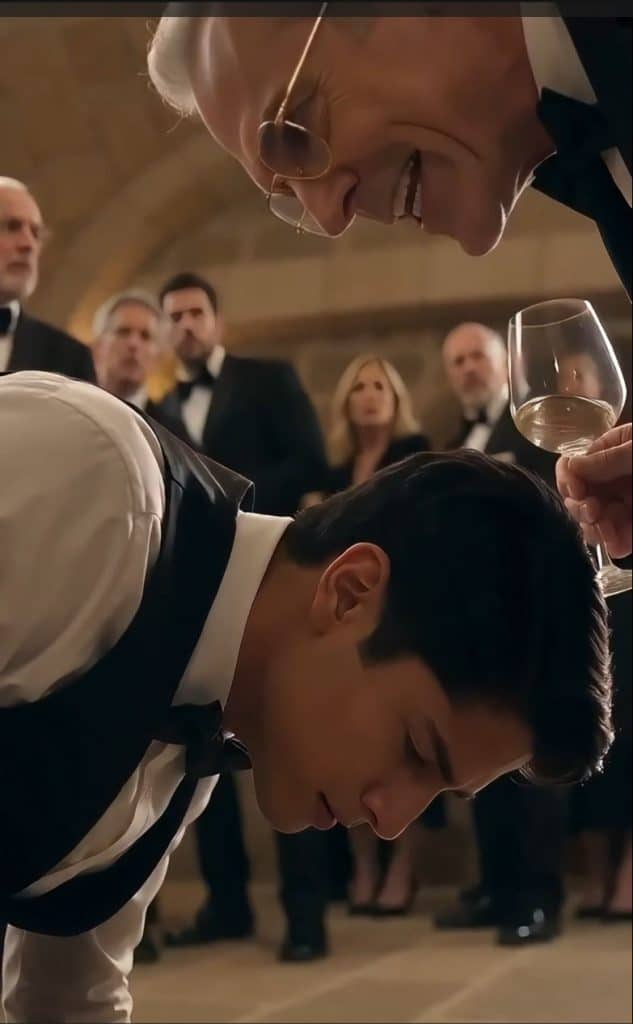
It slipped from the young waiter’s hand and landed on the stone floor beside the oak table, soft and silent for half a heartbeat. Then the bottle trembled in its display cradle, the label catching the candlelight.
Alvarez Reserve.
A second later, Daniel Alvarez staggered backward.
His shoulder struck the edge of the table. His lip marked faintly from the slap. Around him, crystal glasses shivered, and the private cellar of the Napa Valley mansion went dead quiet.
The man who had hit him stood in a burgundy velvet dinner jacket, gold-rimmed glasses low on his nose, one hand still wrapped around a crystal wine glass.
Richard Whitcomb did not look sorry.
He looked offended.
As if the waiter’s cheek had inconvenienced his evening.
“You pour wine,” Richard said, voice sharp enough to scrape the stone walls. “You don’t touch bottles owned by families with names.”
Every guest heard it.
Billionaire bidders sat around candlelit oak tables beneath vaulted ceilings. Sommeliers froze near the glass displays. Assistants lowered tablets. Servers stopped moving. The rare bottles behind the locked cases seemed to glow warmer than the people standing in front of them.
Daniel stayed low, one hand braced against the floor.
His black vest was twisted. His bowtie had shifted. The folded service towel lay near his knee, inches from the bottle that had started everything.
He did not speak.
That restraint made the humiliation worse.
Richard stepped closer, nostrils flared, wine glass held like proof of rank.
“You people always think proximity means permission,” he said. “This cellar is not a kitchen tour.”
A woman near the podium whispered, “That was unnecessary.”
Richard ignored her.
He was too busy enjoying the silence.
Then the auction host rushed down from the podium, black evening suit moving sharply under amber light, pearl earrings swinging as she crossed the room with a tablet clutched in one hand.
Her face had gone pale.
She looked at Daniel on the floor.
Then at the bottle.
Then at Richard.
“Mr. Whitcomb,” she said, voice tight with horror, “step away from him.”
Richard frowned.
“Excuse me?”
The host lowered herself beside Daniel with unmistakable respect.
“Mr. Alvarez,” she said clearly, “your grandfather’s private cellar is ready for the final lot.”
The room inhaled all at once.
The camera of attention shifted to the bottle label.
Alvarez Reserve.
Richard’s grip tightened around his wine glass.
“Alvarez?” he whispered.
Daniel slowly looked up.
Act II
Daniel Alvarez had learned wine before he learned wealth.
His grandfather made sure of that.
Mateo Alvarez never described wine by price first. He described it by weather. Soil. Patience. The way fog settled low over the vines before sunrise. The way summer heat could turn arrogance into vinegar if a grower failed to listen.
“Wine remembers everything,” Mateo used to say. “The rain. The hands. The waiting.”
Daniel was eight when he first heard that.
He had followed his grandfather through the vineyard in shoes too small, carrying pruning gloves he was not allowed to use yet. Mateo walked slowly, touching leaves as if greeting old friends. He had built the Alvarez winery from leased land, borrowed equipment, and a stubborn refusal to sell the family name to bigger labels.
At first, Napa insiders dismissed him.
Too small.
Too traditional.
Too proud.
Then the bottles began winning blind tastings.
Critics came. Collectors followed. Billionaires wanted allocations. Restaurants begged for cases. Men who once mispronounced Alvarez suddenly said it with reverence, usually while asking how many bottles remained.
Mateo smiled politely and kept the best vintages in the family cellar.
Not to hoard them.
To remember.
Each bottle held a story. The year Daniel’s grandmother survived surgery. The year wildfires came close enough to turn the sky brown. The year Daniel’s father left and never returned. The year Daniel’s mother cried in the vineyard because she thought she could not carry the business alone.
Mateo bottled them all.
Not the pain.
The survival.
When Mateo died, the family discovered that he had planned one final auction.
A private cellar sale at the Napa mansion he had bought late in life but never lived in comfortably. The proceeds would fund scholarships for Latino students studying agriculture, hospitality, and winemaking. The last and rarest lot would not be sold to the highest bidder automatically.
It would be released only if Daniel approved the buyer.
That condition infuriated the auction house.
Collectors hated uncertainty.
Richard Whitcomb hated it most.
Richard had spent thirty years turning taste into ownership. He collected rare wines the way some men collected enemies. A bottle meant more to him if someone else wanted it. A vintage was sweeter when it completed a vertical no one else could match.
He had chased Alvarez Reserve for years.
Mateo had refused him twice.
The first time, Richard offered too much money.
The second, he offered a partnership.
Mateo’s response became a private legend among Napa families.
“I do not sell memory to men who only collect trophies.”
Richard never forgave the insult.
So when he received an invitation to the final Alvarez cellar auction, he arrived determined to win what Mateo had denied him in life.
He expected grieving heirs.
He expected lawyers.
He expected a grandson in a tailored suit, perhaps emotional, perhaps easy to flatter.
He did not expect Daniel to enter through the service corridor wearing a crisp white waiter shirt, black vest, bowtie, and carrying a folded towel.
That was Daniel’s choice.
His grandfather had asked for it in a letter.
Before you decide who deserves the last bottle, serve the room first.
Daniel almost refused.
His mother told him he did not have to honor every strange request of a dead man.
But Daniel knew why Mateo had written it.
A room reveals itself to the person it thinks is invisible.
So Daniel put on the uniform.
He carried the towel.
He poured water, replaced glasses, listened to men discuss his grandfather as if they had loved him, and waited to see who understood the difference between wanting Alvarez wine and respecting the family that made it.
By the time Richard Whitcomb raised his hand, Daniel already knew the answer.
Act III
The first sign came before the first bid.
Richard stood near a glass case, studying the Alvarez Reserve as if the bottle had personally challenged him. Daniel approached to adjust the display cloth, careful not to touch the bottle itself.
Richard snapped his fingers.
“Careful.”
Daniel looked up.
“Yes, sir.”
“Do you know what that is?”
Daniel glanced at the label.
“Yes.”
Richard laughed softly.
“No, you don’t.”
A few guests nearby smiled in that nervous way rich people smile when they are waiting to see whether cruelty will become entertainment.
Daniel lowered his eyes.
He had promised himself he would observe, not argue.
Richard leaned closer.
“That bottle is older than your career.”
Daniel nearly smiled.
The bottle was from 1994.
He had helped his grandfather clean the label with a soft cloth when he was twelve.
But he said nothing.
The auction began.
Lot after lot climbed past numbers that would have paid a year of tuition. Guests murmured over vintages as if speaking of royalty. Sommeliers described structure, rarity, provenance, and cellar conditions. Daniel moved quietly between tables, refilling water and removing empty glasses.
He heard everything.
One bidder called Mateo “a charming old farmer.”
Another said the scholarship fund was “good optics.”
Richard said the final lot belonged “in a real cellar, not some sentimental family shrine.”
Daniel’s hand tightened around the towel.
The auction host, Claire Bennett, looked toward him from the podium. She knew who he was. She had been trusted with the final instructions. Her eyes carried a silent question.
Are you all right?
Daniel gave the smallest nod.
Then Richard stood.
He walked toward the final bottle before the lot had been announced, as if his wealth had already purchased permission. The Alvarez Reserve rested in its cradle under warm light, label clean, glass dark, history contained in fragile silence.
Daniel stepped forward.
“Sir, please stay behind the rope until the host opens the lot.”
Richard turned slowly.
“The waiter is correcting me now?”
“I’m protecting the bottle.”
That answer shifted the room.
Richard’s face hardened.
“You’re protecting it?”
“Yes, sir.”
Richard reached toward the bottle.
Daniel moved instinctively, placing one hand near the display cradle to steady it before Richard’s sleeve brushed the stand.
That was all it took.
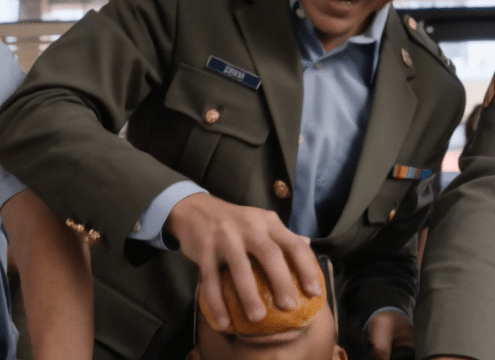
The slap cracked through the cellar.
Daniel stumbled backward into the oak table. The towel fell. The bottle trembled but did not fall. Gasps rose beneath the vaulted ceiling.
Richard stood over him, anger bright in his eyes.
“You pour wine. You don’t touch bottles owned by families with names.”
Daniel tasted blood at the edge of his lip.
He looked at the bottle.
Then at Richard.
For the first time all night, he felt his grandfather’s lesson settle in his bones.
Wine remembers everything.
So do rooms.
Then Claire Bennett left the podium and rushed toward him.
Act IV
Claire did not ask permission to stop the auction.
She simply stopped it.
“Ladies and gentlemen,” she said, voice carrying through the cellar, “bidding is suspended.”
Richard turned sharply.
“On whose authority?”
Claire helped Daniel stand.
“His.”
The answer confused the room for one second.
Then it changed it.
Claire faced Richard, tablet in hand.
“This is Daniel Alvarez, grandson of Mateo Alvarez and executor of the final cellar release.”
A murmur broke across the tables.
Daniel stood beside the rare bottle, waiter uniform rumpled, lip marked, dignity intact.
Richard stared at him.
“No.”
The word came out too fast.
Claire’s expression did not move.
“Yes.”
She tapped the tablet.
The screen behind the podium updated.
FINAL LOT: ALVAREZ RESERVE PRIVATE CELLAR RELEASE.
Approval Authority: Daniel Mateo Alvarez.
Richard’s face drained.
Guests leaned forward. Sommeliers whispered. One older winemaker near the back slowly removed his glasses as if he had just witnessed a man burn his own invitation.
Richard tried to recover.
“I had no idea,” he said.
Daniel looked at him.
“No idea I was Alvarez?”
Richard swallowed.
“Yes. Obviously. This is a terrible misunderstanding.”
Daniel bent and picked up the white service towel from the stone floor.
The room watched him fold it carefully.
“My grandfather wore a service jacket at his first tasting,” Daniel said. “No one poured for him, so he poured for everyone else.”
The cellar went silent again.
“He told me some people reveal their palate by what they praise. Others reveal their character by whom they insult.”
Richard’s jaw tightened.
“I apologized.”
“No,” Daniel said softly. “You explained why you thought it was safe.”
Claire’s eyes flicked toward Richard’s wine glass.
“Mr. Whitcomb,” she said, “your bidding credentials are suspended pending review.”
His head snapped toward her.
“You cannot suspend me from an auction I was invited to.”
Daniel’s voice stayed calm.
“This is my grandfather’s cellar.”
Richard looked around for support.
For decades, rooms had supported him. Private clubs, auction houses, vineyard dinners, boardrooms. Someone always smoothed things over because he spent enough money to make decency negotiable.
Not this time.
A billionaire at the far table lowered his paddle.
A sommelier looked away in disgust.
A server who had flinched when Richard raised his voice earlier now stood a little straighter.
Richard’s panic sharpened.
“You would deny a serious collector access to one of the greatest American wine releases over one moment?”
Daniel glanced at the bottle.
Then at the guests.
“My grandfather did not make this wine so someone could own the story while disrespecting the hands that made it.”
Richard scoffed, but it came out weak.
“You’re emotional.”
Daniel’s face changed.
Not anger.
Finality.
“My grandfather wrote a condition into the final lot. The bottle cannot be sold to any bidder who mistreats winery staff, auction staff, service workers, or family representatives during the event.”
Claire nodded.
“It is legally attached to the release agreement.”
Richard stared.
His mouth opened, but nothing useful came out.
Daniel looked at him fully now.
“You failed before the bidding began.”
Security stepped closer.
Richard’s fingers tightened around the crystal glass until it shook.
“Alvarez?” he whispered again.
Daniel held his gaze.
“Yes,” he said. “And you were never bidding on just wine.”
Act V
Richard Whitcomb was escorted out before the final lot reopened.
The cellar did not applaud.
That would have made the moment too easy.
Instead, the guests sat in a silence thick with embarrassment, listening to his footsteps fade beyond the stone corridor. The candles still burned. The rare bottles still glowed behind glass. The Alvarez Reserve remained in its cradle, untouched, steady, waiting.
Daniel stood beside it, one hand resting lightly on the oak table.
Claire approached him quietly.
“Do you want to stop for the evening?”
Daniel looked around the room.
At the bidders who had watched.
At the servers who had not dared move.
At the sommeliers who understood vineyards better than most collectors ever would.
“No,” he said. “My grandfather wanted the cellar opened tonight.”
Claire lowered her voice.
“He also wanted you protected.”
Daniel folded the towel over his arm.
“Then let’s do both.”
When the final lot resumed, the atmosphere had changed.
The numbers still rose, but the hunger had softened. People bid more carefully, as if suddenly aware that ownership was not the same as deserving. One woman in a simple black gown asked whether the buyer would be permitted to loan the bottle for educational exhibitions before opening it.
Daniel looked at her.
That was the first question all night that sounded like respect.
She won.
Not because she was the richest person in the room.
Because when Claire asked what she intended to do with the bottle, she answered, “I want students to hear the story before anyone tastes it.”
Daniel approved the sale.
The proceeds funded the Mateo Alvarez Scholarship for vineyard workers’ children, hospitality students, cellar apprentices, and young winemakers who had talent but no access. The first scholarship dinner was held not in a mansion, but in the old barrel room at the original Alvarez winery.
No velvet ropes.
No private bidders.
No one snapped fingers at servers.
Daniel’s mother attended in a navy dress and cried when the first student stood to speak. She had worried her father’s legacy would be swallowed by collectors who loved the label more than the life behind it.
Instead, the family name became a door.
Months later, Daniel received a letter from one of the servers who had worked the auction.
Mr. Alvarez, I have served men like him for years. That night was the first time I saw one removed instead of excused.
Daniel kept the letter in the cellar office.
Not framed.
Just folded into the drawer where his grandfather used to keep vineyard maps.
Richard tried to repair his reputation.
He released a statement about stress, misunderstanding, and deep respect for the Alvarez legacy. Wine magazines printed it because scandal sells almost as well as rarity. But the people who had been in the cellar knew the truth.
Richard had not disrespected the Alvarez name by mistake.
He had disrespected a man before knowing the name.
That was worse.
A year after the auction, Daniel opened the private cellar to a group of scholarship students.
He wore jeans this time, a white shirt, and the same black vest. Not because he was pretending to be staff, but because he liked remembering. The students walked slowly between the racks, eyes wide as candlelight moved over old labels.
One young woman paused before a bottle of Alvarez Reserve.
“Is that the one?” she asked.
Daniel smiled.
“One of them.”
“The one from the auction?”
“No,” he said. “That one belongs to someone who promised to share its story.”
She looked at the label.
“My dad picks grapes in Sonoma,” she said. “He says people talk about wine like it grows in glass.”
Daniel laughed softly.
“My grandfather would have liked your father.”
At the end of the tour, Daniel brought the students to a small table. No one drank. They were there to learn, not perform sophistication. He opened a box instead and removed old harvest photographs, handwritten notes, soil reports, and a stained work glove that had belonged to Mateo.
“This,” he said, holding up the glove, “is part of the cellar too.”
The students leaned in.
That was the moment Daniel understood his grandfather’s final lesson.
The bottle mattered.
But only because it carried everything around it.
The hands. The family. The workers. The land. The waiting. The people who served and were mistaken for servants in the cruelest sense of the word.
Daniel still remembered the slap.
The towel falling.
Richard’s voice saying families with names.
But the memory no longer burned the same way.
It had become a boundary.
A scholarship.
A story told to young people standing in a cellar that no longer belonged only to billionaires.
Because Richard Whitcomb had been wrong.
Families with names did not own dignity.
They inherited the responsibility to protect it.
And Daniel Alvarez, once mistaken for a waiter in his own grandfather’s cellar, made sure every bottle opened after that night carried the truth Richard had failed to understand.
Wine remembers everything.
Especially the hands that were never supposed to be seen.