Act I
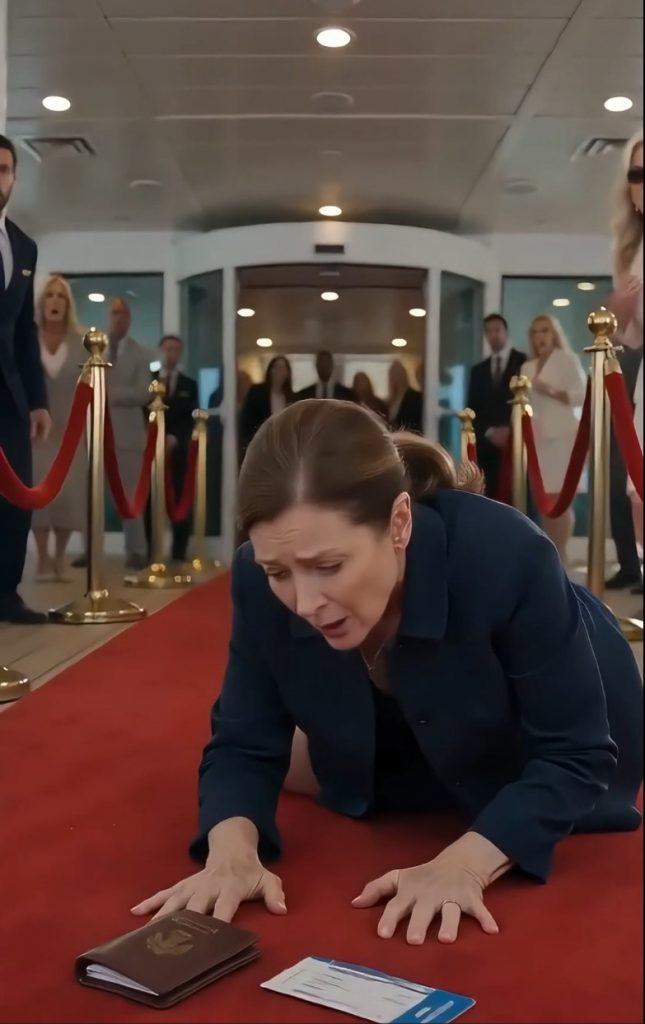
The passport wallet slid across the red carpet before anyone reached for the woman.
It was brown, worn soft at the edges, and so plain that it looked almost out of place beneath the gold stanchions and polished glass doors of the private Miami terminal. A boarding pass slipped beside it, face-down under the glow of the cruise line’s enormous logo.
Then Madam Carter hit the floor.
Her elbow scraped lightly against the tile where the red carpet ended. Her navy coat twisted at the shoulder. A faint mark appeared near her lip, but she did not cry out.
She only looked toward the wallet.
As if that tired piece of leather mattered more than the humiliation.
The woman who had slapped her stood over her in a white linen suit, pearl necklace gleaming at her throat, platinum hair arranged perfectly beneath oversized sunglasses. One manicured hand rested on the handle of a polished gold suitcase.
“This ship is for guests with class,” she said, voice sharp and nasal with contempt, “not women who sneak through service doors.”
The terminal froze.
White-uniformed crew stopped near the gangway. Boarding agents stared from behind the check-in podium. Security guards shifted uneasily beside the velvet ropes. Wealthy passengers with designer luggage turned from the ocean-view windows and watched the woman on the floor.
Madam Carter stayed low, breathing carefully.
Quiet.
Controlled.
The socialite seemed to mistake that silence for weakness.
Her name was Priscilla Whitcomb, and she had arrived thirty minutes late, already offended by the existence of other people. The red carpet was too crowded. The welcome champagne too warm. The boarding line too slow. The crew too young. The terminal too public for a woman who believed luxury meant never having to share air with anyone she considered ordinary.
She had seen Madam Carter step onto the red carpet in plain flats, holding a worn passport wallet instead of a designer clutch.
That was enough.
To Priscilla, modesty looked like trespassing.
“Get up,” she said. “Before you embarrass yourself further.”
The boarding pass lay between them.
No one moved.
Then heavy footsteps sounded from the gangway.
A tall captain in a crisp white maritime uniform descended with two officers behind him, gold shoulder stripes catching the terminal lights. His serious blue eyes moved across the crowd, past Priscilla, past the gold suitcase, straight to the woman on the floor.
His face tightened.
He stopped beside Madam Carter and bowed his head slightly.
“Madam CEO,” he said, voice carrying across the terminal, “the entire cruise line is ready for your inspection.”
A collective gasp passed through the boarding gate.
Crew members lined up behind him near the gangway.
Priscilla’s sunglasses slipped down her nose.
Her mouth opened.
“CEO?”
Act II
Eleanor Carter had inherited a cruise line and a warning.
The cruise line was Carter Atlantic Voyages, founded by her grandfather after World War II with one refurbished ship and a stubborn belief that travel should make people feel larger, not smaller. He had been a steward before he ever owned a vessel. He carried trunks, polished railings, cleaned cabins, and learned how quickly passengers revealed themselves when they thought crew had no power.
His first ship was old, noisy, and always slightly behind schedule.
But people remembered it.
Not for the food. Not for the curtains. Not for the tiny cabins that rattled in rough water.
They remembered how they were treated.
Eleanor’s grandfather wrote one sentence in the first employee handbook, back when the company could barely afford printed stationery.
A voyage begins the moment a person is seen.
He meant everyone.
Guests. Crew. Dock workers. Families with too many bags. Elderly passengers traveling alone. Children nervous about the sea. Kitchen staff leaving after midnight. Cabin stewards entering through narrow corridors while guests slept in sheets they had made smooth.
Eleanor grew up with that sentence.
Her father turned it into a framed slogan when the company expanded.
Eleanor tried to turn it back into a rule.
That became harder every year.
Cruising changed. Luxury changed. The ships grew taller, brighter, louder. Private terminals appeared. Suite classes multiplied. Passenger tiers became more complicated than the weather charts. There were exclusive decks, private lounges, priority carpets, champagne corridors, and service doors that slowly began to look less like logistics and more like shame.
Eleanor noticed the complaints first.
Not the formal ones.
Those were polished into uselessness before they reached her desk.
She noticed the small messages.
A boarding agent wrote that VIP passengers were allowed to abuse crew because “guest recovery costs less than confrontation.” A porter reported that modestly dressed passengers were redirected from premium entrances even when their tickets were valid. A cabin attendant said the company’s new luxury culture had taught some guests to confuse service with obedience.
Then came the video.
A crew member had recorded a passenger screaming at an elderly couple for entering the priority line with a wheelchair. The couple had a suite ticket. No one checked until after the woman cried.
Eleanor watched the video twice.
Then she stopped it before the apology.
She did not need to see the company perform regret.
She needed to see what it tolerated before regret became necessary.
So she scheduled an unannounced inspection of the Miami private terminal, the departure point for the cruise line’s newest ship, the Meridian Crown.
The board expected her to arrive with executives.
She arrived alone.
Navy coat. Plain flats. Minimal makeup. Worn passport wallet.
Inside that wallet was her grandfather’s first crew ID, folded beside her own passport.
She carried it whenever she needed to remember what kind of company she was supposed to lead.
At the gate, no one recognized her.
That was the point.
And for the first few minutes, the terminal seemed to pass the test.
Then Priscilla Whitcomb saw her.
And everything hidden under the red carpet came rushing to the surface.
Act III
Priscilla Whitcomb believed that money should create distance.
Distance from crowds.
Distance from noise.
Distance from children, luggage, waiting, weather, and anything that reminded her luxury was still built by human hands.
She had been cruising with Carter Atlantic for twelve years and had become famous among crew for the kind of complaints that arrived like storms.
A server poured too slowly.
A pianist smiled at the wrong guest.
A cabin steward’s accent was “distracting.”
A family in matching T-shirts ruined the atmosphere near the suite lounge.
Every time, the company offered something.
A credit. A private dinner. A bottle of champagne. A handwritten apology from someone who had not done anything wrong.
Priscilla learned quickly.
Cruelty produced upgrades.
That afternoon, she was boarding the Meridian Crown for the inaugural luxury voyage. Reporters were present. Influencers posed near the gold stanchions. The terminal had been polished into a showcase of wealth at sea.
Eleanor watched from the edge of the red carpet.
She saw crew members smile with their mouths but not their shoulders. She saw a young boarding agent become visibly smaller when a man in a linen blazer tapped his watch at her. She saw security wave through passengers with diamond luggage tags while stopping a nurse traveling with her mother to ask for verification twice.
Then Priscilla arrived.
A boarding agent greeted her by name.
Priscilla did not answer.
Her eyes went to Eleanor instead.
“You,” she said. “This is priority boarding.”
Eleanor looked at her.
“Yes.”
“You’re in the wrong place.”
“I don’t believe I am.”
Priscilla’s lips curled.
“Of course you don’t.”
Eleanor held up her boarding pass.
“I’m expected.”
Priscilla snatched it before the agent could react.
The paper bent in her hand.
The terminal went still in small ripples.
“Give that back,” Eleanor said.
Priscilla glanced at the pass, then dropped it onto the carpet as if it had become dirty through contact.
“Pick it up from the service side.”
Eleanor bent for it.
That was when the slap came.
Now, with the captain standing over her and the crowd staring at the passport wallet on the carpet, Priscilla began to understand only the smallest part of what she had done.
She had not embarrassed a nobody.
She had attacked the woman who could remove her from the voyage.
But Eleanor understood the larger truth.
Priscilla had done exactly what the system had trained her to believe she could do.
Act IV
Captain Robert Hale kept his posture formal, but his eyes were not calm.
He had sailed under Carter Atlantic for twenty-six years. He had met Eleanor Carter when she was twenty-two and touring ships with a notebook instead of an entourage. He had watched her argue with executives twice her age about crew rest hours, passenger safety, and whether luxury meant anything if the people delivering it were too exhausted to stand.
He respected her.
He also knew what the terminal had just failed to do.
“Are you hurt, Madam CEO?” he asked.
Eleanor stood slowly, one hand closing around the passport wallet.
“I’m all right.”
The captain looked at the mark near her lip and did not accept the lie.
But he understood the moment belonged to more than injury.
Priscilla forced a laugh.
“This is ridiculous,” she said. “I had no idea who she was.”
Eleanor turned to her.
“No,” she said softly. “You didn’t.”
Priscilla’s shoulders lowered slightly, as if relief had found an opening.
Then Eleanor continued.
“But you knew I was a woman trying to board.”
The terminal seemed to tighten around the sentence.
A boarding agent near the podium looked down. One of the officers behind Captain Hale lifted his chin. A passenger who had filmed the scene slowly lowered his phone.
Priscilla’s voice sharpened.
“She looked like staff.”
Eleanor glanced at the white-uniformed crew lined near the gangway.
“And that made her safe to strike?”
No one breathed.
The ocean beyond the windows shimmered in the late afternoon light, bright and indifferent.
Captain Hale turned to security.
“Secure terminal footage. All angles. Preserve audio.”
Priscilla’s face changed.
“Footage? There’s no need to make this dramatic.”
“You made it dramatic when you assaulted a passenger,” the captain said.
“I am a platinum suite guest.”
Eleanor looked at her gold suitcase.
“Not on this voyage.”
The words landed with a clean finality.
Priscilla blinked.
“You can’t deny me boarding.”
Captain Hale spoke before Eleanor had to.
“As master of the vessel, I can refuse passage to any person whose conduct threatens the safety or dignity of passengers or crew.”
Priscilla looked around for support.
For the first time all afternoon, wealth gave her none.
A crew member near the gangway spoke quietly.
“She’s done this before.”
Priscilla whipped toward him.
“Excuse me?”
The young crewman’s face paled, but he did not stop.
“Not hitting. But shouting. Throwing things. Calling crew service rats. We reported it last season.”
Eleanor looked at him.
“What happened?”
He swallowed.
“We were told she was high-value.”
The phrase moved through the terminal like a confession no one wanted to claim.
Eleanor turned back to Priscilla.
“There are no high-value guests who lower the value of everyone around them.”
Security stepped forward.
Priscilla’s voice broke.
“CEO?”
This time, Eleanor did not answer.
She looked at the boarding agents instead.
“Before this ship leaves,” she said, “we are going to decide whether my company still remembers how a voyage begins.”
Act V
The Meridian Crown sailed fifty-eight minutes late.
The delay spread across passenger phones before the ship left port. Some people complained online. Some demanded credits. One man in a linen jacket called the terminal “overly sensitive” and was quietly informed by Captain Hale that he was welcome to disembark before departure.
He did not.
Priscilla Whitcomb did.
She was escorted from the private terminal with her gold suitcase rolling behind her and her sunglasses back on, though everyone had already seen the panic in her eyes. Her suite remained empty for the first night of the voyage.
Eleanor ordered that it not be resold.
“Let the empty room teach the company something,” she said.
But she did not stop at banning one passenger.
That would have been too easy.
The real problem was not Priscilla’s hand.
It was the years of soft apologies that had taught her to raise it.
Before the ship departed, Eleanor gathered the boarding agents, porters, security officers, guest relations staff, and senior crew near the gangway. Passengers watched from behind the stanchions, irritated at first, then quieter when they realized the CEO was still wearing the same navy coat, still holding the worn passport wallet that had slid across the carpet.
“My grandfather founded this company after working below deck,” she said. “He believed a voyage begins the moment a person is seen.”
Her voice carried through the terminal.
“Today, I was seen incorrectly. That is not the worst part. The worst part is that too many of you have watched others be seen incorrectly and were told to keep smiling.”
Several crew members looked down.
Eleanor did not blame them.
She blamed the system that had made silence feel like employment.
“That ends today.”
The policies began changing before the ship reached international waters.
Guest conduct rules were rewritten in plain language. Any passenger who threatened, degraded, or physically intimidated crew or other passengers could be denied boarding or removed at the next safe port. Staff no longer needed management approval to call security when abuse began. VIP status could not override safety reports. Repeat offenders lost privileges, no matter how much they spent.
The company created a crew protection office that reported directly to Eleanor.
Not guest relations.
Not revenue management.
Directly to the CEO.
Within a month, three long-protected passengers were banned. Two managers who had buried complaints resigned before review. One terminal supervisor apologized to his staff in a meeting and admitted that he had protected ratings over people.
It was not enough.
But it was a start.
Eleanor kept the passport wallet.
She had carried it for years, but after Miami, it changed meaning. It was no longer only her grandfather’s memory. It was evidence. A small, worn object that had crossed a luxury terminal floor faster than anyone’s courage.
Inside it, beneath his old crew ID, she placed the boarding pass from that day.
Creased.
Scuffed.
Still readable.
Months later, she returned to the Miami terminal unannounced.
Again in plain flats.
Again without an entourage.
This time, the first person to greet her was a young porter helping an elderly man with his bag.
“Welcome aboard,” the porter said warmly to the man. “Take your time. The ship isn’t leaving without you.”
The elderly man laughed with relief.
Eleanor stopped walking.
Not because anyone recognized her.
Because someone had recognized him.
At the podium, the same boarding agent from the incident looked up and saw Eleanor. Her expression flickered with fear, then steadied.
“Good afternoon, Ms. Carter,” she said. “May I check your documents?”
Eleanor smiled.
“Yes. Thank you for asking.”
The agent checked them properly.
Not nervously.
Professionally.
That pleased Eleanor more than any special greeting could have.
Near the gangway, a child dropped a stuffed dolphin. A crew member picked it up and knelt to return it. A man in a designer blazer sighed dramatically at the delay. Before he could say anything cruel, a security officer took one calm step closer.
The man looked at him.
Then said nothing.
Boundaries, Eleanor had learned, did not need to shout when they were real.
Captain Hale met her just before boarding.
“Madam CEO,” he said.
“Captain.”
He glanced at the passport wallet in her hand.
“You still carry it.”
“I always will.”
He nodded toward the ship.
“She’s ready for inspection.”
Eleanor looked through the glass at the Meridian Crown, white and enormous against the Miami water.
“Good,” she said. “But I’m starting at the crew entrance.”
Captain Hale smiled slightly.
“I thought you might.”
Below deck, she found clean corridors, better break rooms, posted conduct reporting procedures, and a wall where crew had written notes in different handwriting.
A guest apologized before I had to ask.
Security came when I called.
A passenger thanked housekeeping by name.
My manager believed me.
Eleanor stood before that last note for a long time.
People would still tell the story of Priscilla Whitcomb, of course.
The socialite slapped a modest woman at the cruise gate.
The captain descended from the gangway.
The woman was the CEO.
CEO?
It was satisfying because arrogance panicked beneath bright terminal lights.
But Eleanor never cared for that version.
It made power the lesson.
The slap had been wrong before anyone heard her title.
The insult had been ugly before the captain spoke.
The woman on the red carpet had deserved help before the crowd learned she controlled the company name on the wall.
That evening, as the ship prepared to depart, Eleanor stood alone near an ocean-view window and opened the worn passport wallet.
Her grandfather’s crew ID stared back at her.
Young face. Tired eyes. Crisp uniform. A man who had once carried bags for people who never imagined he would build a fleet.
Beside it sat her creased boarding pass from Miami.
Two pieces of paper.
Two reminders.
A company could grow so large that it forgot its beginning.
A red carpet could become a barrier.
A luxury ship could become a floating kingdom where the wrong people learned to bow and the wrong people learned to expect it.
Unless someone stopped it.
Unless someone remembered.
Eleanor closed the wallet as the horn sounded across the harbor.
Outside, the Meridian Crown began moving toward open water, lights shimmering along its decks.
Inside, crew members called passengers by name, helped children find windows, guided elderly guests safely across thresholds, and stood a little straighter than before.
Not because the CEO was watching.
Because the rules finally were.
And because a voyage did not begin when the ship left the dock.
It began at the first moment a person wondered whether they belonged.
From that day on, Carter Atlantic made sure the answer was yes.