Act I
The silver name badge fell before Mr. Liang did.
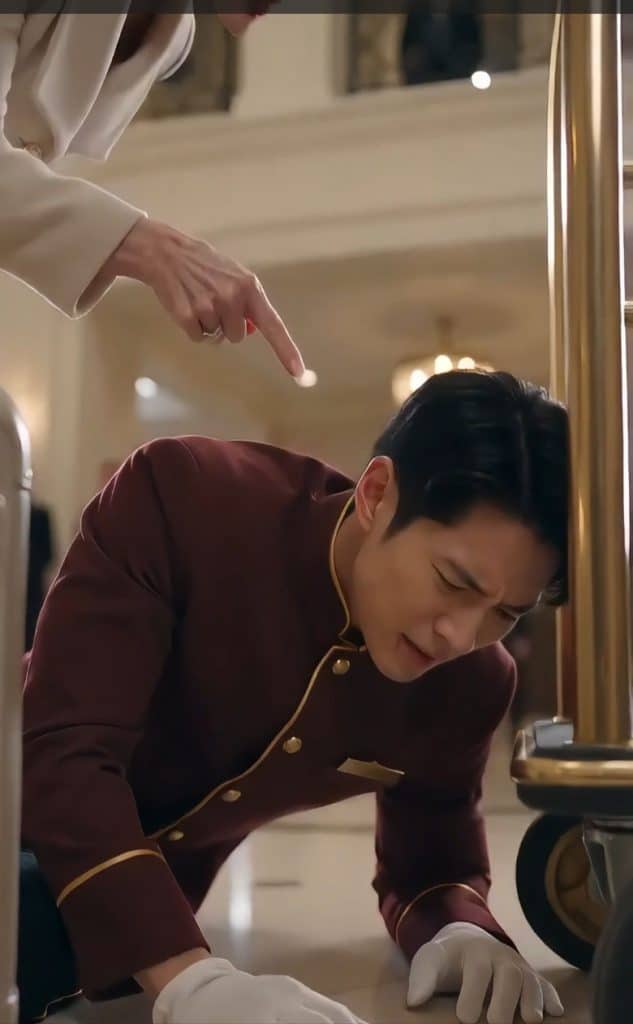
It struck the cream marble with a sharp little sound, slid beneath the wheel of a brass luggage cart, and came to rest face-up under the chandelier light.
Liang.
A second later, the young bellboy hit the cart shoulder-first.
The brass frame rattled loudly through the five-star lobby. A leather suitcase shifted on the lower rack. Mr. Liang caught himself with one white-gloved hand against the marble, his burgundy uniform wrinkled at the sleeve, a tiny red mark appearing near the corner of his mouth.
For one frozen moment, the lobby forgot how to breathe.
Concierges stopped behind the black desk. Security guards turned from the velvet ropes. Wealthy guests paused near the private Presidential Suite elevator, their polished shoes reflected in the floor beneath them.
The woman who had slapped him stood above him in a cream designer coat.
Sharp blonde bob. Heavy diamond earrings. Red lipstick. Louis Vuitton suitcase by her side.
Her face held no regret.
Only disgust.
“Carry bags,” she snapped, leaning over him with her chin lifted. “Don’t pretend you belong near people who own this place.”
The insult moved through the lobby like shattered glass.
Mr. Liang stayed low, breathing through the pain. His calm dark eyes moved briefly to the fallen badge, then to the luggage cart, then to the woman standing over him as if humiliation were part of the service.
Her name was Meredith Calder.
She had arrived that morning in a private car, demanded the Presidential Suite despite a booking conflict, and reminded three separate employees that she spent more in hotels each year than they would ever earn.
Now she pointed toward the service corridor.
“Get up,” she said. “Use the staff elevator where you belong.”
No one moved fast enough.
That was what everyone would remember later.
Not only the slap.
The pause after it.
Then the private elevator doors opened.
A tall Black man in a charcoal suit stepped out with two security staff behind him, gold hotel pin bright on his lapel, earpiece still pressed to one ear. His face changed the second he saw the young bellboy on the floor.
The General Manager crossed the lobby without looking at Meredith.
He went straight to Mr. Liang.
Then he opened a black leather folder embossed with the Liang Hotel Group crest.
“Mr. Liang,” he said, voice formal and loud enough for the lobby to hear, “your family’s Presidential Suite is ready for inspection.”
The room gasped.
Behind him, the private elevator stood open.
Meredith’s hand tightened around the handle of her suitcase.
Her mouth barely moved.
“Liang?”
Act II
Adrian Liang had grown up in hotels, but not in the suites.
His grandmother, Mei Liang, had arrived in New York with two suitcases, one winter coat, and enough English to understand when people were being cruel even if she could not answer properly. Her first job was folding towels in a basement laundry room of a hotel that no longer existed.
She worked twelve-hour shifts under lights that buzzed. She learned room numbers before street names. She learned which guests thanked housekeepers and which ones left insults with their tips. She learned that luxury had two faces: the one shown to guests, and the one hidden behind swinging service doors.
Years later, Mei bought a failing roadside inn with her husband.
Then another.
Then a small city hotel.
She built the Liang Hotel Group slowly, one property at a time, with a rule her children thought old-fashioned until they became old enough to understand it.
No room is luxury if someone is humiliated to prepare it.
Adrian heard that sentence his entire childhood.
His father had it framed in the executive office. His mother repeated it at staff dinners. His grandmother said it more plainly when Adrian complained about folding napkins during school breaks.
“Gold walls do not make a hotel,” she told him. “People do.”
But as the Liang Hotel Group grew, the family name became more polished than personal. New investors came in. New executives spoke in polished phrases. The flagship New York hotel became a symbol of private elevators, Presidential Suites, chandeliered lobbies, and VIP guests who expected the world to bend before they asked.
Adrian had been sent to inspect the hotel after five complaints reached the family office in one month.
A bellman shoved by a guest near the private elevator.
A concierge called “replaceable” after refusing an illegal request.
A housekeeper disciplined for reporting that a VIP had thrown a towel cart into the hallway.
A security guard warned not to upset a repeat guest because her account was “strategically valuable.”
And one anonymous note written in careful block letters:
Your grandmother built this company. I do not think she would recognize the lobby anymore.
Adrian read the note three times.
Then he asked for a bellboy uniform.
The board advised against it. His father called it theatrical. The hotel’s regional director said staff behavior changed when ownership visited undercover, so any data gathered would be unreliable.
Adrian disagreed.
He did not want to see how staff treated owners.
He wanted to see how guests treated staff when they believed no owner was watching.
So he arrived before sunrise through the employee entrance.
He polished brass carts. Carried luggage. Watched the concierge desk. Listened near the service corridor. Learned which employees still cared and which had been trained into silence.
By noon, he had seen enough to worry him.
By evening, Meredith Calder gave him the proof.
And she did it in front of the chandeliered lobby.
Act III
Meredith Calder believed hotels existed to confirm her importance.
She liked being greeted by name. She liked upgrades before she requested them. She liked flowers changed because she disliked the shade of white. She liked staff remembering that she preferred still water at room temperature and that her suitcase was never to be touched by “new people.”
She called it standards.
Everyone else called it surviving her stay.
The hotel had rewarded her for years.
When she shouted, she received credits.
When she insulted staff, she received apologies.
When she demanded rooms already assigned to other guests, managers found solutions by disappointing someone less powerful.
That evening, Meredith arrived expecting the Presidential Suite.
The problem was that the suite had been blocked for ownership inspection.
No one told her that part.
The front desk only said the suite was temporarily unavailable.
Meredith heard insult.
She swept across the lobby toward the private elevator with her suitcase rolling behind her like a threat. Adrian, in the burgundy bellboy uniform, had been standing beside the luggage cart reviewing service timing with a junior bellman.
He stepped forward politely.
“Ma’am, that elevator is restricted at the moment.”
Meredith looked him over.
Not at his face.
At the uniform.
“Move.”
“I’m sorry, ma’am. The Presidential elevator is temporarily closed.”
“I said move.”
“I can call the front desk manager for you.”
Her smile turned cold.
“I don’t negotiate with bellboys.”
Adrian remained calm.
“My job is to keep this area clear until the suite is released.”
“Your job is to carry bags.”
The junior bellman beside him went stiff.
Adrian noticed.
Meredith did too.
That small fear seemed to feed her.
She stepped closer, her diamonds catching the chandelier light.
“Do you know what I paid for this stay?”
“I do not.”
“More than your entire staff floor makes in a month.”
Adrian could have ended it there.
He could have turned the name badge toward her. Could have mentioned the Liang family. Could have summoned the manager and let the room rearrange itself before anyone was exposed.
Instead, he held the line as a bellboy would have been expected to.
“Ma’am, you cannot access the elevator.”
Her hand moved before anyone expected it.
The slap cracked across the lobby.
The luggage cart rattled.
The name badge fell.
And the family name she had ignored landed on the floor at her feet.
Act IV
The General Manager’s name was Malcolm Brooks.
He had worked in hotels since he was nineteen, beginning as a night porter in Chicago and rising through discipline, grace, and the kind of patience guests often mistook for permission. He had met Adrian Liang twice before, both times in boardrooms.
Never like this.
Never on one knee beside him in the lobby.
“Mr. Liang,” Malcolm said again, voice controlled but tight, “are you all right?”
Adrian stood slowly.
His white glove was scuffed where it had scraped the marble. His badge remained beside the cart wheel, silver letters shining under the chandelier light.
He looked at it before answering.
“I’m fine.”
Malcolm did not believe him.
Neither did anyone else.
Meredith tried to laugh.
It came out brittle.
“There has clearly been a misunderstanding.”
Adrian turned toward her.
The lobby watched.
“You misunderstood my position,” he said.
She nodded too quickly.
“Yes. Exactly. I had no idea you were—”
“A person worth not striking?”
Her mouth closed.
The sentence reached every corner of the lobby.
A concierge behind the desk lowered his eyes. A security guard’s jaw tightened. A guest near the floral arrangement stepped back from Meredith as if cruelty had become contagious.
Meredith swallowed.
“I thought you were staff.”
Adrian bent and picked up the badge.
Then he pinned it back onto his uniform.
“I was staff.”
The words were quiet.
That made them worse.
Malcolm turned toward security.
“Preserve all lobby footage. Elevator corridor, concierge desk, and audio from the front entrance if available.”
Meredith’s face changed.
“Footage? That’s unnecessary.”
“No,” Malcolm said. “It is overdue.”
One of the junior bellmen, the same one who had frozen beside Adrian moments earlier, spoke from near the luggage cart.
“She’s done this before.”
Meredith turned on him.
“Excuse me?”
The bellman flinched, but he did not stop.
“She throws luggage tags at people. She calls housekeeping ‘basement staff.’ Last year she made Thomas apologize in the driveway because her car wasn’t close enough to the awning.”
Malcolm looked at him.
“Why was this not escalated?”
The bellman looked toward the desk.
“It was. We were told she was a priority account.”
That answer did more damage than the slap.
Adrian turned toward Malcolm.
The General Manager’s face showed pain, not surprise.
That mattered.
It meant the problem had not been invisible.
Only tolerated.
Meredith gripped the handle of her Louis Vuitton suitcase.
“This is absurd. I am a VIP guest.”
Adrian looked at the private elevator doors still open behind Malcolm.
“No. You are a guest whose stay is ending.”
Her eyes widened.
“You cannot remove me from this hotel.”
Malcolm’s voice became formal.
“Ms. Calder, under hotel policy and at ownership direction, your reservation is canceled. Security will escort you to collect your belongings. You are not permitted to approach staff.”
The lobby seemed to inhale all at once.
Meredith looked from Malcolm to Adrian, then to the surrounding guests who now watched her with the judgment they had withheld when it could have helped.
Her voice dropped to a broken whisper.
“Liang?”
This time, Adrian did not answer.
The name badge already had.
Act V
Meredith Calder left the hotel through the front doors she had entered like a queen.
No announcement was made.
No spectacle was staged.
Security escorted her with professional distance while her suitcase rolled behind her over the same marble floor where Adrian had fallen. She kept her chin high until the revolving doors took her outside.
Then, through the glass, everyone saw her face collapse.
Adrian did not watch long.
Public panic was not justice.
It was only the moment arrogance discovered consequences.
He turned instead to the staff.
The bellmen. Concierges. doormen. housekeepers who had come quietly from the service corridor. Security guards who had been trained to protect velvet ropes more confidently than human dignity.
His grandmother’s sentence echoed in his mind.
No room is luxury if someone is humiliated to prepare it.
The Presidential Suite inspection was postponed.
Adrian asked to see the staff break room instead.
Malcolm hesitated, then led him downstairs.
That told Adrian enough before the door even opened.
The break room was clean but cramped, with flickering lights, mismatched chairs, and lockers dented from years of use. A coffee machine hummed on a counter beside a stack of complaint forms no one seemed to trust.
Adrian stood there in the burgundy uniform with the silver badge still scratched from the fall.
“This is where the people who create the five-star experience rest?” he asked.
Malcolm’s jaw tightened.
“Yes.”
Adrian nodded.
“Then we are not a five-star hotel.”
The words did not sound angry.
They sounded factual.
That made them harder to escape.
By morning, the Liang flagship began changing.
Not cosmetically.
Structurally.
VIP status no longer protected guest abuse. Staff could stop service and call security when threatened or degraded. Repeat guests with conduct violations were reviewed by a central ethics team, not local managers pressured by revenue. Any employee punished for reporting abuse could appeal directly to the Liang family office.
Meredith’s account was permanently banned after the footage confirmed the assault and a review uncovered years of softened complaints.
But Adrian refused to let the hotel pretend the problem had begun with her.
“She was not the storm,” he told the executive team. “She was the leak that showed where the roof was already weak.”
The break room was rebuilt first.
Before the Presidential Suite was touched.
That decision angered investors.
Adrian ignored them.
The new staff floor had windows, proper seating, private lockers, quiet rooms, fresh meals, and a wall where employees could write guest compliments, safety concerns, and policy failures without asking permission.
Near the entrance, Adrian placed the brass luggage cart from the night of the slap.
Its wheel still bore a small scratch where his badge had fallen beside it.
A framed note hung above it.
Carry bags, yes. Carry disrespect, never.
Some executives thought it was too blunt.
Adrian thought blunt was overdue.
Months later, the Presidential Suite reopened after renovation.
It was beautiful, of course.
Cream silk walls. Central Park views. Private dining room. Marble bath. Hand-built furniture. A grand piano no one needed but everyone photographed.
But the most important change was not inside the suite.
It was outside the elevator.
A new plaque had been installed beside the velvet rope, small enough to be elegant, clear enough to be unavoidable.
Liang Hotel Group welcomes guests. It does not worship them.
The first week, a tech billionaire laughed when he read it.
Then he saw Malcolm looking at him.
He stopped laughing.
Adrian eventually returned to the hotel as himself, in a dark suit, no bellboy uniform, no disguise. Staff straightened when he entered, but he wished they would not. Respect built on fear was only luxury wearing a different mask.
The junior bellman from that night, whose name was Aaron, met him near the luggage carts.
“Mr. Liang,” he said.
Adrian smiled.
“Adrian is fine.”
Aaron glanced at the scratched cart displayed near the staff entrance.
“I still think about that night.”
“So do I.”
“I should have moved faster.”
Adrian looked at him.
“You moved when you could.”
Aaron shook his head.
“No. I moved when I knew you mattered.”
The honesty settled between them.
Adrian respected him more for saying it.
“That is why we changed the rules,” he said. “So next time, you do not need to decide alone.”
Years later, people still told the story in the lobby.
The rich guest slapped a bellboy.
The badge fell.
The General Manager opened the leather folder.
The bellboy was Liang.
Liang?
It was satisfying because arrogance panicked beneath golden chandeliers.
But Adrian never liked that version best.
It made the family name too important.
The slap had been wrong before anyone saw the badge.
The insult had been ugly before Malcolm spoke.
The young man on the marble floor had deserved protection before the room learned he belonged to the family that owned the walls.
That was why Adrian kept the burgundy bellboy uniform.
Not framed in a museum case.
Not hidden in shame.
Folded carefully in his office beside a photograph of his grandmother in her laundry uniform, standing outside the first inn she ever owned.
Whenever new managers joined Liang Hotel Group, Adrian showed them both uniforms.
Then he told them the story without mentioning Meredith’s name.
Because she was not the lesson.
The lesson was the pause after the slap.
The silence before authority arrived.
The way a lobby full of polished people waited for a title before finding courage.
Adrian would place the scratched silver badge on the table and let them read it.
Liang.
Then he would say, “A name can open doors. It should never be required to protect dignity.”
Outside his office, hotels continued to shine.
Chandeliers glowed. Marble floors reflected flowers. Private elevators carried guests to suites with views they would remember for years.
But in the best Liang hotels, the true luxury was quieter.
A doorman not afraid to intervene.
A housekeeper greeted by name.
A bellboy standing near the Presidential elevator, knowing the uniform he wore did not place him beneath anyone.
And a luggage cart polished every morning, not because it carried expensive bags, but because it reminded the company what had almost been lost.
Not a guest.
Not a reservation.
A principle.
People do not become worthy when you discover who owns the building.
They were worthy the moment they walked in.