Act I
The slap cracked across the ballroom before the champagne stopped moving.
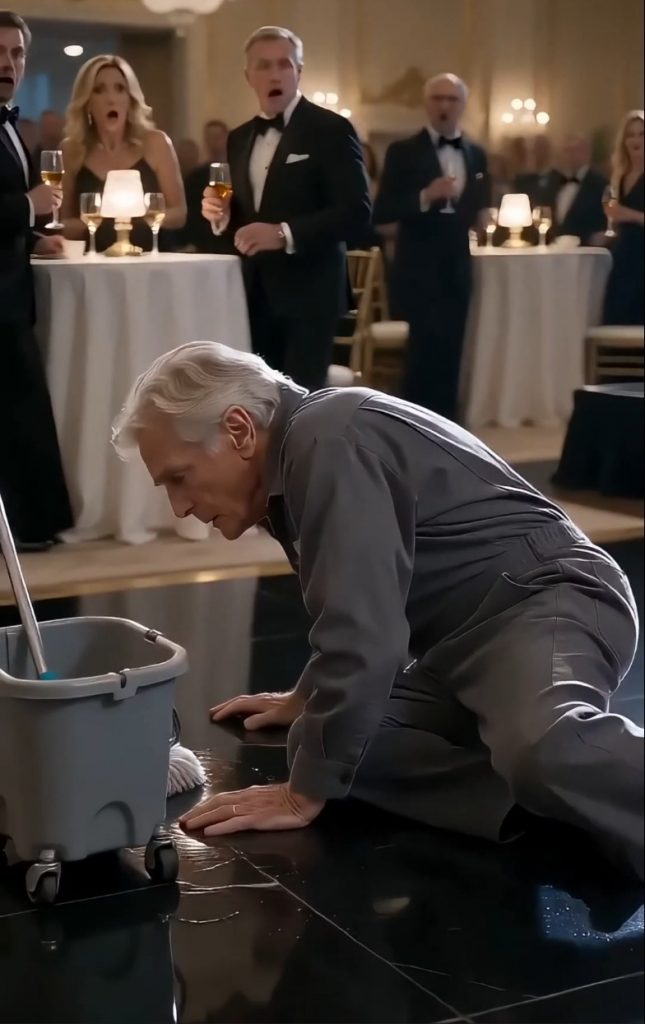
Mr. Whitmore staggered backward in his gray janitor uniform, one hand reaching for the mop he had been using near the diamond display. His palm skimmed the polished black marble, his shoulder twisted, and he fell in front of a circle of guests dressed in tuxedos and glittering gowns.
The mop slid away from him.
The small rolling bucket tipped hard onto its side, sending a thin sheet of water across the marble beneath the chandeliers.
For a moment, no one moved.
Then the woman in the silver evening gown stepped closer.
Her diamond earrings flashed under the spotlights. Her blonde bob sat sharp beneath the glittering light. One hand held a champagne flute, still steady, as if striking an elderly man had not disturbed her balance at all.
“You’re here to clean floors,” she said, voice cutting through the stunned ballroom, “not breathe near people like us.”
A few guests gasped.
Others looked down.
That was worse.
Mr. Whitmore stayed low, one hand braced on the marble beside the spilled water. His lined face held pain, but not panic. A faint mark showed near his mouth, and his tired blue eyes moved slowly across the room, taking in every witness.
The woman’s name was Evelyn Carrington.
She had donated two million dollars that evening and believed it gave her ownership of the air.
“Someone remove him,” she snapped. “This is a diamond charity gala, not a bus station.”
A nervous laugh came from somewhere behind her.
Then it died.
At the far end of the ballroom, the Gala MC stopped mid-sentence onstage. He looked down at the gold event card in his hand, then back at the old man on the floor.
His face changed.
The microphone shook slightly in his grip.
Evelyn turned toward him with irritation.
“What now?”
The MC stepped off the stage and hurried across the marble, his tuxedo jacket pulling at the shoulders.
He did not go to Evelyn.
He went to the janitor.
Then the spotlight shifted.
The foundation logo glowed behind the stage in white and gold.
The MC raised the microphone with a trembling hand.
“Ladies and gentlemen,” he said, voice carrying across the room, “please welcome the founder of this foundation, Mr. Whitmore.”
The ballroom fell into a silence so complete that the bucket could still be heard rocking softly on its side.
Evelyn’s lips parted.
“Founder?” she whispered.
Act II
Walter Whitmore had once cleaned floors in that same hotel.
Not that same ballroom, exactly. The ballroom had been renovated twice since then. New chandeliers. New marble. New gold trim polished so brightly that wealth seemed to shine from the walls.
But the back corridors were the same.
Walter remembered them.
He remembered pushing laundry carts past midnight while medical students held charity luncheons upstairs. He remembered mopping spilled wine after galas where guests spent more on floral arrangements than his mother earned in a month. He remembered standing near kitchen doors, invisible in a uniform, listening to wealthy people speak about generosity as if kindness were something that happened only when cameras arrived.
Back then, Walter was twenty-three and raising his little sister, Grace.
Grace had a heart condition no one found in time because the clinic kept sending them home with bills and apologies. When she died, Walter did not scream. He went quiet in a way that frightened everyone who loved him.
Then he worked.
He studied at night. He took accounting classes. He built a janitorial supply company from a borrowed truck and a storage unit behind a laundromat. The company grew. Then grew again. By fifty, Walter Whitmore had more money than the men who once walked past him without seeing his face.
He did not buy a yacht.
He built a foundation.
The Grace Whitmore Foundation paid for pediatric medical care, emergency housing, and transportation for families who could not afford to reach hospitals that claimed to serve them. It began with three children and a rented office. Thirty years later, it had funded surgeries, clinics, mobile health units, and scholarships across the country.
Walter hated gala season.
He understood fundraising, but he disliked the performance of compassion. He disliked the way some donors smiled at sick children on posters and frowned at service workers carrying trays. He disliked how wealth often wanted gratitude without contact.
Still, the diamond gala mattered.
The foundation was launching its largest medical-access fund yet. A rare diamond collection had been loaned for auction. The hotel ballroom was full of executives, socialites, board members, and donors who wanted to be photographed beside generosity.
Walter was scheduled to be honored publicly that night.
He had asked the MC not to make a fuss.
The MC had laughed nervously.
“Sir, it’s your foundation.”
Walter had looked at the event schedule and said, “No. It’s Grace’s.”
But before the program began, Walter saw water near the diamond display.
A server had spilled from an ice bucket and rushed away to replace a tray. Guests were crossing the slick marble in heels. A child from one of the foundation families stood nearby, staring at the sapphires and diamonds beneath the glass.
Walter found a mop.
He put on the janitor jacket hanging near the service entrance because it was the quickest way to avoid questions. The name patch said Whitmore, but no one looked long enough to read it.
He was halfway through cleaning the spill when Evelyn Carrington saw him near her table.
And decided he was too close to her diamonds.
Act III
Evelyn Carrington had built her life on being seen giving.
Her name appeared on hospital wings, museum plaques, university chairs, and glossy charity magazines where she sat in perfect lighting beside children whose names she never remembered. She was not unintelligent. She knew exactly how power worked.
Public generosity could purchase private access.
That was why she wanted a seat on the Grace Whitmore Foundation board.
Not because she cared about clinics in rural towns or families sleeping in hospital parking lots. She wanted the foundation’s reputation. Its trust. Its purity. The kind of moral shine money alone could not buy.
Her husband’s medical investment firm was under investigation for overcharging nonprofit hospitals. Evelyn needed distance from that scandal. She needed a new story.
The diamond gala was supposed to give it to her.
Two million dollars.
A silver gown.
A photograph beside the founder.
A headline by morning.
Philanthropist Evelyn Carrington Joins Whitmore Foundation Leadership.
But Walter had resisted her appointment for months.
Quietly.
Politely.
Firmly.
He had read the reports. He knew the hospitals her husband’s company had squeezed. He knew the families billed into ruin. He knew Evelyn wanted a foundation seat the way some people wanted a jewel: to wear it, not to serve it.
So he came early that evening to watch.
Not the donors onstage.
The room before the speeches.
He watched how guests treated servers. How board members spoke to reception staff. How security redirected a mother in a simple dress until she explained her son was one of the children featured in the foundation video.
And then Evelyn slapped him.
The MC, Daniel Price, reached Walter and crouched beside him, forgetting the microphone was still live.
“Mr. Whitmore,” he whispered, horrified. “Are you all right?”
The entire ballroom heard him.
Mr. Whitmore.
Not sir.
Not janitor.
Not staff.
Mr. Whitmore.
Walter slowly accepted Daniel’s hand and rose. The mop lay behind him. The bucket remained on its side, water spreading under the chandelier light like a dark mirror.
Evelyn stood frozen.
Her champagne flute trembled now.
Daniel turned toward the crowd, pale but steady.
“This evening’s honoree,” he said, voice stronger, “is Walter Whitmore, founder of the Grace Whitmore Foundation.”
A murmur rolled through the ballroom.
Some guests looked at Evelyn.
Others looked away from her.
Walter stood in the spilled water, gray uniform damp at the cuff, silver hair slightly mussed, face composed despite the humiliation.
He looked less like a man exposed.
More like a man who had exposed everyone else.
Act IV
Evelyn recovered badly.
Powerful people often do.
“I had no idea,” she said quickly. “Mr. Whitmore, I thought you were—”
Walter waited.
The room waited with him.
Evelyn’s mouth remained open because there was no way to finish the sentence without confessing the truth.
A janitor.
Poor.
Unimportant.
Someone safe to strike.
Walter looked at the mop, then at the guests.
“You thought I was here to clean floors,” he said.
Evelyn gave a nervous laugh.
“Well, you were holding a mop.”
“Yes.”
His voice stayed calm.
“So I must have deserved less dignity?”
No one breathed.
Daniel lowered the microphone, but Walter gently took it from him.
He did not raise his voice.
That made everyone listen harder.
“My first job was in this hotel,” Walter said. “I cleaned after galas very much like this one. I knew which donors tipped and which ones stepped around us like we were part of the furniture.”
Faces shifted across the room.
Walter continued.
“I built this foundation because my sister died poor in a city full of expensive buildings. I promised her that if I ever had money, I would spend it making sure other families were seen before it was too late.”
Evelyn’s face drained with every word.
The diamond cases glittered behind him, useless and brilliant.
“Tonight was supposed to raise money for children who cannot afford the care they need,” Walter said. “But before we discuss giving, perhaps this room should ask who it ignores when no one important is watching.”
A man near the banquet tables lowered his head.
A woman in emerald silk began to cry quietly.
Walter turned toward Evelyn.
“You did not strike me because I was in your way. You struck me because you believed my uniform placed me beneath consequence.”
Evelyn’s voice cracked.
“I’m sorry.”
Walter looked at her for a long moment.
“Are you sorry you hurt a man,” he asked, “or sorry the man had a name you recognized?”
The question did not need an answer.
It already had one.
Daniel stepped closer.
“Mr. Whitmore, should I call security?”
Walter handed the microphone back.
“Yes,” he said. “But not only for me.”
Evelyn stiffened.
Walter turned to the foundation’s executive director near the stage.
“Remove Mrs. Carrington from tonight’s board nomination. Preserve the security footage. And tomorrow morning, I want a full review of every donor partnership tied to predatory medical billing.”
The room erupted in whispers.
Evelyn gripped her champagne flute so tightly it might have cracked.
“You can’t do this,” she said.
Walter picked up his cane from where someone had placed it nearby.
Then he looked at the diamond display.
“I spent thirty years learning the difference between price and value,” he said. “So yes, Mrs. Carrington. I can.”
Act V
Evelyn Carrington was escorted from the ballroom before the first auction lot opened.
No one followed her.
That was perhaps the cruelest reversal for a woman who had spent her life believing attention was loyalty. Guests watched her pass in her silver gown, diamonds flashing at her ears, panic hidden poorly beneath a lifted chin.
By the time she reached the doors, the story had already left her control.
Not because Walter wanted scandal.
He did not.
He refused to let the footage leak. He refused interviews. He refused every headline that tried to make him the poor janitor who was secretly rich.
“That is the wrong story,” he told Daniel the next morning.
“What is the right one?” Daniel asked.
Walter looked at the uniform jacket folded across his office chair.
“The janitor should not have needed to be secretly anyone.”
The foundation changed after that night.
Not with a dramatic statement written by public relations.
With rules.
Donor vetting became stricter. Board seats could no longer be purchased through headline gifts. Every gala contract required protections for service staff, vendors, and foundation families. The executive team created a dignity policy that applied to donors first, not last.
Several wealthy supporters withdrew.
Walter let them.
“The children can survive without cruel money,” he said. “They cannot survive if cruel money runs the room.”
The diamond auction still happened.
In fact, it raised more than expected.
But the most valuable item that night was not a necklace, bracelet, or flawless stone displayed beneath spotlights. It was the gray mop and small rolling bucket left near the side of the stage after Walter finished speaking.
No one moved them at first.
Then Walter asked that they remain.
The bucket, still dented from its fall, sat beside the podium while donors raised paddles for medical grants. It looked absurd against the chandeliers and diamonds.
That was why it mattered.
It told the truth.
Months later, the foundation opened the Whitmore Grace Access Clinic on the ground floor of the same hotel, in a space once reserved for luxury retail. There were no chandeliers inside. No diamond cases. No champagne trays.
There were exam rooms, translators, social workers, warm blankets, and a play corner with wooden blocks donated by a carpenter whose daughter had received heart surgery through the foundation.
At the clinic entrance, Walter placed a framed photograph.
Not of himself.
Not of a gala.
Of his sister Grace at nine years old, smiling with missing front teeth and windblown hair.
Below it were the words he had said to the board after Evelyn’s removal.
Dignity is not a donor benefit.
On opening day, Walter arrived in a dark suit.
Then, halfway through the morning, he disappeared.
Daniel found him in the hallway wearing the old gray janitor jacket, mopping a small spill near the clinic entrance.
“Mr. Whitmore,” Daniel said gently, “we have staff for that.”
Walter did not look up.
“I know.”
“Then why are you doing it?”
Walter wrung the mop carefully into the bucket.
“Because somebody could slip.”
Daniel smiled despite himself.
The bucket rolled softly behind Walter as he finished cleaning the floor. It was the same one from the gala, dent and all. He had kept it, though several people had offered to replace it with something newer.
Walter refused.
Some objects, he believed, were not reminders of shame.
They were reminders of clarity.
A year later, the foundation held another gala.
Smaller.
Less glitter.
More families.
Service workers were invited as guests after their shifts, and donors were seated beside clinic staff, nurses, drivers, translators, and parents who could speak directly about what the foundation did when no cameras were near.
At the end of the evening, Daniel introduced Walter again.
This time, no one gasped.
No one looked confused by his plain suit or the cane beside his chair.
Walter walked to the podium slowly. His blue eyes moved over the room, pausing on the staff near the back until they stopped standing like they were ready to disappear.
“I have been asked many times about the night someone mistook me for a janitor,” he said.
A quiet tension settled.
Walter smiled faintly.
“But that was not the mistake. I was a janitor once. An honorable job. Necessary work.”
He looked toward the stage lights.
“The mistake was believing any job could make a human being safe to humiliate.”
No applause came immediately.
The sentence needed room.
Then the clapping began, soft at first, then rising until it reached the chandeliers.
Walter did not bask in it.
He had learned long ago that applause was easy.
Respect was harder.
After the gala, as guests left through gold-trimmed doors, a young cleaning attendant moved cautiously toward a spilled drink near the diamond display. A donor stepped back to give her room.
Then another donor bent down and moved a chair out of her way.
The attendant looked surprised.
Walter saw it from across the room.
That small correction, almost invisible, pleased him more than any standing ovation.
Because the world rarely changed in the dramatic moment everyone remembered.
It changed afterward.
In the next spill.
The next doorway.
The next person in uniform standing near someone who believed wealth made them taller.
Walter picked up his cane and walked slowly toward the exit.
Behind him, the ballroom shone with diamonds, chandeliers, and polished black marble.
But on that floor, somewhere no one could see, remained the memory of a mop skidding away, a bucket rolling onto its side, and an old man rising with more dignity than the woman who had struck him.
People would tell the story as a reversal.
The janitor was the founder.
The donor panicked.
The room gasped.
But Walter knew the deeper truth.
He had been worthy of respect before the announcement.
Before the spotlight.
Before anyone learned his name.