Act I
The punch landed in the center of the showroom, where everything was designed to reflect.
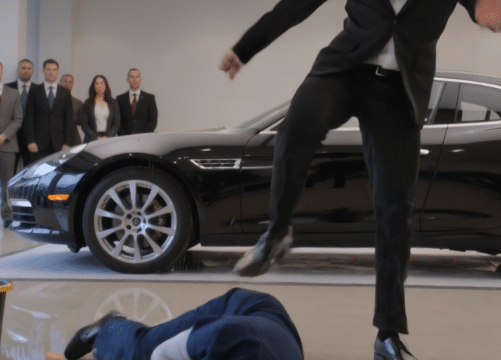
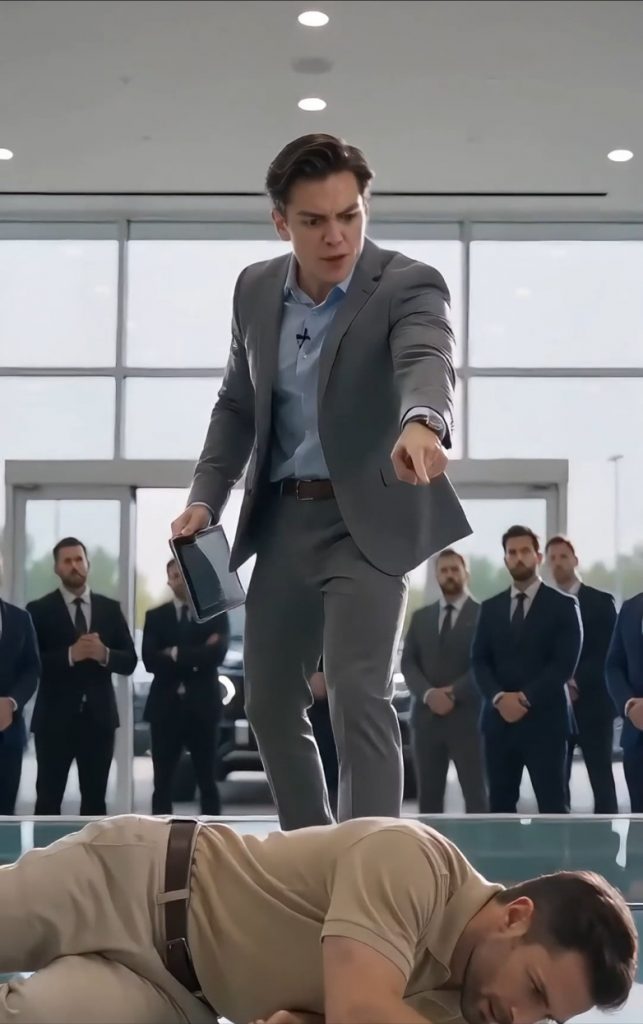
The mechanic stumbled backward across the raised glass platform, his shoes skidding over the transparent panels. Beneath him, steel supports showed through the floor like the bones of the dealership. Above him, white lights flashed against polished cars and the stunned faces of men in suits.
Then he fell.
His back struck the glass with a hard, hollow thud.
The sound traveled through the showroom and silenced every conversation.
A semicircle of executives, salesmen, investors, and well-dressed clients stood frozen around the platform. Through the floor-to-ceiling glass doors, black luxury SUVs idled in the parking lot like silent witnesses. Inside, no one moved.
The manager did.
He stepped forward in a grey suit, light blue shirt, and brown dress shoes, still breathing hard from the punch he had thrown.
“Stay away from my cars, trash!” he shouted.
The man on the glass floor pressed one hand against the platform and took a slow breath.
He wore a tan polo shirt and beige trousers. Not overalls. Not a uniform with a shiny badge. Just the plain clothing of someone who looked like he belonged in a service bay, not on a display floor built for million-dollar machines.
The manager pointed across the showroom.
“People like you ruin this dealership.”
The mechanic said nothing.
His silence made the insult louder.
A few bystanders exchanged uneasy looks. One man near the white coupe lowered his eyes. Another clenched his jaw but did not intervene. The whole room seemed to understand the manager had crossed a line, but no one wanted to be the first person to say so.
Then heels clicked across the glass.
A woman in a sharp black business suit walked directly toward the fallen mechanic, her hair pulled back, her expression composed. In her hand was a small blue cloth.
The manager turned, irritated.
“What are you doing?”
She ignored him.
The mechanic slowly stood, steadying himself. Dust marked one shoulder where he had hit the floor. The woman stopped beside him and gently wiped the mark away with the blue cloth.
The showroom held its breath.
Then she bowed.
“Owner,” she said clearly, “forgive our late arrival.”
The manager’s mouth opened.
The tablet in his hand creaked under his grip.
“Owner?” he stammered. “How?”
The mechanic looked at him at last.
And the glass beneath their feet reflected both men perfectly.
One standing in quiet authority.
The other collapsing in fear.
Act II
No one in the showroom knew that Caleb Hart had built Hartwell Motors before he owned shoes that matched.
His first dealership was not a dealership at all. It was a narrow repair garage behind an abandoned tire shop, with one working lift, a broken coffee machine, and a hand-painted sign that his daughter made on a piece of plywood.
Hartwell Auto Repair.
The letters were crooked.
Caleb kept the sign anyway.
He had been raised by mechanics, cleaners, drivers, and women who could stretch one paycheck across three impossible weeks. His father drove city buses and fixed engines at night. His mother cleaned office buildings where executives sometimes left half-eaten meals in trash cans and never learned her name.
Caleb learned early that work did not make people small.
Other people did that.
He bought wrecked cars, repaired them, sold them honestly, and remembered every customer who came back because nobody else had treated them fairly. He hired men and women who had been dismissed from polished places for being too old, too young, too rough, too honest, too inconvenient.
Slowly, the garage became a lot.
The lot became a showroom.
The showroom became a regional chain.
By the time Hartwell Motors opened its flagship luxury dealership, business magazines called Caleb a disruptor. Investors called him disciplined. Competitors called him impossible to imitate.
But Caleb still walked service floors before he walked boardrooms.
He believed the health of a company could be measured by how managers treated people who could not promote them.
That was why he came to the flagship dealership dressed like a mechanic.
Not as a stunt.
As an audit.
For six months, troubling reports had reached his office. Sales numbers were high, but staff turnover was worse. Technicians were leaving without exit interviews. Porters were being blamed for scratches they had reported before delivery. Junior employees described the showroom manager as “brilliant with clients” and “terrifying with everyone else.”
His name was Nolan Pierce.
Thirty-four years old. Handsome. Aggressive. Record-breaking.
He had doubled luxury sales in one year.
That made the board cautious.
Caleb was less impressed.
Numbers were easy to worship from a distance. Up close, they often had bruised people standing behind them.
So Caleb arrived unannounced through the service entrance that morning with a temporary badge, plain clothes, and no entourage. His assistant, Mara Chen, was scheduled to arrive fifteen minutes later with the final ownership documents for a surprise leadership review.
Fifteen minutes.
That was all the delay.
Enough time for Nolan Pierce to reveal exactly what kind of empire he thought he was building.
Act III
It began with fingerprints.
Caleb was standing near the raised glass platform, examining the display car positioned under the lights. A black Venom GT edition, rare enough that clients had flown in just to see it. He noticed dust along the lower panel and a loose protective strip near the rear wheel.
Small issue.
Easy fix.
He crouched to inspect it.
Nolan saw him from across the showroom.
“What do you think you’re doing?”
Caleb looked up.
“Checking the panel.”
“On whose authority?”
Caleb glanced at the car again.
“Common sense.”
The nearest salesmen went still.
Nolan walked onto the glass platform, tablet in hand, smile tight enough to cut.
“Service staff do not touch display inventory.”
“This strip is loose.”
“Did I ask?”
Caleb stood.
“No.”
“Then step away.”
Caleb watched him carefully.
The tone. The posture. The way every employee behind Nolan seemed to stop breathing at once.
There it was.
Fear in a room pretending to be luxury.
“I was told this car was prepped,” Caleb said.
“It was.”
“Not properly.”
A few bystanders murmured.
Nolan’s face shifted.
To most people, it would have looked like irritation. Caleb recognized it as panic wearing pride. A manager who built his identity on control could not tolerate correction from someone he considered beneath him.
“Listen,” Nolan said, lowering his voice, “I don’t know which bay dragged you in, but this floor is for clients. You understand?”
“I understand the car needs attention.”
Nolan stepped closer.
“This floor is for people who belong here.”
Caleb’s eyes moved to the glass beneath them.
“Interesting choice of words.”
That was the moment Nolan chose violence.
Not because Caleb threatened him.
Because Caleb did not shrink.
The punch came fast, hard enough to knock Caleb backward onto the raised platform in front of every suited observer Nolan had been trying to impress.
And for one long second afterward, Nolan seemed satisfied.
Until Mara Chen entered.
She had seen the fall through the glass doors.
She came in with the blue cloth already in her hand.
Not because the dust mattered.
Because dignity did.
Act IV
“Owner?” Nolan repeated, voice thinner now. “That’s impossible.”
Mara folded the blue cloth once and held it at her side.
“Mr. Hart is the founder and sole owner of Hartwell Motors.”
The room absorbed the words slowly.
Founder.
Sole owner.
Mr. Hart.
One of the investors near the platform stepped back as if distance could erase his silence. A senior salesman stared at the floor. The young receptionist behind the desk began blinking too quickly.
Nolan’s hand tightened around the tablet.
“I didn’t know who he was.”
Caleb touched his shoulder where Mara had wiped away the dust.
“No,” he said. “You didn’t.”
Nolan swallowed.
“If I had known—”
“That is not the defense you think it is.”
The showroom went still again.
This time, no one looked away.
Caleb turned toward the semicircle of men in suits.
“How many of you saw him strike me?”
No one answered at first.
Mara looked at them one by one.
A man in a navy tie cleared his throat.
“I did.”
Another said, “We all did.”
Caleb nodded.
“And how many of you moved?”
Silence.
That was the heavier answer.
Nolan tried to recover.
“Mr. Hart, please. I thought he was damaging inventory. I acted to protect the dealership.”
Caleb looked down through the glass floor at the metal supports beneath it.
“This platform was designed to show what holds the car up,” he said. “Funny thing about transparent floors. They don’t hide structure.”
He looked back at Nolan.
“They don’t hide rot either.”
Nolan’s face flushed.
Mara opened the leather folder she had brought and removed several reports.
“Mr. Hart,” she said, “we also have the employee statements you requested.”
Nolan went pale.
Caleb did not reach for the folder.
“Read the first one.”
Mara’s voice stayed professional.
“Technician report, March 7. Manager Pierce instructed service staff not to enter the showroom during VIP appointments because, quote, clients don’t pay to see grease people.”
A murmur moved through the room.
Mara continued.
“Porter complaint, March 14. Public verbal abuse after a client’s child left marks on a vehicle. Porter’s pay docked despite video evidence.”
Nolan snapped, “That was handled internally.”
Caleb looked at him.
“By you?”
Nolan said nothing.
Mara turned the page.
“Sales associate resignation note, April 2. ‘I cannot keep watching him humiliate staff and call it standards.’”
A woman near the entrance covered her mouth.
Caleb finally took the folder.
Then he looked toward the security cameras above the glass doors.
“Preserve today’s footage. All angles. Send copies to legal, HR, and outside counsel.”
Nolan stepped forward.
“Mr. Hart, please. My sales record—”
“Your sales record is not a shield.”
“I built this showroom.”
Caleb’s voice was quiet.
“No. You stood on what other people built and punched down.”
The sentence ended him.
Mara turned toward security.
“Escort Mr. Pierce from the property.”
Nolan looked around for someone to save him.
The bystanders gave him nothing.
Act V
The glass platform remained closed for the rest of the day.
A small sign was placed at its edge.
Under inspection.
Employees passed it quietly, some with relief, some with fear, some with the cautious expression of people who had seen powerful men fall before and wondered whether anything would really change after the noise faded.
Caleb understood that doubt.
He did not resent it.
Trust was not restored by one dramatic reveal.
It was restored by what happened after.
Nolan Pierce was terminated before sunset. The assault was reported. Legal reviewed prior complaints. Every employee disciplined under Nolan’s management received a reopened case. Two service workers were reinstated with back pay. The porter whose wages had been docked was called personally by Caleb, not by HR, because some apologies should not be delegated.
The board was not pleased with the scandal.
Caleb was not pleased with the board.
For years, they had praised Nolan’s sales while treating staff complaints as operational friction. They liked clean numbers. They did not ask who had been swept aside to make them shine.
At the emergency meeting, Caleb wore the same tan polo shirt.
One director suggested he change before addressing investors.
Caleb looked at him.
“This is what I was wearing when your best manager punched me.”
No one suggested it again.
The review became deeper than anyone expected.
Hartwell Motors rewrote its management policies from the service bay up. No employee could be barred from the showroom because of job title or appearance. Sales leaders were evaluated by staff retention, complaint history, and technician feedback. Client experience no longer meant protecting clients from seeing the people who made the cars safe.
The glass platform changed too.
It had once displayed cars as if they were floating above the world.
Caleb ordered the structural supports beneath it lit from below.
When the platform reopened, visitors could see the beams clearly. Nothing hidden. Nothing pretending to stand by magic.
Beside it, a new plaque was installed.
What shines is held up by what works.
Some marketing executives hated it.
Caleb kept it.
Months later, the flagship dealership held a relaunch event. Black SUVs lined the parking lot outside. The glass doors gleamed. The cars were flawless. Men and women in expensive clothes moved through the showroom with champagne and careful smiles.
But the room felt different.
Technicians stood beside sales consultants, answering questions with their names printed on the same polished badges. Porters were introduced as vehicle-care specialists, not invisible hands. Service staff entered the showroom through the front whenever their work required it.
Mara stood beside Caleb near the platform.
“No bruises this time,” she said.
Caleb gave her a look.
“That’s your standard for success?”
“Today, yes.”
He almost smiled.
Across the showroom, a young apprentice named Luis explained the underlighting to a boy staring down through the glass.
“So the car doesn’t just sit on the pretty part,” the boy said.
Luis grinned.
“Exactly. The pretty part needs support.”
Caleb heard that and felt something in his chest loosen.
That was the lesson.
Simple enough for a child.
Too difficult for too many adults.
During the relaunch speech, Caleb stepped onto the raised glass platform alone. The room quieted. The floor beneath him reflected his shoes, the lights, and the steel supports below.
“A few months ago,” he said, “I fell right here.”
No one moved.
“Not because glass failed. Because leadership did.”
Mara lowered her eyes briefly.
Caleb continued.
“This company was built by mechanics, drivers, porters, assistants, detailers, salespeople, receptionists, and customers who trusted us with more than money. Somewhere along the way, parts of this place began confusing polish with worth.”
He looked toward the staff first.
Not the investors.
The staff.
“That ends here.”
Applause came, but he did not chase it.
He had learned long ago that applause was easy in rooms where people wanted to be seen agreeing.
The harder test came afterward.
A man in a tailored suit complained to a receptionist that he did not want “service people” near the car he planned to buy.
The receptionist glanced once toward Caleb.
Caleb said nothing.
She did not need him.
“Sir,” she said calmly, “our service team is part of the purchase experience. If that is a problem, this may not be the right dealership for you.”
The man blinked, unused to boundaries delivered politely.
Then he left.
The receptionist looked shaken.
Mara walked over and handed her a glass of water.
Caleb watched from the platform.
That was when he knew the change had begun.
Not when Nolan was escorted out.
Not when policies were signed.
When someone with less power than a manager felt allowed to protect dignity without waiting for permission.
Later, after guests left and the showroom lights dimmed, Caleb stood alone on the glass floor. Outside, the black SUVs were gone. The parking lot reflected the evening sky. The dealership was quiet except for distant movement from the service bay.
Mara joined him with the blue cloth folded in her hand.
“You kept that?” he asked.
She looked at it.
“You told me once objects remember what people try to forget.”
“I was probably being dramatic.”
“You were probably right.”
She handed it to him.
Caleb took the cloth and looked down at the platform.
For a moment, he saw it again.
The punch.
The fall.
The circle of silent men.
Nolan’s voice calling him trash.
Then he saw what came after.
A shoulder wiped clean.
A title spoken aloud.
A room forced to look through its own floor and see what held it up.
He folded the cloth carefully and placed it in his pocket.
People would tell the story later as a dramatic reversal.
The mechanic was actually the owner.
The assistant bowed.
The manager panicked.
Owner? How?
That version would travel well.
But Caleb knew the real story was not about a hidden billionaire.
It was about a man who believed he could strike someone beneath him because the room had taught him no one would stop him.
And it was about the room learning, too late but not too late forever, that no one stands above the people holding the structure together.
The glass platform gleamed under his feet.
Transparent.
Unforgiving.
Honest.
Exactly how leadership should be.