Act I
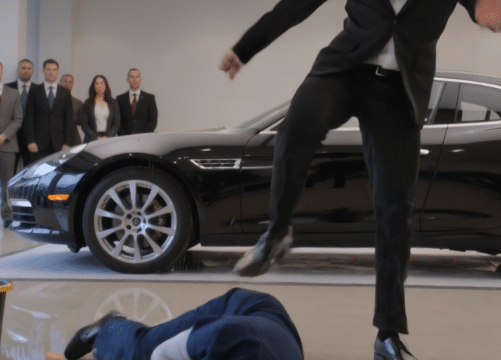
The slap sounded louder than the chandelier above them.
It cracked through the marble lobby, sharp and impossible to ignore, and every conversation died at once. A woman near the lounge seating gasped. A businessman lowered his phone. Somewhere by the reception desk, a glass of water trembled in a guest’s hand.
The elderly man staggered.
His crutches slipped out from under him, metal striking the polished floor with a brutal clatter. One slid toward the doorway. The other spun once and came to rest beside his shoe.
Then he fell.
Not dramatically.
Not like a man trying to make a scene.
He simply lost the support his body needed, and the floor caught him before anyone else did.
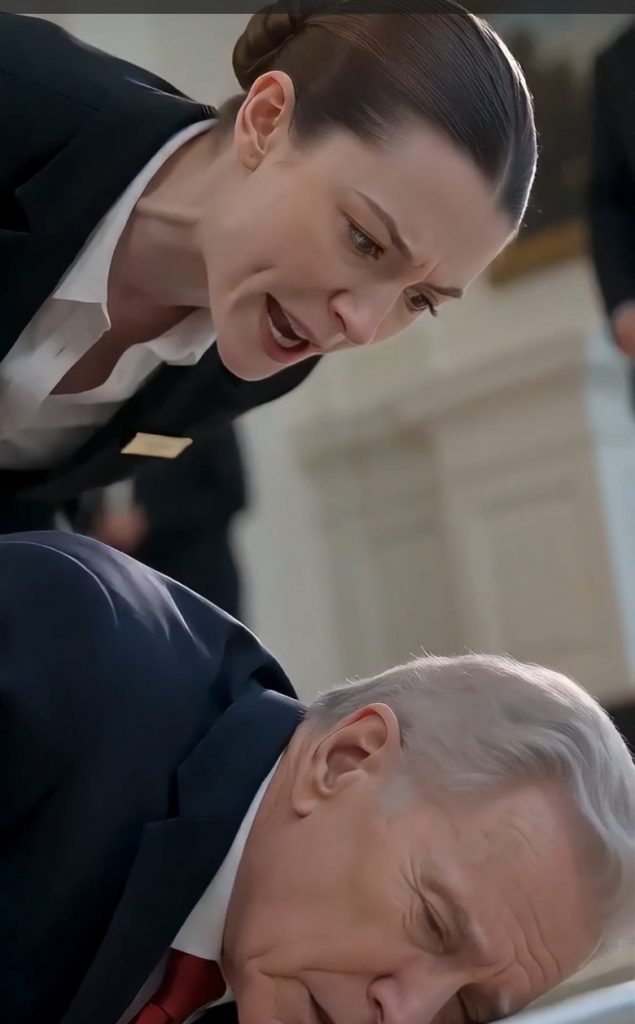
The woman who struck him stood over him in a black blazer, white shirt, and a gold name tag that read Miranda Cole. Her hair was pulled into a sleek bun, her posture rigid with the kind of authority borrowed from expensive walls and frightened employees.
“Don’t bring your misery here, trash!” she snapped.
The old man took a slow, strained breath.
His suit jacket had twisted beneath one shoulder. His cheek bore the shock of the hit. His hand moved carefully across the floor, reaching for the nearest crutch.
Miranda stepped closer.
“People like you ruin this place.”
The lobby froze around them.
It was the lobby of the Caldwell Meridian, a hotel so expensive it no longer called itself a hotel. It called itself an experience. Marble columns, pale floors, wide glass doors, velvet seating, floral arrangements that looked too perfect to be real.
Outside, beyond the open front doorway, black SUVs sat along the driveway.
Miranda had noticed them but had not understood them.
Not yet.
The old man reached again for his crutch.
No one moved.
A few bystanders looked horrified. A few looked away. The worst ones watched with the helpless curiosity people reserve for disasters that do not belong to them.
Then car doors slammed outside.
The sound cut through the room.
Men in dark suits stepped from the SUVs and moved toward the entrance with terrifying discipline.
At their center walked a tall man in a black suit, red tie, gold lapel pin, and an earpiece. His eyes found the elderly man on the floor, and something in his face hardened.
He crossed the lobby fast.
Miranda turned, irritated.
“Sir, this area is—”
The agent ignored her.
He reached the old man, lowered his head slightly, and placed one hand with careful respect on his shoulder.
“Mr. President,” he said, voice calm and formal. “Forgive our late arrival.”
The lobby went silent in a different way.
Miranda’s mouth opened.
Her face lost color.
And the old man she had called trash slowly lifted his eyes.
Act II
President Elias Grant had spent his entire public life being recognized too quickly.
People stood straighter when he entered rooms. Voices softened. Doors opened before he reached them. Men who disliked him still shook his hand with both palms. Women who had criticized him on television still smiled carefully when cameras appeared.
Power changed people.
That was why he distrusted it.
Long before the presidency, Elias Grant had been a schoolteacher’s son from Ohio who walked to class with patched shoes and a lunch his mother wrapped in wax paper. His father worked at a post office. His mother taught history and believed every child should know the difference between being poor and being powerless.
“You can lack money and still keep your spine,” she used to say.
Elias never forgot.
Years later, after Congress, after the governor’s mansion, after the campaign that turned his name into a chant, he still hated the way wealthy rooms treated ordinary people. He noticed which staff members went unseen. Which wheelchair ramps were decorative but inconvenient. Which security guards smiled at donors and frowned at delivery workers.
The Caldwell Meridian had become a problem months before he ever stepped inside it.
The hotel was scheduled to host an international housing summit, one tied to a presidential initiative on veterans, disability access, and emergency shelter. On paper, the Caldwell Meridian was perfect. Secure location. Private conference halls. Luxury accommodations. Media-ready architecture.
Then the complaints arrived.
A veteran using a walker had been refused access to the main lobby because he “disrupted the atmosphere.” A retired nurse was told to wait outside after asking for a restroom. A homeless outreach volunteer attending a policy meeting was directed to the service entrance despite having credentials.
Each report carried the same quiet poison.
People were being judged before being helped.
The President read the file in the residence late one night, glasses low on his nose, one hand resting on the cane he sometimes used when cameras were not near. His doctors preferred he avoid unnecessary strain after his surgery, but he disliked appearing frail in public.
His chief of staff wanted to move the summit.
The Secret Service wanted a full security walkthrough.
The hotel management wanted to apologize without admitting anything.
Elias wanted to see the lobby himself.
“Sir,” Agent David Mercer said, “you cannot simply walk into a hotel unannounced.”
Elias looked up.
“I’m not walking in unannounced. You’ll be outside.”
“That is not comforting.”
“It isn’t meant to be.”
Mercer had protected him long enough to know when arguing became decoration.
So they compromised.
The President would arrive through a side security route for the summit rehearsal, but before the formal escort entered, he would cross the public lobby alone for less than two minutes. His detail would be seconds behind him. Cameras would be monitored. Medical support would be nearby.
It was reckless by protocol standards.
It was necessary by Elias Grant’s.
“If this building only behaves when it sees the motorcade,” he said, “then I need to know that.”
He dressed simply that afternoon.
A dark suit jacket. No flag pin. No visible press pool. His crutches instead of the more polished cane, because the crutches were what he had been using during recovery and because discomfort had a way of revealing people.
When he entered the Caldwell Meridian lobby, no one noticed him at first.
That almost made him smile.
For thirty beautiful seconds, he was just an old man moving slowly across an expensive floor.
Then Miranda Cole saw him.
She was assistant guest relations director, though she wielded the title like a crown. She had built her career on pleasing wealthy guests before they complained and removing uncomfortable sights before they became visible.
To her, the lobby was a stage.
The wrong people ruined the picture.
She watched Elias pause near the entrance to steady himself, and her expression changed. Not to concern. To annoyance.
“Sir,” she said sharply, “this entrance is for registered guests.”
“I’m expected,” Elias said.
His voice was quiet.
Miranda heard only the crutches.
Expected by whom, her face seemed to ask, though she did not bother asking aloud.
“You need to leave,” she said.
Elias turned toward her.
“I’m waiting for someone.”
“No,” Miranda replied. “You’re making our guests uncomfortable.”
He looked around.
Several guests had noticed now.
Some were watching.
Miranda felt the audience and mistook it for support.
She stepped into his path.
“Move along.”
Elias’s fingers tightened around the crutch handles.
“Miss, I suggest you check with your manager.”
That was the sentence that angered her.
Not because it was rude.
Because it was calm.
Because it assumed she was answerable.
Miranda’s face hardened.
And before the first Secret Service agent crossed the driveway, she raised her hand.
Act III
Agent David Mercer saw the fall through the glass doors.
For the rest of his life, he would remember the exact second his stomach dropped.
The President was on the floor.
The crutches were scattered.
A woman in a hotel blazer stood over him, still speaking.
Mercer moved before thought finished forming.
Two agents followed. A third covered the entrance. Outside, the black SUVs remained positioned along the driveway, engines running low beneath the noise of evening traffic.
Inside, the lobby seemed trapped in amber.
Miranda was still pointing down at the elderly man.
“People like you ruin this place,” she said.
Then Mercer entered.
The air changed with him.
Bystanders stepped back without being told. A hotel manager near the desk went pale before he understood why. Miranda turned with irritation first, then confusion, then the faintest beginning of fear.
Mercer went straight to Elias.
“Mr. President,” he said, kneeling. “Forgive our late arrival.”
The words spread across the lobby like fire.
Mr. President.
A woman near the lounge seating whispered, “Oh my God.”
The businessman with the phone lowered it completely.
The hotel manager gripped the reception desk as if the floor had shifted beneath him.
Miranda stood perfectly still.
Her gold name tag caught the chandelier light.
Elias did not rush to stand. He hated that he needed help, but he hated pride more. Mercer handed him one crutch. Another agent retrieved the second and checked it quickly before placing it within reach.
“Are you injured, sir?” Mercer asked.
Elias shook his head once.
“Bruised.”
Mercer’s jaw tightened.
That was not an acceptable answer, but he knew better than to argue in front of the room.
With careful support, the President rose.
He stood slowly, putting weight through the crutches, his face composed in a way that made the violence against him feel even more shameful. He looked not broken, but revealed.
Miranda’s lips trembled.
“The President?” she whispered.
Mercer turned to her.
His voice stayed controlled.
“Step back.”
She obeyed immediately.
The same woman who had ordered a man on crutches out of the lobby now moved like a frightened child.
“I didn’t know,” she said.
Elias looked at her.
That sentence had followed him his entire career.
I didn’t know he was important.
I didn’t know she had influence.
I didn’t know they were connected.
As if cruelty were acceptable when practiced on the powerless.
“No,” Elias said quietly. “You didn’t.”
Miranda seized on the softness of his tone.
“Sir, I am so sorry. Truly. I thought—”
He waited.
The room waited with him.
Miranda swallowed.
“I thought you were someone else.”
The President’s expression changed.
Only slightly.
But everyone felt it.
“That,” he said, “is the problem.”
Act IV
The general manager arrived almost running.
His name was Leonard Voss, and he had spent twenty years mastering the art of apologizing upward. He entered the lobby with his tie slightly crooked and his face already arranged into horror.
“Mr. President,” he said. “Sir, I cannot express—”
“Then don’t,” Elias said.
Leonard stopped.
The silence that followed was devastating.
Miranda looked as if she might collapse. Her hands hovered uselessly near her sides, fingers trembling, mouth opening and closing around explanations that died before they became words.
Elias looked around the lobby.
At the guests who had watched.
At the staff who had frozen.
At the marble floor where his crutches had clattered.
“This hotel is hosting a summit on dignity and access,” he said.
Leonard’s face tightened.
“Yes, sir.”
“And your staff assaulted a disabled man in the lobby.”
Miranda flinched.
“I didn’t assault—”
Mercer’s eyes moved to her.
She stopped.
Elias did not raise his voice.
That made every word sharper.
“She struck me. I fell. My crutches were knocked from my hands. The room saw it.”
The bystanders looked down, one by one.
A woman in a blue dress stepped forward, voice shaking.
“She did, sir.”
Miranda’s eyes snapped toward her.
The woman did not step back.
“She slapped him,” she said. “And no one helped.”
That last part wounded the room.
Another guest spoke from near the seating area.
“She told my father last month he couldn’t sit here because he looked unwell. He had just finished treatment.”
A bellhop near the entrance looked terrified, then raised his hand slightly.
“She makes us move people out if they don’t look like paying guests.”
Leonard turned on him.
“Thomas—”
The President’s voice cut through the warning.
“Let him speak.”
Thomas swallowed.
His uniform looked too large on him suddenly.
“She says the lobby is the brand.”
Elias looked at Miranda.
“Is that what you believe?”
Her face had gone pale.
“I was protecting the hotel’s standards.”
The President’s eyes hardened.
“From misery?”
Miranda’s throat worked.
“From disruption.”
Elias leaned slightly on his crutches.
“People in pain are not disruptions.”
No one spoke.
Outside, another car door closed. More agents took positions near the entrance, their stillness making the lobby feel less like a hotel and more like a hearing.
Leonard began again, softer now.
“Sir, Ms. Cole will be removed from duty immediately. We will cooperate fully with any investigation.”
Elias studied him.
“Will you?”
“Yes, Mr. President.”
“You received complaints before today.”
Leonard’s face went blank.
That was answer enough.
Elias turned to Mercer.
“Document everything. Witness names. Security footage. Prior complaints. Staff statements.”
Mercer nodded.
“Yes, sir.”
Miranda’s fear broke open.
“Please,” she whispered. “I made a mistake.”
Elias looked back at her.
“A mistake is misdirecting a guest to the wrong room. What you did was decide a man’s value from his weakness.”
Her eyes filled.
Not with remorse, he thought.
With terror.
“Do you know why I came through this lobby without announcement?” he asked.
She shook her head.
“To see whether this place understood dignity before it recognized power.”
The words settled over the marble.
Then Elias turned toward the guests.
“I received my answer.”
Miranda’s lips parted. She looked from him to the agents, from the agents to the bystanders, from the bystanders to the black SUVs outside.
“How?” she stammered at last.
It was not a real question.
It was disbelief that power had arrived wearing pain, crutches, age, and silence.
Elias did not answer.
He simply looked at her until she understood that the question itself condemned her.
Act V
Miranda Cole left the Caldwell Meridian lobby through the employee corridor.
Not through the grand entrance.
Not past the floral arrangements.
Not beneath the chandelier where she had liked to stand and decide who belonged.
Two agents and the hotel’s internal security escorted her away while Leonard Voss remained in the lobby, pale and sweating, giving statements to federal staff and corporate counsel.
The summit did not move.
That surprised everyone.
Elias insisted it remain exactly where it was.
“If a building fails a test,” he told his chief of staff later that night, “you do not always abandon it. Sometimes you make it take the lesson in public.”
The next morning, the President entered the Caldwell Meridian lobby again.
This time, cameras were waiting.
So were disability advocates, veterans, housing organizers, medical workers, and hotel staff who looked as if they had not slept.
Elias stood at the same spot where he had fallen.
His cheek no longer showed the mark clearly, but he could still feel the memory of it. He looked down once at the marble, then up at the crowd.
“I came here yesterday as an old man on crutches,” he said. “Before anyone knew my title, I was treated as a problem to be removed.”
The cameras clicked softly.
He continued.
“What happened to me was not important because I am President. It was important because it happens every day to people without motorcades, without agents, without microphones, and without anyone rushing in to correct the room.”
Behind the cameras, several hotel employees lowered their eyes.
Elias did not shame them by name.
He did not need to.
“Dignity is not a premium service,” he said. “It is not reserved for guests who look wealthy, healthy, young, polished, or convenient. A society reveals itself by how it treats people before it knows what they can do in return.”
The clip was everywhere by noon.
By evening, the Caldwell Meridian’s parent company announced an external investigation. Leonard Voss resigned within the week. Miranda Cole was dismissed and later faced legal consequences for the assault.
But the larger story did not stop with one woman.
It widened.
Former employees came forward. Guests shared stories. Disability rights groups published reports on luxury spaces that treated accessibility as decoration instead of commitment.
The summit became harsher than planned.
Better than planned.
Instead of polished speeches about compassion, people spoke plainly about humiliation. About ramps blocked by flower displays. About staff trained to protect atmosphere over people. About how quickly suffering became invisible when it wore the wrong clothes.
President Grant listened to all of it.
That was what people remembered.
Not the slap.
Not even the reveal.
They remembered the old man with crutches sitting for hours beside people who had never been invited into rooms like that and taking notes with his own hand.
Three months later, the Caldwell Meridian reopened its lobby after policy changes and accessibility renovations.
The marble remained.
The chandelier remained.
The flowers were moved away from the access path.
Near the entrance, where Elias had fallen, a bronze plaque was placed low enough for anyone using a wheelchair or walker to read without looking up.
Dignity begins before recognition.
The President returned privately to see it.
No cameras.
No announcement.
Only Agent Mercer beside him and a young hotel employee at the desk who looked nervous when she realized who he was.
“Mr. President,” she said quickly. “Welcome back.”
Elias smiled faintly.
“Thank you.”
She glanced at his crutches, then at his face.
“Would you like assistance, sir?”
There it was.
Not panic.
Not pity.
A question.
Permission.
Respect.
“Yes,” he said. “I would.”
She walked beside him at his pace, not ahead, not hovering. Mercer watched carefully and said nothing.
At the center of the lobby, Elias paused.
He remembered the sound of the crutches sliding away. The cold marble under his palm. The woman’s voice telling him he brought misery into a place built to hide it.
Then he looked around.
A veteran with a cane sat comfortably near the window. A delivery worker signed paperwork at the front desk without being redirected outside. A mother pushing a stroller asked a question and received an answer without impatience.
Small things.
Human things.
The kind of things no society should need a scandal to learn.
Mercer stood beside him.
“Sir?”
Elias took a slow breath.
“It’s better.”
“Is that enough?”
The President looked toward the plaque.
“No.”
Then, after a moment, he added, “But better is where enough begins.”
Outside, the black SUVs waited near the driveway.
Inside, the lobby moved around him with careful, ordinary life.
No one stared for long.
No one whispered in fear.
No one made a performance of kindness.
And for once, Elias Grant felt something close to hope in a place that had once mistaken his vulnerability for permission.
Because the lesson had never been that the woman slapped the President.
The lesson was that she thought he was no one.
And the country had finally been forced to ask how many people had been treated that way without a motorcade waiting outside.