Act I
The mechanic hit the tires before he hit the floor.
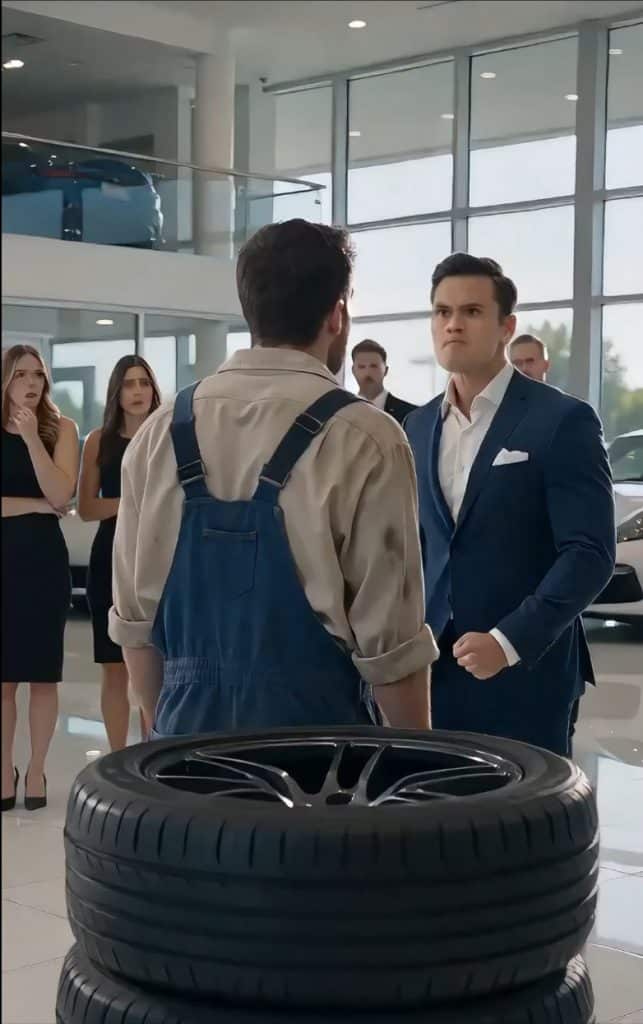
Four black performance tires rattled violently in the foreground, rubber thudding against rubber as the man in stained blue overalls stumbled backward from the punch. His shoulder struck the stack, his boots slid across the glossy white tile, and he dropped beside the display like something the showroom wanted to hide.
A woman near the silver coupe gasped.
Someone else whispered, “He hit him.”
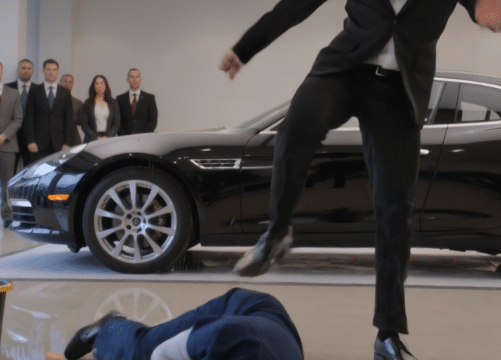
The man who had thrown the punch stood over him in a tailored navy suit, chest rising hard beneath a spotless white shirt. His pocket square had not moved. His hair remained neatly combed. Only his face betrayed the rage underneath the polish.
“Get out of here, trash!” he shouted.
The mechanic stayed low beside the tires, one hand braced on the tile, breathing unevenly but saying nothing.
Around them, the luxury dealership went still. White floors. Glass walls. Cars so expensive they seemed more like sculpture than transportation. Men and women in business clothes stood frozen between displays, unsure whether to help the man on the floor or protect themselves from the manager who had just crossed a line in public.
The manager’s name was Grant Ellison.
He ran the flagship showroom of Dominion Motors like a private kingdom. Every car gleamed. Every client was screened. Every employee knew the rules without seeing them written down.
Shine mattered.
Dirt did not enter.
Grant gestured across the showroom with both hands as if the mechanic had polluted the air itself.
“People like you dirty my whole showroom!”
The mechanic looked down at his overalls.
Oil stains. Worn knees. A beige shirt faded by years of work. Hands rough from engines, tools, and labor no one in that room respected until something expensive stopped working.
He did not defend himself.
That seemed to make Grant angrier.
Then the helicopter noise began.
At first, it was just a low vibration beyond the open service bay. Then rotor blades chopped the air outside, growing louder until the glass walls trembled faintly. Every head turned toward the landing pad beyond the bay door.
A black helicopter sat outside.
A man in a sharp black suit stepped down, earpiece glinting against his cheek. Security personnel moved with him in disciplined formation.
Grant straightened his jacket.
He thought the arrival was for him.
The man in black crossed the showroom without looking at him.
He walked directly toward the mechanic on the floor.
Another aide beside him stopped, bowed his head slightly, and spoke in a formal voice that carried across the dead-silent room.
“Sir, please forgive our late arrival.”
Grant’s expression froze.
The mechanic lifted his eyes.
And the showroom manager, who had just punched him into a stack of tires, whispered one broken word.
“How?”
Act II
His name was Samuel Royce, but most men in suits only knew that name engraved on buildings.
Royce Automotive Holdings owned ninety-two dealerships across five countries. Luxury showrooms. Restoration garages. Racing divisions. Electric performance labs. A private museum with cars that collectors would fly across oceans to see.
But Samuel Royce had not begun with marble floors and helicopters.
He began under rust.
His first job was in a repair bay behind a gas station off Route 16, where the roof leaked in winter and the owner paid in cash when he remembered. Samuel was sixteen, hungry, and stubborn enough to believe engines were honest because they only complained when something was wrong.
He learned to listen.
To belts.
To valves.
To old men who loved cars more than their families understood.
To single mothers who prayed a repair would cost less than rent.
To teenage boys who pretended not to care about the cars their fathers had left behind.
Samuel built his first shop with three borrowed lifts and a hand-painted sign. He slept in the office for two years. He hired men no one trusted because they had records, women no one hired because customers asked for “a real mechanic,” and veterans who needed routine more than speeches.
Dominion Motors came later.
Much later.
By then, Samuel had money, influence, and a board that preferred him in Italian suits instead of denim overalls. They told him founders should not crawl under cars anymore. It confused investors.
Samuel ignored them.
Once a year, he visited a dealership unannounced.
Not as the owner.
As a mechanic.
He would work one service shift, talk to technicians, watch how managers treated people who could not help their careers, and listen for the sound of rot beneath polish.
That morning, he chose the flagship showroom.
The board had begged him not to.
Dominion Beverly Crest was the crown jewel: glass walls, custom lighting, imported tile, rare inventory, celebrity clients, and Grant Ellison, the manager credited with “elevating the client experience.”
Samuel had read the reports.
Record sales.
Record complaints.
High staff turnover.
Technicians resigning without interviews.
Assistants crying in supply rooms.
A porter fired after a client accused him of leaving fingerprints on a hood, though security footage later showed the client’s own child had done it.
Grant’s numbers were beautiful.
His people were not.
So Samuel arrived early in dirty overalls, using a side service entrance with a temporary contractor badge. He asked where to stack tires. He helped move parts. He watched three sales associates step around a cleaning woman without making eye contact.
Then he entered the showroom carrying a torque wrench he had found abandoned near a display car.
Grant saw the overalls before he saw the man.
That was all it took.
Act III
The confrontation began with a car.
A midnight-blue Veyron edition rested in the center of the showroom, roped off under a circle of lights. Grant treated it like a holy object because a collector was scheduled to view it that afternoon.
Samuel noticed a problem immediately.
The front tire pressure was visibly low.
Not dangerous in a showroom, but embarrassing. Worse, it suggested the car had been moved without proper inspection.
He stepped closer to check the valve stem.
Grant crossed the showroom fast.
“What do you think you’re doing?”
Samuel looked up.
“This tire is soft.”
Grant’s smile was sharp and public.
“Do you normally wander around touching seven-figure inventory?”
“I work here today.”
Grant glanced at the contractor badge.
“Service stays behind the bay doors.”
“Not if something out here needs service.”
A few bystanders noticed the exchange. Grant noticed them noticing. That was when his irritation became theater.
He lowered his voice, but not enough.
“Listen carefully. Clients don’t want to see grease near their cars.”
Samuel looked at his own hands.
“They want the cars to run.”
Grant stepped closer.
“Don’t get clever.”
Samuel should have walked away.
He had done enough. Seen enough. Heard enough. He could have ended the inspection quietly, called the board, and let lawyers do what lawyers do.
But then a young porter near the reception desk dropped his gaze in fear.
Samuel recognized that fear.
He had employed men who came from shops where fear was part of the uniform.
So Samuel said, “You talk to all your workers like this?”
Grant’s face changed.
There it was.
The truth beneath the expensive suit.
“You are not my worker,” Grant said. “You are a stain on my floor.”
Someone gasped softly.
Samuel remained still.
Grant mistook stillness for weakness.
He shoved Samuel’s shoulder first. Samuel stepped back, refusing to give the room an excuse to call it a fight. Grant’s humiliation deepened when the mechanic did not react the way he expected.
So he swung.
The punch landed.
The tires rattled.
And the entire showroom finally saw what had always been there.
Not discipline.
Not luxury.
Violence dressed as standards.
Now, with the helicopter outside and the aide bowing beside him, Samuel slowly pushed himself upright.
The aide moved to help.
Samuel lifted one hand.
“Not yet.”
He stood on his own.
Grant looked as if the showroom floor had opened beneath him.
The man in black suit spoke again.
“Mr. Royce, security is in position. The board is waiting.”
A sound moved through the bystanders.
Not a gasp.
An unraveling.
Grant stepped back.
“Mr. Royce?”
Samuel looked at him.
“Yes.”
Act IV
Grant tried to speak three times before words came.
“Sir, I didn’t know.”
Samuel touched the side of his face once, then lowered his hand.
“No,” he said. “You didn’t.”
Grant swallowed.
“I thought you were—”
“A mechanic?”
The word filled the room.
Grant’s mouth stayed open.
Samuel looked at the tire stack beside him.
The top tire still sat crooked from the impact.
“I am a mechanic,” he said.
No one moved.
“I was a mechanic before this company existed. I was a mechanic when I bought my first lift. I was a mechanic when I signed the papers that eventually paid for every light in this room.”
He turned back to Grant.
“So the question is not why you struck the owner. The question is why you thought striking a mechanic was acceptable.”
Grant’s face went pale.
Bystanders looked away, not because they felt sorry for him, but because the sentence found them too. Every one of them had watched the punch happen. Every one of them had waited for someone more powerful to decide it mattered.
The aide, Marcus Vale, stepped forward.
“Mr. Royce, would you like medical assistance?”
Samuel shook his head.
“Later.”
Marcus’s jaw tightened, but he obeyed.
Samuel looked toward the reception desk.
“Preserve all security footage. Every angle. Save the audio. Lock the system until legal arrives.”
A receptionist moved immediately.
Grant’s panic sharpened.
“Mr. Royce, please. This is a misunderstanding.”
Samuel glanced at the performance tires.
“No. A misunderstanding is putting the wrong tire on the wrong car. This was a choice.”
One of the bystanders, a woman in a black dress, stepped forward.
“He punched him,” she said, voice shaking. “He yelled at him before that.”
Another man added, “He called him trash.”
A technician standing near the service bay finally spoke.
“He calls all of us that.”
Grant turned toward him.
“Quiet.”
Samuel’s eyes snapped to Grant.
The command died on Grant’s tongue.
The technician continued, stronger now.
“He tells clients not to look at us. He makes us use the back hallway when VIPs come. He fired Luis for getting oil on a floor mat even though Luis stayed all night fixing the transmission.”
Another voice came from the service bay.
“He docks pay for tool scratches.”
“He tells women technicians to stay off the showroom floor.”
“He says the bay is where the dirty people belong.”
The showroom became a courtroom without benches.
Grant stood in the center of it, surrounded by the testimony of people he had forgotten could speak.
Samuel listened to every word.
Then he turned to Marcus.
“Remove Mr. Ellison from the premises.”
Grant’s eyes widened.
“Remove me? Sir, I run this flagship.”
Samuel’s voice was calm.
“You ran it into shame.”
Security stepped forward.
Grant looked around for support.
There was none.
Act V
The helicopter left without Samuel.
That was the first thing employees noticed.
The founder of Royce Automotive Holdings could have returned to the sky, gone to the board meeting, and let the incident become another executive problem handled in sealed rooms.
Instead, he stayed in the service bay.
He sat on a metal stool near the lifts with a cold pack against his cheek while technicians stood in an awkward half-circle around him, unsure how to behave around a billionaire in dirty overalls who had just been punched by their boss.
Samuel pointed at the midnight-blue car.
“Who checked that front tire?”
A young technician raised her hand slowly.
“I did yesterday. It was fine.”
“Then we find the leak,” Samuel said. “Not the person to blame. The leak.”
That sentence did more for the staff than any speech could have.
Within an hour, the problem was found: a faulty valve stem damaged during transport. The technician had done nothing wrong. Grant had been too busy polishing the showroom image to ask the question that mattered.
The board meeting moved downstairs.
Directors in suits entered the service bay with careful shoes and uncertain expressions. Samuel did not change clothes. He stood beside a lift, oil stains on his overalls, and told them what had happened.
No one interrupted.
They had seen the footage.
The punch.
The fall.
The tires rattling.
The insults.
The silence.
Grant Ellison was terminated before sunset. Assault charges were left to the authorities, and Samuel made it clear the company would cooperate fully. But he refused to let Grant become the whole story.
“Bad managers survive in good companies only when good companies enjoy their results too much to question their methods,” Samuel told the board.
The room absorbed that.
Some uncomfortably.
Good.
Within weeks, Dominion Motors changed.
Not cosmetically.
Structurally.
Service staff no longer used back corridors to avoid wealthy clients. Technician names appeared on delivery reports beside salespeople’s names. Complaint channels bypassed showroom managers. A new conduct policy made physical intimidation an immediate termination offense. Sales bonuses were tied not only to revenue, but to staff retention, customer honesty, and service-team evaluations.
Some top sellers complained.
Samuel invited them to leave.
Several did.
The company survived.
The showroom changed too.
The stack of performance tires remained in the foreground for three months, deliberately left visible near the service entrance. Not as decoration. As memory. Beside it, Samuel placed a small sign.
Respect the hands that keep the wheels turning.
A few clients called it dramatic.
One said it ruined the luxury atmosphere.
Samuel personally refunded his deposit.
The mechanic who had spoken up about Luis was promoted to service lead. The young technician who had checked the tire was asked to design a new inspection protocol. Luis was rehired with back pay.
And every year after that, Samuel Royce continued his unannounced inspections.
But now he did them openly enough that staff understood the point.
Not to trap them.
To listen.
Months after the incident, Samuel returned to the Beverly Crest showroom for its relaunch. The floors still gleamed. The glass still rose from tile to ceiling. The cars still looked impossible beneath the lights.
But the room felt different.
Technicians moved through it without lowering their eyes. Sales associates introduced service staff to clients by name. The manager’s office door stayed open.
Marcus walked beside Samuel near the tire display.
“Board wants to know if you’ll consider retiring from undercover work.”
Samuel smiled faintly.
“They’ve wanted that for ten years.”
“They say it’s a security risk.”
“Treating workers badly is a bigger one.”
Marcus did not argue.
Near the tire stack, a young apprentice knelt beside a wheel, explaining something to a boy and his father. The boy listened with the serious awe children reserve for people who know how machines work.
Samuel stopped to watch.
The apprentice looked up and began to stand quickly.
Samuel waved him down.
“Finish teaching.”
The apprentice smiled and continued.
That was the showroom Samuel wanted.
Not one where wealth floated above labor.
One where a child could see the car and the hands that made it safe.
Later, during the relaunch ceremony, Samuel stood in front of the tire stack and spoke without notes.
“I built my life in repair bays,” he said. “Places with noise, heat, oil, mistakes, and people who knew that respect is not proven by how clean your floor is. It is proven by how you treat the person cleaning it, fixing it, or standing on it after someone knocks them down.”
The room stayed quiet.
He touched the top tire, the same one that had wobbled when he fell.
“This company forgot that for a while. I forgot to check closely enough. That ends.”
Applause followed, but Samuel did not bask in it.
He had never trusted applause as much as action.
After the crowd dispersed, he walked alone through the showroom. Evening light stretched across the tiles. The service bay door stood open, and the landing pad outside was empty now, no helicopter, no rotor noise, no dramatic arrival to force people into respect.
That mattered to him.
Because the lesson was not that the mechanic turned out to be rich.
That was the easy version.
The deeper truth was that he had deserved dignity before anyone knew his name.
Before the helicopter.
Before the aide.
Before the board.
Before Grant Ellison’s face went pale with the realization that he had attacked a man above him.
Samuel looked back at the performance tires.
Four circles of black rubber.
Ordinary objects.
Built to carry weight.
He thought about all the workers who had carried the weight of polished places without ever being allowed to stand proudly inside them.
Then he turned off the showroom lights one row at a time.
The cars faded into shadow.
The floors stopped shining so brightly.
And for once, the service bay remained lit longer than the sales floor.
Exactly as it should have.