Act I
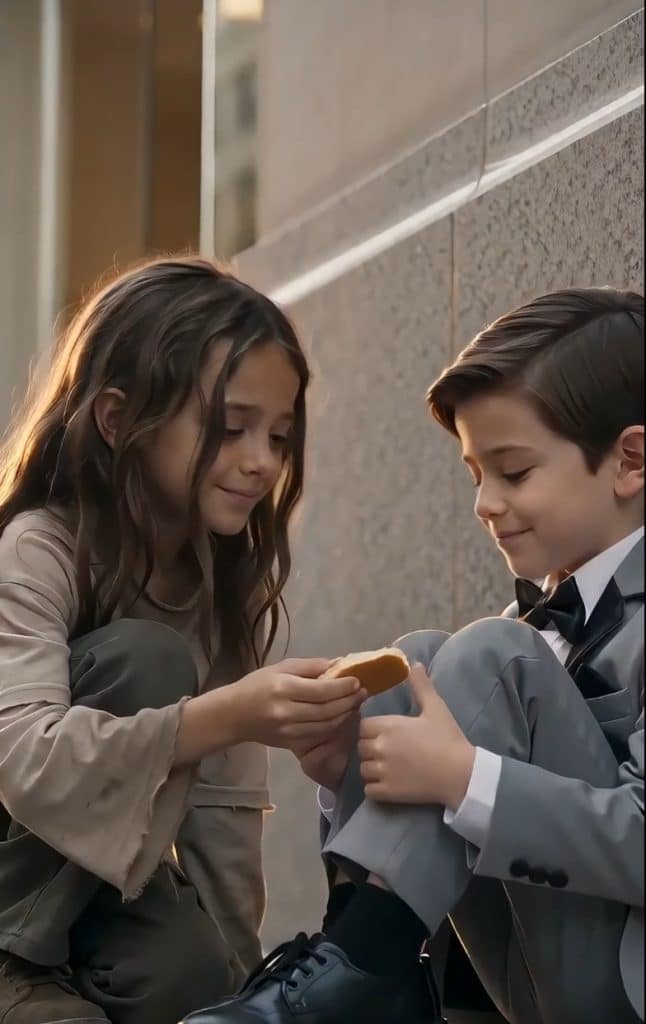
The boy in the gray suit looked too polished to be sitting on the sidewalk.
His knees were pulled to his chest beneath a tailored jacket. A white collar peeked above a black silk bow tie. Behind him, the glass storefront reflected warm late-afternoon light across the clean pavement, making him look like a child forgotten inside a magazine ad.
“I’m hungry,” he whispered.
No one stopped.
Not the shoppers leaving the luxury store. Not the man in sunglasses stepping into a black car. Not the woman carrying a white shopping bag that cost more than some families spent in a month.
Only the girl sitting near the heavy stone wall looked up.
She was small, maybe seven, with messy brown hair and a coat too thin for the cooling evening. Her clothes were dirt-stained. Her shoes were worn at the toes. In her hand was a small piece of bread wrapped in paper, the kind someone keeps because there might not be another.
She leaned toward him carefully.
“Are you lost?”
The boy lifted his eyes.
He did not answer at first. His face was pale, tired, and trying not to cry in the way children do when they have already learned crying may not bring anyone.
The girl looked at the bread.
Then at him.
Without a word, she knelt in front of him and held it out.
The boy accepted it with both hands.
His small smile came slowly, like sunlight reaching a locked room.
Then a woman screamed.
“Don’t touch my son!”
She rushed in from the side, pearls flashing at her ears, off-white dress sharp against the street’s warm reflections. Before the girl could stand, the woman shoved her hard away from the boy.
The girl stumbled backward and fell onto the pavement.
The bread flew from the boy’s hands and landed near her.
For a moment, everyone froze.
The woman stood between them, breathing fast, her face twisted with fear and disgust.
The boy scrambled to his feet.
“She gave me her only bread,” he cried. “When I had no one!”
The woman turned toward him.
Her certainty cracked.
And on the pavement between them, the small piece of bread lay like evidence.
Act II
His name was Oliver Vale.
At six years old, he already knew how adults behaved when cameras were around.
They smiled lower. Spoke softer. Bent down to his height as if kindness were a pose they could hold for ten seconds, then drop the moment photographers moved on.
His mother, Celeste Vale, owned half the block behind the luxury storefront. Her family name was on the building, the foundation, the art wing of the children’s hospital, and the gold letters above the boutique entrance. In public, she was elegant, generous, untouchable.
In private, she was exhausted.
Oliver’s father had died two years earlier, and grief had turned Celeste into someone who mistook control for safety. She hired drivers, tutors, guards, nurses, assistants, and consultants. She scheduled Oliver’s days so tightly that loneliness had nowhere to sit except inside him.
Then Graham Mercer entered their lives.
He was polished, patient, and always ready with the right sentence.
Oliver needs structure.
You can’t let grief make you soft.
People will take advantage of him because of who he is.
Celeste believed him because fear always sounds like wisdom when spoken in a calm voice.
That afternoon, they had come to the boutique for a private children’s charity event. Oliver hated the cameras. He hated the itchy suit. He hated the way Graham placed one hand on his shoulder whenever donors passed, as if showing ownership.
When Oliver asked for food, Graham smiled without looking down.
“After the photos.”
But the photos kept going.
The speeches kept going.
The adults kept touching his hair and calling him brave.
Finally, Graham led him outside.
“Sit there,” he said, pointing to the stone wall beside the storefront. “Stop embarrassing your mother.”
Oliver looked toward the glass doors.
“Can I go back in?”
“When you learn not to make a scene.”
Then Graham left him.
At first, Oliver thought he would return quickly.
Then minutes stretched.
His stomach hurt. His eyes burned. He watched strangers walk past him, too ashamed to ask for help because rich children are taught not to look needy, even when they are.
That was when the girl found him.
Her name was Nora.
She knew hunger well enough to recognize it without being told.
She had slept behind the bakery two streets over with her older brother the night before. The bread in her hand was supposed to be dinner. Not enough, but something. She had been saving it carefully, breaking off tiny pieces at a time to make it last.
Then she saw Oliver.
A boy in a suit.
A boy who looked like he belonged everywhere, sitting like he belonged nowhere.
So she gave him the only thing she had.
And for that, Celeste Vale shoved her to the ground.
But the bread was not the only thing that fell.
Something else had slipped from Oliver’s pocket when he stood to defend her.
A small silver key.
And Nora recognized it before anyone else did.
Act III
Celeste saw the key last.
At first, she saw only the girl on the pavement, the bread beside her, and Oliver standing between them with both fists clenched at his sides.
“She was helping me,” Oliver said.
His voice shook, but he did not step back.
Celeste’s hand hovered in the air, useless now. The anger that had carried her into the scene drained so quickly it left her cold.
“I thought—”
“You didn’t ask,” Oliver said.
The words struck her harder because they were so small.
Nora slowly pushed herself upright. She did not cry loudly. She only looked at the bread on the ground, then at Oliver, as if worried he still needed it.
That made Celeste feel something she had no defense against.
Shame.
A security guard from the boutique stepped outside, followed by two staff members and several guests. Behind them, Graham Mercer appeared in the doorway, his expression already arranged into concern.
“Celeste,” he said quickly, “I told you. These street kids hang around the entrance. She must have grabbed him.”
Oliver spun toward him.
“No, she didn’t!”
Graham’s face tightened.
“Oliver, don’t lie.”
The boy’s eyes filled.
“I’m not lying. You left me here.”
The crowd shifted.
Celeste turned slowly toward Graham.
“What?”
Graham gave a soft, wounded laugh.
“He was upset. I gave him a minute to calm down.”
“You told me he was with the driver.”
“I thought he was.”
Oliver bent and picked something from the pavement.
The silver key.
He held it out to Nora.
“You dropped this.”
Nora shook her head.
“That’s not mine.”
But her eyes stayed on it.
Celeste noticed.
“What is it?”
Oliver looked at the key in his palm. It was small, old, and engraved with a tiny crescent moon. Celeste recognized it immediately.
Her husband’s study key.
The one she had lost after the funeral.
The one that opened the locked writing desk Graham had insisted contained only old business files.
Nora pointed to it with a trembling finger.
“My brother found one like that,” she whispered. “In the box with the papers.”
Graham’s face changed.
Only for a second.
But Celeste saw it.
“What papers?” she asked.
Nora looked scared now.
Not of Celeste.
Of Graham.
“My mom worked for Mr. Vale,” she said. “Before she got sick. She kept letters.”
Celeste could barely hear over the sudden pounding in her ears.
Graham stepped forward.
“That’s enough.”
Nora flinched.
Oliver moved in front of her.
“No.”
This time, he was not the hungry boy sitting against the wall.
He was his father’s son.
Act IV
Celeste had the boutique security office opened within minutes.
Graham protested all the way inside.
“This is humiliating,” he said. “You’re letting a child from the street manipulate you.”
Celeste did not answer.
Oliver walked beside Nora, still holding the bread in its dusty paper. He had picked it up because Nora kept looking at it as if leaving it behind would be wasteful, even after everything.
Inside the security office, the monitors showed the storefront from four angles.
The footage told the truth without raising its voice.
Graham leading Oliver outside.
Graham pointing to the wall.
Graham walking back into the boutique alone.
Oliver waiting.
Oliver wiping his eyes.
Nora approaching carefully.
Nora offering the bread.
Celeste pressing both hands to her mouth when the shove appeared on screen.
She watched herself come into frame like a stranger.
Watched herself hurt a child who had done what no adult had done.
Watched Oliver stand up to her with a courage she had almost trained out of him.
Graham said nothing now.
The guard rewound the footage.
Celeste turned to him.
“Save it.”
The guard nodded.
Graham’s voice sharpened.
“Save it for what?”
“For the police if necessary,” Celeste said. “And for my lawyers.”
His eyes narrowed.
“Celeste.”
She turned on him.
“You left my son alone on a sidewalk.”
“He needed discipline.”
“He was hungry.”
“He was making you look weak.”
The room went silent.
There it was.
The sentence beneath every correction, every warning, every cold smile Graham had given her since he entered her life.
Oliver was not unsafe.
He was inconvenient.
Nora was not dangerous.
She was poor.
And Celeste had let Graham teach her to confuse both things with threats.
She looked at Nora.
The girl stood near the door, one hand curled around the edge of her sleeve, trying to make herself smaller in a room full of adults.
Celeste knelt.
Not elegantly.
Not for cameras.
Just down onto the hard floor in front of the child she had shoved.
“Nora,” she said, voice breaking, “I hurt you. I was wrong. You helped my son, and I punished you for it.”
Nora stared at her.
Children who have been disappointed by adults do not trust apologies quickly.
Celeste understood that she did not deserve quick trust.
“I’m sorry,” she said.
Nora looked at Oliver.
Oliver nodded once.
Only then did Nora whisper, “He said he was hungry.”
Celeste closed her eyes.
That sentence would stay with her for the rest of her life.
Act V
The letters were found that night.
Not in Graham’s office.
In the locked writing desk that had belonged to Celeste’s late husband, Daniel Vale.
The silver key still fit.
Inside were documents Graham had hidden before Celeste had the strength to sort through Daniel’s final papers. Letters from Nora’s mother, Amalia, who had worked for Daniel’s foundation outreach program. Records of emergency housing grants that were approved but never delivered. Complaints about funds being redirected after Daniel’s death.
And one letter addressed to Celeste.
Daniel’s handwriting.
If anything happens to me, find Amalia Santos and her children. Graham has been blocking the housing fund. I need you to know this was never charity to me. It was a promise.
Celeste sat in Daniel’s study and read it three times.
Graham was gone by then, removed from the house and from every foundation account he had touched. The legal consequences came later. Investigations. Frozen access. Quiet donors suddenly eager to explain what they had not known.
But that night belonged to smaller truths.
Oliver ate soup at the kitchen table beside Nora and her older brother, Mateo, who arrived with a social worker after Celeste’s team found them near the bakery.
Nora kept half a roll wrapped in a napkin.
Celeste noticed but did not comment.
Some habits come from fear deep enough that one dinner cannot reach them.
The next morning, Celeste returned to the sidewalk.
Not with photographers.
Not with a ribbon-cutting.
With Oliver.
They stood beside the stone wall where he had been left and where Nora had given him bread.
“I was scared,” Oliver said.
Celeste took his hand.
“I know.”
“You didn’t see me.”
Her throat tightened.
“No,” she said. “I didn’t.”
He looked at the pavement.
“She did.”
Celeste squeezed his hand gently.
“Yes.”
The storefront changed after that.
At first, people called it damage control. They were not entirely wrong. Wealthy families are always accused of repairing their image when they begin repairing what their image hid.
Celeste accepted that.
She deserved suspicion.
But she kept working.
Daniel’s frozen housing fund was restored and renamed The Bread Door, after the thing one child gave another when adults failed them. The luxury storefront’s unused side entrance became a daily outreach center for children and families in crisis. The boutique donated space, not just money. Meals were served there. Legal aid met families there. Social workers had desks there. No one had to enter through an alley.
Nora and Mateo were not turned into a fairy tale.
They were not adopted overnight by a rich woman with guilt.
They had an aunt in another neighborhood who had been trying to find stable housing for months. Celeste’s foundation helped secure it, but the aunt signed every paper herself. Nora kept her name, her family, and her stubborn habit of offering food before taking any.
She and Oliver became friends slowly.
At first, through letters.
Then through weekend art classes at the outreach center.
Oliver drew buildings with doors too large for their frames.
Nora drew bread in every picture for a while.
One day, Celeste asked her why.
Nora shrugged.
“So nobody forgets.”
Nobody did.
A small bronze sculpture was placed near the side entrance six months later. Not of Celeste. Not of Oliver. Not even of Nora.
It was a simple piece of bread resting on an open hand.
Beneath it were words Daniel Vale had once written in the margin of a foundation proposal.
Kindness is not small when it is all someone has.
On the day the sculpture was unveiled, Nora stood beside Oliver in a clean yellow sweater her aunt had bought her. Her hair was brushed but still wild at the ends. She looked uncomfortable with all the attention, so Oliver stepped slightly closer, shoulder to shoulder.
Celeste saw it.
The same boy who had once sat hungry on a sidewalk now standing beside the girl who had fed him.
The woman who shoved her stood behind them, not asking to be forgiven by the crowd.
Only committed to becoming someone who would never do it again.
After the ceremony, Nora walked to the bronze hand and touched the bread with one finger.
“Does it look like the real one?” Oliver asked.
“No,” she said.
He frowned.
“It doesn’t?”
“The real one was smaller.”
Oliver thought about that.
Then Nora smiled.
“But this one won’t get dirty.”
Years later, people in the neighborhood still told the story.
They spoke of the well-dressed boy crying against the stone wall. The homeless girl who gave him her only bread. The wealthy woman who rushed in, saw poverty, and mistook kindness for danger.
Some told it as a story about shame.
Some told it as a story about redemption.
Nora, when asked, told it simply.
“He was hungry,” she would say. “So I gave him what I had.”
That was the whole truth.
And also the part adults spent years trying to learn.
Because the bread had been small.
The heart behind it was not.
And on a sidewalk outside a luxury storefront, where wealth passed by in polished windows and perfect shoes, the richest thing in sight had been a hungry girl giving away her dinner.