Act I
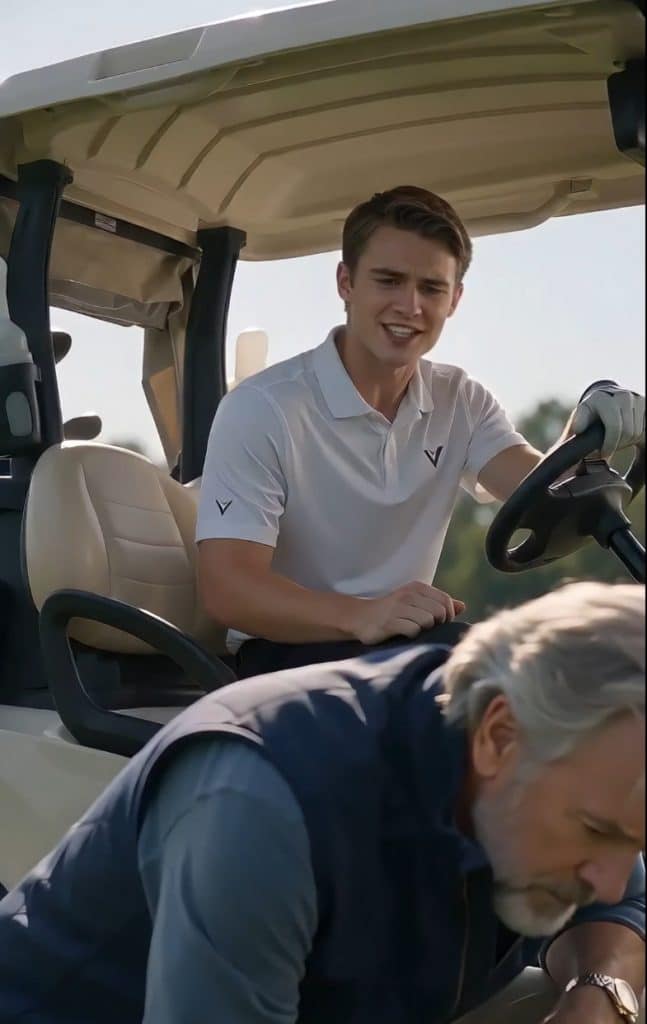
The golf cart hit the old man before the fairway had time to go silent.
One moment, Mr. Whitmore was kneeling beside a damaged patch of turf, one gloved hand steadying a small tool bucket, the other pressing loose grass back into the earth. The next, the cart surged forward with a cruel little growl, its wheels crushing the manicured green as it drove straight into his space.
The bucket flew sideways.
Metal tools clattered across the grass.
Mr. Whitmore dropped hard to both knees, both hands bracing against the turf as his muddy work boots dug into the ground.
Above him, seated comfortably behind the wheel, the young golfer leaned back like nothing serious had happened.
“Step back,” he said.
The words were casual.
That made them worse.
The old man stayed still for a second, gray hair ruffled by the breeze, beard shadowing a jaw clenched tight with restraint. His navy vest had shifted from the impact. Dirt marked one sleeve. His fingers dug into the grass as if the only thing keeping him from standing too quickly was discipline.
The young golfer looked him over and smirked.
He was dressed in a white polo shirt with the club’s V-shaped crest on the chest, black pants perfectly pressed, a glove on one hand. He looked like he had been raised to believe the world came with reserved parking and polite apologies.
He glanced at the spilled tools.
Then at the old man.
“Members don’t pay six figures for this kinda scene,” he said.
The fairway stretched around them, lush and spotless under the bright afternoon sun. Behind them, the white clubhouse rose with its tall columns and wide balconies, a monument to money pretending it was tradition.
Mr. Whitmore lifted his head slowly.
He said nothing.
That silence annoyed the young golfer.
His eyes dropped to the old man’s wrist, where a gold-and-silver luxury watch caught a flash of sunlight near the torn grass.
The golfer laughed under his breath.
“Nice watch,” he said. “Trying to look like you belong here?”
Mr. Whitmore finally released the grass from one fist.
His hands were steady now.
Too steady.
From the direction of the clubhouse, hurried footsteps cut across the fairway.
A man in a green blazer was coming fast, face pale, yellow tie shifting in the wind.
“Mr. Whitmore!” he called.
The young golfer’s smirk faded.
The club representative reached the old man and bowed his head slightly before offering both hands to help him rise.
“Mr. Whitmore,” he said, voice shaking with formal respect, “forgive us for arriving late. No one here outranks the founder.”
The young golfer froze in the cart.
And the old man he had just rammed into the grass slowly turned his eyes toward him.
Act II
Vale Ridge Golf Club was built on a lie people loved to repeat.
Tradition.
That was the word embroidered onto towels, engraved into silver trophies, and printed beneath photographs of smiling members shaking hands under the clubhouse columns. Tradition explained the dress code. Tradition explained the membership fees. Tradition explained why certain people were welcomed warmly and others were watched from the moment they stepped out of their cars.
But Harold Whitmore knew the truth.
Tradition was often just exclusion with better manners.
He had founded Vale Ridge thirty-two years earlier, not as a playground for inherited arrogance, but as a refuge from it. Back then, he had been a contractor with rough hands, no famous last name, and a talent for seeing potential in land everyone else dismissed.
The original property was not grand.
It was uneven, half-wild, and full of drainage problems. Wealthy investors laughed when Harold described what it could become. One banker told him, with a smile that never reached his eyes, that men who worked with dirt should not dream in acres.
Harold remembered that smile.
He built Vale Ridge anyway.
Not alone.
His wife, Margaret, kept the books at the kitchen table while their children slept nearby. His first grounds crew worked through storms. Local carpenters built the earliest clubhouse. The first members were not celebrities or heirs. They were doctors, teachers, small-business owners, retired firefighters, and a few wealthy people who understood that money did not make a person interesting.
The club became beautiful slowly.
Then famous.
Then expensive.
Then dangerous.
Not dangerous in the obvious way. No, Vale Ridge became dangerous the way institutions do when success attracts people who love the symbol but not the soul. The newer members adored the clubhouse, the wine cellar, the private tournaments, the six-figure initiation fee, the idea of belonging somewhere others could not.
They did not know Harold still walked the course before sunrise.
They did not know the old founder sometimes wore work boots and repaired turf himself, not because the staff failed, but because he loved the land with the tenderness of someone who remembered it before anyone called it prestigious.
They did not know he listened.
He heard how some members spoke to caddies when they thought no one important was nearby. He saw how young executives treated groundskeepers like moving scenery. He read complaints from staff that had been softened by management into “personality conflicts” and “service expectations.”
One name kept appearing.
Preston Vale.
The surname was coincidence, though Preston acted as if the club had been built for him personally. He was twenty-six, handsome in the careless way of men who had never had to earn a room’s patience. His father managed money for several club investors, and Preston had turned that connection into a kind of borrowed royalty.
He complained about waiters.
Mocked maintenance workers.
Demanded tee times that were already booked.
Once, he told a caddie that people who carried clubs should be grateful rich men gave them exercise.
When Harold heard that story, he closed the report and sat alone in his office for a long time.
The board wanted a warning letter.
The general manager suggested sensitivity training.
Harold chose something else.
He arrived at the course the next week in a navy vest, old tan pants, muddy boots, and no visible name tag. His watch remained on his wrist because Margaret had given it to him for their fortieth anniversary, and he never took it off. If anyone noticed it, they usually assumed it was fake.
That amused him.
By noon, he was working near the seventh fairway, repairing a patch of torn turf by the cart path. It was peaceful work. Honest work. The kind that reminded him what the club was before people began confusing luxury with superiority.
Then he heard the cart.
Fast.
Too fast for that section of the course.
Harold did not move immediately. He expected the driver to slow. Any decent player would. Any trained member knew better than to drive close to maintenance work.
The cart did not slow.
Preston Vale leaned on the wheel like the fairway was his private driveway.
“Step back,” he called.
Harold looked up.
The cart kept coming.
And in that moment, Harold understood that the reports had not exaggerated enough.
Act III
The collision was not an accident.
Everyone who saw it knew that.
Preston could have turned left. He could have tapped the brake. He could have waited five seconds for the old man to move his bucket. Instead, he drove forward with just enough force to make a point and not enough courage to call it violence afterward.
That was how cowards preferred their cruelty.
Deniable.
Harold remained on his knees longer than he needed to.
Not because he was unable to stand.
Because anger, at his age, had become something he measured carefully before spending.
His palms pressed into the fairway. The grass was cool and damp. A few scattered tools lay near his right boot. His bucket rested on its side, fertilizer pellets spilled like pale seeds across the green.
Preston stared down at him from the cart.
At first, he expected an apology.
Not from himself.
From the old man.
He expected stammering. Fear. Maybe a muttered “sorry, sir” while the worker gathered his tools and crawled back into invisibility.
Instead, Harold only looked at him.
Preston’s jaw tightened.
“Do you know how much people pay to play here?” he said. “This isn’t a public park. Nobody wants to see maintenance trash in the middle of the fairway.”
Harold’s eyes sharpened.
Still, he said nothing.
The young golfer laughed again, though this time there was something nervous beneath it.
Then he noticed the watch.
The sunlight caught the gold-and-silver band as Harold moved one hand from the grass.
Preston leaned forward.
“Nice watch. Trying to look like you belong here?”
There it was.
The whole disease in one sentence.
Harold could have spoken then. He could have told the boy his name. He could have watched panic bloom immediately, neat and satisfying.
But he had built Vale Ridge from soil, not theater.
So he waited.
Behind Preston, the clubhouse doors had opened.
Martin Ellery, the club representative assigned to founder relations, had seen the last part from the terrace. He saw the cart too close. Saw Harold on his knees. Saw the bucket overturned. Saw Preston sitting above him with that lazy aristocratic posture Martin had learned to distrust.
Martin came running.
Not jogging.
Running.
By the time he reached them, his blazer was creased, his breath short, and his face full of horror.
“Mr. Whitmore,” he said, bowing his head slightly. “Forgive us for arriving late.”
Preston’s expression flickered.
Mr. Whitmore?
Martin extended both hands and helped Harold rise with careful respect.
The old man stood slowly, brushing grass from his palms. He did not wince, though one knee ached. He adjusted his vest. Then he looked at Preston without a trace of embarrassment.
Martin turned toward the golfer, his voice suddenly formal.
“No one here outranks the founder.”
The words settled over the fairway with the weight of a closed gate.
Preston’s hands tightened around the steering wheel.
“The founder?” he said.
No one answered.
They did not need to.
The old man in muddy boots stood beneath the white clubhouse he had built, his luxury watch flashing in the sun, his scattered tools still lying in the grass like evidence.
Preston’s face drained by degrees.
First confusion.
Then calculation.
Then fear.
Harold Whitmore picked up one small turf knife from the grass, wiped it clean with a cloth, and placed it back into the fallen bucket.
Only then did he speak.
“Your name?”
Preston swallowed.
“Preston Vale.”
Harold nodded once.
“Of course it is.”
Act IV
Preston tried to smile.
It died before reaching his eyes.
“Mr. Whitmore, I’m sure this looks bad.”
Harold looked at the cart still parked too close to his legs.
“It does.”
“I didn’t hit you. Not really. I mean, the cart bumped the bucket, and you lost your balance.”
Martin’s face tightened.
Harold bent slowly, picked up another tool, and placed it into the bucket.
Preston watched, panic sharpening his voice.
“I said step back.”
Harold looked up.
“Yes. You did.”
The simplicity of that answer trapped Preston more effectively than an accusation.
By now, several club members had stopped near the path. A caddie stood frozen with a bag over one shoulder. Two players from the next fairway had turned toward the scene. On the clubhouse terrace, people leaned over the railings, trying to understand why Martin Ellery was standing beside a groundskeeper like he was royalty.
Preston noticed the audience.
That made him desperate.
“I thought he was staff,” he said to Martin.
Martin stared at him.
Harold straightened fully.
The wind moved across the green.
“You thought I was staff,” Harold repeated.
Preston nodded too quickly.
“Yes. Exactly. I didn’t know—”
“You didn’t know I mattered.”
The sentence cut cleanly through the fairway.
Preston’s mouth opened.
Nothing useful came out.
Harold took one step closer to the cart. His voice remained low, but everyone nearby leaned in to hear it.
“My grounds crew matters.”
Preston blinked.
“My caddies matter. My kitchen staff matters. The people who cut this grass before sunrise matter. The people who clean your mud from the locker room matter. The people you do not recognize matter.”
Preston’s face reddened.
“I didn’t mean—”
“You meant exactly what you said. Members do not pay six figures for this kind of scene.”
Harold glanced toward the clubhouse.
“I agree.”
Preston looked relieved for half a second.
Then Harold turned back.
“No member should ever have to witness another member using a golf cart to intimidate a man on his knees.”
The relief vanished.
Martin spoke quietly into his phone, calling security and the course marshal. Preston saw the movement and sat upright.
“Wait,” he said. “You’re not serious.”
Harold looked at him.
Preston forced a laugh.
“My father knows half the board.”
“I know the other half,” Harold said. “I appointed them.”
A few people near the cart path lowered their heads to hide their reactions.
Preston’s breathing grew shallow.
“This is insane. I made a mistake.”
Harold’s face hardened.
“A mistake is taking the wrong club from a bag. You drove a vehicle into a working man because you believed his dignity was cheaper than your inconvenience.”
The fairway went silent.
Even the breeze seemed to pause.
Preston climbed out of the cart slowly, as if standing might help him regain status. It did not. Without the cart beneath him, he looked younger, smaller, and far less certain.
“Mr. Whitmore,” he said, voice dropping. “Please. I apologize.”
Harold studied him.
“To me?”
Preston hesitated.
The question confused him.
Then he saw the caddie watching. The grounds crew member near the sand trap. The cart attendant standing beside the path. The people he had treated as background suddenly standing in the foreground of his consequences.
Preston swallowed.
“To everyone,” he said weakly.
Harold did not soften.
“Apologies offered after recognition are not proof of character. They are proof of fear.”
The words struck Preston visibly.
Martin ended his call and stepped closer.
“Sir, club security is on the way.”
Harold nodded.
Preston’s eyes widened.
“Security? For what?”
Harold looked down at the scattered tools, then at the tire marks pressed into the fairway.
“Reckless conduct. Member misconduct. Property damage. Staff intimidation.”
“I’m not staff,” Preston blurted, panicking.
Harold’s eyes went cold.
“No. That is your problem. You thought staff deserved less.”
Security appeared from the path moments later.
Two men in dark club uniforms approached quietly, not touching Preston, not making a show. That almost made it worse. Consequences delivered calmly are harder to dismiss as anger.
Preston looked at Martin.
Then at Harold.
Then at the clubhouse, where more members were watching now.
“My membership—”
“Suspended,” Harold said.
Preston’s face collapsed.
“Fine,” Harold added.
One word.
Low.
Final.
It did not mean the situation was acceptable.
It meant the decision had already been made.
Act V
Preston Vale was escorted off the seventh fairway without a raised voice.
His cart was left behind.
That image traveled through the club faster than any official memo could have. The entitled young member walking toward the clubhouse under security supervision while the old man he had mocked remained on the grass, calmly collecting tools from the bucket Preston had knocked over.
By sunset, every staff member at Vale Ridge had heard.
By morning, every board member had too.
Preston’s father called Harold before breakfast.
He opened with concern.
Moved quickly to embarrassment.
Then slid into negotiation.
Harold listened for exactly three minutes.
When the man suggested that young people sometimes acted impulsively and that the matter should be handled “within the family culture of the club,” Harold interrupted.
“Your son showed us the family culture he learned,” he said.
The call ended soon after.
The disciplinary hearing took place one week later.
Preston arrived in a navy blazer, face pale, father beside him, lawyer behind him. He apologized again, this time with prepared language about misunderstanding, stress, and respect for the club’s workers.
Harold sat at the head of the table.
He let him finish.
Then he asked one question.
“What was the old man’s name when you struck him?”
Preston looked confused.
“You, sir?”
Harold shook his head.
“No. When you believed he was only maintenance. What was his name?”
Preston had no answer.
That was enough.
His membership was revoked.
His father’s investment group withdrew in protest.
The club survived.
Grass has a way of growing back when the people tending it are allowed to breathe.
But Harold did not stop with Preston.
He ordered a full review of member conduct complaints from the previous five years. The findings were uglier than Martin had feared. Caddies insulted. Servers touched or snapped at. Groundskeepers nearly hit by carts and told to “watch themselves.” Complaints settled quietly with gift cards, apologies, and warnings no one enforced.
Harold read every page.
Then he called an all-staff meeting on the back lawn beneath the clubhouse balcony.
Not members.
Staff.
The people who arrived before dawn and left after the last glass was cleared.
Harold stood before them in the same muddy boots he had worn on the fairway. The tool bucket sat beside him, dented but upright.
“I built this club with people like you,” he said. “And somewhere along the way, people like me forgot to protect that.”
No one spoke.
Some looked surprised.
Some looked angry.
Some looked tired in a way that told Harold apology was only the first inch of a long road.
So he gave them more than words.
New policies followed. Member misconduct now triggered immediate review. Staff complaints bypassed department heads and went directly to an independent committee. Cart violations near workers carried automatic suspension. Caddies could refuse abusive players without losing pay. Service employees received authority to report mistreatment without fear of retaliation.
And on the seventh fairway, near the place Preston had struck the bucket, Harold installed a small bronze marker.
It did not name Preston.
It did not name Harold.
It read:
No one belongs here more than the people who care for this ground.
Some members complained that it was dramatic.
Harold agreed.
Then he left it there.
Months later, on a bright spring morning, Harold returned to the same patch of fairway.
The grass had healed.
No tire mark remained. No scattered tools. No sign of the moment except the bronze marker catching sunlight near the cart path.
A young caddie approached carefully.
“Mr. Whitmore?”
Harold looked up.
“Yes?”
The boy hesitated.
“I just wanted to say the new reporting system works. A member yelled at Mara last week, and she reported it. He apologized before lunch.”
Harold’s brows lifted.
“Because he meant it?”
The caddie smiled faintly.
“Because he was scared.”
Harold sighed.
“Well. Fear is not virtue, but it can keep the grass alive until virtue arrives.”
The boy laughed before realizing Harold was not entirely joking.
From the clubhouse terrace, Martin Ellery watched the exchange with a relieved expression. He had aged five years in the week after the incident, but he had become better at his job because of it. He no longer smoothed complaints into soft language. He no longer protected the club’s image from the truth.
He protected the club by telling it.
Harold knelt slowly beside the fairway and pressed his palm against the grass.
The earth was firm.
Healthy.
Worth the work.
His watch flashed again in the sunlight, the same watch Preston had mocked. Harold turned his wrist slightly and smiled despite himself.
Margaret had once told him that rich men often revealed themselves by what they failed to notice.
“They’ll stare at the gold,” she had said, fastening the clasp around his wrist, “and miss the hand wearing it.”
She had been right.
Preston saw a watch and not a man.
He saw muddy boots and not history.
He saw labor and mistook it for low status.
That was the blindness Harold had spent his life fighting, even when it crept into the place he built.
A cart rolled slowly along the path behind him.
It stopped at a respectful distance.
“Morning, Mr. Whitmore,” the driver called.
Harold turned.
A new member sat behind the wheel, hands visible, posture careful.
“Morning,” Harold replied.
The member gestured toward the turf.
“Need us to wait?”
Harold looked at the distance between the cart and his bucket.
Then he nodded once.
“That would be fine.”
Not sharp this time.
Not final.
Just simple.
Human.
The cart waited.
The fairway stayed quiet.
And under the bright clean morning, Vale Ridge Golf Club looked beautiful again—not because it was exclusive, not because it was expensive, but because for once, the people on its grass seemed to understand who truly made it worth standing on.