Act I
The bucket hit the marble and rolled onto its side.
Only one bucket.
One hollow plastic clatter cutting through the grand foyer like a cracked bell.
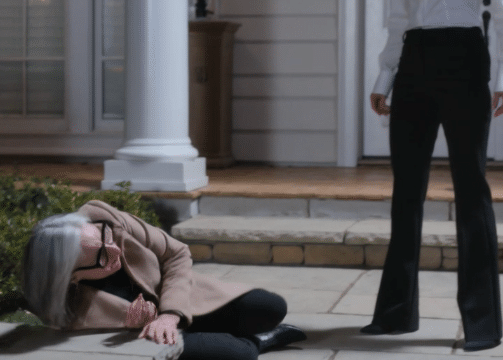
Water spilled across the polished floor beneath the chandelier, spreading in a thin silver sheet around the young maid’s skirt as she fell hard beside it. Her dark green and white uniform twisted under her knees. One hand braced against the marble. The other pressed against the floor as if she could hold herself together through sheer stillness.
Above her, Mrs. Vivian Ashford stood breathing hard.
Her beige dress and apron made her look like the keeper of the house, but her eyes held no warmth. Styled dark hair. Tight jaw. Hands still lifted from the shove she had just delivered.
“Get out of here, trash!” Vivian shouted.
Two men in suits stood near the back of the foyer, frozen beneath the white columns. Neither moved. One looked as if he wanted to step forward and could not remember how. The other stared at the fallen girl and then at Vivian with horror he was too afraid to voice.
The maid said nothing.
Her name was Isabel.
At least, that was the name Vivian used when she called for someone to scrub floors, polish silver, or carry trays.
“People like you dirty my house,” Vivian said, leaning down as if the girl on the floor were a stain she could command away.
Isabel’s shoulders tightened.
She looked at the single bucket lying beside her, the handle still trembling from the fall. It seemed absurd that the object had made more noise than she did. Her breath shook, but she swallowed it back.
Then footsteps sounded outside.
Heavy.
Measured.
Military.
Vivian turned toward the open front door.
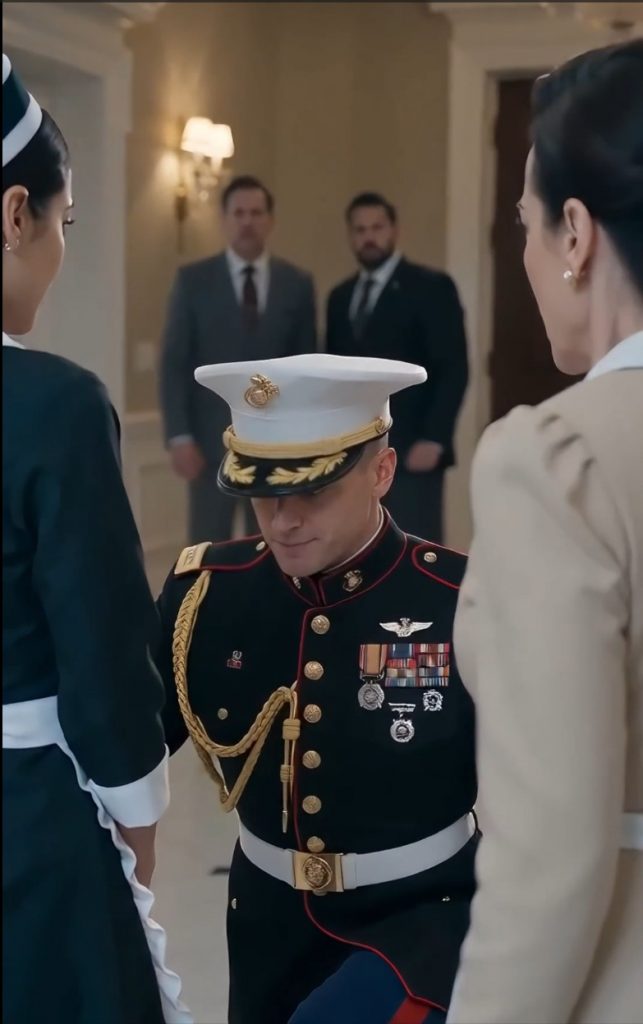
A green military vehicle sat in the driveway beyond the threshold, impossible against the elegant white house and manicured hedges. A man in full Class A service dress stepped through the doorway, medals catching the daylight, posture straight enough to silence the room before he spoke.
He did not look at Vivian first.
He walked directly to Isabel.
The maid slowly pushed herself to her feet, stunned and wary.
The soldier stopped in front of her.
Then he lowered himself onto one knee.
His voice was calm, formal, and heavy with apology.
“Miss, please forgive us for being late.”
Vivian’s face changed.
The two witnesses forgot to breathe.
And Isabel, still standing beside the fallen bucket, looked down at the soldier as if the floor beneath her had shifted.
Because no one in that house had ever knelt to her before.
Act II
Ashford House had always belonged to men in uniform.
Portraits lined the upstairs corridor: generals, colonels, decorated officers with hard eyes and polished buttons. The house had hosted officers’ dinners, charity balls, defense ministers, and memorial receptions where grief wore black silk and spoke quietly beside crystal glasses.
Vivian married into that history.
She never earned it.
Her late husband, General Edmund Ashford, had been twenty-seven years older than she was and nearly finished with public life when she became his second wife. The house came with him. So did the staff, the portraits, the old military friends, and the stories Vivian smiled through without understanding.
But the general had one grief even she could not decorate.
His daughter.
Maribel Ashford.
Lost as an infant during a period of chaos after an overseas evacuation, when Edmund was stationed abroad and his first wife, Lucia, traveled with a humanitarian convoy. The official file said the convoy was separated. The mother died. The child vanished into a refugee aid system that collapsed before names could be verified.
For decades, Edmund searched.
Quietly at first.
Then obsessively.
He hired investigators. Wrote letters. Sent money to clinics, orphanages, consulates, aid workers, retired officers, anyone who might have seen a baby girl with a crescent-shaped birthmark beneath her left collarbone and a silver medallion engraved with the Ashford crest.
Vivian hated the search.
Not because she feared heartbreak.
Because she feared an heir.
After Edmund’s health failed, Vivian took control of the house, the calendar, the staff, the stories. She told visitors the general had made peace with the loss. She told lawyers his mind was clouded whenever he mentioned Maribel. She told herself that grief was not proof.
But Edmund had not made peace.
Three months before his death, he received a letter from a retired military nurse named Sister Helena Ward. She had found records from a small border clinic destroyed years earlier. A child had been admitted under the temporary name Isabel. No surname. No family. No papers beyond a medallion later confiscated by a local official.
The child survived.
Then disappeared into domestic labor contracts.
Edmund tried to travel.
Vivian stopped him.
The letter vanished from his study.
And a year later, a young woman named Isabel arrived at Ashford House looking for work.
Vivian recognized the birthmark before Isabel even knew she had been seen.
It appeared one morning when the maid bent to lift laundry and the collar of her uniform slipped.
A small crescent beneath her left collarbone.
Vivian’s first instinct was panic.
Her second was control.
She hired Isabel permanently.
Kept her close.
Kept her tired.
Kept her too busy to ask questions about the old portraits, the locked study, or why Vivian sometimes stared at her like a ghost had learned to mop floors.
But the dead have a way of keeping records.
And General Ashford had left one final order with the army lawyer who had served him for thirty years.
If Maribel was found, the house was to return to her.
And the soldier now kneeling in the foyer had come to execute that order.
Act III
His name was Major Adrian Cole.
He had been a young lieutenant when General Ashford saved his career after a disastrous convoy ambush. Later, when Adrian’s own father died, the general helped pay for his sister’s schooling and never mentioned it again.
To Adrian, Edmund Ashford was not a portrait.
He was a debt.
That was why he spent two years following the trail Vivian tried to bury.
The nurse’s letter. The missing clinic file. The domestic placement records. A medallion sold to a pawn dealer and later recovered from a collector who did not know what it meant. The DNA sample Edmund had left with his lawyer because, near the end, he trusted documents less than blood.
All of it led to Isabel.
The military vehicle in the driveway had not come for ceremony.
It came because the army legal office, the Ashford estate attorney, and two witnesses were supposed to arrive together that morning and formally identify the general’s daughter.
They were late because Vivian’s front gate had been locked.
Not jammed.
Locked.
One of the men in suits standing in the foyer was her private attorney. The other was a trust representative she had summoned early, hoping to finalize a transfer of house assets before the military team arrived.
She had miscalculated by minutes.
Only minutes.
Enough time to shove the girl.
Enough time to reveal herself.
Major Cole rose slowly from one knee and turned toward Vivian.
The entire foyer seemed to tighten.
Vivian lifted her chin, but the color had left her face.
“What is this?” she asked.
Adrian’s voice stayed formal.
“This is the conclusion of General Edmund Ashford’s final search.”
Isabel looked at him, confused.
“My search?”
Adrian softened instantly.
“Your father’s.”
The word struck her so gently and so violently at once that she almost reached for the fallen bucket to steady herself.
“My father?”
Vivian snapped, “Don’t fill her head with nonsense.”
Adrian looked at her then.
Not angrily.
With the kind of calm that made anger unnecessary.
“Mrs. Ashford, the army records office, the estate court, and the Ashford Trust have verified Miss Isabel’s identity.”
Vivian’s fingers curled into the fabric of her apron.
“That’s impossible.”
Adrian reached inside his jacket and removed a sealed folder.
“No,” he said. “It was delayed.”
He turned back to Isabel.
“Your birth name is Maribel Lucia Ashford.”
The chandelier lights blurred in Isabel’s eyes.
Behind her, the single bucket lay on its side, still leaking water across Vivian’s perfect marble.
And for the first time, the house looked less like Vivian’s home than a place waiting to remember its rightful daughter.
Act IV
Vivian laughed once.
It was a terrible sound.
Thin, sharp, and already afraid.
“You expect anyone to believe that this maid is Edmund’s daughter?”
Isabel flinched at the word maid, not because the work shamed her, but because Vivian used it like a chain.
Major Cole opened the folder.
The trust representative took one step forward, suddenly very interested in preserving his own innocence.
Adrian laid the documents on the small marble console beneath the staircase.
Birth records reconstructed from military evacuation files.
The clinic intake page signed by Sister Helena.
A photograph of Lucia Ashford holding an infant wrapped in a blue blanket.
A copy of the medallion engraving.
And a sealed DNA report confirming Isabel as Edmund Ashford’s biological child.
Vivian stared at the papers as if they were insects crawling across the marble.
“This proves nothing,” she said.
The private attorney beside her whispered, “Vivian.”
She turned on him.
“Quiet.”
That was when Isabel spoke.
Her voice was low, but the foyer heard every word.
“You knew.”
Vivian looked at her.
Isabel’s face had changed.
Not hardened.
Cleared.
Like a window after rain.
“You knew before today.”
Vivian said nothing.
Isabel touched the collar of her maid uniform where the crescent birthmark was hidden beneath fabric.
“You saw it,” she whispered.
Major Cole turned toward Vivian.
The attorney closed his eyes.
That was confirmation enough.
Vivian stepped back.
“I gave her work.”
“You gave me fear,” Isabel said.
The words came quietly.
But they shook the room more than Vivian’s shouting ever had.
“You gave me floors to scrub in a house where my father’s portrait hung upstairs. You watched me carry trays past his medals. You let me sleep in the laundry room below the stairs while calling this your house.”
Vivian’s mouth trembled.
“I protected what was mine.”
Adrian’s voice sharpened for the first time.
“It was never yours.”
The two witnesses finally moved.
Not heroically.
Late.
But late was better than forever.
The trust representative gathered the documents with shaking hands and said, “Major Cole is correct. Under the general’s final will, the primary residence and personal estate transfer to Maribel Lucia Ashford upon verification.”
Vivian stared at him.
“You work for me.”
“No,” he said, voice unsteady. “I worked for the trust.”
Outside, another vehicle door closed. Two more officials stepped into view near the military car.
Vivian looked toward the door, then at Isabel, then at the bucket on the floor as if the small, ordinary object had betrayed her.
Her lips parted.
“How?” she whispered.
Isabel looked at her calmly.
“Because he never stopped looking.”
Act V
Vivian left Ashford House before sunset.
Not in chains.
Not dragged down the steps.
She left surrounded by lawyers, silence, and the unbearable knowledge that every insult she had thrown at Isabel had landed in a house that legally belonged to the girl she degraded.
The investigation came afterward.
It always did in families where cruelty learned to use paperwork.
The missing letter from Sister Helena was found in Vivian’s locked writing desk. So were copies of old search reports, bank records showing payments to a private investigator Vivian later dismissed, and a note in Edmund Ashford’s handwriting.
If you find her after I am gone, tell her I am sorry I was late.
Isabel read that note alone in the study.
Major Cole waited outside the door.
She did not cry loudly.
She had spent too many years learning how to keep pain quiet. Instead, she sat in her father’s leather chair, held the paper with both hands, and let tears fall where no one demanded she explain them.
Her father had searched.
That did not return the years.
But it changed their meaning.
She had not been abandoned by him.
She had been hidden from him.
The difference did not heal everything, but it gave grief somewhere honest to stand.
In the weeks that followed, Ashford House changed faster than anyone expected.
The laundry room below the stairs was emptied first.
Isabel stood in its doorway while two workers carried out the narrow cot where she had slept. She watched the bucket from that day placed beside the door, cleaned now, dented along one edge from the fall.
Major Cole asked if she wanted it thrown away.
She shook her head.
“No.”
He did not ask why.
Some objects are not worth keeping because they are beautiful. They are worth keeping because they tell the truth when people try to soften it.
Vivian’s portrait was removed from the sitting room.
General Ashford’s portrait remained, but Isabel moved it from the upstairs corridor to the foyer, not as a shrine, but as an answer. Beneath it, she placed a small brass plaque with his final words.
Tell her I am sorry I was late.
Major Cole visited often during the legal transition.
At first, Isabel found his formality strange. He stood when she entered. He addressed her as Miss Ashford. He asked permission before opening folders. He never forgot that the first time she met him, he had seen her on the floor.
One afternoon, she finally said, “You don’t have to keep apologizing.”
He looked at her.
“Yes, I do.”
“You weren’t the one who shoved me.”
“No,” he said. “But I serve the institution that promised your father we would find you. Promises matter.”
Isabel thought about that.
Then she nodded.
“They do.”
The house staff returned under new contracts.
No one slept below the stairs anymore.
The old servant quarters were renovated into guest rooms for families of deployed soldiers receiving medical treatment in the city. The formal dining room became a place for monthly dinners honoring veterans, widows, caretakers, and children of service members who had grown up with absence at the table.
Isabel did not become grand overnight.
She still woke early. Still folded towels when nervous. Still reached to clean spills before remembering she could ask for help. Power did not erase habit. It only gave her room to choose.
On the anniversary of her father’s death, she held the first public gathering at Ashford House.
No champagne towers.
No cold speeches.
Just rows of chairs beneath the chandelier, the front door open, and the green military vehicle parked outside in ceremonial tribute.
Major Cole stood near the entrance.
The bucket from the day of the shove sat near the console table, not hidden, not polished into something it was not. Beside it was a small card.
One bucket fell here. One life was not defined by it.
People paused to read it.
Some looked uncomfortable.
Good.
Isabel had learned discomfort was sometimes the beginning of decency.
When it was her turn to speak, she stood where Vivian had once stood over her.
The marble beneath her feet shone.
“My father searched for me,” she said. “But this house did not know how to welcome me when I arrived.”
No one moved.
“I was treated as if work made me lesser. As if a uniform could erase a name. As if someone holding a bucket could not also be someone’s daughter.”
Her voice trembled once.
She let it.
Then she continued.
“I will not be ashamed of the work I did here. I am ashamed only of the people who believed work made cruelty acceptable.”
Major Cole lowered his eyes.
The staff listened.
The witnesses from that first day stood near the back, both pale with memory. One had already given testimony against Vivian. The other had resigned from her service and written Isabel a letter he was too ashamed to deliver in person.
She read it anyway.
She accepted the truth in it.
Forgiveness could wait.
Truth had arrived first.
Months later, Isabel walked through the foyer alone in the early morning. Sunlight spilled through the open door. The military vehicle was gone now. The mansion was quiet. The chandelier hung above her like frozen rain.
She stopped beside the single bucket.
For a long moment, she saw herself on the floor again.
The shove.
The shout.
People like you dirty my house.
Then she saw what came after.
A soldier kneeling.
A name returned.
A father’s apology across time.
A house learning who it had wronged.
She picked up the bucket by its handle and carried it to the garden.
Not to throw it away.
To fill it with water.
There were new white roses planted near the front path, the kind her mother Lucia had loved in the only photograph Isabel had of her. The soil was dry from a hot week, and the flowers needed care.
So Isabel watered them.
Slowly.
Carefully.
Without shame.
Because the bucket had never made her low.
The cruelty had.
And now, beneath the open sky outside the mansion that had tried to hide her, Maribel Lucia Ashford stood in the morning light and understood something Vivian never had.
A house is not owned by the person who shouts the loudest inside it.
It belongs to the one who finally makes it worthy of being called home.