Act I
The cane left his hand before the lobby understood the danger.
One sharp yank.
A scrape of wood against marble.
Then the man lost his balance.
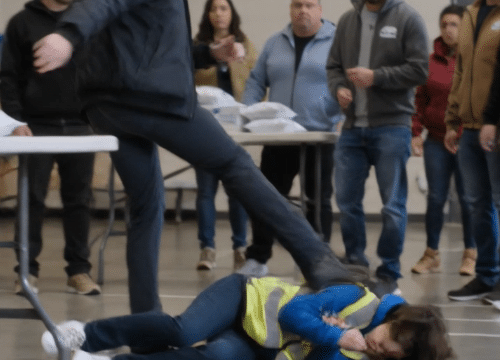
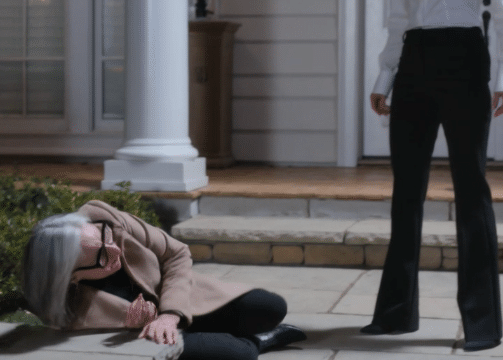
His right leg failed first, folding beneath him as he reached for support that was no longer there. His jacket twisted at the shoulder, his shoes slid across the polished floor, and he fell hard in front of the reception desk.
The sound traveled through the hotel like a dropped plate.
Staff members froze in their neat row behind the counter. A bellman stopped with one hand on a luggage cart. Somewhere near the elevators, a guest whispered, “Oh my God.”
The woman in the white suit did not move to help.
She stood above him with her dark hair perfectly styled, name tag shining on her lapel, black pencil skirt sharp beneath the bright lobby lights.
Her name was Marissa Crane.
General Manager of The Aurelia Grand.
She pointed down at the man as if he had offended the marble by touching it.
“Don’t you dare drag your poverty into this hotel,” she snapped. “People like you contaminate places like this.”
The man on the floor took one slow breath.
He wore jeans, a dark jacket, and the tired expression of someone used to pain but not humiliation. His cane lay just out of reach. He looked at it, then at the staff, then back at the manager.
He did not shout.
He did not beg.
That made the silence worse.
Marissa turned toward the front doors, irritated by the attention gathering around them.
“You can crawl back outside,” she said.
Then the hotel entrance opened.
A car door slammed beyond the glass.
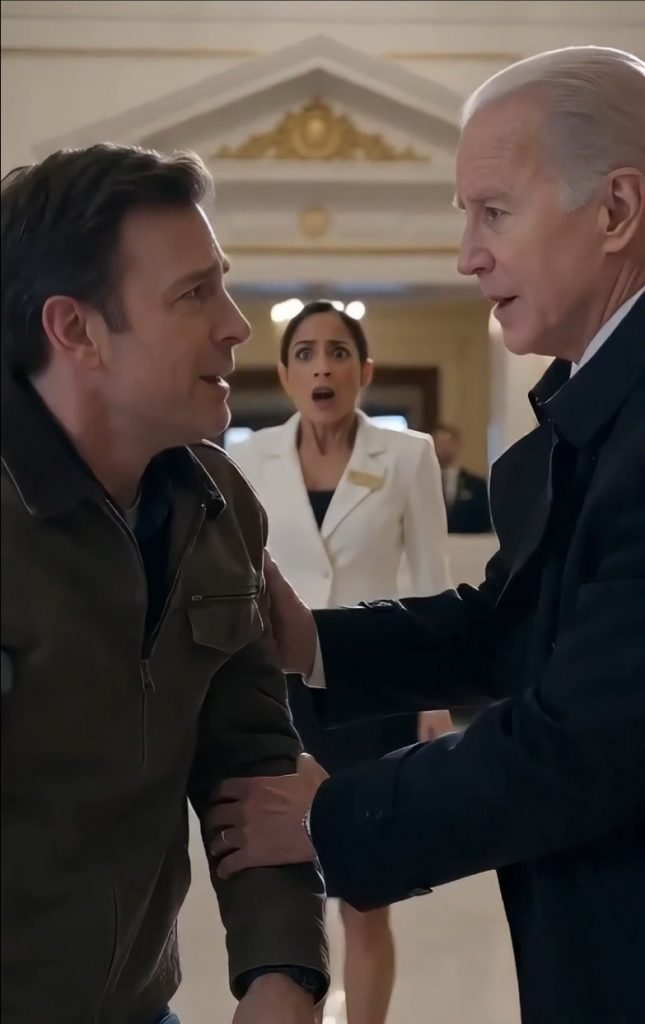
Men in dark suits entered first, scanning the lobby with disciplined eyes. Behind them came an older man in a black trench coat, silver hair neat, face pale with controlled alarm.
He walked straight toward the man on the floor.
The staff stepped back.
Marissa frowned.
The older man knelt beside the fallen guest, one hand steadying his shoulder with unmistakable respect.
“Mr. President,” he said, voice low and formal, “forgive our late arrival.”
The lobby went silent.
Marissa’s face changed.
The man she had thrown to the floor lifted his eyes, calm despite the pain.
And the hotel manager whispered the title like it had become a sentence.
“Mr. President?”
Act II
President Elias Monroe had learned to hate grand entrances.
He had endured too many of them.
Flags. Cameras. Marble steps. Brass bands. Men and women applauding before he had said a single useful word. Every room he entered became theater, and every person in it became careful.
That was why he sometimes moved without announcement.
Not recklessly. Not alone in the true sense. His security detail was never far. But close enough to observe, far enough to let him see the world before the world corrected itself for his title.
He called it walking the country.
His staff called it a security headache.
The cane had become part of those walks after the accident.
Two years earlier, during a storm visit to a flooded coastal town, a temporary platform collapsed beneath him and several rescue workers. The injury ended his old stride. It did not end his presidency. Still, the cane changed how strangers looked at him when they did not know his name.
Some became kind.
Some became impatient.
Some looked through him completely.
Elias considered those moments more honest than polling data.
That week, The Aurelia Grand was hosting an international summit on accessible infrastructure, public health, and disaster recovery. The irony would not arrive until later. For now, the hotel had been swept, polished, secured, and instructed to welcome foreign ministers, cabinet officials, press teams, and presidential guests.
But Elias had arrived through a side entrance thirty minutes ahead of schedule.
He wanted to inspect the hotel’s accessibility route himself.
The official plan said the lobby was fully accessible.
The reality was different.
The ramp near the east entrance was blocked by decorative planters. The automatic door opened too quickly and closed too heavily. The concierge desk had no lowered section. And when Elias paused near the reception area to ask for directions to the summit hall, Marissa Crane saw only a casually dressed man with a limp standing too close to her perfect lobby.
She did not recognize him.
That was not her sin.
Her sin was deciding recognition should determine respect.
“Sir,” she had said, voice already cold, “this area is restricted.”
Elias looked at her name tag.
“I’m expected upstairs.”
Her eyes moved over his jacket, jeans, cane, and worn leather shoes.
“By whom?”
He almost told her.
Then he saw the staff behind her.
Young receptionists. A bellman. A concierge trainee. All watching their manager to learn what kind of hotel they worked in.
So he answered simply.
“A meeting.”
Marissa smiled without warmth.
“Not in this hotel.”
He asked to speak with security.
She reached for his cane instead.
Act III
The presidential aide’s name was Victor Hale, and he had served three administrations before Elias chose him as chief of staff.
Victor had seen scandals, crises, wars of ego, and men who could smile while lying to entire rooms. He was not easily shaken.
But when he entered the lobby and saw the President on the marble floor with his cane out of reach, something in his face went still.
Not cold.
Worse.
Controlled.
“Help him,” Victor said.
Two security officers moved immediately, but Elias lifted one hand.
“Slowly.”
They obeyed.
That was when the hotel staff began to understand this was not merely an important guest.
This was command.
Real command.
Not the kind Marissa had borrowed from her title and aimed downward.
Victor picked up the cane himself and placed it in Elias’s hand.
The President accepted it, then pushed himself carefully upright with the help of one officer. He winced once, small enough that most people missed it.
Marissa did not.
Her panic deepened.
“Sir,” she began, “I had no idea—”
Elias looked at her.
She stopped.
The lobby seemed to shrink around that silence.
“You had no idea I was President,” he said.
Her lips trembled.
“Yes. I mean, no. I mean, I thought—”
“You thought I was poor.”
She swallowed.
“I thought you were unauthorized.”
“You pulled away my cane.”
“I was trying to maintain hotel standards.”
Victor’s eyes hardened.
Elias turned slightly toward the staff.
“Is that what this hotel teaches?”
No one answered.
The youngest receptionist began crying silently.
A security officer from the presidential detail spoke into his sleeve. Within seconds, the front entrance was secured, the reception area cleared, and the hotel’s own security director came running from a side corridor with terror written plainly across his face.
“Mr. President,” he said, breathless, “we are deeply—”
Elias raised his hand.
“Do not apologize before you know what you are apologizing for.”
The man went quiet.
Elias turned back to Marissa.
“What is your name?”
She looked down at her lapel as if she had forgotten.
“Marissa Crane.”
“Ms. Crane, why did you touch my cane?”
The question was simple.
That made it impossible to dodge.
Her eyes darted toward Victor, toward security, toward the staff who had watched her do it.
“I thought he was refusing to leave,” she said, voice shrinking.
Victor stepped closer.
“You mean the President.”
Marissa flinched.
Elias corrected him gently.
“No, Victor. She means the disabled man.”
That landed across the lobby with more force than anger.
Because it was the truth beneath the reveal.
Act IV
The hotel owner arrived twelve minutes later.
He came through the side entrance in a navy suit, hair disheveled, face gray. His name was Lawrence Bell, and his family had spent seventy years turning The Aurelia Grand into a symbol of wealth, diplomacy, and polished discretion.
He found no discretion waiting for him.
Only witnesses.
His manager.
His staff.
The President standing with a cane in one hand and quiet disappointment in his eyes.
“Mr. President,” Bell said, “I cannot express my regret.”
Elias studied him.
“Then don’t begin with regret. Begin with facts.”
Bell nodded quickly.
“Of course.”
Elias looked toward the lobby floor.
“I entered your hotel using an approved guest route. I asked for directions. Your manager judged my appearance, removed my mobility aid, caused me to fall, and verbally humiliated me in front of your employees.”
Marissa covered her mouth.
Bell looked as if each sentence struck him separately.
Elias continued.
“Your staff froze. Your accessibility route is blocked. Your public desk is not designed for wheelchair users. And this hotel is hosting a summit on accessibility tomorrow morning.”
No one moved.
Outside, beyond the glass doors, camera crews had begun gathering at the barricade, not yet knowing the full story, only sensing that something inside the lobby had gone very wrong.
Bell turned sharply to Marissa.
“You’re suspended immediately.”
Elias’s voice cut in.
“No.”
Bell froze.
The President’s expression did not change.
“Do not perform accountability for me. Do it properly.”
Victor glanced at him, understanding.
Elias turned to the staff.
“Every person who witnessed this will give a statement. The footage will be preserved. Hotel leadership will cooperate with my security team and local authorities. Ms. Crane will be removed from duty, but this does not end with one employee.”
Bell nodded, shaken.
“Yes, Mr. President.”
Elias looked back at the reception row.
A bellman, barely twenty, stepped forward.
“I should have helped,” he said.
Marissa stared at him as if betrayed.
The bellman did not look at her.
“I saw her take the cane. I knew it was wrong.”
Another staff member whispered, “Me too.”
Then another.
The silence that had protected Marissa began to break apart.
Elias listened to all of them.
Not with satisfaction.
With sadness.
Because he knew fear when he saw it. Not fear of him. Fear of hierarchy. Fear of losing jobs. Fear of stepping out of line in a building where politeness had been trained to flow upward only.
Finally, Marissa spoke again.
“I’m sorry,” she said, voice cracking. “I’m so sorry, Mr. President.”
Elias looked at her for a long moment.
“You still don’t understand,” he said.
Her face crumpled.
He tapped his cane once against the marble.
“You are sorry because I am President. You should be sorry because I was on the floor.”
Act V
The summit did not move to another hotel.
Elias insisted on staying.
His team argued. Victor argued the longest. The optics were dangerous, the security complications unnecessary, and the emotional cost obvious to anyone who had seen the President’s hand tremble for half a second when he thought no one was looking.
But Elias refused.
“If we leave,” he said, “they will call it an incident. If we stay, it becomes a lesson.”
The next morning, the lobby looked different.
Not because the marble had changed.
Because the hotel could no longer pretend polish was the same as dignity.
The decorative planters blocking the ramp were gone. Temporary accessibility desks had been installed. Staff stood not in a decorative row, but at assigned support points. The cane mark on the marble had been cleaned, though several employees admitted later they wished it had stayed.
Marissa Crane was not there.
An outside investigator had already begun reviewing guest complaints from the past five years. What surfaced was ugly and familiar. Disabled guests moved to inferior rooms. Poorly dressed visitors questioned near elevators. Service workers removed from common areas during VIP arrivals. Staff rewarded for keeping the lobby “visually elevated,” a phrase that sounded elegant until people understood what it meant.
The President opened the summit himself.
Not from the main stage.
From the hotel lobby.
Cameras faced him as he stood with his cane beside the reception desk where he had fallen less than twenty-four hours earlier.
He did not name Marissa.
He did not need to.
“A country is judged not only by how it welcomes power,” he said, “but by how it treats a person it has not yet identified.”
The room was silent.
“Yesterday, I was reminded that disability does not make a person invisible. Systems do. Fear does. Class prejudice does. And sometimes, beautiful buildings hide ugly habits behind polished floors.”
Victor stood off to the side, eyes fixed ahead.
Elias continued.
“The lesson is not that a hotel manager mistreated a president. The lesson is that she mistreated a man and only became afraid when she learned his title.”
That line traveled farther than the hotel.
By evening, it was on every major broadcast.
But inside The Aurelia Grand, the more important changes happened away from cameras.
Bellmen received authority to report managers. Accessibility audits became monthly. Guest conduct policies were rewritten. Staff training no longer used soft words like comfort concern when the issue was discrimination. The hotel created a direct support office for disabled guests, designed with actual disabled travelers instead of executives guessing from conference tables.
Lawrence Bell met privately with the young bellman who had spoken up.
“Why didn’t you move?” he asked, not cruelly.
The young man looked ashamed.
“Because she was my boss.”
Bell nodded.
“That answer is why we have work to do.”
Months later, Elias returned to The Aurelia Grand without announcement.
Not for a summit.
For a private dinner with veterans injured in public service and organizers who had spent years fighting for accessible cities before politicians discovered the issue was popular.
He entered through the front door.
The ramp was clear.
The doors stayed open long enough.
A receptionist looked up and smiled before recognition hit.
“Good evening, sir. Welcome to The Aurelia Grand. Would you like assistance, or would you prefer space?”
Elias paused.
Then smiled.
“That is an excellent question.”
Her face brightened.
“Thank you, sir.”
He crossed the lobby slowly, cane tapping against marble.
Not hidden.
Not hurried.
Not ashamed.
Near the reception desk, a small brass plaque had been installed. It did not mention his name. He had refused that. Instead, the plaque held one sentence chosen by the hotel staff.
Respect must arrive before recognition.
Elias stood before it for a moment.
Victor, walking beside him, said quietly, “You approved this?”
“No.”
“Do you dislike it?”
The President looked across the lobby.
A wheelchair user spoke with a concierge at a lowered desk. A delivery worker asked directions without being chased from the floor. A child watched the chandelier while her father checked in. A housekeeper walked through the lobby carrying folded towels, and no one treated her presence as a stain on luxury.
“No,” Elias said. “I think they listened.”
At dinner that night, someone asked whether he had forgiven Marissa Crane.
Elias took his time answering.
“Forgiveness is personal,” he said. “Accountability is public.”
The room accepted that.
So did he.
He did not think often about Marissa herself anymore. He thought about the staff who had frozen. The young bellman who found his voice. The receptionist who learned to ask before assuming. The hotel owner who finally understood that a building could be five-star and morally cheap at the same time.
And sometimes, late at night, he thought of the moment his cane left his hand.
The sudden emptiness.
The fall.
The cold marble.
The insult.
People like you contaminate places like this.
He remembered it not because it broke him.
It did not.
He remembered it because it revealed the work still waiting.
That was the burden of power when used properly. Not to punish one frightened manager and call the story finished. But to force every polished room to ask who it had been built to exclude.
Years later, guests would still hear whispers about the day a hotel manager pulled away a disabled man’s cane and learned too late that he was the President.
They would remember the gasp.
The security arrival.
The aide kneeling.
The manager’s terrified question.
Mr. President?
But Elias always believed the title was the least important part.
The man had already deserved help.
Before the aide.
Before the security.
Before the country knew.
Before anyone in the lobby realized power had fallen on the marble and was waiting to see who would bend down first.