Act I
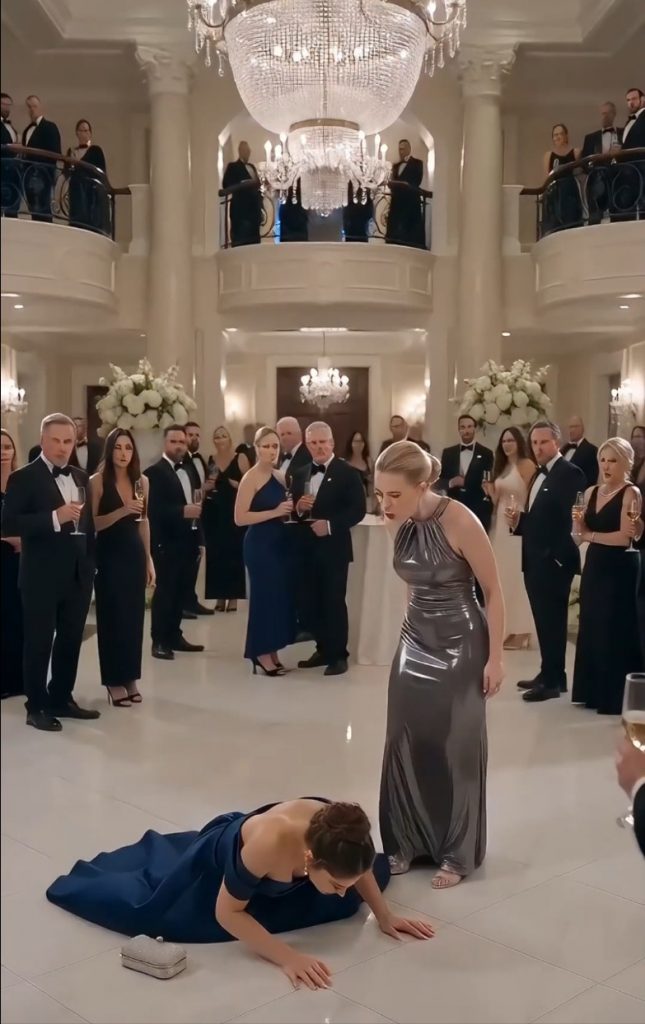
Rosa hit the marble before the music stopped.
Her purse slipped from her hand, bounced once beside her navy gown, and slid beneath the edge of a white floral arrangement. The polished ballroom floor reflected everything with cruel clarity: the crystal chandeliers, the startled faces, the blonde woman standing over her as if she had simply moved an obstacle out of the way.
“Move,” the blonde woman snapped. “You don’t belong in this room.”
Gasps rippled through the mansion ballroom.
Champagne glasses froze halfway to lips. Men in tuxedos turned from quiet conversations. Women in silver, black, and ivory gowns looked over their shoulders, pretending surprise could hide the fact that most of them had watched the shove happen.
Rosa stayed on the floor for a breath too long.
Not because she could not stand.
Because humiliation has weight.
The blonde woman stepped closer, her sleeveless metallic gown catching the chandelier light like a blade. Her slicked-back hair did not move. Her long silver earrings swayed as she pointed toward the far wall.
“Stand to the side,” she said. “Girls like you. Don’t embarrass this room. You stain it.”
A man nearby laughed.
Not loudly.
Worse.
Softly, as if Rosa’s fall were a private joke he was refined enough not to enjoy too openly.
Rosa lifted her eyes toward him. He wore a black tuxedo and a polished smile that belonged to men who always found the safest side of cruelty.
His name was Adrian Bell.
And once, Rosa had almost trusted him.
The blonde woman noticed Rosa looking at him and smiled wider.
“Don’t look at him,” she said. “He invited people like us. Not whatever you are.”
Rosa’s fingers closed around the strap of her fallen purse.
Then came the cane.
Tap.
Tap.
Tap.
The sound descended from the grand marble staircase beneath the chandeliers.
The room turned.
An elderly man in a white tuxedo jacket stepped into view, his wooden cane striking each stair with measured authority. His white hair gleamed under the crystal light. His face was calm, but the anger in his eyes made the entire ballroom stiffen.
“Stand down,” he said.
The blonde woman turned, irritated.
Then the announcement came over the ballroom speakers.
“Ladies and gentlemen, the owner of the company has arrived. Please welcome Rosa.”
The room went silent.
Rosa rose from the floor.
The blonde woman lifted one hand, still ready to strike again.
Then her body locked.
Her face drained.
Because the woman she had thrown to the floor was no guest.
No assistant.
No mistake.
She was the reason the mansion doors had opened at all.
Act II
Before that night, Rosa Marquez had been a rumor in her own company.
People knew the name.
They did not know the woman.
Marquez Bellamy Group had begun forty years earlier as a family-owned shipping and development firm. By the time it became a luxury real estate empire, most employees knew only the portraits in the headquarters lobby: old men in suits, serious signatures, founding dates engraved in brass.
Rosa’s mother, Elena Marquez, had been the real mind behind the company’s survival.
She handled the contracts no one else understood. She saved the firm twice from bankruptcy. She knew which partners lied by studying the pauses before they answered questions. But Elena lived in a world that praised men for vision and women for support.
So when she died, the public assumed control passed fully to her longtime business partner, Victor Bellamy.
It did not.
Elena left her voting shares, private holdings, and final ownership rights to Rosa.
Quietly.
Legally.
Completely.
Rosa was twenty-four then, grieving too hard to sit at a board table surrounded by men who called her “sweetheart” and asked if she wanted someone to explain the documents. Victor Bellamy offered to remain chairman until she felt ready.
At first, Rosa accepted.
Then reports began reaching her.
Staff dismissed without severance. Minority vendors removed from contracts. Luxury events funded while employee pensions were delayed. Charity partnerships turned into photo opportunities. And Adrian Bell, Victor’s nephew, appearing in rooms where he had no authority but too much confidence.
Adrian had courted Rosa during the year after her mother’s death.
He had brought flowers. Sent long messages. Called her brilliant when she was sad enough to believe him. He spoke of legacy and family and how the company needed someone like him to “stand beside” her.
Then Rosa discovered he had been telling investors he was practically engaged to her.
Practically.
A word men like Adrian used when a woman had not agreed but they wanted the benefits of pretending she had.
Rosa ended it.
Adrian smiled when she did.
That frightened her more than anger.
“You’ll come around,” he said.
She did not.
Instead, she spent two years studying the company from the ground up. Not from executive reports. From delivery docks, hotel service corridors, vendor invoices, payroll complaints, and handwritten notes from employees who still trusted her mother’s name.
She learned who was loyal.
She learned who was afraid.
Most of all, she learned that the company had become a ballroom full of people who believed they owned what they had only been allowed to touch.
That night’s gala was supposed to celebrate a merger.
It was also supposed to introduce the new controlling owner.
Rosa had arrived early through a side entrance, wearing her mother’s pearl earrings and a navy gown that belonged to no designer anyone in the room would recognize. She wanted to see the party before the announcement.
She wanted to see who people were when they thought she was no one.
The blonde woman made that unnecessary within five minutes.
Act III
Her name was Celeste Wynn.
She was not part of the family, though she behaved as if the chandeliers hung because she had approved them.
Celeste had attached herself to Adrian Bell months after Rosa ended things with him. She was the daughter of a hotel magnate, ambitious in the polished way that made cruelty sound like confidence. She collected powerful people the way others collected jewelry, and she had been told that Adrian was rising fast.
That was enough.
By the time Rosa entered the ballroom, Celeste had already imagined herself at the center of the company’s future.
Adrian helped her believe it.
He told her Rosa was unstable.
Too emotional.
Too inexperienced.
A legal heir in name only.
He told her Victor Bellamy still controlled the real power and that, once the merger passed, the company would need someone elegant beside him to reassure investors.
Celeste heard the word elegant and built a throne around it.
Then she saw Rosa near the center table.
The founder’s table.
Rosa had only been looking at the place card.
Elena Marquez.
Her mother’s name, printed in gold.
The sight had stopped her.
For a moment, Rosa was not the hidden owner of a billion-dollar company. She was simply a daughter standing in a room her mother should have been alive to enter.
That was when Celeste came up behind her.
“Excuse me,” Celeste said. “That table is reserved.”
Rosa turned.
“I know.”
Celeste’s eyes moved over her gown, her curls, her purse, her pearl earrings.
“And who are you with?”
Rosa almost answered.
Then she saw Adrian watching from behind Celeste’s shoulder.
Smiling.
Waiting.
Not confused.
Not surprised.
Waiting to see what Rosa would tolerate.
So Rosa said only, “My family.”
Celeste laughed.
“Not this family.”
Then came the shove.
Now, as the announcement echoed across the ballroom, Celeste’s raised hand trembled in the air.
Rosa stood steady in front of her.
The elderly man with the cane reached the bottom of the staircase.
Sebastian Vale, the company’s retired general counsel and Elena’s oldest friend, looked first at Rosa’s fallen purse, then at Celeste’s frozen hand.
His voice stayed calm.
“Lower it.”
Celeste did.
Slowly.
The whole ballroom watched her arm fall to her side.
Act IV
Adrian moved before anyone else did.
He stepped forward with both hands lifted, smile rearranging itself into concern.
“Rosa,” he said softly, “there’s been a terrible misunderstanding.”
Rosa looked at him.
That was all.
His smile weakened.
Sebastian Vale walked toward her with his cane, each tap louder than the whispers trying to rise around the room.
He stopped beside Rosa.
“Are you hurt?”
“No,” she said.
Her voice was controlled, but her cheek was wet. She had not noticed the tear until the air touched it.
Celeste saw it too.
For one second, shame almost reached her.
Then fear swallowed it.
“I didn’t know,” she said quickly. “Nobody told me who she was.”
Rosa turned.
“You knew I was a person.”
The sentence traveled through the ballroom and found every guilty face.
Celeste’s mouth opened.
No answer came.
Sebastian faced the crowd.
“Let the record reflect that the owner of Marquez Bellamy Group was physically assaulted and publicly insulted in a room full of senior executives, investors, and partners.”
A cold murmur passed through the guests.
Victor Bellamy appeared near the elevated walkway, face tight, already calculating damage.
“Sebastian,” he called. “This is not the time.”
Rosa lifted her eyes to him.
“No,” she said. “This is exactly the time.”
The room shifted again.
Not because she shouted.
Because she did not.
Rosa walked to where her purse had fallen and picked it up. Her hand shook once, then stilled. From inside, she removed a folded document sealed with her mother’s initials.
“My mother left me this company,” she said. “Not so I could inherit its parties. So I could protect what she built.”
Victor descended two steps from the walkway.
“Rosa, we can discuss governance privately.”
“We did,” Rosa said. “For two years. Privately is where you hid everything.”
Adrian’s smile vanished.
Sebastian opened a leather folder carried by an assistant near the staircase.
Inside were board resolutions, amended trust records, internal audits, vendor complaints, and a final transfer document filed that morning.
Rosa did not need to explain all of it.
The lawyers in the room understood first.
Then the investors.
Then everyone else.
As of six o’clock that evening, Rosa Marquez had assumed full controlling authority over the company.
The gala was not a celebration of Victor’s merger.
It was the end of his control.
Act V
Celeste was escorted from the ballroom before dessert was served.
Not dragged.
Not shouted at.
Simply surrounded by security and asked to leave the property while guests pretended not to stare. She walked out in her silver gown with her head high for the first ten steps. By the fifteenth, her shoulders had begun to fold.
Adrian tried to follow Rosa into the library after the announcement.
Sebastian stopped him with the cane.
Not by raising it.
By placing the wooden tip gently in front of his polished shoe.
“Mr. Bell,” he said, “you are not invited into this conversation.”
Adrian’s face hardened.
“You’re making a mistake.”
Rosa turned at the library door.
“No. I made one when I mistook your attention for loyalty.”
The door closed before he could answer.
Inside, away from the chandeliers and champagne, Rosa finally sat down.
Her hand went to her mother’s pearl earring.
Sebastian stood beside the fireplace and waited.
He had known her since she was a child hiding under conference tables while Elena negotiated contracts above her head. He had watched her grieve. Watched her doubt herself. Watched men underestimate her because she did not mistake volume for strength.
“You handled it well,” he said.
Rosa gave a small, tired laugh.
“I was on the floor.”
“And then you stood.”
That stayed with her.
The investigations began the next morning.
Victor Bellamy resigned before the board could remove him, but the audit continued. Adrian’s unauthorized communications with investors surfaced within a week. Several contracts tied to his allies were suspended. Vendor payments were reviewed. Employee benefits frozen under Victor’s leadership were restored.
The merger died.
The company did not.
It changed.
Rosa moved the executive offices out of the mansion and opened the ground floor of headquarters to employee services, vendor meetings, and community partners. The founder’s table from the gala was moved to the main lobby, not for parties, but for monthly listening sessions where warehouse workers, cleaning crews, junior analysts, drivers, and contractors could speak directly to leadership.
Some executives hated it.
Rosa expected that.
Power rarely enjoyed being made to sit at the same table as the people it affected.
Three months later, Rosa returned to the mansion ballroom for one final event.
Not a gala.
An employee ceremony honoring her mother.
The chandeliers still glittered. The marble still shone. The columns still rose like something from an old empire. But the room felt different without guests measuring one another’s worth by invitation weight and last names.
This time, the front rows were filled with people who had built the company from below.
Receptionists.
Drivers.
Hotel staff.
Warehouse crews.
Accountants.
Retired assistants who remembered Elena Marquez staying late to help them file health claims.
Rosa wore the same navy gown.
Not because she wanted drama.
Because she wanted the room to remember.
When she stepped onto the ballroom floor, she paused at the exact place where Celeste had shoved her. There was no mark on the marble. The staff had polished it away before anyone asked.
Rosa almost wished they had not.
Then she realized the mark was not gone.
It had moved.
Into policy.
Into memory.
Into every person who had watched her fall and then heard her name announced.
She walked to the microphone.
“My mother believed ownership was not the right to stand above people,” Rosa said. “It was the responsibility to stand between people and what would harm them.”
Sebastian sat in the front row, cane resting beside his chair.
His eyes shone.
Rosa continued.
“For too long, this company rewarded people who knew how to enter ballrooms and ignored people who made sure the doors opened, the lights stayed on, and the floors were safe beneath everyone’s feet.”
A few people wiped their eyes.
Rosa looked toward the back of the room, where younger staff stood uncertainly, still not used to being addressed as if they mattered.
“That ends here.”
The applause rose slowly.
Then fully.
Not the brittle applause of rich guests approving a performance.
The kind that begins in the chest.
Afterward, a server approached Rosa near the floral arrangements. She was young, maybe nineteen, carrying an empty tray against her hip.
“I saw what happened that night,” the girl said.
Rosa nodded.
The girl looked down.
“I didn’t help.”
Rosa did not rescue her from the truth.
“No,” she said.
The girl swallowed.
“I will next time.”
Rosa’s expression softened.
“Then that night taught more than pain.”
The girl nodded, eyes wet, and went back to work standing a little taller.
Later, when the room had emptied and the chandeliers reflected across the marble like stars scattered on water, Rosa stood alone beside the founder’s table.
Sebastian joined her.
“You know,” he said, “your mother hated this room.”
Rosa laughed quietly.
“She did?”
“She said chandeliers made weak men feel historic.”
That time, Rosa laughed for real.
Then silence settled again, but gently.
She looked across the ballroom and thought of the moment Celeste’s hand froze in the air. The fear in her eyes had not come from realizing she had hurt someone. It had come from realizing the person she hurt had power.
That was the difference Rosa would never forget.
A company that needed a reveal before it recognized dignity was still a company in need of repair.
So Rosa repaired it.
Not all at once.
Not perfectly.
But deliberately.
And years later, people would still talk about the night a young woman in a navy gown was shoved to the marble floor at a luxury mansion gala, only for the announcement to reveal she owned the company.
They would talk about Celeste freezing mid-slap.
About Adrian losing his smile.
About Sebastian’s cane tapping down the staircase.
But Rosa remembered something quieter.
Her mother’s name on the place card.
Her purse hitting the floor.
The long breath before she stood.
Because that was the real turning point.
Not when the room learned who she was.
When she remembered.