Act I
The first insult was not spoken.
It was the glove.
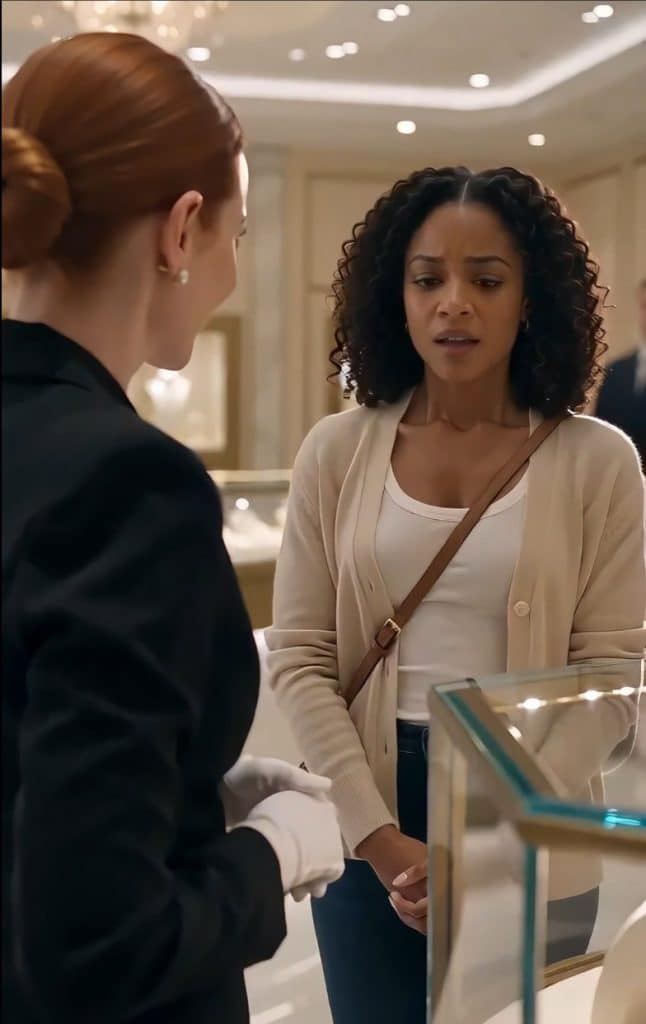
A white-gloved hand cut sharply across the glass display case and swiped Maya Bennett’s fingers away before she could finish pointing.
Maya pulled her hand back, startled but silent.
Inside the case, under warm gold light, the sapphire necklace glowed on a black velvet stand. Its center stone was deep blue, almost midnight, surrounded by small diamonds arranged like drops of rain. It was elegant, old, and so carefully made that even the air around it seemed expensive.
The clerk looked at Maya as if she had left a mark on the glass.
Her name tag read Vivienne Hart.
Red hair pinned into a perfect bun. Black blazer tailored cleanly at the waist. Pearl earrings. White service gloves. A woman trained to smile at wealth and sharpen her voice for everyone else.
“Can I help,” Vivienne said, “or are you just touching things you can’t afford?”
The boutique went still.
A security guard in a dark suit stood near the far wall, watching but not moving. Diamonds glittered beneath spotless glass. The air smelled faintly of perfume, polished wood, and quiet money.
Maya stood on the other side of the case in a beige cardigan over a white tank top, a small brown crossbody purse resting against her hip. Her natural curls framed a face that was younger than Vivienne expected and calmer than Vivienne liked.
“I just want to see that necklace,” Maya said.
Her voice was soft.
Not weak.
Soft.
Vivienne’s mouth curved.
“It costs more than your outfit.”
The silence after that was colder than the jewelry case.
A couple near the diamond bracelets looked away. The security guard shifted but still said nothing. Somewhere behind the wall, air-conditioning hummed gently, as if the boutique itself refused to acknowledge anything ugly had happened inside it.
Maya looked at the sapphire again.
For one second, the clerk thought she had won.
Then Maya lifted her chin.
“I only wanted a closer look.”
Vivienne gave a tiny laugh.
“Of course you did.”
Maya did not step back.
She only looked through the glass at the necklace, and the hurt in her eyes slowly became something else.
Recognition.
Because the necklace was not just beautiful.
It was impossible.
It should have been locked in a police evidence vault, or buried in the bottom of an estate dispute, or lost forever like everyone told her it was.
It should not have been sitting for sale under warm light in a boutique that had once ruined her mother’s life.
Act II
Maya knew the necklace before she knew its name.
As a child, she had seen it in pencil.
Her mother, Althea Bennett, kept sketches hidden in an old green folder beneath a loose board under the kitchen sink. Maya found them when she was seven, searching for birthday candles. She remembered sitting on the floor while the pipes clicked above her, staring at pages filled with sapphires, diamonds, clasp diagrams, and tiny notes written in her mother’s careful hand.
Althea had been a bench jeweler.
Not a saleswoman. Not a model in the boutique advertisements. Not one of the polished women who drifted through gold-lit rooms carrying velvet trays.
She worked in the back.
Magnifying lens. Stone tweezers. Burnishing tools. Tired shoulders. Steady hands.
Maison Valmont never put her name in campaigns, but her fingerprints lived in half the collection. She could set a stone so cleanly that light seemed to sit inside it instead of striking it from above. She could repair antique pieces that richer jewelers declared impossible.
And once, before everything collapsed, she designed a sapphire necklace for the Valmont centennial collection.
The Meridian.
That was what she called it.
A necklace inspired by the night sky over New Orleans, where Althea’s mother had taught her to recognize stars from the roof of a rented apartment during summer blackouts.
But Maison Valmont called it something else when it launched.
The Laurent Sapphire.
Named after Victor Laurent, the boutique’s European creative director, who had never once held the design pencil.
Althea protested.
Quietly at first.
Then formally.
Three weeks later, she was accused of stealing loose stones from the workshop.
No charges stuck. No evidence held. But reputation is fragile when the person defending it cannot afford lawyers in expensive suits.
Althea lost her job.
She lost clients.
She lost sleep.
When Maya was ten, her mother sold their car to keep the apartment. When Maya was twelve, Althea stopped designing altogether. The green folder disappeared, except for one page Maya had hidden inside a library book because she loved the necklace and wanted to keep one piece of her mother’s dream safe.
Althea died when Maya was nineteen.
At the funeral, only one person from Maison Valmont came.
An elderly stone setter named Mr. Orlan.
He pressed a small envelope into Maya’s hand and whispered, “Your mother never stole anything. They stole from her.”
Inside was a photograph.
Althea in the workshop, holding the unfinished sapphire necklace beside Victor Laurent.
On the back, in her mother’s handwriting, were four words.
Open the clasp someday.
For years, Maya thought it was grief speaking in code.
Then, three months before she walked into the boutique, a private collector’s catalog appeared online.
Maison Valmont was offering a “rediscovered archival sapphire necklace.”
The Meridian.
Only they still did not call it that.
And Maya saw the clasp.
The same hidden crescent shape from her mother’s sketch.
The same signature curve.
The same secret her mother had left behind.
So Maya made an appointment.
Not as a shopper.
As the legal heir to Althea Bennett’s designs.
And she came dressed exactly as herself.
Because her mother had spent a lifetime being told she only belonged in the back room, and Maya wanted to enter through the front door without costume, apology, or borrowed diamonds.
Act III
Vivienne tapped one white-gloved finger against the glass.
“Are you finished looking?”
Maya’s eyes stayed on the necklace.
“No.”
Vivienne’s smile sharpened.
“Then perhaps you’d like to tell me what payment method you imagined using.”
The couple by the bracelet case stiffened.
The guard finally glanced toward the reception alcove, uncertain.
Maya opened her purse and removed a folded sheet of paper.
Vivienne looked amused before she even read it.
“What is that?”
“My appointment confirmation.”
“With whom?”
“Mr. Desmond Hale.”
That name changed the clerk’s posture by half an inch.
Desmond Hale was not sales staff. He was the new director of Valmont’s North American estate division, brought in after rumors of forged provenance began circling the company’s archived collections.
Vivienne recovered quickly.
“Mr. Hale is very selective.”
“So am I.”
For the first time, irritation flickered across the clerk’s face.
Maya unfolded the paper and placed it on the counter, careful not to touch the glass again.
“I’m here to authenticate the sapphire necklace listed under archive item V-1907.”
Vivienne stared at her.
Then she laughed.
Short.
Disbelieving.
“You’re here to authenticate it?”
“Yes.”
“On whose authority?”
Maya met her eyes.
“Althea Bennett’s estate.”
The name meant nothing to the couple at the bracelet case.
It meant something to Vivienne.
Only a flicker, but Maya saw it.
A buried recognition.
A story staff had been told not to repeat.
Vivienne leaned closer.
“Listen carefully,” she said, voice lowering into something colder. “People come in here all the time claiming some family connection to valuable pieces. A sketch in a shoebox doesn’t make you an owner.”
Maya’s fingers tightened around the strap of her purse.
“My mother designed that necklace.”
Vivienne’s eyes moved over Maya’s cardigan, purse, jeans, shoes.
Then she said, “Your mother was workshop labor.”
The words hit harder than the earlier insults.
Maya took one slow breath.
Behind her, the boutique door opened.
A man in a charcoal suit entered with two others behind him: a woman carrying a leather document case and an older man with silver hair, walking slowly with a jeweler’s loupe hanging from a chain around his neck.
The older man stopped when he saw Maya.
His face changed.
“Maya Bennett?”
Vivienne turned sharply.
The older man stepped forward, eyes wet.
“You have your mother’s face.”
Maya swallowed.
“Mr. Orlan.”
He looked past her to the necklace in the case.
Then his expression hardened.
“Open it,” he said.
Vivienne stiffened.
“Excuse me?”
Desmond Hale approached the counter.
“Ms. Hart,” he said, calm but firm, “open the case.”
Act IV
Vivienne did not move immediately.
That was her second mistake.
Her first had been thinking Maya’s appearance told her what power she had.
Her second was thinking power only mattered when it looked familiar.
Desmond Hale placed a document on the counter.
“This boutique received notice last week that item V-1907 is subject to a provenance hold. No sale, transfer, removal, or display authorization was approved until authentication.”
Vivienne’s face lost color.
“I wasn’t told that.”
“You were emailed twice.”
The woman with the leather case opened it and removed copies of sketches, employment records, workshop photographs, and old internal memos. The boutique, once so perfectly controlled, began to feel like a room where dust had finally been disturbed.
Maya did not look at Vivienne.
She looked at the necklace.
Mr. Orlan put on his loupe.
“May I?”
Maya nodded.
Vivienne unlocked the case with hands that had begun to tremble.
The sapphire necklace was lifted from the velvet stand and placed on a black examination tray. Up close, it looked even more beautiful and more painful. The diamonds were not large, but they were set with a rhythm Maya recognized from the drawings. Tiny drops of light around a blue center, the way stars gather around the moon.
Mr. Orlan turned the necklace over.
“Here,” Maya whispered.
Her voice nearly failed.
She pointed to the clasp.
Not touching.
Just pointing.
Mr. Orlan pressed a tiny hinge hidden beneath the crescent-shaped curve.
The back of the clasp opened.
Inside, beneath the gold, was an engraving so small the naked eye could almost miss it.
A.B.
Not Victor Laurent.
Not Valmont.
Althea Bennett.
Mr. Orlan closed his eyes.
“She marked it,” he said.
Maya pressed one hand over her mouth.
For years, people had told her grief made her exaggerate. That her mother’s bitterness had infected her memory. That luxury houses did not steal from women like Althea Bennett because women like Althea Bennett were lucky to be allowed inside them at all.
But there it was.
Two letters hidden in gold.
A mother’s proof.
A daughter’s inheritance.
Desmond Hale turned toward Vivienne.
“Ms. Hart, step away from the counter.”
Vivienne’s lips parted.
“I only followed sales protocol.”
Maya finally looked at her.
“No,” she said quietly. “You followed prejudice and called it protocol.”
The boutique fell silent.
Even the security guard lowered his eyes.
Act V
The necklace was removed from display that afternoon.
Not wrapped for a buyer.
Not transferred to a collector.
Removed as evidence.
Maison Valmont’s lawyers tried to contain the matter with private language. Misattribution. Archival confusion. Unclear design lineage. The usual soft words used to sand down theft until it looked like an accident.
Maya refused.
She did not want hush money.
She wanted her mother’s name restored.
Desmond Hale, to his credit, did not fight the obvious once the clasp opened. The internal investigation uncovered more than one stolen credit. Althea Bennett’s sketches had been copied into Valmont archives under Victor Laurent’s collection notes. Several workshop artisans had signed nondisclosure agreements after being dismissed. A centennial campaign worth millions had been built partly on work that never carried the right names.
Vivienne Hart was fired within the week.
Officially for discriminatory conduct and failure to comply with a provenance hold.
Unofficially, because a viral clip from a bystander’s phone caught enough of the exchange to make the company’s polished apology look thin.
Can I help, or are you just touching things you can’t afford?
It costs more than your outfit.
The world heard the contempt clearly.
But Maya did not watch the clip more than once.
She had lived the moment. She did not need to replay her own humiliation to prove it existed.
What mattered came three months later.
Maison Valmont held a private press event in the same boutique, though the room no longer felt untouchable to Maya. The glass cases were still spotless. The gold lighting was still warm. The sapphire still glowed under velvet-black shadow.
But the plaque had changed.
THE MERIDIAN SAPPHIRE
Designed by Althea Bennett
Restored in partnership with the Bennett Estate
Maya stood in front of it wearing the same beige cardigan.
People noticed.
Some probably thought it was symbolic.
It was simpler than that.
She liked the cardigan.
Her mother would have liked that answer best.
Mr. Orlan stood beside her as Desmond Hale announced the creation of the Bennett Workshop Fellowship, funding apprenticeships for young jewelers whose work too often disappeared behind famous names. Maya had insisted the first class include bench jewelers, setters, polishers, engravers, and repair artists.
“The people in the back,” she said during planning, “are usually the ones holding the whole house together.”
When it was her turn to speak, she did not give the speech the publicist wrote.
She held her mother’s old sketch instead.
The paper was worn soft at the folds.
“My mother taught me that beautiful things can still carry ugly stories,” Maya said. “But she also believed truth was part of craftsmanship. If the setting is false, the stone never sits right.”
The room listened.
Not because she looked wealthy.
Because she had become impossible to dismiss.
She turned toward the display case.
“This necklace was not lost. It was claimed by the wrong people. My mother knew that, so she left her initials where only someone willing to look closely would find them.”
Maya paused.
“I came here asking for a closer look. That was all. And I was told I didn’t belong close enough to see.”
No one moved.
Her voice stayed steady.
“That is how theft survives. Not only through forged papers and hidden names, but through rooms that decide who deserves to ask questions.”
The applause came slowly.
Then fully.
Maya did not smile until she saw Mr. Orlan wiping his eyes.
After the event, the security guard from that first day approached her near the door. His name was Marcus, she had learned. He had stood silent while Vivienne insulted her, and he looked like he had been carrying that silence ever since.
“I should have stepped in,” he said.
Maya looked at him.
“Yes.”
He nodded.
“I know.”
The honesty mattered.
Not enough to erase the moment.
Enough to begin somewhere better.
“What will you do next time?” Maya asked.
“Step in before the customer has to defend her own dignity.”
Maya nodded.
“Then do that.”
Weeks later, the boutique changed its training, its complaint process, and its hiring practices. Not perfectly. No institution becomes decent overnight because one scandal embarrasses it. But the display cases no longer felt quite so sealed against the truth.
The Meridian Sapphire was never sold.
Maya placed it on long-term loan to a museum exhibit about hidden labor in luxury design. On opening night, she stood before the necklace with a group of students from the Bennett Workshop Fellowship.
One of them, a quiet girl with nervous hands, leaned close to the glass.
“It’s smaller than I expected,” the girl whispered.
Maya smiled.
“Most powerful things are.”
The girl looked at the tiny clasp.
“Are her initials really in there?”
“Yes.”
“Can you see them?”
“Only if someone opens it.”
That was the lesson Maya carried.
Some truths do not glitter from the front. They wait in hinges, in backs of clasps, in workshop notes, in family folders under kitchen sinks. They wait for someone patient enough, stubborn enough, and wounded enough to ask for a closer look.
Years later, people would remember the story as a dramatic reversal.
The rude clerk.
The sapphire necklace.
The hidden initials.
The public apology.
But Maya remembered the moment before all that, when she stood in a beige cardigan in a gold-lit boutique and a woman in white gloves decided she was not worth basic respect.
That was the real beginning.
Not the reveal.
Not the proof.
The judgment.
Because the necklace had never needed Maya to prove it was valuable.
People already believed that.
Maya had been the one they misjudged.
And in the end, it was not anger that opened the clasp.
It was dignity.
Quiet.
Steady.
Refusing to move away from the glass.