Act I
The boarding pass disappeared from Elena Vargas’s hand before she could take another step.
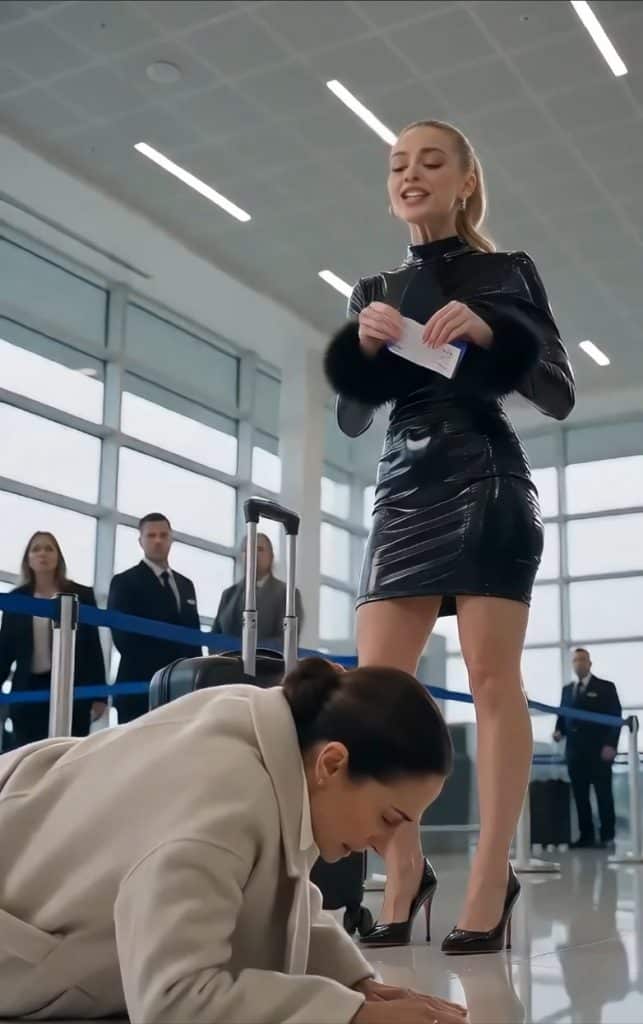
A younger woman with a high blonde ponytail snatched it cleanly, her black patent leather dress catching the terminal lights like polished armor. Fur-trimmed sleeves brushed against Elena’s cream wool coat as she stepped too close, smiling with the bright cruelty of someone who expected an audience.
“You?” she said, lifting the pass. “In first class?”
Elena did not answer.
The first-class queue at Gate 14 went quiet in uneven waves. Rolling suitcases stopped. A businessman lowered his phone. Two airline staff members behind the counter froze with practiced smiles still stuck on their faces.
The blonde woman looked Elena up and down.
Middle-aged. Dark hair pulled back. Cream coat. White collared shirt. No flashy jewelry. No designer luggage shouting for attention. To the woman blocking her path, Elena looked ordinary enough to dismiss.
That was the mistake.
Elena reached for her boarding pass.
“Please return that.”
The slap came instead.
Sharp.
Public.
Violent enough to turn Elena’s head and send her stumbling sideways. Her heel caught on the polished airport floor, and she fell beside the first-class barrier with one hand braced beneath her.
Gasps moved through the line.
The blonde woman stood over her, breathing hard, the stolen boarding pass still clenched in her left hand.
“This lane is for people who actually belong here,” she said.
Then she tore the pass in two.
The paper ripped crisply under the terminal lights. She tore it again, then let the pieces fall near Elena’s coat as if scattering proof of victory.
For a few seconds, Elena remained on the floor.
A tear formed despite her best effort to stop it.
Not because of the slap alone.
Because public humiliation has a way of dragging old memories to the surface. Doors closed in her face. Rooms where she was assumed to be staff. Board tables where men repeated her ideas louder and received credit.
The blonde woman smirked.
Behind her, a large digital display board flickered.
The flight information vanished.
A new corporate feature filled the screen.
A portrait of Elena appeared above a headline in bold white letters.
NEW GLOBAL CEO — ELENA VARGAS
The terminal went silent.
Elena slowly lifted her head.
The blonde woman did not notice at first. She was still looking down, still standing too tall over a woman she thought she had reduced to scraps of paper.
Then the whispers started.
“Oh my God.”
“That’s her.”
“The screen—look.”
Elena stood.
She did not wipe away the tear.
She walked forward, calm now, the torn boarding pass at her feet.
“First class isn’t for everyone,” she said. “And after today, neither is this airline.”
Then she turned her head.
“Security.”
The blonde woman’s smile collapsed.
Act II
Elena Vargas had spent thirty years learning how to enter rooms without asking the room to believe in her first.
She was born in San Antonio, raised by a mother who cleaned airport lounges at night and a father who repaired baggage belts until his knees gave out. As a child, Elena knew terminals the way other children knew parks. She knew which floors squeaked near the gates. Which airline counters gave away stickers. Which executives ignored the woman emptying trash beside them.
Her mother used to say, “Airports show people who they really are.”
Elena did not understand then.
She understood later.
Airports stripped people down. Delay a flight, lose a bag, ask someone to wait in the wrong line, and whatever mask they wore in ordinary life began to slip. Kind people became kinder. Tired people became honest. Entitled people became dangerous.
Elena’s first job was at a check-in counter.
She learned to smile while being called incompetent by people who had arrived late. She learned to rebook families sleeping on floors. She learned that a first-class tag on a suitcase did not make a person noble, and a standby ticket did not make anyone lesser.
From there, she rose.
Operations.
Crisis management.
International logistics.
Regional director.
Executive vice president.
Every promotion came with rooms where someone assumed she was there to take notes. She took them anyway. Then she used those notes to fix things nobody else had bothered to understand.
GlobalAir brought her in when the company was bleeding trust.
Delays. Labor unrest. Customer scandals. A viral video of a staff member being screamed at while managers watched from ten feet away.
The board wanted a polished face.
Elena gave them a warning.
“I will not decorate a broken culture,” she told them. “I will change it or I will leave.”
They hired her anyway.
Her appointment as Global CEO was scheduled to be announced publicly that morning across all major hubs. Screens would update at 9:00 a.m. local time. Staff briefings would follow. Press releases were already queued.
Elena could have arrived through a private executive entrance.
She refused.
She wanted to walk through the terminal like a passenger. She wanted to see how her airline treated people when nobody knew the person watching had power.
Her assistant protested.
“Elena, this is your first day.”
“Exactly,” Elena said.
So she carried one bag, wore her cream coat, printed her own boarding pass, and joined the first-class line without a handler beside her.
That was where Cassandra Vale found her.
Cassandra was not an airline employee. She was not security. She was a luxury travel influencer with a diamond-tier membership, a million followers, and a habit of filming herself “calling out impostors” in premium spaces.
She mistook cruelty for discernment.
She mistook a queue for a throne.
And when she saw Elena standing ahead of her, she decided to perform.
She had no idea the performance would become evidence.
Act III
Security moved only after Elena’s command.
That detail stayed with everyone who saw it.
Before that, they had watched. They had shifted their weight. They had looked toward supervisors, waiting for someone else to decide whether a wealthy-looking passenger striking another woman was serious enough to interrupt.
After Elena said one word, they moved fast.
Two uniformed airport security officers approached from the side of the checkpoint. A GlobalAir ground manager hurried from behind the counter, face pale, eyes locked on the digital display behind Cassandra.
“Elena Vargas,” the screen still read.
New Global CEO.
Cassandra turned.
Her eyes climbed from the headline to the portrait, then back to the woman standing in front of her.
Recognition arrived like a crash without sound.
“No,” she whispered.
Elena looked at the torn pieces of paper on the floor.
“Pick them up.”
Cassandra blinked.
“What?”
“My boarding pass,” Elena said. “You tore it. Pick it up.”
A security officer stopped beside Cassandra.
“Ma’am, step away from Ms. Vargas.”
Cassandra raised both hands slightly.
“I didn’t know who she was.”
Elena’s expression did not change.
“That is not a defense. It is the confession.”
The passengers heard it.
So did the staff.
The ground manager swallowed hard.
“Ms. Vargas, I am so sorry. We can reissue your pass immediately.”
Elena turned to him.
“Why did no one intervene when she took it?”
His mouth opened.
No answer came.
“Why did no one intervene when she struck me?”
He looked down.
Elena nodded once, not in acceptance, but in recognition. She had seen this disease before. Organizations often failed not because nobody cared, but because too many people had been trained to wait for permission to do the obvious right thing.
Cassandra’s voice sharpened in panic.
“This has been blown completely out of proportion. I thought she was cutting the line.”
A man behind the barrier spoke up.
“She wasn’t.”
A woman with a toddler added, “She was just standing there.”
Another passenger lifted his phone.
“I recorded the slap.”
Cassandra’s face changed again.
Not remorse.
Calculation.
“Delete that,” she snapped.
Elena turned toward the man.
“Please preserve it for security.”
He nodded.
The torn pass lay between them.
Cassandra looked at it as if the paper itself had betrayed her.
Then, slowly, under the eyes of the terminal, she bent down and picked up the pieces.
Act IV
The airport did not erupt.
That would have been easier.
Instead, it became controlled and official, which frightened Cassandra far more than shouting would have.
Security escorted her away from the first-class lane and into a glass-walled holding office beside the checkpoint. Her heels clicked too loudly. Her confidence had nowhere to hide under the sterile white lights.
Cassandra kept talking.
At first to security.
Then to the ground manager.
Then to Elena, though Elena did not follow her immediately.
“I have status with this airline.”
“My family’s company books hundreds of flights.”
“You cannot treat me like some criminal.”
Elena heard enough.
She turned to the ground manager.
“What is her name?”
“Cassandra Vale.”
“Freeze her account pending review.”
He stared.
“Now,” Elena said.
He moved.
Cassandra saw him typing and went pale.
“You can’t do that.”
Elena finally stepped into the office.
The glass door closed behind her, muting the terminal noise into a distant hum.
“I can,” she said. “But more importantly, this airline should have done it before.”
Cassandra laughed once, high and brittle.
“For what? A misunderstanding?”
Elena placed the torn boarding pass pieces on the table between them.
“For theft of travel documentation. For assault. For harassment. For interfering with a passenger in a secure airport area. And for proving exactly why premium status has been allowed to become a shield for misconduct.”
Cassandra’s mouth trembled.
“I said I didn’t know.”
Elena leaned forward slightly.
“If you had known I was the CEO, would you have hit me?”
Cassandra looked away.
That was the answer.
Elena’s face softened for the first time, but not with pity.
With disappointment.
“You thought I was beneath consequence.”
Outside the glass, passengers were still watching. Airline employees stood straighter now, as if each one understood the morning had become a test they had already partly failed.
Elena stepped back into the terminal.
The announcement board continued cycling her image across multiple screens.
A staff member approached with a freshly printed boarding pass.
“Ms. Vargas, your replacement ticket.”
Elena accepted it.
“Thank you.”
Then she turned toward the gate team, security, and the stunned passengers.
“This flight will depart after statements are collected,” she said. “No one who witnessed this will be penalized for the delay.”
A child near the line whispered, “Is she the boss?”
His mother whispered back, “Yes.”
Elena heard it.
She looked down at the boy.
“No,” she said gently. “I’m responsible.”
That was the word she wanted the whole company to learn.
Not powerful.
Responsible.
Act V
Cassandra Vale did not board that flight.
Her account was suspended before the plane pushed back. Airport police issued a formal report. GlobalAir banned her pending investigation. By evening, clips of the incident reached the internet, though the most shared part was not the slap.
It was Elena’s sentence.
That is not a defense. It is the confession.
People repeated it because it applied far beyond airports.
Cassandra released a statement the next day claiming stress, confusion, and concern over line enforcement. It did not mention the slap until the third paragraph. It did not mention the torn boarding pass at all.
Elena read it once and closed the file.
She was not interested in public revenge.
She was interested in systems that made private cruelty feel safe.
Her first executive meeting as Global CEO did not begin with profits or route expansions. It began with airport footage from Gate 14. Not the slap itself; Elena refused to replay her own fall for spectacle. She showed the minutes before and after.
The hesitation.
The frozen staff.
The security officers waiting for a command.
The way passengers understood the wrongness before the institution acted.
“This,” she told the board, “is the gap between policy and culture.”
No one spoke.
She continued.
“A rule that requires courage from the most vulnerable person in the room is not a rule. It is decoration.”
Within thirty days, GlobalAir changed its passenger misconduct policy. Gate agents were given clear authority to summon security for harassment without supervisor approval. Premium loyalty status could no longer delay removal or review. Assault, document interference, and discriminatory gatekeeping triggered automatic escalation. Staff training shifted from appeasement to intervention.
Some customers complained.
Elena expected that.
The people most offended by boundaries were often the ones who had benefited from their absence.
The staff response came more quietly.
A message from a check-in agent in Dallas.
Thank you. A passenger threw coffee at me last year and still flew first class.
A note from a flight attendant in Dublin.
I cried after the new briefing. No one ever said we were allowed to act before it got worse.
A letter from a baggage supervisor in Manila.
My team watched the video. We talked for two hours. We have stories.
Elena kept those messages in a folder labeled Not Decoration.
Months later, she returned to the same airport.
Gate 14 looked ordinary again. Same polished floors. Same barriers. Same large display board cycling departures, delays, upgrades, weather. People rushed. Babies cried. Wheels clicked over tile.
No one recognized her at first.
That pleased her.
She stood near the first-class lane and watched a tired older man approach the counter wearing a worn jacket and carrying a folded paper ticket. A man behind him sighed loudly.
“This is priority,” the man said.
The gate agent looked up immediately.
“Sir, he is in the correct lane. Please give him space.”
Elena smiled.
Small.
Private.
The older man turned, surprised.
“Thank you,” he said.
The gate agent nodded.
“Of course.”
That was all.
No dramatic reveal.
No display board.
No security command.
Just a boundary held before someone had to be hurt.
Elena walked toward the window and looked out at the aircraft waiting under a gray sky.
Airports still showed people who they were.
But maybe, she thought, they could also teach them who they were expected to become.
Her assistant found her there ten minutes later.
“Board meeting is ready.”
Elena nodded.
As they walked, they passed the digital display board. It had moved on from her announcement months ago. New flights. New cities. New names.
But Elena remembered the exact place where she had fallen.
The cold floor under her palm.
The torn pass beside her.
The tear she had refused to hide.
For years, she had believed composure meant never letting them see pain.
She no longer believed that.
Composure meant feeling the pain and still choosing what happened next.
At the entrance to the executive lounge, a young employee stopped her.
“Ms. Vargas?”
Elena turned.
The employee looked nervous, clutching a tablet to her chest.
“I was working the counter that day.”
Elena waited.
“I froze,” the young woman said.
Elena’s expression softened.
“What is your name?”
“Priya.”
“Priya, what would you do now?”
“Call security immediately,” she said. “Step between if it’s safe. Preserve evidence. Report the passenger. Check on the person harmed before protecting the schedule.”
Elena nodded.
“Then you did not stay frozen.”
Priya’s eyes brightened.
“Thank you.”
Elena continued into the lounge, but she glanced once more toward the terminal.
Somewhere beyond the security checkpoint, Cassandra Vale was still fighting consequences through lawyers and public statements. Elena did not hate her. Hatred took too much space, and Elena had an airline to rebuild.
But she did remember her.
Not as a rival.
As a warning.
A woman who believed first class was a caste.
A torn boarding pass that became proof.
A slap that revealed not weakness, but a company’s unfinished work.
And a screen that changed at exactly the right moment, not to make Elena powerful, but to show everyone that she had been powerful before they knew her name.
That was the lesson the terminal carried forward.
Respect should not require a headline.
But when people forget, truth has a way of lighting up the whole board.