Act I
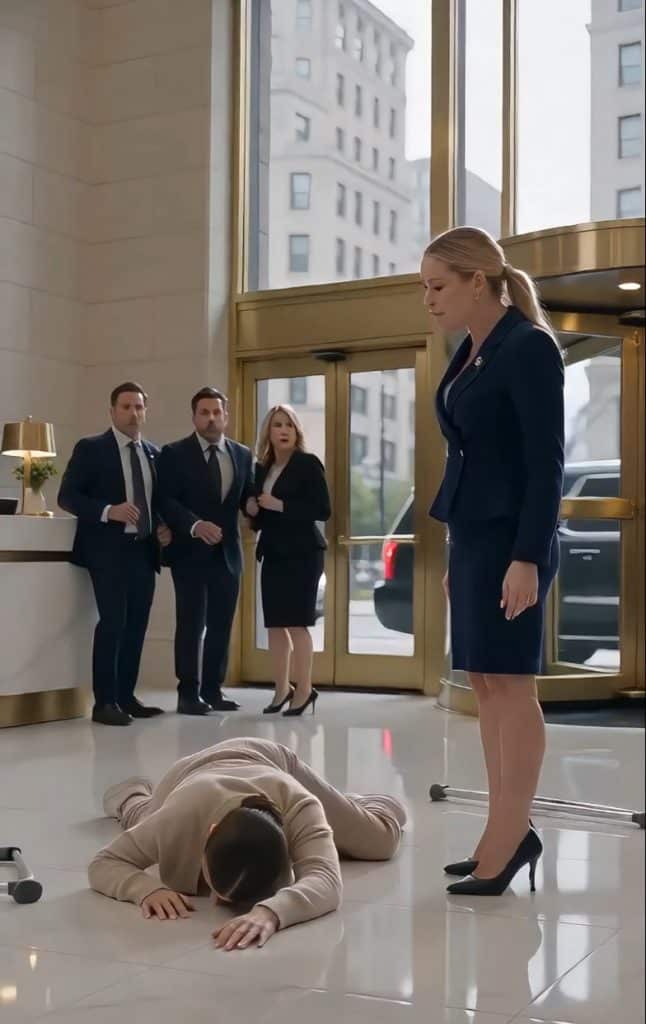
The crutches hit the marble before Miss Carter did.
One struck the floor with a sharp metallic crack and skidded toward the revolving glass door. The other spun beneath the gold-accented frame, scraping a silver line across the polished white stone.
Then Miss Carter fell.
Her beige cardigan twisted beneath her shoulder. Her hand slapped against the marble as she tried to catch herself. Around her, the private bank lobby froze in horror beneath its soft luxury lighting.
The blonde woman who had shoved her did not step back.
She stood over her in a navy blue skirt suit and high heels, chin lifted, lips curled with disgust.
“Take those crutches and drag yourself back out to the sidewalk,” she said.
The words were loud enough to reach the reception desk.
A banker in a charcoal vest stopped breathing. A client near the window covered his mouth. Outside, beyond the glass, a black SUV idled at the curb, its tinted windows reflecting the city skyline.
Miss Carter stayed on the floor for a moment.
Young. Quiet. Dressed too modestly for a room built to worship wealth.
She reached for one crutch, but it had slid too far away.
The woman leaned down, pointing toward the exit.
“Private banking is for power,” she said, voice dripping contempt. “Not girls dressed like they beg for spare change.”
A murmur passed through the lobby.
Still, no one moved fast enough.
That was the shame of the room.
Everyone was shocked.
No one was brave yet.
Miss Carter pulled one crutch toward herself. The metal scraped loudly across the marble, a thin, painful sound that made people flinch. She did not cry. She did not plead. She gathered herself slowly, with visible effort, until she stood again on shaking supports.
Her face remained calm.
Too calm.
The revolving glass door began to turn.
A tall man in a sharp black suit stepped into one compartment from outside, pushed through the gold-trimmed panels, and entered the lobby with controlled urgency. His polished shoes struck the marble once, then again, each step silencing another whisper.
He walked past the stunned clients.
Past the reception desk.
Past the woman in navy.
He stopped in front of Miss Carter and bowed his head.
“Miss Carter,” he said, deep voice grave with respect, “forgive our delay. The sole heir to this bank should never be treated like a trespasser.”
The lobby went dead silent.
The aggressive woman’s hands lifted slightly, fingers trembling.
“To the sole heir?” she whispered.
Miss Carter turned her eyes toward her.
Cold.
Unwavering.
And for the first time, the woman who had shoved her looked smaller than the person she had thrown to the floor.
Act II
Before that morning, Evelyn Carter had not stepped inside Carter & Whitestone Private Bank in thirteen years.
Not through the front door.
Not through the executive entrance.
Not even for the annual founder’s gala where her grandfather’s portrait hung above the ballroom staircase and men in tuxedos toasted a legacy they had quietly stolen from her.
She had been eight when her parents died.
The official story was an accident on a mountain road after a charity dinner. Fog. Wet pavement. Failed brakes. The kind of tragedy wealthy families wrapped in flowers and expensive silence.
Evelyn remembered almost nothing from that night.
Only glass.
Rain.
Her mother’s perfume.
Her father’s hand reaching back toward her.
And afterward, hospital ceilings.
When she woke, her legs did not answer the way they used to. Doctors spoke gently. Lawyers spoke around her. Her uncle, Malcolm Whitestone, became temporary executor of her family trust.
Temporary became convenient.
Convenient became permanent.
By the time Evelyn was old enough to ask questions, Carter & Whitestone was being run by people who referred to her as “the unfortunate child.” Her name remained in the founding documents, but not on the invitations. Her shares were managed for her. Her access was restricted for her own protection. Her questions were delayed, redirected, softened, and buried.
Malcolm told her the bank would overwhelm her.
“You need peace,” he said.
What he meant was silence.
So Evelyn left the city.
She studied finance from a small apartment near the river. She learned trust law, inheritance law, corporate governance, and the language people use when they want theft to look like stewardship. She built strength quietly, the way people do when the world mistakes physical vulnerability for helplessness.
Her grandmother’s former assistant, Agnes Vale, was the one who found the first missing ledger.
Then the second.
Then the hidden amendment.
Evelyn Carter was not merely a beneficiary.
She was the sole heir to the Carter family’s controlling interest in the bank.
On her twenty-fifth birthday, full authority passed to her automatically.
Malcolm had known.
The board had known.
They had spent years preparing to challenge it.
That morning, Evelyn came to the bank to sign the formal succession documents. She chose the front entrance deliberately. No secret elevator. No private escort through a back corridor. No hiding behind the fear people had used to define her.
But the official assigned to receive her had been delayed outside by security clearance confusion.
Another “mistake.”
Evelyn waited near the revolving door with her crutches and her beige cardigan, watching bankers glance at her and look away.
Then Veronica Sloane arrived.
Act III
Veronica Sloane was not family, though she behaved as if she had been born into the marble.
She managed elite client relations, which meant she knew the richest people by name and the vulnerable ones by category. Her power came from proximity: donor dinners, private suites, quiet favors, whispered introductions to the right executives.
She was Malcolm Whitestone’s favorite weapon.
Beautiful enough to charm rooms.
Cruel enough to guard doors.
When she saw Evelyn standing near the entrance, she did not ask her name. She did not ask whether she had an appointment. She did not even ask if she needed assistance.
She saw crutches.
A modest cardigan.
No diamond watch.
No security detail at her side.
And she decided the girl did not belong.
That decision revealed more about the bank than Evelyn’s documents ever could.
Now, in the silent lobby, Marcus Reed stood beside Evelyn with the formal stiffness of a man containing fury through professionalism.
Marcus was the bank’s senior legal officer, appointed years earlier by the original Carter trust. He had spent the last six months helping Evelyn rebuild the chain of proof Malcolm tried to fracture.
He turned toward Veronica.
“Ms. Sloane, step away from Miss Carter.”
Veronica swallowed.
“I didn’t know who she was.”
Evelyn’s voice came quietly.
“That was never the problem.”
The words cut through the lobby.
Veronica stared at her.
Evelyn shifted her weight on the crutches. The movement was small, but the room watched it as if it were a declaration.
“You shoved me when you thought I was no one,” Evelyn said. “That is the problem.”
Marcus looked toward the reception desk.
“Lock down the lobby footage. Preserve all angles. Call security and compliance.”
A young receptionist moved instantly, pale but relieved to have an instruction strong enough to obey.
Veronica’s confidence began to crack.
“There’s no need for theatrics.”
A client near the window spoke before Marcus could.
“She pushed her.”
Another woman added, “Hard.”
A banker behind the desk said, “I saw the crutches scatter.”
The witnesses came slowly at first.
Then all at once.
That was how cowardice often broke: not through sudden heroism, but because one voice made room for the next.
Veronica looked around, realizing the room she had expected to fear her had begun recording her instead.
The revolving door turned again.
This time Malcolm Whitestone entered.
He saw Evelyn standing beside Marcus.
He saw Veronica pale beside the scattered evidence of what she had done.
And for the first time in thirteen years, Evelyn saw fear cross her uncle’s face.
Act IV
Malcolm recovered quickly.
Powerful men practice that.
He adjusted his cuff, walked toward Evelyn, and smiled with the wounded warmth of a guardian betrayed by misunderstanding.
“Evelyn,” he said. “You should have called me before coming in through the public lobby.”
Evelyn looked at him.
“This is my bank. I can use the front door.”
The line traveled through the lobby like electricity.
Malcolm’s smile tightened.
“Of course. But emotions are high. Let’s move this upstairs.”
Marcus stepped slightly forward.
“No private rooms.”
Malcolm’s eyes flicked to him.
“This is a family matter.”
“No,” Evelyn said. “It stopped being a family matter when your employee put her hands on me in front of witnesses.”
Veronica whispered, “Mr. Whitestone, I was only trying to protect the lobby.”
Evelyn turned to her.
“From me?”
Veronica said nothing.
Marcus opened a leather folder and removed a sealed document.
“Mr. Whitestone, at 9:00 a.m. this morning, Evelyn Carter’s succession authority became active under Article Seven of the Carter Trust. As of that moment, you no longer had standing to delay, redirect, or supervise her access.”
Malcolm’s face hardened.
“We are contesting that article.”
“You may attempt to,” Marcus said. “But until a court says otherwise, Miss Carter controls the Carter voting shares.”
He looked toward the executive corridor.
“And she has requested an emergency board session.”
Evelyn corrected him softly.
“Not requested.”
Marcus bowed his head.
“Ordered.”
That word changed everything.
Ordered.
Not begged.
Not petitioned.
Not invited if convenient.
Ordered.
Veronica took a step back, heel clicking against marble.
Evelyn noticed the movement.
“You were very brave when I was on the floor,” she said.
Veronica’s mouth trembled.
“I apologize.”
“No,” Evelyn said. “You’re afraid.”
The lobby held its breath.
Evelyn looked down at the crutch nearest her, then at the faint scrape mark it had left across the marble.
“For years, people in this building discussed me as if I were fragile. Too fragile to know the truth. Too fragile to manage my inheritance. Too fragile to enter rooms where decisions were made about my name.”
She lifted her eyes to Malcolm.
“But nobody in this building was worried about my fragility when I was useful as an excuse.”
Malcolm’s face went still.
Evelyn reached into her cardigan pocket and removed a small flash drive.
Agnes Vale’s last gift before she died.
Inside were scans of the original trust, emails between Malcolm and board allies, and internal notes discussing how to “maintain visual distance” from Evelyn to avoid “sympathy complications” if she appeared before shareholders.
Marcus had already filed copies with outside counsel.
But Evelyn wanted Malcolm to see the drive in her hand.
A symbol small enough to fit in her palm.
Heavy enough to bring down a room.
“Shall we go upstairs?” she asked.
This time, Malcolm did not tell her where to walk.
Act V
The emergency board session lasted three hours.
No one touched Evelyn’s chair.
No one interrupted her.
No one suggested she wait outside while older men discussed her future.
She sat at the head of the long glass table with her crutches resting beside her and Marcus standing behind her right shoulder. Malcolm sat halfway down the table, stripped of the center seat he had occupied for thirteen years.
The documents spoke first.
Then the video.
The lobby footage showed Veronica stepping into Evelyn’s space. Grabbing her. Shoving her. The crutches flying. Evelyn falling. Veronica standing over her with a pointed finger and a sentence no one in the boardroom could defend.
Private banking is for power.
Evelyn paused the video there.
The room stared at Veronica’s frozen image.
“That,” Evelyn said, “is what this institution has become.”
No one answered.
She continued.
“My grandfather built this bank because immigrant shop owners, widows, teachers, and small manufacturers were being denied fair credit by institutions that judged them at the door. Carter & Whitestone was not founded to worship inherited wealth. It was founded to protect dignity from it.”
Malcolm looked away.
Evelyn saw.
Good.
“Effective immediately, Veronica Sloane is terminated for assaulting a client and violating conduct policy. Security will cooperate with any legal action I choose to pursue.”
Veronica, who had been waiting outside under supervision, was not called in to plead.
Evelyn did not need performance.
She needed accountability.
Then she turned to Malcolm.
“You are suspended from executive authority pending independent investigation into trust interference, board manipulation, and concealment of heir rights.”
The oldest board member inhaled sharply.
“Miss Carter, that is a serious step.”
Evelyn looked at him.
“It is thirteen years late.”
The sentence ended the argument.
The months that followed were not neat.
Power never leaves politely.
Malcolm challenged the succession in court and lost his emergency motion within a week. Veronica hired a lawyer and claimed she had acted under security concerns, until the lobby audio became part of the complaint. Several board members resigned before investigators reached their emails.
The bank’s name changed within the year.
Carter & Whitestone became Carter Private Trust.
Evelyn removed the family that had hidden behind her name while trying to erase her from it.
The lobby changed too.
Not the marble.
Not the revolving door.
The culture.
Staff were retrained to greet people before judging them. Accessibility protocols were rewritten by people who actually used them. Private clients were warned that abusive conduct would end relationships regardless of account balance. A new line appeared beneath the bank crest at the reception desk.
Wealth is managed here. Dignity is required.
Evelyn kept the scrape mark from her crutch in the marble.
Facilities offered to polish it out.
She refused.
“Leave it,” she said.
So they did.
A thin silver scar near the revolving door.
A reminder that marble can remember what people try to smooth away.
One morning, nearly a year after the shove, Evelyn arrived alone.
No SUV.
No official escort.
Just her beige cardigan, her crutches, and a navy folder tucked beneath one arm. A new receptionist greeted her by name, not with fear, but warmth.
“Good morning, Miss Carter.”
Evelyn smiled.
“Good morning.”
Near the windows, an elderly man in a worn coat stood uncertainly with a bank envelope in both hands. A younger employee approached him, not to move him aside, but to offer a chair.
Evelyn paused to watch.
The old man sat.
The employee knelt slightly to hear him better.
That was the bank she wanted.
Not softer.
Stronger.
Because any institution could protect the powerful. It took something better to protect someone who walked in without proof of importance visible on their body.
Marcus joined her near the desk.
“The foundation committee is waiting upstairs.”
Evelyn nodded.
The Carter Access Fund would launch that afternoon, providing financial services for disabled entrepreneurs, caregivers, widows, and first-generation business owners who had spent their lives being told private banking was not for people like them.
As they approached the elevators, Marcus glanced toward the scar on the floor.
“Do you ever regret leaving it there?”
Evelyn looked back.
She remembered the fall.
The sound of crutches scattering.
Veronica’s voice.
The cold marble beneath her palm.
Then she remembered standing.
“No,” she said. “It tells the truth before anyone else can rewrite it.”
The elevator doors opened.
This time, no one delayed her.
No one redirected her.
No one mistook her silence for weakness or her crutches for permission.
Evelyn Carter entered the elevator as the bank’s sole heir, but that was not the most important thing about her.
The most important thing was that she had been shoved to the floor in a room full of witnesses and still rose with more dignity than the woman who stood over her.
And from that day forward, every person who entered through the gold-accented revolving door passed the small mark in the marble.
Most did not know the whole story.
But the staff did.
The board did.
Veronica Sloane did.
And Evelyn did.
A bank built on power had been forced to learn the difference between status and worth.
Status could shove.
Worth stood back up.