Act I
The girl hit the wet pavement before anyone in the hotel lobby remembered how to move.
A second earlier, her wheelchair had been rattling across polished marble, pushed too fast by a man in a black tuxedo who wore his security earpiece like a badge of royalty. Crystal chandeliers shivered above them. Guests in tailored coats turned from the reception desk with champagne still in their hands.
Then the glass doors flew open.
Rain roared in.
And Martin Vale, the night manager of the Haleworth Grand Hotel, shoved the wheelchair through the entrance hard enough to make the girl lose her grip on the white bucket in her lap.
“Get this filthy gutter trash out of my hotel,” he shouted.
The bucket flew sideways.
Water splashed across her maroon hoodie, her sleeves, her backpack, the pavement beneath her. The wheelchair tipped with a metallic scrape, and the girl went down beside it as rain hammered the driveway.
Inside the lobby, people gasped.
No one helped.
Martin stepped out beneath the awning, not caring that rain was soaking the shoulders of his tuxedo. His face was tight with disgust, his lips curled as if the child on the ground had insulted him by existing near expensive flowers and marble floors.
The girl blinked rainwater from her lashes.
Her name was Amara Whitfield.
She was fourteen years old.
And she did not cry.
That seemed to anger him more.
Martin pointed toward the sidewalk beyond the hotel’s gold-trimmed entrance.
“People like you belong out there,” he said. “Not in here.”
Amara’s fingers tightened against the wet pavement. The white bucket lay beside her overturned wheelchair, rain tapping against the plastic like a tiny, nervous drum.
Behind the glass doors, guests stared from the warmth of the lobby.
A woman in pearls covered her mouth. A young bellhop looked like he wanted to step forward, but an older receptionist caught his sleeve and shook her head quickly.
Martin Vale ran this lobby like a kingdom.
And everyone knew what happened to people who crossed him.
Amara looked up at the man standing over her.
Her hoodie clung damply to her shoulders. Her backpack strap had slipped down one arm. Her wheelchair rested on its side, one wheel still spinning slowly in the rain.
Martin leaned closer.
“Do you understand me?” he snapped. “You do not come into this hotel looking like that.”
Amara breathed in slowly.
For three minutes, she had been called filthy. For three minutes, people had watched a grown man throw a child into the rain.
But Amara did not look broken.
She looked like she was waiting.
Then headlights swept across the driveway.
Three black SUVs pulled up through the rain.
Act II
The Haleworth Grand had spent seventy years teaching people who mattered and who did not.
That was never written on the walls, of course.
The walls spoke in softer language. Gold-framed mirrors. White orchids. Imported marble. Private elevators. Rooms that cost more per night than some families made in a month.
The hotel’s motto was engraved behind the reception desk in elegant brass letters.
Every guest is family.
Amara had always hated that motto.
Not because it was false.
Because she knew exactly who was allowed to be family there.
Her mother, Evelyn Whitfield, owned the hotel group that controlled the Haleworth Grand and six other luxury properties across the country. To the public, Evelyn was a brilliant businesswoman with perfect posture and a quiet smile. To investors, she was untouchable. To hotel staff, she was a name spoken with respect and fear.
To Amara, she was Mom.
The woman who learned how to braid Amara’s hair from online videos after Amara’s father died. The woman who kept a framed drawing of a purple elephant in her office because Amara had made it when she was six. The woman who built hotels for the wealthy but still answered calls from every housekeeper who had worked for the family longer than ten years.
Evelyn Whitfield believed luxury did not excuse cruelty.
But Martin Vale believed otherwise.
He had arrived at the Haleworth Grand eighteen months earlier with expensive shoes, perfect references, and a talent for smiling at people with money. Under his supervision, wealthy guests received handwritten notes, complimentary upgrades, and flowers in their rooms.
Everyone else received suspicion.
Delivery drivers were forced to wait outside in bad weather. Housekeepers were scolded in public for taking elevator space. A retired veteran was once asked to leave the lobby because his coat looked “distressed.” A mother with two children was denied access to the restroom because she was not a registered guest.
The complaints reached Evelyn slowly.
Not because they were rare.
Because Martin knew how to bury them.
He called them misunderstandings. Security concerns. Brand protection. Necessary standards.
Then, three weeks before the rainstorm, Amara found a folder on her mother’s desk.
She had been waiting for her tutor to arrive and had rolled into Evelyn’s office looking for a phone charger. The folder was half-open, thick with printed emails and staff statements.
One phrase caught her eye.
Wheelchair accessibility incident suppressed.
Amara read more than she should have.
A woman using a wheelchair had been denied a room transfer after the accessible bathroom in her suite flooded. A staff member who complained was reassigned to overnight laundry. Another report described Martin mocking a young guest who used mobility equipment.
At the bottom of one page, someone had written in red pen:
Need proof before board meeting.
Amara closed the folder before her mother returned.
But she kept thinking about it.
Because Amara knew what it felt like when strangers looked at her chair before they looked at her face.
She had started using a wheelchair after an illness two years earlier changed the way her body handled distance and balance. Some days were better than others. Some days she could stand for short moments with support. Other days, moving across a room felt like crossing a mountain.
She had learned to live with people staring.
She had not learned to accept people deciding her worth for her.
So she made a plan.
A risky one.
On the night of the hotel’s annual donor reception, Amara put on a plain maroon hoodie, packed her school bag, and asked her driver to drop her two blocks away instead of at the private entrance.
She told no one inside who she was.
Not her mother.
Not the front desk.
Not Martin Vale.
She wanted to see what happened when the Haleworth Grand met someone it thought had no power.
The white bucket had not been part of the plan.
She found it near a hallway service closet after a leak began spreading across the marble near the west corridor. A young housekeeper named Rosa had been trying to manage the spill alone while balancing towels in both arms.
Amara asked if she could help.
Rosa looked startled.
“You don’t have to do that.”
“I know,” Amara said. “But I can hold the bucket.”
So she did.
She sat near the edge of the hallway with the bucket in her lap, catching water from a slow drip while Rosa ran to get more towels.
That was when Martin saw her.
He did not ask her name.
He did not ask why she was there.
He saw a Black girl in a hoodie, a backpack, a wheelchair, and a bucket, and decided the story before she spoke.
“You,” he snapped. “How did you get inside?”
Amara looked up.
“I’m waiting for someone.”
“Not here, you’re not.”
“I wasn’t bothering anyone.”
Martin’s eyes moved over her hoodie, the bucket, the worn sticker on her backpack.
“You people always have an explanation.”
The words made the hallway feel suddenly smaller.
Amara’s hands tightened on the bucket handle.
By then, several guests had turned to watch.
Martin noticed them too. His face changed. Not with shame, but calculation. The donor reception was beginning. Wealthy people were arriving. A girl in a wheelchair holding a bucket did not fit the picture he wanted in the lobby.
So he grabbed the handles of her chair.
“Stop,” Amara said.
He did not.
The chair lurched forward.
Rosa came running back with towels in her arms.
“Sir, please, she was helping me—”
“Stay out of this,” Martin barked.
Amara tried to lock her wheels, but he was already moving too fast, pushing her down the marble corridor toward the glass doors.
Guests watched.
Staff froze.
Rain pounded outside like a warning.
And then Martin shoved her into the storm.
But the storm was not the thing he should have feared.
Act III
The first SUV stopped so close to the entrance that rainwater splashed beneath its tires.
Then a second pulled in behind it.
Then a third.
Their headlights spread across the wet driveway, turning every puddle silver. The hotel lobby reflected in the glass doors behind Martin, bright and silent and full of witnesses.
The driver’s door of the first SUV opened.
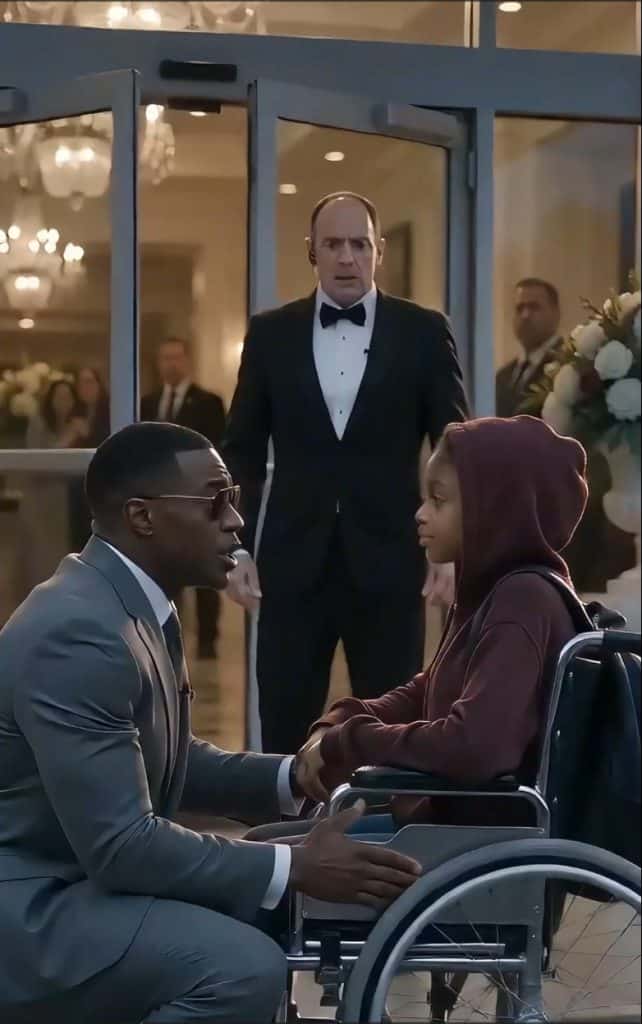
A tall Black man in a gray suit stepped out into the rain.
He wore sunglasses despite the dark weather, but there was nothing theatrical about him. He moved with purpose, one hand already reaching toward his jacket pocket as he spotted Amara on the ground.
Martin frowned.
“Excuse me,” he called. “This is a private hotel entrance.”
The man ignored him.
He crossed the driveway fast, shoes splashing through the rain, suit darkening at the shoulders. Behind him, two more doors opened. Security personnel stepped out but did not rush ahead.
They waited for him.
That was the first thing Martin noticed.
The second was the way the suited man looked at the girl.
Not with pity.
With recognition.
“Miss Amara,” he said, dropping beside her chair. “Are you hurt?”
Martin went still.
Amara shook her head once.
“I’m okay, Mr. Hayes.”
But her voice was tight.
Daniel Hayes, chief of security for Whitfield Hotels, looked at the overturned wheelchair, the spilled bucket, the soaked hoodie, the scrape of wet pavement beneath the wheel. His jaw clenched once, then relaxed with professional discipline.
He did not make a scene.
He made a record.
His eyes moved briefly to the security camera above the entrance, then to the guests staring through the glass, then to Martin Vale standing under the awning as if arrogance could still protect him.
Daniel gripped the wheelchair frame carefully.
“I’m going to lift the chair upright,” he said to Amara. “Ready?”
She nodded.
He moved with steady strength, raising the chair without jolting her, checking the brakes, the footrests, the wheel alignment. Rain ran down the side of his face, but he did not wipe it away until Amara was seated upright again.
Only then did he kneel.
Right there on the wet pavement.
In front of the girl Martin had thrown outside.
The lobby fell completely silent.
Daniel bowed his head slightly.
“Ma’am,” he said, his voice calm enough to cut through the rain, “the owner’s daughter should not have been kept waiting.”
The words struck the entrance like thunder.
Owner’s daughter.
A woman inside the lobby gasped.
Rosa dropped the towels she had been holding.
Martin’s face drained of color.
Amara sat very still in her wheelchair, rain sliding down her cheeks, her maroon hoodie soaked from the bucket and the storm. She looked smaller than everyone around her, and yet, suddenly, she was the only person at the entrance who seemed completely in control.
Martin blinked.
“What?”
The word came out too loud.
Too empty.
As if volume could make reality change direction.
Daniel rose slowly from his kneeling position.
He removed his sunglasses and turned toward the manager.
“Martin Vale,” he said, “you have just assaulted Evelyn Whitfield’s daughter at the entrance of her own hotel.”
The sentence did what the rain could not.
It washed the arrogance from Martin’s face.
“I didn’t know,” he said quickly.
Amara looked at him.
That was when Martin realized his mistake was even worse than he thought.
Because the girl did not look surprised.
She looked disappointed.
Daniel noticed too.
He turned slightly toward her.
“Miss Amara?”
She reached into the pocket of her hoodie with damp fingers and pulled out a small phone. Its screen was cracked at one corner, but still recording.
Martin stared at it.
His mouth opened.
No sound came out.
Amara held the phone against her lap.
“You asked how I got in,” she said quietly. “You never asked why.”
Act IV
For the first time since anyone in the hotel had known him, Martin Vale looked afraid of a child.
Not because Amara shouted.
She did not.
Not because she threatened him.
She did not need to.
Her silence had become heavier than his cruelty.
Daniel held out his hand, and Amara passed him the phone. He checked the recording without playing it aloud, then slipped it into a sealed evidence pouch handed to him by one of the security officers.
Martin’s eyes darted toward the lobby.
“This is absurd,” he said. “She was causing a disturbance.”
Rosa stepped forward from behind the glass doors.
Her hands were shaking, but she opened the door anyway.
“No, she wasn’t.”
Martin turned on her.
“Go back inside.”
Rosa flinched, but stayed where she was.
“She was helping me with the leak,” she said. “I asked her to wait while I got towels.”
“You asked a child in a wheelchair to hold a cleaning bucket?” Martin snapped, trying to redirect the room’s disgust.
Amara answered before Rosa could.
“I offered.”
The simplicity of it made Martin look smaller.
Guests began whispering.
Not the uncomfortable whispers from before, the kind people use when they want cruelty to pass quickly so dinner can continue.
These whispers had edges.
They had judgment.
Daniel stepped closer to Martin.
“Security footage from the west corridor, the lobby, and the entrance has already been preserved.”
Martin swallowed.
“You had no right to run an internal test without informing hotel management.”
Amara tilted her head.
“You mean without informing you?”
A few guests looked away, ashamed of how satisfying that sounded.
Daniel’s expression remained steady.
“Ms. Whitfield authorized a full review after multiple accessibility and discrimination complaints were suppressed.”
Martin’s jaw tightened.
“Those complaints were investigated.”
“No,” Daniel said. “They were buried.”
The glass doors opened again.
This time, a woman stepped through.
Evelyn Whitfield did not run.
She walked into the rain with the kind of calm that made people step aside before knowing why. Her cream coat was buttoned to the throat. Her hair was swept back. Her face was composed, except for her eyes.
Her eyes were on her daughter.
“Amara.”
That one word cracked the girl’s composure more than all of Martin’s insults had.
“Mom,” Amara whispered.
Evelyn crossed the pavement and crouched in front of the wheelchair, not caring that the hem of her coat touched the wet ground. She took Amara’s face gently in both hands and looked her over the way only a mother could, searching for pain her daughter might hide.
“Did he hurt you?”
Amara shook her head.
“Not the way he wanted to.”
Evelyn closed her eyes for one second.
When she opened them, the mother was still there.
But so was the owner.
She stood.
Martin straightened instinctively, clinging to old habits.
“Ms. Whitfield, I can explain.”
Evelyn looked at him.
“No, Mr. Vale. You can answer.”
The rain seemed to grow quieter.
Evelyn turned toward the lobby, where staff and guests watched from behind glass and beneath the chandelier glow.
“For months,” she said, “this hotel has received complaints from disabled guests, working-class visitors, delivery drivers, staff members, and families who were treated as if dignity were a service reserved for premium suites.”
Martin’s lips pressed together.
Evelyn continued.
“Those complaints were redirected away from my office. Witness statements disappeared. Staff were intimidated. Guests were refunded quietly instead of heard publicly.”
A man near the reception desk muttered, “My God.”
Martin lifted his hands.
“That is a gross mischaracterization.”
Evelyn’s voice sharpened.
“You threw my daughter into the rain.”
There was no polished corporate language that could survive that.
Martin looked at Amara.
Then at the guests.
Then back at Evelyn.
“I thought she was someone else,” he said.
The answer hung there, uglier than a confession.
Evelyn stared at him.
“Yes,” she said. “That is exactly the problem.”
Martin’s face collapsed.
Daniel stepped beside Evelyn and handed her a tablet. She glanced at the screen, then looked toward Rosa.
“Rosa Delgado?”
Rosa froze.
“Yes, ma’am.”
“You filed two reports about guest mistreatment and one about staff retaliation.”
Rosa’s eyes filled instantly.
“Yes, ma’am.”
“Thank you for telling the truth.”
Rosa covered her mouth.
Evelyn turned back to Martin.
“Effective immediately, you are removed from your position. You will leave the property under supervision. The full file will be sent to legal counsel, the board, and the appropriate authorities.”
Martin staggered as if the words had physical weight.
“You’re firing me over one mistake?”
Amara looked at the white bucket still lying beside her chair.
Rainwater pooled around it.
“One mistake?” she asked softly.
Martin had no answer.
Because everyone could see it now.
The shove had lasted seconds.
But the cruelty behind it had been built over months.
Maybe years.
Act V
They did not escort Martin through the lobby.
Evelyn would not give him that final performance.
Security guided him away through the side entrance, past the service corridor where he had once humiliated workers for using the wrong door. His tuxedo was soaked now. His earpiece hung loose against his collar.
No one followed him.
No one defended him.
Inside the lobby, the chandelier light still glittered over marble and flowers, but the room felt different. Less grand, somehow. Less untouchable.
Amara sat near the entrance while Daniel checked her wheelchair again. Rosa brought warm towels, hands still trembling, and Amara accepted one with a small smile.
“Thank you,” Amara said.
Rosa shook her head.
“I should have stopped him.”
Amara looked toward the watching guests.
“A lot of people should have.”
The words were not cruel.
That made them worse.
Evelyn heard them and lowered her gaze.
For all her power, for all her hotels and boardrooms and private drivers, she had not seen what her own lobby had become until her daughter forced the truth into the rain.
She knelt beside Amara again.
“I should never have let you do this.”
Amara gave her a tired look.
“You didn’t let me.”
Despite everything, Evelyn almost smiled.
Then Amara’s expression softened.
“I read the file on your desk.”
“I know.”
“You do?”
“You are my daughter,” Evelyn said. “You think I don’t notice when a folder moves three inches?”
Amara looked down at her damp sleeves.
“I wanted proof.”
Evelyn touched her hand.
“You should not have had to become proof.”
For a moment, Amara was just a girl again.
Not the owner’s daughter.
Not the center of a scandal.
Just a child in a wet hoodie who had been brave longer than anyone should have asked her to be.
She leaned forward, and her mother wrapped her arms around her.
The lobby watched in silence.
This time, the silence was not cowardice.
It was shame.
Two weeks later, the Haleworth Grand closed its lobby for one full day.
Not for renovations.
For training.
Every manager from every Whitfield property was flown in. Every department head attended. Evelyn stood on the same marble where Martin had pushed Amara’s chair and played the security footage once.
Only once.
Then she turned it off.
“This company will never again confuse luxury with permission to degrade people,” she said.
Policies changed.
Complaint channels bypassed local managers. Accessibility reviews became public. Staff retaliation triggered automatic investigation. Delivery drivers were given indoor waiting space. Lobby restrooms became available to anyone who needed them.
And Rosa Delgado was promoted to guest services supervisor.
On her first day, she placed a small white bucket behind the front desk.
Not for cleaning.
For memory.
When Evelyn noticed it, Rosa looked embarrassed.
“I can move it, ma’am.”
Evelyn shook her head.
“Leave it.”
Months later, Amara returned to the Haleworth Grand on a clear spring afternoon.
No rain.
No black SUVs lined up like a rescue.
No shouting manager at the door.
Just sunlight through the glass, fresh flowers on the reception desk, and a new brass plaque near the entrance.
Every guest is family. Every person is worthy before they are known.
Amara stopped in front of it.
Daniel stood behind her, hands folded, still watchful.
“Too much?” he asked.
Amara considered it seriously.
“A little dramatic.”
Daniel nodded.
“Your mother wrote it.”
“That explains it.”
They both smiled.
Then the glass doors opened, and a tired-looking father entered with a little boy using forearm crutches. The man paused uncertainly, glancing around as if expecting someone to tell him where he did not belong.
Rosa stepped from behind the desk immediately.
“Welcome to the Haleworth Grand,” she said warmly. “How can we help?”
The father’s shoulders relaxed.
Amara watched the boy look up at the chandeliers with wide eyes, not fearfully, but with wonder.
That was when she finally understood what her mother had been trying to build before people like Martin turned it into a fortress.
A beautiful place did not have to be cruel.
A grand entrance did not have to be a gate.
And dignity did not become real only after a black SUV arrived.
Amara rolled forward, past the place where she had once fallen, past the doors where rain had soaked her hoodie, past the memory of a man who thought power meant deciding who deserved shelter.
The marble beneath her wheels gleamed.
This time, no one tried to move her.
No one spoke over her.
No one asked who she belonged to before deciding how to treat her.
At the reception desk, Rosa looked up and smiled.
“Good afternoon, Miss Amara.”
Amara smiled back.
“Good afternoon.”
And for once, the Haleworth Grand sounded like it meant every word.