Act I
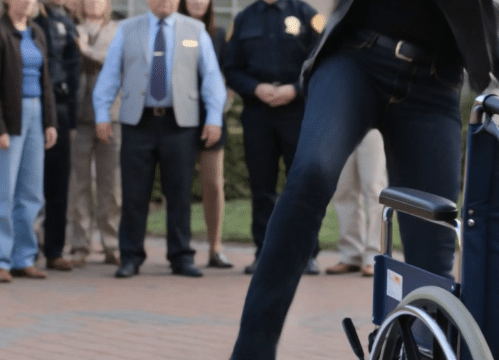
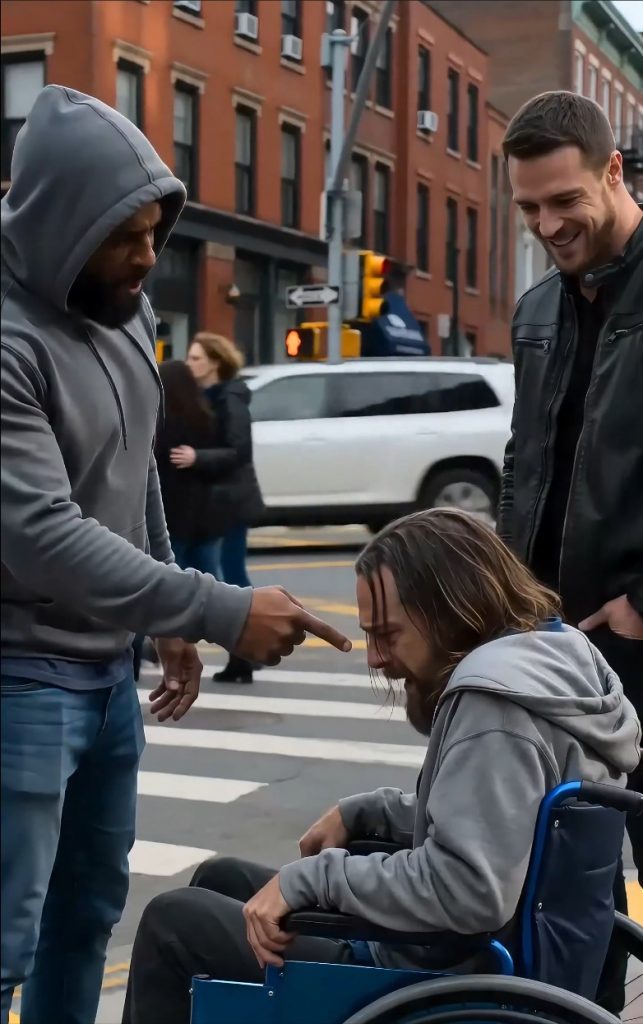
The man in the wheelchair kept his eyes down until the second threat.
The first one came with a finger in his face.
“Give us all your money right now!”
The man shouting wore a gray hoodie and blue jeans, his sneakers planted too close to the front wheels of the blue chair. He leaned in like distance itself belonged to him. Behind him, another man in a black leather jacket laughed under the city noise, sharp and ugly, enjoying the way pedestrians looked over and then looked away.
The crosswalk light was green.
Traffic moved.
A white car idled near the curb.
Yellow road markings cut across the asphalt like warning stripes, but nobody treated the moment like a warning. People kept walking around them, pretending not to hear what was happening at the corner of Maple and 9th.
The man in the wheelchair was named Sam Whitaker.
His long brown hair fell into his face. His beard was uneven. His gray zip-up hoodie hung loose over a faded blue shirt. In his lap, one hand curled protectively around a small pharmacy bag.
Aggressor One jabbed his finger closer.
“You heard me.”
Sam lifted his chin just enough to speak.
His voice trembled.
“That money is for my medicine.”
The man in the leather jacket laughed.
“Oh, that’s sad.”
Then he leaned down, smiling.
“Give us the money or you’ll regret it.”
Sam’s shoulders pulled inward. For one moment, he looked smaller than the chair, smaller than the corner, smaller than the city that had decided not to see him.
But then the laughter faded.
Not because the men felt shame.
Because a shadow crossed the pavement behind them.
Long.
Still.
Too close.
The man in the gray hoodie stopped laughing first. The one in the leather jacket turned slightly, his smile weakening.
Sam saw the shadow before they did.
His breathing changed.
His back straightened.
The fear did not vanish from his face, but something older rose beneath it. Something steady. Something the two men had mistaken for weakness because it had been sitting down.
A voice came from behind them.
“Step away from him.”
The men turned.
And Sam Whitaker, still holding the pharmacy bag in his lap, looked up as if the past had finally arrived on time.
Act II
Sam had not always been the kind of man people ignored.
Twenty years earlier, Officer Samuel Whitaker could stop a room by clearing his throat.
He was not loud. He did not need to be. He had the quiet authority of a man who noticed everything and wasted nothing. He knew which teenagers on his patrol route were hungry, which shop owners were scared, which corners went bad after midnight, and which kids needed a ride home more than a warning.
People trusted him because he listened before he acted.
That was before the warehouse fire.
Before the ceiling came down.
Before one bad night took his partner, damaged his spine, ended his career, and left him learning how to move through a city that suddenly treated him like furniture.
After the chair, strangers changed.
Some overhelped. Some stared. Some spoke to whoever stood beside him instead of to him. Others saw only vulnerability, as if his body had become an invitation.
Sam hated that most.
He hated it more than the pain. More than the appointments. More than the days when his hands shook opening pill bottles and he pretended it was no big deal.
His daughter, Nora, hated it too.
She had been nine when the fire happened, old enough to remember her father in uniform but young enough to believe he would always come home the same way he left. She grew up in hospital rooms, physical therapy centers, and court hearings where adults said words like sacrifice and tragedy while Sam stared at the floor.
Nora became a lawyer because of him.
Then an investigator.
Then a detective assigned to crimes against vulnerable adults, though Sam always teased her that the title sounded like it had been invented by a committee afraid of plain language.
“Say what it is,” he told her once. “People hurting people they think won’t be believed.”
That sentence stayed with her.
For months, Nora had been tracking robberies near pharmacies and clinics. The victims were older people, disabled people, people carrying cash because their cards were maxed out or because insurance had failed them in quiet, humiliating ways.
Most did not report.
Some were too embarrassed.
Some thought no one would care.
One man said, “They only took sixty dollars.”
Nora wrote in her notes:
They took safety.
Sam knew about the case because Nora still told him too much over dinner. She could never fully stop being the daughter who brought her father evidence like homework.
That morning, he went to the pharmacy alone.
Nora told him to wait for her.
He told her he had been crossing streets before she was born.
She called him stubborn.
He called it exercise.
But when he rolled out of the pharmacy with the paper bag tucked in his lap, he saw the two men watching him from across the street.
Gray hoodie.
Black leather jacket.
Smiling too soon.
Sam knew that kind of attention.
He also knew Nora was supposed to meet him at the corner.
So when the men stepped in front of him at the crosswalk, his fear was real.
But so was his patience.
And when the shadow crossed the pavement, Sam knew his daughter had found him.
Act III
The men expected a cop.
They did not expect Nora Whitaker.
She was not in uniform.
She wore a dark coat, plain boots, and a badge clipped at her belt. Her hair was pulled back. Her face had the same calm Sam once carried into bad rooms, except hers had been sharpened by watching too many people mistake kindness for permission.
Behind her stood two officers and a woman holding a phone in record mode.
The woman was Mrs. Alvarez from the corner bakery.
Sam recognized her immediately.
She had watched the whole thing through her front window.
This time, she had not looked away.
The man in the gray hoodie raised both hands.
“Hey, we weren’t doing nothing.”
Nora looked at Sam.
“Dad?”
The two men froze.
Dad.
The word changed the air more than the badge did.
Sam gave a small nod.
“I’m all right.”
Nora’s eyes moved to the pharmacy bag in his lap, then to the men, then to the crowd that had begun slowing at the edges of the sidewalk.
“You sure?”
Sam looked at the man in the leather jacket.
“He said I’d regret not giving him my medicine money.”
The man’s face tightened.
“That’s not what I meant.”
Nora stepped closer.
“No? What did you mean?”
He looked around, suddenly aware of witnesses.
The city that had ignored Sam a minute earlier had become very interested.
Phones lifted.
A bus hissed to a stop.
The man in the gray hoodie tried to laugh.
“Lady, this is a misunderstanding.”
Sam’s voice was quiet.
“No, it isn’t.”
Everyone turned toward him.
He straightened in his chair, tired eyes locked on the two men.
“You saw the chair first. Not me. The chair. That’s how you chose.”
The man in gray looked away.
Nora’s jaw tightened.
One of the officers stepped forward.
“Hands where we can see them.”
The man in the leather jacket scoffed.
“For what? Talking?”
Mrs. Alvarez lifted her phone.
“I recorded everything.”
His face changed.
Not fear of guilt.
Fear of proof.
Nora looked at the officers.
“Detain them.”
The gray-hooded man started protesting. The one in the leather jacket cursed under his breath. The officers moved quickly, calmly, professionally.
Sam watched without satisfaction.
That surprised Nora.
She expected anger. Relief. Maybe triumph.
Instead, her father looked exhausted.
As the men were led toward the curb, one of them snapped, “You set us up.”
Sam looked at him.
“No,” he said. “You picked me.”
The sentence landed harder than any shout.
Act IV
The arrests at Maple and 9th opened a door Nora had been pushing against for weeks.
The two men were Marcus Lane and Daryl Pike. Petty records. Missed court dates. A trail of small crimes treated as separate incidents because the victims had been scattered across different precincts and different levels of public concern.
But their phones tied them together.
Photos of pharmacy exits.
Texts about “easy marks.”
Messages naming corners, clinic days, check-cashing times, and one phrase that made Nora go cold.
Chair guy, blue hoodie, Friday pickup.
Sam.
They had followed him before.
Nora did not tell him that part until they were back at the station and he was sitting near her desk with a paper cup of coffee he kept forgetting to drink.
He listened without interrupting.
That was his old habit.
Listen first. React second.
When she finished, he looked down at his hands.
“I should’ve waited for you.”
Nora leaned against her desk.
“Yes.”
He looked up, surprised by the bluntness.
She softened.
“But they shouldn’t have done it.”
Those two truths sat between them.
Sam looked toward the window overlooking the street.
“I hated how scared I sounded.”
Nora’s expression changed.
“Dad.”
“I did.” He gave a humorless smile. “Old cop in a chair, begging two idiots not to take his medicine money.”
“You weren’t begging.”
“I was.”
“You were surviving the moment.”
He looked at her then.
She had learned that sentence from him.
Maybe all children become mirrors at the most inconvenient times.
Mrs. Alvarez came to the station to give her statement. She brought a box of pastries because she did not know how else to apologize for filming instead of stepping outside sooner.
Sam accepted a guava pastry and thanked her.
She started crying.
“I saw them bothering you,” she said. “For a second, I thought someone else would help.”
Sam nodded.
“That second gets a lot of people hurt.”
“I’m sorry.”
He looked at her gently.
“You stayed. You recorded. You gave a statement. Next time, call sooner.”
She nodded hard.
“I will.”
By evening, more victims had come forward.
A retired teacher who used a walker.
A man recovering from surgery.
A woman who carried cash for diabetes supplies and cried while telling Nora she had been too ashamed to report losing it.
Sam sat quietly through part of it, listening from the corner of the interview room.
Every story was different.
Every story was the same.
People targeted because someone decided their need made them weak.
The district attorney approved enhanced charges after reviewing the pattern. Nora’s team connected Marcus and Daryl to at least eight incidents, possibly more. The city news picked up the story, but for once, the headline did not bother Sam.
Two Arrested in Robbery Pattern Targeting Disabled Residents Near Clinics
Not helpless.
Not wheelchair-bound.
Residents.
People.
Sam read it twice.
Then he folded the paper and put it beside his pharmacy bag.
Act V
Nora drove Sam home after midnight.
He could have rolled himself from the car to the ramp without help, and she knew better than to touch his chair without asking. So she walked beside him, holding the pharmacy bag while he pushed himself up the ramp at his own pace.
The porch light flickered.
Sam glared at it.
“I told the landlord about that three weeks ago.”
Nora took out her phone.
“I’ll handle it.”
“No, you won’t.”
She stopped.
He looked at her.
“I can call about a light.”
“I know.”
“Then let me.”
Nora put the phone away.
That was part of loving him too.
Not rescuing him from everything.
Not turning care into control.
Inside, the apartment was small but neat. Framed photos lined one wall: Sam in uniform, Nora at graduation, Sam and his late wife at Coney Island, both laughing into the wind. On the shelf below sat a tarnished medal from the department and a clay mug Nora had made in third grade.
World’s Best Dad.
The handle had broken off years ago.
He refused to throw it away.
Nora placed the pharmacy bag on the kitchen table.
“I was scared when I saw them over you,” she said.
Sam locked his chair beside the table.
“So was I.”
“You looked calm at the end.”
“I saw your shadow.”
She smiled a little, then looked away.
He knew that look too.
“You’re angry,” he said.
“Yes.”
“At them?”
“Yes.”
“At me?”
She hesitated.
Then answered honestly.
“A little.”
He nodded.
“Good.”
“Good?”
“You’re allowed.”
Nora sat across from him.
“You always do that.”
“What?”
“Make room for the hard answer.”
Sam smiled faintly.
“Took me years to learn.”
They sat in quiet for a while, the kind of quiet families earn after the danger has passed but the fear has not yet left the room.
Finally, Nora said, “I don’t want you changing your life because of them.”
Sam looked at the medicine bag.
“I won’t.”
“Promise?”
He looked back at her.
“I’ll be careful. That’s the promise I can make.”
It was enough.
Not perfect.
Enough.
In the weeks that followed, Maple and 9th changed.
Not dramatically. Cities rarely change that way.
But the bakery window got a sign that said:
Need help? Come inside. No questions.
The pharmacy added a direct line to the precinct for customers who felt unsafe leaving with medication or cash. The crosswalk camera, broken for six months, was repaired after Nora made one call to the right city office and three calls to the wrong ones until they stopped transferring her.
Sam returned to the same corner two Fridays later.
Nora wanted to come.
He told her no.
Mrs. Alvarez watched from the bakery window anyway.
Sam saw her and raised two fingers in greeting.
She raised an entire coffee cup back.
At the crosswalk, people moved around him like always. A delivery cyclist cursed at traffic. A bus sighed. A man in a suit nearly stepped into a puddle and blamed the puddle.
The city remained itself.
But Sam did not feel quite as invisible.
A teenage boy outside the pharmacy held the door open for him without making a performance of it.
“Thanks,” Sam said.
“No problem.”
That was all.
Good.
Sam hated when basic decency arrived wearing a cape.
Months later, at the sentencing hearing, several victims spoke. Nora stood at the back of the courtroom, arms crossed, proud and furious. Sam rolled to the front when his turn came.
Marcus Lane and Daryl Pike would not look at him.
Sam looked at them anyway.
“You thought my chair meant I was alone,” he said. “You were wrong. But even if I had been alone, I still would have mattered.”
The judge paused after that.
So did everyone else.
The sentence was not magic. It did not undo the fear on the corner or the money stolen from people who needed it. But it named the pattern for what it was.
That mattered.
Afterward, Nora pushed the courtroom door open and waited beside it, careful not to grab his chair.
Sam rolled through.
“You did good,” she said.
He smiled.
“You sound surprised.”
“I sound like your daughter.”
“That you do.”
Outside, the afternoon light hit the courthouse steps. Reporters waited near the sidewalk, but Sam ignored them. He turned toward Nora instead.
“You know what I remembered at the crosswalk?” he asked.
“What?”
“When you were little, you were scared of your own shadow.”
Nora laughed despite herself.
“I was four.”
“You made me hold your hand because you said it was following you.”
She smiled.
“And what did you say?”
Sam looked toward the street, where passing cars threw shadows across the pavement.
“I told you sometimes shadows just mean someone is standing close enough for the light to prove it.”
Nora’s face softened.
At Maple and 9th, the shadow had crossed the pavement before her voice arrived. To the attackers, it meant consequence. To Sam, it meant his daughter was there.
But later, he thought of it differently.
The shadow belonged to more than Nora.
It belonged to every person who finally stopped pretending not to see. Mrs. Alvarez in the bakery window. The officer who took the report seriously. The victims who came forward. The strangers who learned that looking away is a choice, and so is stepping closer.
Sam still went to the pharmacy on Fridays.
He still carried his medicine money.
He still used the blue wheelchair, wore the gray hoodie, and moved through a city that did not always make room for him.
But he no longer lowered his eyes at Maple and 9th.
Because the men who tried to make him feel small had accidentally reminded the whole corner of something bigger.
Vulnerability was not weakness.
Need was not shame.
And a man sitting down could still rise in every way that mattered.