Act I
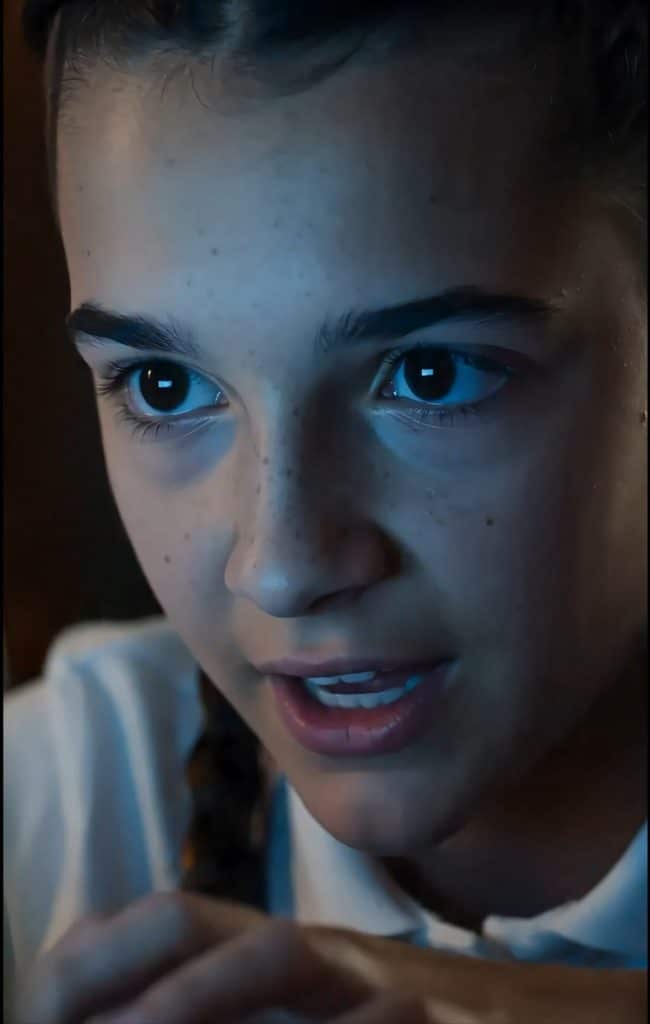
Ava Whitmore did not look like a child when she sat behind her father’s desk.
She looked like a witness.
The luxury office around her was dim, expensive, and still. Dark wood panels swallowed most of the warm desk-lamp light. Leather books lined the shelves. A black laptop sat open in front of her, its cold glow reflecting across the white collar of her school uniform.
Her small fingers moved over the keys with careful precision.
Not fast.
Not nervous.
Certain.
On the wall above the leather couch, a massive monitor flickered from black to blue.
Ava took one breath.
Then she said, “Dad deserves to see everything.”
Behind her, footsteps rushed down the hallway.
The office door flew open.
Her mother stood there in a maroon satin dress, hair loose over her shoulders, beautiful in the way expensive women learned to be beautiful even when they were terrified. But there was no softness in her face now.
Only panic.
“Ava, stop right now!”
Ava did not turn around.
She pressed Enter.
Six surveillance feeds appeared on the wall.
The front hall.
The garden.
The upstairs landing.
The playroom.
The pool terrace.
The children’s courtyard.
For a moment, the only sound was the low hum of the monitor.
Then her father walked in.
Nathan Whitmore had been halfway through a phone call when he heard his wife scream. He entered the office in a navy suit, white shirt open at the collar, confusion still on his face.
Then he saw the screen.
At first, he frowned like he was trying to understand what kind of security feed he was looking at.
Then his eyes moved from one camera angle to the next.
The playroom.
The courtyard.
The hallway outside the children’s bedrooms.
The garden bench where Ava often sat alone with her books.
His face went still.
“You filmed our children?”
Ava’s mother, Celeste, did not answer.
That silence was worse than denial.
Nathan turned to her slowly.
“Celeste?”
Her lips parted, but Ava clicked again.
A folder opened on the laptop.
Names filled the screen.
Ava crying.
Luca tantrum.
Nora disobedient.
Nathan angry.
Father unsafe.
Nathan took one step closer.
His voice dropped.
“What is this?”
Ava looked up at him, and only then did her composure crack at the edges.
“Dad,” she said, quiet and grave, “there’s more.”
Celeste lunged for the laptop.
Nathan caught her wrist before she reached it.
The room froze.
And in the glow of the security monitor, the perfect mother of Whitmore House finally looked like someone who knew the truth had already escaped.
Act II
Whitmore House had always been full of cameras.
That was what people said when they visited.
The gates were monitored. The driveway was monitored. The terrace doors, the garage, the side entrance, the wine cellar, the east garden path. Nathan called it necessary because wealthy families attracted opportunists. Celeste called it tasteful security because the cameras were hidden well enough not to ruin the architecture.
Ava never questioned them.
She had grown up inside polished walls and invisible watching. Drivers signed logs. Nannies wore discreet panic buttons. The alarm system knew which window opened and what time the kitchen lights switched off.
It was normal.
Or at least, Ava thought it was.
Until she found the second system.
Her father knew about the official cameras.
He did not know about the others.
The ones in the playroom clock.
The ones in the nursery bookshelf.
The one above the piano where Nora practiced with trembling hands.
The one in the hallway outside Ava’s room, angled perfectly to capture every time she stepped out crying after Celeste spoke to her.
Celeste had not installed them for security.
She installed them for a story.
Ava had learned that word from her mother: story.
Not truth. Not memory. Story.
Celeste believed life belonged to whoever controlled the story first.
She controlled birthday photos, charity dinners, family statements, the staff schedule, the school emails, the holiday cards, the way Nathan’s grief was described after his older brother died. She knew how to turn concern into suspicion and suspicion into fact.
Nathan was generous, tired, trusting.
Celeste was patient.
That made her dangerous.
The trouble had started after Nathan refused to sell his late brother’s company shares.
The Whitmore family trust had rules older than Ava. If Nathan were ever declared unfit to manage the estate or unsafe around his children, temporary control could pass to his spouse until the youngest child turned eighteen.
Celeste had smiled when the lawyer explained it years ago.
Nathan had barely listened.
He trusted her.
Ava remembered the day trust began sounding different in her mother’s mouth.
“Your father is under pressure,” Celeste told her one evening, smoothing Ava’s braid too tightly. “Sometimes people under pressure behave in ways they don’t remember.”
“Dad doesn’t yell,” Ava said.
Celeste smiled.
“Not at you, perhaps.”
Then came the questions.
Did Daddy forget dinner?
Did Daddy look angry?
Did Daddy scare Luca when he slammed the door?
But Nathan had not slammed the door.
A gust of wind had.
Ava said that, and Celeste’s hand paused on her shoulder.
“You’re very loyal,” her mother said.
It did not sound like praise.
A week later, the nanny, Mara, was fired.
Celeste said Mara had been careless with Luca near the pool. Ava knew it was not true because she had been there. Mara had grabbed Luca before he even reached the steps.
But the next day, Celeste showed Nathan a clip.
It began after Luca slipped.
It did not show Mara saving him.
It showed only the child crying, Mara kneeling in front of him, and Celeste’s voice off-camera saying, “How could you let this happen?”
Mara was gone before sunset.
As she left, she pressed a small flash drive into Ava’s palm.
“Don’t open this unless you have to,” Mara whispered. “But if your mother tries to take you away from your father, show him everything.”
Ava hid it in the lining of her school bag.
For three nights, she did not sleep.
On the fourth, she opened it.
And discovered that her mother had not only been watching them.
She had been building a case.
Act III
The files were organized like a trial.
Ava understood that immediately.
Her mother had folders for each child, each staff member, each incident. Some clips were seconds long. Others were edited from longer footage, cut so cleanly that anyone who did not know what happened before and after would believe the lie.
Nathan entering Ava’s room late at night.
The title: Father ignores boundary.
The truth: Ava had a fever, and he was bringing her medicine.
Luca crying in the hallway.
The title: Child frightened after father’s discipline.
The truth: Luca had lost his toy dinosaur, and Nathan was searching the house for it.
Nora refusing to play piano.
The title: Emotional instability in home.
The truth: Celeste had told her she would disappoint everyone if she missed one note.
Ava watched the clips in the dark with one hand over her mouth.
Then she found the audio folder.
Celeste’s voice came through the laptop speakers, calm and smooth.
“When the evaluator asks, you say Daddy makes the house feel scary.”
That was Nora’s small voice answering, “But Daddy reads to us.”
Celeste sighed.
“Do you want Mommy to cry?”
Ava closed the laptop so hard she nearly broke it.
The next morning, she watched her father kiss Celeste goodbye in the breakfast room, completely unaware that she was preparing to erase him from his children’s lives and call it protection.
Ava wanted to tell him then.
She almost did.
But Celeste watched her too closely.
So Ava waited.
She copied the files onto three drives. She sent one to Mara. Hid another behind the loose panel beneath her window seat. Kept the last in her pencil case at school.
She learned the password to the hidden surveillance dashboard because Celeste always used words that sounded elegant and meant something cruel.
The password was Legacy.
That night, Ava listened outside the office door and heard her mother speaking to a man named Victor Bell, the family lawyer.
“The footage is enough,” Celeste said.
“It will be stronger if the oldest girl confirms emotional distress,” Victor replied.
“Ava is difficult.”
“She’s eleven.”
“She’s observant.”
“Then isolate her from the others first.”
Ava did not move.
Not even to breathe.
Victor continued, “Once Nathan is judged unfit, control of the trust transfers. You will need a boarding placement recommendation for the children. Temporarily, of course.”
Celeste laughed softly.
“Temporary is what people call permanent when they don’t want to panic.”
That was when Ava stopped being afraid of getting in trouble.
She became afraid of being silent.
So she chose the office.
Her father’s desk.
Her mother’s own monitor.
The room where Celeste had planned to destroy them.
Now all three of them stood inside it while the truth lit the wall.
Nathan stared at the monitor.
Ava clicked the next file.
The screen changed.
Celeste appeared in the playroom, crouching in front of Nora.
“Say Daddy scared you,” Celeste said.
Nora shook her head, crying.
“He didn’t.”
Celeste’s voice hardened.
“Then maybe Daddy won’t be allowed to come home until you learn how to tell the truth.”
Nathan staggered back as if struck.
Celeste whispered, “That is not the full context.”
Ava looked at her mother.
“It is the part you cut out.”
Act IV
Celeste tried tears next.
Ava had expected that.
Her mother’s tears had always arrived at useful times, never messy enough to ruin her makeup, never early enough to be mistaken for real panic. They gathered beautifully in her eyes as she turned toward Nathan.
“I was trying to protect this family.”
Nathan stared at her.
“From what?”
“From your decline.”
“My decline?”
“You haven’t been yourself since Adrian died. Everyone sees it. The board sees it. The children feel it.”
Ava stood from the chair.
“No, we don’t.”
Celeste’s gaze snapped toward her.
“You are a child.”
Ava’s voice trembled now, but it did not break.
“Yes. That’s why you thought no one would believe me.”
Nathan looked at his daughter.
Something in his face changed.
Not shock anymore.
Shame.
Because he finally understood how long she had been carrying this alone.
Ava clicked again.
This time, the monitor showed an email chain.
Victor Bell to Celeste Whitmore.
Subject: Custody Strategy and Trust Transfer.
Nathan read the first visible line aloud.
“Recommended sequence: establish parental volatility, secure child statements, initiate emergency board review, petition temporary trust control.”
His hand fell to his side.
Celeste stopped crying.
The mask slipped completely now, and the woman beneath it looked cold.
“You have no idea what I have held together,” she said.
Nathan’s voice was almost unrecognizable.
“You tried to turn my children into witnesses against me.”
“I tried to save them from being raised by a man too weak to protect what his family built.”
The room went silent.
Ava looked at her father.
She expected anger.
Instead, she saw something quieter and more devastating.
He had loved Celeste.
Even now, betrayed and horrified, some part of him was still trying to find the woman he thought he married.
But she had never been there.
Not really.
Ava clicked the final file.
A live feed opened.
The children’s courtyard.
Luca and Nora were outside with a substitute nanny Celeste had hired after Mara left. The nanny was speaking on the phone, turned away from the children.
Then Ava zoomed in on the edge of the frame.
A black car waited beyond the side gate.
Nathan frowned.
“What is that?”
Ava’s voice became small.
“She told Mrs. Bellamy on the phone that we were leaving tonight.”
Celeste’s face went pale.
Nathan turned to her.
“Leaving?”
Celeste stepped back.
“Only for a few days.”
“Where?”
No answer.
Ava clicked one more document.
Boarding Placement Authorization.
All three children.
Signed by Celeste.
Scheduled for tonight.
Nathan picked up his phone.
This time, his hand did not shake.
He called security.
Then his sister.
Then the police.
Celeste lunged again, not for the laptop now, but for Ava.
Nathan moved first.
He stepped between them.
For the first time in Ava’s life, her father looked at her mother like a threat.
“Do not come near her.”
Celeste froze.
And the power in the room finally changed hands.
Act V
The black car at the side gate was stopped before it left the property.
The driver claimed he was waiting for a staff member.
He could not explain why he had three child travel bags in the trunk.
By midnight, the house was full of people Celeste could not charm: police officers, a child welfare advocate, Nathan’s sister Margaret, and two members of the Whitmore trust committee who arrived still wearing coats over evening clothes.
Mara came too.
When Ava saw her former nanny step into the front hall, the little girl’s courage finally collapsed.
She ran into Mara’s arms and cried so hard she could not speak.
Mara held her and looked over Ava’s shoulder at Nathan.
“She tried to tell you,” Mara said.
Nathan’s face crumpled.
“I know.”
Celeste was removed from the house before dawn.
Not dragged. Not screaming.
She was too proud for that.
She walked out in her maroon satin dress beneath the cold white lights of the entryway, chin lifted, attorney on speakerphone, still pretending this was a misunderstanding that could be corrected by paperwork.
But the files had already been copied.
The hidden cameras had already been found.
The emails had already been preserved.
And the children were inside, safe, with their father.
That was the part Celeste could not undo.
The legal process took months.
Celeste claimed the cameras were for safety. She claimed the recordings were misunderstood. She claimed Ava had been manipulated by a resentful former employee. She claimed Nathan was unstable, grief-stricken, unfit, and vengeful.
Then the unedited footage was reviewed.
The edited clips were compared.
Victor Bell’s emails were subpoenaed.
The driver testified.
Mara testified.
And finally, Ava spoke to a child advocate in a quiet blue room with a bowl of wrapped candies on the table and her father waiting outside the door.
She told the truth.
Not perfectly.
Not without crying.
But clearly.
The court froze Celeste’s access to the children and the trust. Victor Bell lost his position as family counsel and faced professional discipline. Celeste’s attempt to transfer the children into a private boarding program was exposed as part of a broader strategy to isolate them from their father while she gained control of the estate.
Nathan retained custody.
The children began therapy.
The hidden cameras came down one by one.
From the playroom clock.
From the nursery shelf.
From the garden lantern.
From the hallway outside Ava’s door.
Each tiny black lens went into an evidence bag.
Luca watched one being removed from the toy room and whispered, “Was Mommy always watching?”
Nathan knelt in front of him.
“She was wrong to do that.”
“Did I do bad things?”
“No,” Nathan said, voice thick. “You were just being a child.”
Nora climbed into his lap and cried.
Ava stood in the doorway, arms folded, trying to look like she did not need comfort.
Nathan saw.
This time, he did not miss it.
“Ava,” he said gently.
Her chin trembled.
“I’m fine.”
“No,” he said. “You don’t have to be.”
That was all it took.
She crossed the room and folded into him, and Nathan held all three of his children on the playroom floor while the last hidden camera was carried away.
The office changed after that.
The wall monitor was removed.
The leather couch stayed, but the room no longer belonged to secrets. Nathan kept the door open when he worked. Ava did homework at the desk sometimes, and Luca built block towers on the rug while Nora practiced reading aloud in a voice that got stronger every week.
The laptop was kept in a locked drawer.
Not hidden.
Preserved.
Ava asked why her father did not destroy it.
Nathan answered carefully.
“Because sometimes proof is what protects people when memory gets questioned.”
Ava nodded.
She understood that too well.
One evening, almost a year later, snow fell outside the office windows. The room glowed warm with lamplight. No monitor flickered on the wall. No unseen lens watched from a shelf.
Nathan sat at the desk signing papers.
Ava stood beside him with a school folder tucked under one arm.
“Dad?”
He looked up immediately.
That was new.
Before, he might have said one second.
Now, he looked up.
“Yes, star?”
She pretended to hate the nickname, but she did not walk away.
“Do you ever wish I didn’t show you?”
Nathan set down his pen.
“No.”
“Even though everything changed?”
He looked around the office.
Dark wood.
Warm light.
Open door.
Children laughing somewhere down the hall.
“Especially because everything changed.”
Ava stared at the place where the monitor used to hang.
“She was still my mom,” she said.
Nathan’s face softened with pain.
“I know.”
“Sometimes I miss who I thought she was.”
“That’s allowed.”
Ava looked at him.
“You’re not mad?”
“At you? Never.”
She breathed out slowly, like she had been holding that question for a long time.
Nathan reached for her hand.
Ava let him take it.
The night she opened the security feeds, she had thought she was exposing her mother.
But later, she understood she had done something bigger.
She had turned the house back into a place where children could speak.
Celeste had believed cameras gave her power because cameras could cut life into pieces, label those pieces, and present them as truth. She believed children were too small to understand strategy, too emotional to preserve evidence, too obedient to resist a mother who knew how to sound wounded.
She was wrong.
Ava had seen the missing seconds.
Heard the words before the recording began.
Remembered the truth after adults tried to rename it.
And when the time came, she sat in her father’s chair, opened the laptop, and filled the wall with everything Celeste had tried to hide.
Not because she wanted to ruin her family.
Because she wanted to save what was left of it.
The monitor had shown six feeds that night.
Six silent windows into a house built on lies.
But the most important thing in that room was not the footage.
It was the little girl in the white school uniform who finally made the adults look.