Act I
The girl came running down aisle seven like the building was on fire.
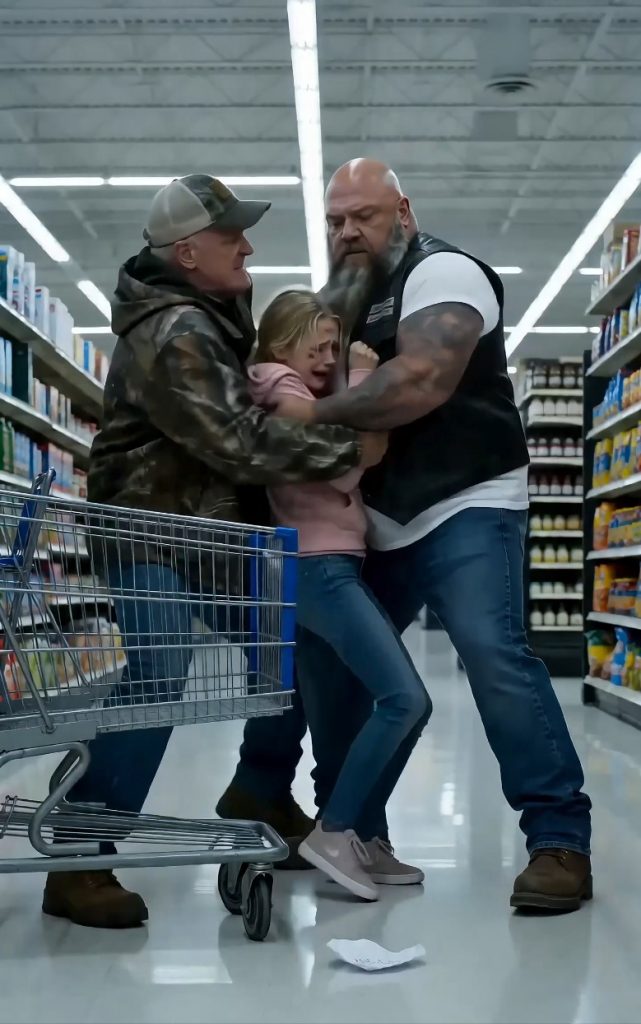
Her pink hoodie flashed between shelves of cereal and canned soup. Her blonde hair stuck to her tearful face, and one fist was clenched so tightly her knuckles had gone pale. Sneakers squeaked against the white tile as she glanced over her shoulder, sobbing too hard to breathe properly.
Frank Doyle looked up from his shopping cart.
He was holding a jar of peanut butter in one tattooed hand when she slammed into him.
The cart rattled. The girl bounced off his chest and nearly fell, but Frank caught her by the shoulders before she hit the floor.
“Easy,” he said, voice low. “Calm down, kid.”
She looked up at him, eyes wide with terror.
Not embarrassment.
Not surprise.
Terror.
Frank had seen that look before.
He was a large bald man with a long gray beard, a black leather vest, and arms inked with old names, road symbols, and one line wrapped around his wrist:
Protect what can’t protect itself.
Most people in grocery aisles moved around him carefully. This child clung to his vest like she had found the only solid thing in the store.
A crumpled white paper slipped from her hand and slid near his boot.
Before Frank could look down, a man in a camouflage jacket and baseball cap rounded the corner.
“There you are,” the man snapped.
The girl made a small broken sound and tried to hide behind Frank’s cart.
The man reached for her.
Frank moved first.
He stepped between them.
“Hold on.”
The man’s face hardened. “She’s with me.”
The girl shook her head so violently her hood slipped back.
Frank glanced down.
The paper had unfolded slightly on the tile.
Blue pencil marks showed through the crease.
The man lunged past him and grabbed the girl from behind, pulling her toward his chest.
She cried out and reached for Frank.
That was when Frank bent just enough to read the paper.
Help me. I don’t know him.
The grocery store changed shape around him.
The fluorescent lights hummed louder. A woman at the end of the aisle froze with a bag of oranges in her hands. Somewhere, a cart wheel squeaked and stopped.
Frank’s expression went still.
Then he looked up at the watching shoppers and roared, “Call 911! Hurry up!”
The man tightened his grip on the girl.
Frank planted his boots on the tile.
“Let the girl go, old man.”
The man bared his teeth.
“No way.”
Frank took one slow step forward, and for the first time, the girl stopped looking alone.
Act II
Frank Doyle had come to Miller’s Market for milk, bread, and the kind of canned peaches his mother insisted tasted better than fresh.
He had not planned to become anyone’s wall that afternoon.
But walls are not always built on purpose.
Sometimes they are made from all the things a person has survived.
Frank had grown up in a house where loud footsteps meant everyone got quiet. His father had been the type of man who could charm the church ladies on Sunday and terrify his family by dinner. Frank learned early that danger did not always look like danger to outsiders.
Sometimes it wore a clean shirt.
Sometimes it laughed.
Sometimes it said, “She’s with me,” in a public place and expected strangers to step aside.
Frank did not step aside anymore.
After twenty years driving long-haul trucks and another ten fixing bikes in a garage behind his house, he spent his weekends volunteering with a local child safety group. He transported donated bikes. Helped install locks. Stood outside courtrooms when frightened kids needed to walk past adults they did not trust.
He was not a police officer.
He was not trying to be one.
But he knew one rule better than most people:
A terrified child’s words come first.
Questions come after.
The girl in the pink hoodie had understood something adults often forgot. She knew that screaming might not be enough. Running might not be enough. So she carried proof.
A note.
It had been written in crooked, hurried letters on the back of a grocery receipt. The pencil had pressed so hard in places it nearly tore the paper.
Help me. I don’t know him.
Frank saw more than the words.
He saw planning.
A child had waited for one chance.
She had run when the man looked away, clutching the note like a match in the dark, and crashed into the biggest stranger she could find.
That meant she had chosen him.
Frank took that seriously.
The man in camouflage did not.
“She’s confused,” he barked, dragging the girl back a step. “She’s my niece. She gets like this.”
The girl sobbed, “No.”
The word barely came out.
Frank heard it anyway.
A shopper near the pasta shelf fumbled with her phone. Another backed away, whispering into the speaker. A store clerk peeked around the endcap, saw Frank’s face, and ran toward the front.
The man noticed the phones.
His eyes shifted.
That was the second thing Frank saw.
Not fear for the girl.
Fear of witnesses.
“Everybody mind your business,” the man shouted. “Family problem.”
Frank’s voice dropped.
“Then you won’t mind waiting for the police to sort it out.”
The man sneered. “You think that vest makes you important?”
Frank looked at the girl’s wrist caught in the man’s hand.
“No,” he said. “She does.”
The girl’s eyes filled again.
For one trembling second, she looked like she wanted to believe him but did not dare.
Then the man tried to move.
And the aisle became a line no one wanted him to cross.
Act III
The first person to block him was not Frank.
It was an older woman with a red scarf and a gallon of milk in her cart.
She pushed the cart sideways across the aisle without saying a word.
The man jerked to a stop.
“What are you doing?”
The woman’s hands shook on the handle, but she did not move.
“Waiting,” she said.
A teenage stock clerk came next, pulling a flatbed cart across the other end of the aisle. The woman with the oranges stayed on the phone with 911, voice trembling but clear as she read the address from a sale sign hanging above the shelves.
Frank kept his eyes on the man’s hand.
“Let her go.”
The man hissed, “I told you, she’s mine.”
The girl cried harder.
Frank’s jaw tightened.
“No child is yours like that.”
The man’s grip shifted, and the girl winced.
Frank moved.
He did not strike him. He did not throw him into the shelves. He simply stepped in, caught the man’s wrist with one hand, and placed his other palm between the girl’s shoulder and the man’s chest.
The man tried to yank back.
Frank did not let him.
“Open your hand,” Frank said.
The man struggled. “Get off me!”
“Open it.”
The girl slipped free.
Frank guided her behind him with one arm, never taking his eyes off the man.
The moment she was loose, the older woman with the red scarf hurried forward and pulled the girl gently behind her cart.
“Come here, honey. Behind me.”
The girl went.
Not because she trusted easily.
Because Frank nodded once, telling her it was safe enough.
The man lunged after her.
Frank blocked him with his body.
The camouflage jacket hit Frank’s chest and stopped there.
Shelves rattled. A jar toppled somewhere and rolled across the floor. Someone gasped.
The man shoved at Frank.
Frank did not shove back.
He leaned in close enough that only the nearest shoppers heard him.
“You are in a grocery store full of witnesses, and half of them are filming. Think carefully about your next mistake.”
The man froze.
His breathing came fast beneath the brim of his cap.
From behind the cart, the girl whispered, “He took me from the bus stop.”
The aisle went silent.
Frank turned just enough to see her face.
“What’s your name, sweetheart?”
“Annie,” she said. “Annie Wallace.”
The woman on the phone repeated it immediately.
“Annie Wallace. She says her name is Annie Wallace.”
The 911 operator must have said something, because the woman’s face changed.
“Oh my God,” she whispered.
Frank looked at her.
The woman swallowed hard.
“They have a missing child alert for that name.”
The man bolted.
But the store manager had already locked the front doors.
Act IV
He made it three steps before the teenage stock clerk and a man in a work uniform blocked the aisle.
The aggressor turned, wild-eyed, searching for another way out. The baseball cap slipped low over his forehead, but it could not hide the panic now.
Frank stood between him and Annie.
Sirens wailed outside.
The sound rolled through the automatic doors and across the polished tile like a promise.
Annie curled into herself behind the older woman’s cart. Her hoodie sleeves covered half her hands. Dirt marked one cheek. A faint bruise-like shadow showed near her jaw, and Frank looked away quickly enough not to make her feel studied.
“You’re doing good, Annie,” he said.
She shook her head.
“I ran away from him.”
“That sounds pretty good to me.”
“He said nobody would believe me.”
Frank looked at the paper on the floor.
“We believed the note.”
Her lower lip trembled.
“I wrote it at the gas station.”
The older woman knelt beside her.
“You held onto it the whole time?”
Annie nodded.
“He made me come in here because he needed food. I waited until he looked at the chips.”
The older woman covered her mouth.
Frank felt something twist hard in his chest.
Not pity.
Respect.
A child had been terrified, watched, pulled through public places by a man who counted on her fear to keep her quiet. And still she had found paper. Written a message. Waited. Run.
The police entered through the front doors moments later, followed by two store employees pointing toward aisle seven.
“Hands where I can see them,” an officer shouted.
The man in camouflage tried one last lie.
“She’s my niece! These people are crazy!”
Annie whimpered.
Frank looked at the officer.
“She has a note. It says she doesn’t know him. She gave her name as Annie Wallace.”
The officer’s face sharpened.
The second officer moved toward Annie, lowering her voice.
“Annie? I’m Officer Perez. Your mom is looking for you.”
Annie’s face crumpled.
“My mom?”
“Yes,” Perez said gently. “She’s on her way.”
The man cursed under his breath.
The officers turned him toward the shelves and secured his hands behind his back. He shouted about misunderstanding, about being a friend, about how the girl was lying. No one in the aisle looked convinced.
Not the woman with the oranges.
Not the teenage stock clerk.
Not the manager.
Not Frank.
As the man was led away, he twisted his head toward Annie.
“You stupid little—”
Frank stepped once into his line of sight.
He said nothing.
He did not have to.
The man looked away first.
Annie watched him disappear around the end of the aisle, then looked down at the note still lying near Frank’s boot.
Her voice was tiny.
“Can I keep it?”
Officer Perez glanced at Frank.
Frank bent slowly and picked up the crumpled paper.
He handed it to the officer first.
“Evidence,” he said.
Annie’s face fell.
Perez softened.
“We’ll keep it safe. And I’ll make sure you get a copy.”
Annie nodded, but her eyes stayed on the note.
Frank understood.
Sometimes the smallest thing is the only proof a child has that they fought back.
Act V
Annie’s mother arrived in less than ten minutes.
She ran into the store wearing hospital scrubs and one shoe untied, her face hollow with the terror of a parent who had imagined every possible ending on the drive over.
“Annie!”
The girl turned.
For a second, she did not move.
Then she broke into a run.
Her mother dropped to her knees in the front of the store and caught her so tightly both of them almost fell. Annie buried her face in her mother’s shoulder and cried without holding anything back.
The whole store went quiet.
Even Frank looked away.
He had learned that rescue has two parts. The first is stopping danger. The second is giving people enough privacy to fall apart safely.
Officer Perez spoke with Annie’s mother near the registers while paramedics checked Annie gently. The man in camouflage, whose name turned out to be Warren Pike, had no connection to the family. He had followed Annie from her bus stop after school, used a story about her mother being hurt, and counted on panic to do the rest.
Annie had questioned him too late to run at first.
Then she had listened.
Watched.
Waited.
At a gas station, she found a pencil near the counter and wrote the note on the back of a receipt when Pike was arguing with the cashier. She kept it hidden in her sleeve until the grocery store. When she saw Frank, she took the biggest gamble of her young life.
She ran.
The police took statements from everyone in aisle seven.
The woman with the red scarf cried while giving hers. The teenage stock clerk kept saying he should have moved faster. The store manager apologized for not noticing sooner.
Frank gave his statement last.
Officer Perez asked, “What made you believe her?”
Frank looked toward Annie, wrapped in a blanket beside her mother.
“She was scared of him,” he said. “That was enough.”
The officer nodded.
The story hit the local news by evening, though Annie’s face was kept private. People talked about the biker, the grocery aisle, the crumpled note, the shoppers who formed a barrier with carts.
But Frank did not like being called a hero.
He had not run through fire.
He had read.
He had believed.
That should not have been rare enough to make headlines.
A week later, Miller’s Market changed its employee training. The manager placed signs in the break room teaching staff how to respond when a child appears afraid of an accompanying adult. The teenage stock clerk started carrying a small notepad in his apron, saying, “Just in case somebody needs paper.”
The woman with the red scarf, whose name was Marlene, came back every Tuesday and always stopped by aisle seven for a moment before shopping.
Frank returned too, because his mother still wanted canned peaches.
The first time he walked down that aisle again, he paused near the spot where the note had fallen.
The tile was clean.
No sign remained.
That bothered him at first.
Then he realized maybe that was right.
Places should not have to hold the fear forever.
A month later, Annie and her mother came to Frank’s motorcycle garage.
Annie wore a yellow sweater this time. Her hair was brushed back. She stayed close to her mother, but she looked Frank in the eye when she handed him a folded piece of paper.
He opened it carefully.
It was a copy of the note.
Not the original. That was still with the case.
This one had the same words, rewritten in steadier handwriting:
Help me. I don’t know him.
Underneath, Annie had added:
You believed me.
Frank swallowed hard.
“Can I keep this?”
Annie nodded.
“I made it for you.”
He crouched so his huge frame did not tower over her.
“You know what I think when I read it?”
She shook her head.
“I think you were brave.”
Her face tightened in confusion.
“I was scared.”
Frank smiled gently.
“Most brave people are.”
Annie looked at the motorcycles lined up behind him, then at the patch on his vest.
Protect what can’t protect itself.
“I protected myself a little,” she said.
Frank’s eyes warmed.
“You protected yourself a lot.”
Her mother started crying then, quietly, turning toward the garage window so Annie would not feel responsible for the tears.
Frank framed the copy and hung it in his office beside old photos, bike parts, and a newspaper clipping he never admitted to keeping. Whenever someone asked about it, he told the truth.
“A girl wrote that before she found help.”
He did not say he saved her.
He said she reached.
He said people listened.
That mattered more.
Years later, Annie would not remember every detail of the grocery store. Some sounds faded. Some faces blurred. The fear changed shape with time, counseling, safety, and the stubborn love of a mother who never stopped showing up.
But she remembered the tile.
The paper.
The cart rattling.
The giant man who looked scary until he became a shield.
And Frank remembered the same moment from the other side.
A child ran into him with terror in her eyes, carrying two sentences that weighed more than any weapon.
Help me.
I don’t know him.
The world could have dismissed her.
It could have called it confusion, drama, a family issue, none of our business.
But in aisle seven of an ordinary grocery store, between peanut butter and breakfast cereal, one girl’s note turned strangers into witnesses.
And one man with a shopping cart and a leather vest decided that believing her was not optional.
It was the only decent thing to do.