Act I
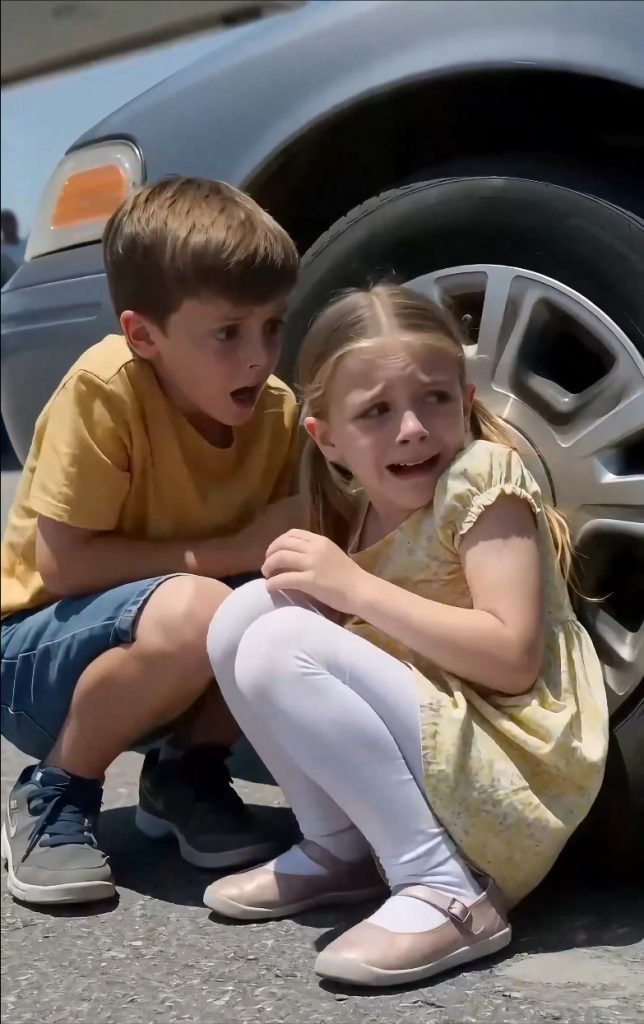
The little girl hit the asphalt first.
Her yellow floral dress twisted under her knees, and one white legging scraped against the gray pavement as she curled in on herself, crying before she even understood why she was on the ground.
Her brother fell beside her a second later.
He wore a yellow T-shirt and denim shorts, his small sneakers skidding as he tried to scramble backward from the open passenger door of the silver sedan. He covered his head with both arms, not because anyone told him to, but because his body had already learned what fear looked like.
Their father leaned out of the car, face red with rage.
“You ruined my life!” he screamed.
The gas station went still.
A woman at pump three froze with the nozzle still in her hand. A man carrying a soda stopped beside the convenience store door. Someone near a pickup muttered, “Hey,” but did not move fast enough.
The boy, Mason, sobbed into his arms.
The girl, Ellie, crawled closer to him and clung to his shirt.
Their father, Daniel Voss, slammed the passenger door half-shut, then stormed around toward the driver’s side. His gray polo clung damply to his back in the harsh afternoon sun. His hands shook, but not with regret.
With anger.
Mason looked up just enough to see the front tire beside him.
Too close.
“Ellie,” he cried, pulling his sister back.
Then the engine started.
The silver sedan coughed once, then roared.
The crowd gasped.
Daniel gripped the steering wheel and leaned forward, staring through the windshield like the children were not curled near the car, like the whole parking lot had disappeared and only his fury remained.
Then a man stepped into the lane in front of the sedan.
He was broad-shouldered, long-bearded, wearing a faded denim jacket over a black shirt. In one hand, he carried a sledgehammer low by his side.
He did not run.
He did not shout.
He walked straight toward the car with the calm of a man who had already decided what he would do if the engine moved one inch.
“Put it in park,” he said.
Daniel revved the engine.
The bearded man planted his boots on the asphalt.
“Last chance.”
Daniel’s jaw tightened behind the glass.
The man raised the sledgehammer.
One second later, the windshield shattered in a bright, violent web across Daniel Voss’s face.
And for the first time since the children hit the ground, their father stopped moving.
Act II
Before that afternoon, nobody at the gas station knew Mason and Ellie’s names.
They were just two small children in the passenger side of a silver sedan, silent in the way children become when they have learned silence might keep the storm from turning on them.
But Ruthie, the cashier behind the counter, had noticed them.
She noticed everything.
The little girl holding her brother’s hand too tightly. The boy watching his father’s face instead of the candy rack. The man in the gray polo snapping at them because Ellie asked for water.
“I said no,” Daniel hissed.
Ruthie pretended to organize lottery tickets while keeping one eye on the family.
The bearded man had noticed too.
His name was Jack Mercer.
Most people in town called him Hammer because he ran Mercer Roadside Repair, a small towing and mechanic shop off Route 19. He carried tools the way other men carried briefcases. That day, he had stopped at the gas station after helping a trucker with a bent trailer hitch.
The sledgehammer was still in the bed of his old work truck.
Jack had seen angry men before.
His own father had been one.
That was why Jack had learned early that the most dangerous moment was not always the yelling. Sometimes it was the sudden quiet afterward, when a man decided the world owed him obedience and everyone else became an obstacle.
He watched Daniel Voss from the pump.
Watched him grip Ellie’s arm too hard.
Watched Mason put himself between his sister and their father’s hip when Daniel turned too quickly.
Jack set the gas nozzle back in place.
Inside the sedan, something was already breaking.
Daniel had lost his job that morning.
Not because of the children.
Not because of bad luck.
Because he had spent months stealing from the warehouse where he worked and blaming missing inventory on a younger employee who did not have the confidence to fight back. When the company found the camera footage, Daniel was fired in front of two supervisors and escorted out by security.
By noon, he had emptied his account.
By one, he had picked the children up from summer day camp without telling their grandmother.
By two, he was at the gas station with a half-packed duffel bag in the back seat, two frightened kids, and a plan built out of panic.
Mason knew only pieces.
He knew his father had been driving too fast.
He knew Ellie had cried because she wanted to call Grandma.
He knew Daniel kept saying, “Nobody takes my kids from me.”
That sentence scared Mason more than the shouting.
Because it did not sound like love.
It sounded like a threat.
At the gas station, Ellie dropped her small water bottle while trying to climb back into the car. It rolled under the passenger seat.
She reached for it.
Daniel snapped.
He shoved her out first.
Mason grabbed for her.
Daniel shoved him too.
And when both children were on the pavement, crying in front of strangers, Daniel looked at them like they were proof of everything he had lost.
That was the moment Jack Mercer started moving toward his truck.
Because some men only stop when something stronger than their rage stands in front of them.
Act III
The windshield did not collapse inward.
It cracked in a dense white circle where the sledgehammer struck, spiderweb lines bursting outward across the glass and blocking Daniel’s view of the children on the ground.
The sound hit the gas station like thunder.
People screamed.
Daniel recoiled behind the wheel, hands flying up, the engine dropping from a roar to a rough idle.
Jack kept the sledgehammer in both hands.
He did not swing again.
He did not need to.
“I said,” Jack told him, voice low, “put it in park.”
This time, Daniel obeyed.
The gear shifted with a dull mechanical click.
At pump three, the woman with the nozzle finally moved. She ran to Mason and Ellie, crouching beside them with both hands out.
“Come here, babies. Away from the car.”
Mason hesitated, still shielding Ellie.
Jack glanced back.
“It’s okay, son. Move away from the tire.”
That voice reached him.
Not soft exactly.
Solid.
Mason pulled Ellie toward the woman, both children shaking. Ellie cried into her brother’s shoulder, and Mason kept whispering, “I got you, I got you,” though his own voice was breaking.
Ruthie had already called 911.
Her voice trembled behind the store counter as she gave the dispatcher the address.
“Man threw two kids out of a car. He tried to drive. Another man stopped him. Please hurry.”
Outside, Daniel pushed open the driver’s door.
Jack turned the sledgehammer slightly, not raising it, just letting its weight speak.
“Stay in the car.”
Daniel stepped out anyway.
His face twisted with outrage.
“You psycho! You smashed my windshield!”
Jack looked at the crying children.
“Better glass than bones.”
The crowd heard it.
So did Daniel.
For a second, his anger faltered under the weight of what he had nearly done.
Then pride rushed back in.
“They’re my kids!”
Jack took one step forward.
“No child belongs to your rage.”
Daniel lunged, but not far.
Two men from the crowd caught him before he reached Jack. One was a truck driver. The other was a nurse’s husband who had been too frozen before and refused to stay frozen twice.
Daniel fought them, shouting about rights, respect, ruined lives, and ungrateful children.
The whole gas station watched him become smaller with every word.
Because the children were no longer beside the car.
They were huddled near the ice machine with the woman from pump three kneeling in front of them, her phone in one hand, her body turned like a shield.
Mason stared at the cracked windshield.
Ellie sniffled against his shirt.
“Is he going to come back?” she whispered.
Mason did not know.
Jack heard her.
He lowered the sledgehammer and turned toward them.
“No,” he said. “Not while I’m standing here.”
Act IV
The police arrived in four minutes.
To Mason, it felt like an hour.
Two patrol cars pulled hard into the lot, lights flashing against gas pumps and chrome bumpers. Officers stepped out quickly but carefully, reading the scene in pieces: cracked windshield, children crying, father restrained by strangers, bearded man holding a sledgehammer pointed safely toward the ground.
One officer took the hammer from Jack.
Jack handed it over without argument.
“Used it on the windshield,” he said. “Not on him.”
The officer glanced at the sedan, then at the children.
“Good choice.”
Daniel shouted the entire time they cuffed him.
“He attacked me! He broke my car! Those are my kids!”
The second officer looked at Mason.
The boy flinched.
The officer’s face softened.
“I’m not mad at you,” she said. “Can you tell me your name?”
Mason looked at Jack first.
That small movement told everyone enough.
“Mason,” he whispered.
“And your sister?”
“Ellie.”
Ellie pressed her face into his shoulder.
The officer crouched lower.
“Are you hurt?”
Mason shook his head, then looked down at Ellie.
“She fell hard.”
The woman from pump three, whose name was April, brushed Ellie’s hair gently from her face.
“She’s scared,” April said. “Both of them are.”
Ruthie came out of the store carrying two bottles of water and a box of tissues. Her hands shook so badly that Jack took the water from her before it spilled.
“You did good calling,” he said.
Ruthie wiped her eyes.
“I should’ve done something sooner.”
Jack looked at the children.
“Everybody thinks that afterward.”
That sentence settled over the onlookers.
Several looked away.
Not from shame alone.
From recognition.
They had all watched the first seconds, trying to decide whether it was their place. Trying to understand whether the man was really dangerous. Trying to convince themselves someone else would step in.
Jack had stepped in.
But even he knew the truth.
The children had already fallen by then.
A minivan pulled into the lot minutes later, brakes squealing.
An older woman stumbled out before the vehicle fully stopped.
“Mason! Ellie!”
The children’s grandmother, Linda Voss, ran toward them with both arms open. Mason held still for half a breath, like his body needed permission to believe she was real.
Then he broke.
“Grandma!”
Linda dropped to her knees on the asphalt and gathered both children against her. Her sob was quiet but raw, the sound of someone hearing the nightmare after it had already happened.
“I called the camp,” she cried. “They said your father picked you up. I knew something was wrong.”
Daniel, standing beside a patrol car, twisted toward her.
“Mom, tell them!”
Linda looked at her son.
Her face changed.
Not into anger.
Into something colder.
“No,” she said. “I’m done telling people you’re better than this.”
Daniel stared at her.
For the first time all day, he had no words.
Jack stood near the cracked sedan, watching the children cling to the woman who had come for them.
The sledgehammer lay on the hood of a patrol car.
The windshield glittered in the sun.
And the public mask of Daniel Voss had finally broken as completely as the glass.
Act V
The story spread through town by evening.
At first, people talked about the sledgehammer.
That was the part that caught attention. The dramatic part. The part easy to repeat while standing in grocery lines or scrolling on phones.
Man smashes windshield to stop father from driving near kids.
But the real story was quieter.
It was Mason covering Ellie’s head with his own arms.
It was Ellie whispering, “I want Grandma,” after the paramedics wrapped a blanket around her shoulders.
It was Linda standing in the police station, signing emergency guardianship paperwork with a shaking hand, refusing to make one excuse for the son she loved but could no longer defend.
And it was Jack Mercer sitting alone on the curb after everyone left, staring at the dented head of his sledgehammer.
The police cleared him that night.
Witnesses confirmed Daniel had started the engine while the children were near the car. The windshield strike was treated as intervention to stop immediate danger. Jack gave his statement, short and plain.
“I saw two kids on the ground. I saw him rev the engine. I stopped the car.”
The officer asked if he regretted breaking the windshield.
Jack looked through the station window at Mason and Ellie asleep against Linda in the waiting room.
“No.”
Weeks passed before he saw the children again.
They came to Mercer Roadside Repair with their grandmother on a Saturday morning. Mason wore the same yellow T-shirt, now washed clean. Ellie wore pink sneakers and held a stuffed rabbit with one missing button eye.
Jack was under the hood of a pickup when they arrived.
Linda cleared her throat.
He looked up.
Mason stepped forward first, holding a folded piece of paper.
“I drew you something.”
Jack wiped his hands on a rag and took it carefully.
The drawing showed a silver car, two small children, and a very large man holding what looked like a giant lollipop.
Jack smiled.
“That the hammer?”
Mason nodded.
“I’m not good at hammers.”
“You did fine.”
At the bottom, in careful letters, Linda had helped him write:
Thank you for stopping the car.
Jack swallowed hard.
Ellie stepped from behind Linda and looked up at him.
“Were you scared?”
Jack crouched so she would not have to look so far up.
“Yes.”
Her eyes widened.
“You looked mad.”
“I was that too.”
She thought about this.
“Daddy gets mad.”
Jack’s face softened.
“Your daddy’s mad is not your fault.”
Ellie looked at the cracked concrete beneath her shoes.
Mason whispered, “He said we ruined his life.”
Jack took a slow breath.
Children remember sentences adults throw like garbage. They pick them up and carry them for years unless someone takes them away.
So Jack spoke carefully.
“No,” he said. “That was a lie his anger told. You didn’t ruin anything.”
Mason’s eyes filled.
Linda turned away, covering her mouth.
Jack looked at both children.
“You hear me? Grown-ups are responsible for what they do with their pain. Kids are not responsible for carrying it.”
Mason nodded once, but Jack knew a single sentence could not undo what had been screamed at them.
Still, it was a start.
Daniel Voss faced charges and lost custody. He entered court angry, then defensive, then quiet when surveillance footage from the gas station played on a large screen. The camera showed everything: the shove, the children on the pavement, the engine starting, Jack stepping forward.
It also showed the crowd.
People watching.
Frozen.
That footage changed more than Daniel’s case.
The gas station owner installed panic buttons and trained employees on emergency intervention. Ruthie stopped apologizing for being “just a cashier” and started telling every new hire, “If your gut says a kid is in danger, call first and explain later.”
April, the woman from pump three, began volunteering with a family crisis center.
Jack replaced the smashed windshield himself after the car was released from evidence, not for Daniel, but because the vehicle was later sold and the money placed in a support fund for Mason and Ellie.
He kept the old cracked glass for a while, leaning against the wall of his shop.
Linda asked why.
Jack shrugged.
“Reminder.”
“Of what?”
He looked at the webbed impact mark.
“That sometimes stopping something costs something. And you should still stop it.”
A year later, Mason and Ellie were living with Linda in a small blue house with a vegetable garden and a tire swing in the backyard. Mason still startled at loud engines. Ellie still cried when adults shouted. Healing came slowly, in bedtime routines, counseling appointments, packed lunches, and ordinary mornings where no one blamed them for being children.
On the anniversary of the gas station incident, Linda brought them back to Mercer Roadside Repair.
Not to remember the terror.
To replace it.
Jack had arranged something in the lot behind the shop. An old junkyard windshield, already removed from a wrecked car, stood upright inside a safe frame. Beside it was a bucket of washable paint and two foam toy hammers.
Mason stared.
“What’s that?”
Jack smiled.
“Thought you might like to break something that can’t hurt you.”
Linda looked uncertain until the counselor beside her nodded.
Mason dipped the foam hammer in blue paint and tapped the glass.
Nothing shattered.
A bright mark appeared.
Ellie chose yellow.
Soon both children were laughing, covering the old windshield in handprints, paint streaks, crooked suns, flowers, and two stick figures holding hands.
Jack watched from a distance.
No engine revved.
No one screamed.
No one fell.
The glass stayed whole, but the memory changed shape anyway.
At the end, Ellie painted a big crooked heart in the center.
Mason wrote one word beneath it.
Safe.
Jack kept that windshield too.
He hung it in the shop office where sunlight passed through the paint every afternoon.
Customers asked about it sometimes.
He never gave the whole story.
Only the part that mattered.
“Two kids made that,” he would say. “Bravest artists I know.”
And when people asked about the sledgehammer mounted on the wall below it, Jack would look at the painted heart, then at the heavy tool that had once cracked a windshield open in front of an angry man.
“That,” he said, “is for remembering the difference between damage and protection.”
Because the day at the gas station was not about broken glass.
It was about two children thrown onto pavement and the moment one person decided that watching was no longer enough.
The father had screamed that they ruined his life.
But Jack knew the truth.
They had not ruined anything.
They were just children, crying beside a car, waiting for the world to prove that someone would stand between them and the next terrible thing.
And that day, someone did.