Act I
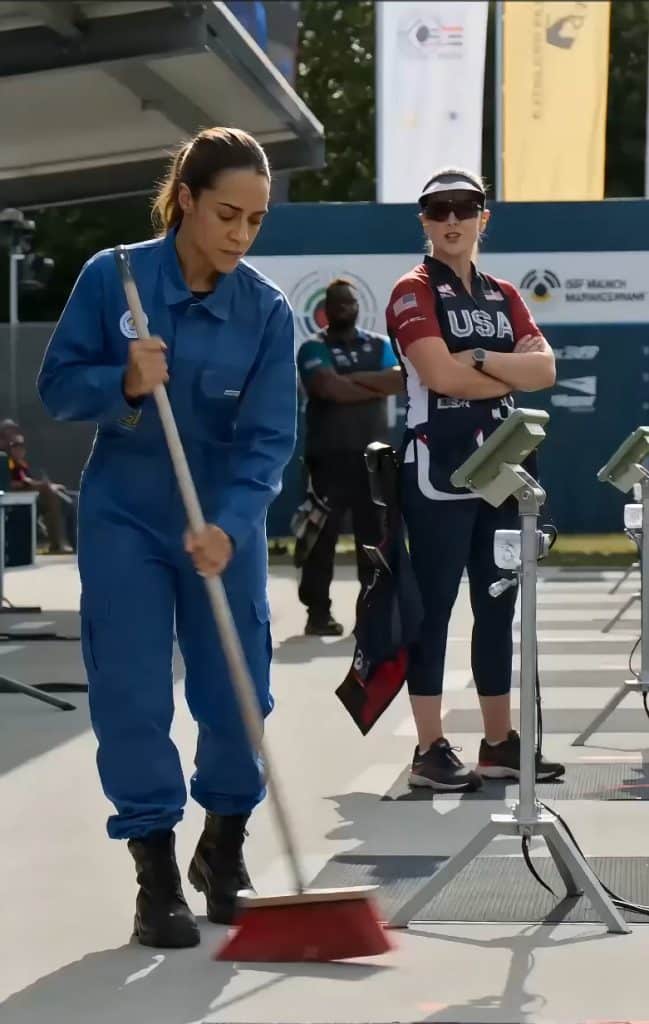
The broom scraped across the pavement before anyone looked at the woman holding it.
That was how Lena Voss liked it.
Invisible people heard everything.
She moved along the edge of the firing lanes in blue industrial coveralls, black boots, and a brown ponytail tucked low at the back of her neck. The red bristles of her broom pushed dust, paper scraps, and spent nerves into a neat line beneath the sponsor boards.
Above her, a white sign read:
ISSF MUNICH GER
The range was bright, official, expensive. Electronic monitors blinked beside polished stations. National flags stirred lightly in the morning wind. Coaches whispered behind clipboards while athletes stretched their fingers and adjusted specialized eyewear like surgeons preparing for delicate work.
Lena kept sweeping.
Then Brooke Harrington saw her.
Brooke wore the USA shooting jersey like armor. Blonde hair tucked beneath a sun visor, sharp lenses over colder eyes, shoulders squared with the entitlement of someone used to being photographed before she earned the headline.
She watched Lena drag the broom past her lane and laughed.
“Sweep properly, you janitor,” Brooke called. “This is a competition.”
Two men behind her laughed immediately.
Not because it was funny.
Because Brooke had said it, and people around winners often laughed before deciding whether they meant it.
Lena paused.
Only for a second.
The broom bristles stopped against the pavement.
Then she continued.
Brooke’s smirk deepened.
“What’s wrong? Don’t understand English?”
The men laughed louder.
Lena lifted her eyes.
Calm.
Too calm.
Brooke mistook it for fear.
She stepped closer, folding her arms across her USA jersey.
“Tell you what,” she said, voice carrying enough for nearby shooters to hear. “Hit the center and I’ll give you one thousand dollars.”
The range quieted in patches.
Lena looked at the electronic monitor. Then at the target line. Then at Brooke.
“One shot?”
Brooke scoffed. “One shot.”
Lena leaned the broom against her hip.
“And if I hit it,” she said softly, “you kneel in front of me until I say you can stand.”
The men behind Brooke went silent, then laughed again, less sure this time.
Brooke tilted her head.
“OK.”
She said it like she had already won.
Lena set the broom down.
The soft clack against pavement sounded louder than it should have.
She stepped to the firing line, and for the first time, the woman in coveralls moved like someone who belonged there.
Act II
Three years earlier, Lena Voss had not owned coveralls.
She owned jackets with her country’s crest. Custom gloves. Travel cases. Notebooks full of wind notes, breathing counts, competition schedules, and her father’s handwritten reminders.
Slow hands. Clear mind. Let the noise embarrass itself.
Her father, Viktor Voss, had been a shooter first and a coach second, though Lena always thought he was best at being a father. He could spot a flaw in someone’s stance from twenty meters away, but he never once raised his voice at her after a bad shot.
“A bad shot tells the truth,” he used to say. “Listen before you argue.”
Under Viktor’s guidance, Lena became impossible to ignore.
At sixteen, she won junior European gold. At seventeen, she broke a national record. By nineteen, she was being called the future of precision shooting in Europe, the kind of athlete sponsors loved because she was quiet, disciplined, and looked almost shy until she stood at the line.
Then came Munich.
Not this year’s Munich.
The other one.
The championship where everything collapsed.
Her pistol failed inspection minutes before the final. Officials found an illegal adjustment inside the grip mechanism. Lena denied knowing anything about it. Viktor denied touching it. The equipment had been inspected before travel, locked overnight, and handled only under federation supervision.
No one listened.
The scandal spread faster than the investigation.
Cheater.
Fraud.
Dirty prodigy.
Viktor was suspended from coaching. Lena was banned pending review. Sponsors vanished. Teammates stopped answering messages. Her federation called it regrettable and moved on.
Two months later, Viktor died of a heart attack in a small apartment outside Vienna, surrounded by appeal documents no one had read.
Lena disappeared after the funeral.
At least, that was what the sports world believed.
In truth, she stayed close.
She cleaned ranges.
Carried equipment.
Swept floors.
Emptied bins.
People who looked through her never thought to lower their voices. She heard coaches joke about bribes. Heard athletes complain about officials. Heard names repeated in hallways like loose threads waiting to be pulled.
One name returned more than once.
Brooke Harrington.
Three years ago, Brooke had been the American rising star standing beside Lena before the Munich final. She had placed fourth after Lena’s disqualification. She later signed the sponsor Lena lost.
Her coach, Martin Blake, had been seen near the equipment room the night before inspection.
There was no proof.
Only whispers.
Then, six weeks before this championship, Lena received an anonymous email.
Your father was right. Munich was fixed. Come back where it happened.
Attached was a maintenance contract for ISSF Munich.
A cleaner’s badge.
A schedule.
And one photo.
Brooke’s coach entering the restricted equipment area three years earlier, a small black case in his hand.
Lena accepted the cleaning job the next morning.
She did not come to Munich to shoot.
She came to listen.
But Brooke Harrington had a talent for turning hidden things into public moments.
And now, with a broom lying on the pavement and a crowd holding its breath, Lena realized the range had finally given her something her appeals never had.
A microphone made of silence.
Act III
The range marshal stepped forward.
“Wait,” he said. “This is not—”
Brooke cut him off with a laugh.
“She won’t hit anything. Let her embarrass herself.”
The marshal hesitated.
Lena looked at him.
“I’ll follow range commands.”
Something in her voice changed his expression.
Not arrogance.
Familiarity.
He had heard that tone from professionals. From finalists. From athletes who understood that a firing line was not a stage for carelessness, no matter how loud the audience became.
He nodded once.
“Under supervision,” he said. “One shot. Safety rules remain.”
Lena stepped into position.
Brooke’s smile flickered.
Only slightly.
The men behind her stopped laughing completely.
Lena did not rush.
She accepted the competition pistol placed under the marshal’s supervision. Her hands checked nothing theatrically. Her face showed nothing dramatic. She simply settled into stillness, and the entire range seemed to tighten around her.
Brooke whispered, “This is ridiculous.”
No one answered.
Lena raised the pistol.
In that moment, the coveralls changed.
They no longer looked like a uniform of labor.
They looked like a disguise she had chosen.
Her shoulders dropped. Her breath slowed. The noise around her fell away piece by piece: spectators, flags, cameras, the soft electronic hum of the monitor, Brooke’s breathing somewhere behind her.
For a second, Lena saw her father.
Not as he looked at the end, tired and gray from fighting people who had already decided not to believe him.
She saw him at their old practice range, arms folded, smiling because she had finally learned not to force a perfect shot.
A perfect shot, he said, is not taken. It is allowed.
Lena fired once.
The sound cracked across the range and vanished into the open air.
A digital chime followed.
Everyone turned to the monitor.
10.5
Dead center.
The number glowed on the screen in clean, objective light.
No rumor.
No politics.
No sponsor influence.
Just the shot.
Brooke stared.
Her jaw loosened.
“That’s impossible.”
Lena lowered the pistol safely and stepped back from the line.
The range marshal was staring too, but not at the monitor anymore.
At her.
His face had gone pale with recognition.
“Lena,” he whispered.
Brooke turned sharply.
“What did you say?”
The marshal looked from the woman in coveralls to the perfect score.
Then he said the full name.
“Lena Voss.”
The silence that followed was not empty.
It was loaded.
Act IV
Brooke laughed once.
Too loud.
“No,” she said. “Lena Voss is banned.”
Lena turned toward her.
“Suspended,” she said. “Pending investigation.”
Brooke’s face tightened.
“Same thing.”
“No,” Lena said. “It isn’t.”
People began pulling out phones. Coaches stepped closer. The two men who had laughed behind Brooke now looked as if they wished they had chosen a different morning to be visible.
Martin Blake appeared from behind the sponsor board.
Brooke’s coach was older now, hair silver at the temples, expression sharp with alarm. His eyes went first to Lena, then to Brooke, then to the monitor.
He understood faster than Brooke did.
“Brooke,” he said quietly. “Come with me.”
Lena did not raise her voice.
“Leaving already?”
Martin smiled in the polished way men smile when they want the room to forget what it just saw.
“This is an inappropriate interruption.”
Lena reached into the pocket of her coveralls and pulled out a folded lanyard.
She clipped it to her chest.
Not a janitor’s badge.
A temporary credential issued by the Integrity Review Commission.
Martin stopped smiling.
Brooke looked at the badge, then at Lena.
“What is this?”
Lena’s eyes did not leave Martin.
“An investigation.”
The crowd shifted.
The marshal stepped back as two officials in dark jackets approached from the administrative tent. One carried a tablet. The other carried a sealed evidence pouch.
Lena spoke clearly now, not just to Brooke, but to everyone.
“Three years ago, my equipment was tampered with in Munich. My father reported irregular access to the storage room. His complaint disappeared. So did the surveillance file.”
Martin’s mouth hardened.
“You should be careful.”
Lena’s voice stayed calm.
“I was careful. That’s why I came back as staff.”
Brooke looked at Martin.
For the first time, uncertainty touched her face.
Lena continued.
“People talk around cleaners. They leave doors open. They assume the person sweeping the floor has no memory, no skill, no name.”
She looked at the broom.
“My father used to say arrogance makes people sloppy.”
One of the officials held up the evidence pouch. Inside was a black access card.
The second official spoke.
“Mr. Blake, this card was recovered from restricted storage this morning. It was used at 22:14 last night.”
Martin said nothing.
The official tapped the tablet.
“Your credential was logged at the same door three years ago before Ms. Voss’s equipment inspection failure. The archived footage, recently recovered, confirms your entry.”
Brooke stepped back.
“What?”
Martin’s face turned cold.
“Don’t say anything.”
That was the wrong instruction.
Because Brooke heard the confession inside it.
Lena looked at her.
“You mocked the wrong janitor.”
The perfect 10.5 still glowed on the monitor behind them.
Brooke’s wager hung in the air now, ridiculous and cruel, but smaller than the truth unfolding beside it.
Still, humiliation has a way of demanding payment.
Lena glanced at the ground in front of her.
Brooke’s face flushed.
“You can’t be serious.”
Lena’s expression did not change.
“You were.”
The crowd watched.
Brooke looked at Martin, but Martin was too busy calculating his own escape.
Slowly, with rage burning through disbelief, Brooke lowered one knee to the pavement.
Then the other.
The men who had laughed looked away.
Lena let the silence last just long enough for Brooke to feel the shape of what she had tried to do to someone else.
Then Lena said, “Stand.”
Brooke looked up, startled.
Lena’s voice sharpened.
“I don’t need you on your knees. I need you under oath.”
Act V
By evening, the story was everywhere.
Not the silly version first.
Not the janitor beating the champion with one perfect shot.
That clip spread fast, of course. The broom. The wager. Brooke’s frozen face. The monitor flashing 10.5 like a verdict.
But the real story followed close behind.
Lena Voss had returned to Munich under an integrity review assignment. Officials had recovered access logs, hidden footage, and internal emails suggesting her disqualification three years earlier had not been an accident. Martin Blake was suspended immediately. Brooke Harrington withdrew from the final pending inquiry after admitting, through counsel, that she had known “parts of the history” but claimed she had not understood the full extent of the sabotage.
People believed what they wanted.
They always had.
But now Lena had proof.
The investigation reopened her case and cleared her father’s name first.
That mattered more than her own.
When the official letter arrived, Lena sat alone in the empty range office after midnight and read the sentence three times.
No evidence of wrongdoing by Viktor Voss or Lena Voss has been found. Prior disciplinary action was based on compromised evidence.
Compromised evidence.
Such clean words for ruin.
She placed the letter on the desk and pressed both palms flat beside it.
For three years, she had imagined this moment.
She thought she would scream.
She thought she would laugh.
Instead, she whispered, “Papa.”
And cried in a room that smelled of printer ink, dust, and rain.
The next morning, the federation offered a formal apology. Lena accepted it with the expression of someone receiving a repaired vase after the flowers had died.
Then came the harder question.
Would she compete again?
Reporters asked it.
Officials asked it.
Sponsors asked it with greedy hope already returning to their eyes.
Lena did not answer right away.
She went back to the range before sunrise, still wearing the blue coveralls because they had become part of the story and because, strangely, she no longer hated them. The broom leaned where she had left it.
The target lanes were empty.
The monitors dark.
For the first time in years, silence did not feel like exile.
It felt like a beginning waiting to be chosen.
The range marshal from the day before approached quietly.
His name was Tomas Keller. He had been a junior official during the original scandal, too low-ranking to challenge the decision, too haunted to forget the look on Viktor’s face when the verdict came down.
“I should have spoken louder then,” he said.
Lena looked at him.
“Yes.”
He took the answer without defense.
“I’m sorry.”
She nodded.
It was not forgiveness.
Not yet.
But it was truth, and truth was a better start than apology without cost.
Brooke came later.
No cameras. No visor. No USA jacket.
She stood at the edge of the lane wearing plain training clothes and a face stripped of performance.
“I didn’t know he planted it,” she said.
Lena kept her eyes on the target line.
“But you knew he laughed when I was disqualified.”
Brooke looked down.
“Yes.”
“And you knew your contract came after mine disappeared.”
“Yes.”
“And you still called me janitor.”
Brooke flinched.
There was no useful answer to that.
For a long moment, the two women stood beneath the pale German morning, the competition grounds quiet around them.
Finally, Brooke said, “I’m sorry.”
Lena turned to her.
“Are you sorry because you were wrong? Or because people saw you being wrong?”
Brooke’s eyes filled with angry tears, but she did not look away.
“I don’t know yet.”
That was the first honest thing Lena had heard from her.
So she nodded once.
“Then start there.”
The rematch came six months later.
Not against Brooke.
Against the world.
Lena was reinstated too late to recover the years she lost but early enough to qualify for the European circuit. Her first official return took place in Prague, beneath lower lights, smaller banners, and an audience that rose when her name was announced.
Lena Voss.
Not disgraced.
Not former.
Not janitor.
Competitor.
She walked to the line carrying her father’s old range notebook in her bag. Inside the front cover, his handwriting had faded slightly, but the words remained.
Let the noise embarrass itself.
She smiled.
Then she shot.
Not every score was perfect.
That almost made her happier.
Perfection had become the wrong myth around her. One shot in Munich had opened the door, but it was not what made her great. What made her great was returning after years of being treated as a lie and still trusting her own hands enough to begin again.
After the event, a young cleaner approached her near the exit.
A teenage girl with a mop bucket and wide eyes.
“Miss Voss?” she asked. “Is it true you were really sweeping when you made the shot?”
Lena glanced down at the girl’s work uniform.
“Yes.”
The girl smiled shyly.
“They laugh at us sometimes.”
Lena took a marker from her bag and signed the girl’s event program.
Then she wrote beneath her name:
They laugh because they haven’t seen you aim yet.
The girl read it and grinned.
Months turned into a year.
The Voss case reshaped security protocols across several European competitions. Equipment storage rules changed. Access logs became independently reviewed. Complaints from staff, athletes, and lower-ranked officials could no longer disappear into federation drawers without trace.
Viktor Voss’s name was restored to the coaching registry.
Lena placed the clearance letter beside his photograph at home, next to the medal he once told her mattered less than good character and more than bad politics.
As for Brooke Harrington, she testified against Martin Blake after the investigation found messages proving he had manipulated more than one athlete’s equipment over the years. Her career survived, but her certainty did not. That may have been the first useful thing that ever happened to her.
Years later, people still replayed the Munich clip.
The arrogant champion.
The janitor.
The broom.
The single shot.
The 10.5.
But those who watched closely saw more than a viral reversal. They saw the moment a woman everyone tried to erase stepped back into the world without asking permission.
Lena never framed the coveralls.
She kept them in a box.
Not as a costume.
As evidence.
Of the work she did when no one clapped.
Of the silence she carried without letting it rot her.
Of the morning a champion mistook humility for weakness and learned, in front of the entire range, that the person sweeping the floor might be the only one who truly understood how to hit the center.