Act I
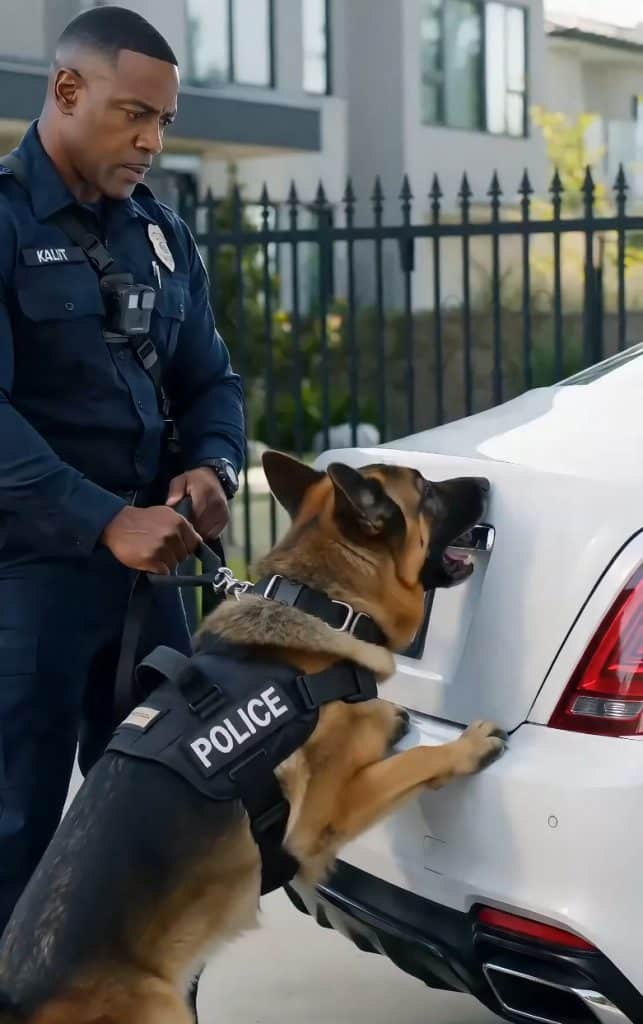
The German Shepherd would not move away from the trunk.
His name was Atlas, and he was trained to obey.
Sit meant sit.
Stay meant stay.
Leave it meant leave it.
But that afternoon, on a clean private street lined with modern mansions and black metal gates, Atlas ignored every sound except whatever was coming from the rear of the white luxury sedan.
He barked at the trunk seam until his whole body shook.
Officer Marcus Reed held the leash tight with both hands, boots planted on the pavement, eyes fixed on the dog’s nose as it pressed near the rear panel.
“Atlas,” he said. “Steady.”
The dog did not settle.
He pawed once at the bumper, claws clicking against the paint, then barked harder.
The neighborhood around them looked too perfect for panic. Bright sun on trimmed hedges. Marble steps. Long driveways. Security cameras tucked discreetly above iron gates. The kind of street where people complained about leaf blowers, not police dogs.
Then the woman came out.
She swept through the dark gated entryway in a metallic silver dress that caught the light like a blade. Her blonde hair was styled in loose waves. Tattoos covered her arms and collarbone, elegant and expensive-looking, like even rebellion had been tailored for her.
“Get that damn dog away from my car!” she shouted.
Officer Reed turned toward her but kept Atlas near the trunk.
“Ma’am, step back.”
“This is private property.”
“The car is parked at the curb.”
“You have no right to search my vehicle!”
Atlas barked again, louder, snapping his head toward the trunk latch.
The woman flinched.
Just once.
Reed saw it.
He had been a K9 officer for nine years. He trusted evidence, procedure, and his dog’s nose in that order. Atlas was not barking at reflections. He was not reacting to the woman’s voice. He was locked onto the trunk as if the whole world had narrowed to one hidden thing behind white metal.
Reed looked at her.
“The dog picked up something,” he said. “What’s in the trunk?”
The woman lifted her chin.
“This is a mistake. There’s nothing in there.”
Atlas barked upward, straining against the harness marked POLICE.
Reed reached for the trunk release.
The woman’s face changed.
“No.”
It came out too fast.
Reed paused.
The street went quiet except for Atlas.
Then the latch clicked.
The trunk opened.
Sunlight spilled into the dark space.
Officer Reed leaned in, expecting maybe contraband, maybe stolen property, maybe something he could explain to the report before dinner.
Instead, he froze.
His breath caught.
“Jesus Christ.”
Inside the trunk, curled beneath a gray blanket and a pile of designer garment bags, was a little boy.
His eyes were open.
And the first thing he whispered was, “Please don’t let her take me back.”
Act II
Officer Marcus Reed had not planned to be on Hawthorne Crest that day.
He was supposed to be across town helping with a school safety demonstration, showing fourth graders how Atlas could find a lost backpack and sit proudly for applause. Atlas liked children. He endured the applause like a retired actor and accepted every treat with solemn importance.
But at 2:17 p.m., a call came through dispatch.
A child’s voice.
Whispering.
Barely audible.
The caller did not give a name. The call dropped before dispatch could trace more than a rough location near the luxury neighborhood.
The only clear words were:
White car.
Trunk.
Gate.
Reed was closest.
By the time he arrived, the street looked undisturbed. Gardeners worked two houses down. A delivery van idled near the corner. No one seemed alarmed. No child was visible.
Then Atlas caught the scent.
He pulled Reed down the curb past three parked vehicles, past a black SUV, past a silver coupe, straight to the white sedan sitting near the dark gate of 18 Hawthorne Crest.
Atlas had alerted before Reed even touched the car.
That was when Serena Vale appeared.
Reed recognized the name only after she said it with the expectation that it should matter.
Serena Vale.
Philanthropist.
Art patron.
Board member of a children’s charity.
The kind of woman whose photograph appeared in society pages beside words like “generous” and “visionary.”
She looked less visionary now.
She looked furious.
At first, Reed thought it was pride. Rich people often treated inconvenience like persecution. But the longer Atlas barked, the more Serena’s anger sharpened into something else.
Fear.
Not fear for the car.
Fear of the trunk.
“Officer,” she said after his first command, voice suddenly lower, “you’re making a terrible mistake.”
Reed studied her face.
“Then help me correct it. Open the trunk.”
She laughed once.
Cold.
“You don’t get to give orders because your dog scratched my bumper.”
Atlas barked again.
Reed’s hand remained near the latch.
A curtain moved in the mansion window behind the gate. Someone was watching from inside but did not come out. That mattered. In neighborhoods like Hawthorne Crest, people came outside quickly when police arrived near their property.
Unless they had been told not to.
Reed radioed for backup before opening the trunk.
Serena heard him.
Her shoulders tightened.
That was when the last piece clicked into place.
The call had not come from a passerby.
It had come from inside the gate.
From someone who could see the car.
From someone who knew what was in it.
And maybe from someone too scared to speak longer than three words.
White car.
Trunk.
Gate.
Reed looked once at Atlas.
The dog did not look back.
He was still barking at the place where a child had almost disappeared in broad daylight.
Act III
The boy’s name was Noah Vale.
He was ten years old, though he looked younger in the trunk, folded in on himself beneath the blanket. His hair was damp with sweat. His face was pale. One hand clutched a small inhaler. The other held a cracked phone with no service.
Reed stepped back immediately and held one hand up to stop Serena from coming closer.
“Stay where you are.”
Serena’s mouth opened.
“Noah,” she said sharply, “stop this nonsense.”
The boy flinched.
Atlas stopped barking for the first time.
He growled.
Low.
Controlled.
The sound made Serena take one step back.
Reed softened his voice.
“Noah, I’m Officer Reed. I’m going to help you out. Are you hurt?”
Noah shook his head, but tears spilled over anyway.
“I couldn’t breathe.”
Reed kept his face calm, though something hot and furious moved through his chest.
“You’re safe now.”
“No,” Noah whispered, eyes flicking toward Serena. “Not if she talks.”
The words landed harder than any scream.
Serena lifted both hands.
“This is my nephew. He has emotional problems. He hides when he’s upset.”
Reed looked at the trunk.
“Inside locked vehicles?”
“He climbed in himself.”
Noah shook his head.
“She said nobody would believe me.”
Serena’s eyes flashed.
“Enough.”
Reed turned fully toward her.
“Ma’am, do not speak to him.”
Backup arrived in two patrol cars seconds later. The quiet street finally woke up. Curtains moved. Doors cracked open. A gardener froze with hedge clippers in hand. A woman in tennis clothes stopped halfway down a driveway, staring at the little boy being helped from the trunk of a car that cost more than most homes.
Reed guided Noah to the curb and placed him beside Atlas.
The dog sat immediately.
Noah reached one shaking hand toward him, then stopped.
“Can I?”
Reed nodded.
Atlas lowered his head.
Noah touched the dog’s ear and began to cry silently.
Serena watched with pure hatred in her eyes.
Not at Reed.
Not at the officers.
At the boy.
That was when Reed understood this was not a misunderstanding.
This was control breaking in public.
One of the responding officers opened the rear door of the sedan. On the back seat was Noah’s school backpack, a sealed envelope, and a small suitcase packed with children’s clothes.
Reed looked at Serena.
“Where were you taking him?”
She smiled tightly.
“To his therapist.”
“No appointment,” Noah whispered.
Reed looked down.
Noah swallowed.
“She was taking me to the airport.”
Serena’s mask slipped.
And behind the gates of Hawthorne Crest, another secret began to move.
Act IV
The second child came forward from the mansion ten minutes later.
She was not a child exactly.
Maya Vale was seventeen, barefoot, shaking, and wrapped in a cardigan too heavy for the warm afternoon. She stepped through the gate with both hands raised, not because anyone told her to, but because fear had trained her to announce she was not a threat.
“I called,” she said.
Serena spun toward her.
“Maya, go inside.”
Maya did not move.
Reed saw Noah stand.
For the first time since the trunk opened, the boy’s face showed something other than terror.
“Maya.”
The girl looked at him and nearly broke.
“I’m sorry,” she said. “I waited until she took the driver inside. I didn’t know if they’d answer.”
Reed stepped between her and Serena.
“Tell me what happened.”
Serena snapped, “She is a minor. She cannot make statements without—”
“She can tell me why a ten-year-old was in your trunk,” Reed said.
The entire street heard him.
So did the people watching from behind mansion windows.
Maya’s voice trembled, but she spoke.
Noah’s parents had died eighteen months earlier in a private plane crash. Serena, their aunt, had become temporary guardian while the estate settled. There was a trust. A large one. There were conditions. Noah would inherit control later, but only if he remained in the country and under approved supervision until the court review.
Maya had overheard Serena on the phone that morning.
A flight.
A private school overseas.
New papers.
A warning that “the boy talks too much.”
Noah had tried to call the family lawyer. Serena took his phone. Maya hid an old one in the laundry room and whispered to Noah to call 911 if he got a chance.
He did.
For seven seconds.
White car.
Trunk.
Gate.
Then Serena found him.
Maya stopped speaking there.
Reed did not push.
He did not need the rest in that moment. Not in the middle of the street. Not with Noah standing beside a police dog, trying to look brave while gripping the fur at Atlas’s neck like a lifeline.
The envelope from the back seat made the picture clearer.
Inside were travel documents.
A handwritten medication schedule.
And a letter printed on expensive paper authorizing Serena to “transfer the child for private treatment,” signed with a name that did not match the court-appointed guardian file dispatch pulled up minutes later.
The signature was wrong.
The plan was not.
Serena’s attorney arrived before the ambulance did.
That was how the neighborhood knew she was truly afraid.
He stepped out of a black town car, took one look at the open trunk, the K9, the officers, Noah on the curb, Maya by the gate, and Serena’s trembling jaw, and stopped speaking before he began.
Reed looked at him.
“Counselor, your client can speak to you after she’s detained.”
Serena’s face went white.
“You can’t do this to me.”
Noah looked at her then.
Small.
Exhausted.
Alive.
“You already did it to me,” he said.
No one on Hawthorne Crest spoke after that.
Not the lawyer.
Not the neighbors.
Not Serena.
Only Atlas made a sound, a soft breath as he leaned his shoulder against the boy he had found before money could hide him.
Act V
Noah did not leave in Serena’s car.
He left in an ambulance with Maya beside him and Officer Reed following behind.
Serena Vale left in the back of a patrol car, still wearing the silver dress that had flashed so brightly in the sun when she thought status could blind everyone around her.
It did not blind Atlas.
That became the line people repeated later.
The mansion, the car, the charity galas, the polished photographs, the black gates, the attorney arriving in a town car—none of it mattered to a dog trained to notice what humans missed.
Fear had a scent.
So did a child trapped in a place he was never meant to be.
The case unfolded slowly, as real cases do.
Not in one dramatic confession.
In files.
Court orders.
Bank transfers.
Security footage.
Staff statements.
Maya’s testimony.
The cracked phone recovered from the trunk.
The 911 audio, seven seconds long, played in court months later while Serena stared at the table and Noah sat behind a screen so he would not have to look at her.
White car.
Trunk.
Gate.
Three words were enough.
The court removed Serena from guardianship. Her charity board resigned her name from every brochure before the ink had time to dry. Investigators found attempts to move trust assets, forged treatment letters, and travel arrangements made under false pretenses.
Serena’s defense tried to call it a family crisis.
The judge called it what it was.
A crime hidden behind money.
Noah went to live with his grandfather in Vermont, a quiet man who had fought for custody from the beginning but had been dismissed by Serena’s lawyers as “too old” and “too rural” to manage a child of the Vale family.
Noah liked the farm.
He liked the old barn cats.
He liked that nobody locked the pantry, nobody took his phone, and nobody told him gratitude meant silence.
He started therapy.
He started school.
He started sleeping with the door open because closed spaces made his chest tighten.
Healing came slowly.
But it came.
Three months after the arrest, Reed received a letter at the precinct.
The handwriting was careful and uneven.
Dear Officer Reed,
Thank you for opening the trunk.
Please give Atlas this badge.
Inside the envelope was a drawing of a German Shepherd wearing a gold medal shaped like a bone.
On the back, Noah had written:
He believed me before he saw me.
Reed sat at his desk for a long time after reading that.
Then he went to the kennel room, where Atlas lifted his head from his paws as if he had been expecting praise.
Reed clipped the paper medal to the outside of Atlas’s locker.
“Good boy,” he said.
Atlas wagged once.
As if saving children from luxury sedans was simply part of the work.
A year later, Hawthorne Crest held a neighborhood safety event in the same gated community where no one had wanted to be seen watching the arrest. The irony was not lost on Reed, but he came anyway because Maya asked him to.
She was different now.
Still quiet.
Still careful.
But her shoulders no longer curved inward like she was waiting for a command. She had turned eighteen, petitioned the court for access to her own inheritance, and started volunteering with a child advocacy group.
When Atlas stepped out of the K9 vehicle, the children gathered immediately.
Reed gave the usual speech.
How K9 units track.
How handlers communicate.
Why nobody should approach a working dog without permission.
He did not mention Noah by name.
He did not need to.
At the end of the demonstration, a boy in a green jacket stepped out from behind Maya.
Noah.
Older now. Taller. Still cautious around crowds, but smiling when Atlas recognized him and pulled gently toward him.
Reed loosened the leash.
Atlas walked straight to Noah and sat at his feet.
No barking.
No urgency.
No alarm.
Just recognition.
Noah knelt and wrapped both arms around the dog’s neck.
For a moment, the whole luxury street seemed to hold its breath again.
But this time, nothing terrible was hidden.
No trunk.
No secret.
No woman in silver screaming about rights while a child waited in the dark.
Noah looked up at Reed.
“Does he remember me?”
Reed smiled.
“Better than most people remember anything.”
Noah pressed his forehead against Atlas’s fur.
“I remember him too.”
Across the street, the white sedan was gone. The mansion behind the black gate had been sold. New owners had painted the front door blue and planted lemon trees by the path, as if color alone could prove the past had been removed.
But Reed knew better.
Places remember.
So do children.
So do dogs.
And sometimes justice begins not with a confession, not with a witness willing to speak, not even with an officer seeing the truth.
Sometimes it begins with a German Shepherd refusing to stop barking at a trunk everyone else is too polite, too frightened, or too impressed by money to question.
Atlas did not know the woman was rich.
He did not know the car was expensive.
He did not know the neighborhood had gates meant to keep trouble out.
He only knew someone inside needed to be found.
So he barked until the truth opened.