Act I
The doctor pulled the second glove over his hand like a man preparing for surgery.
The room was too bright.
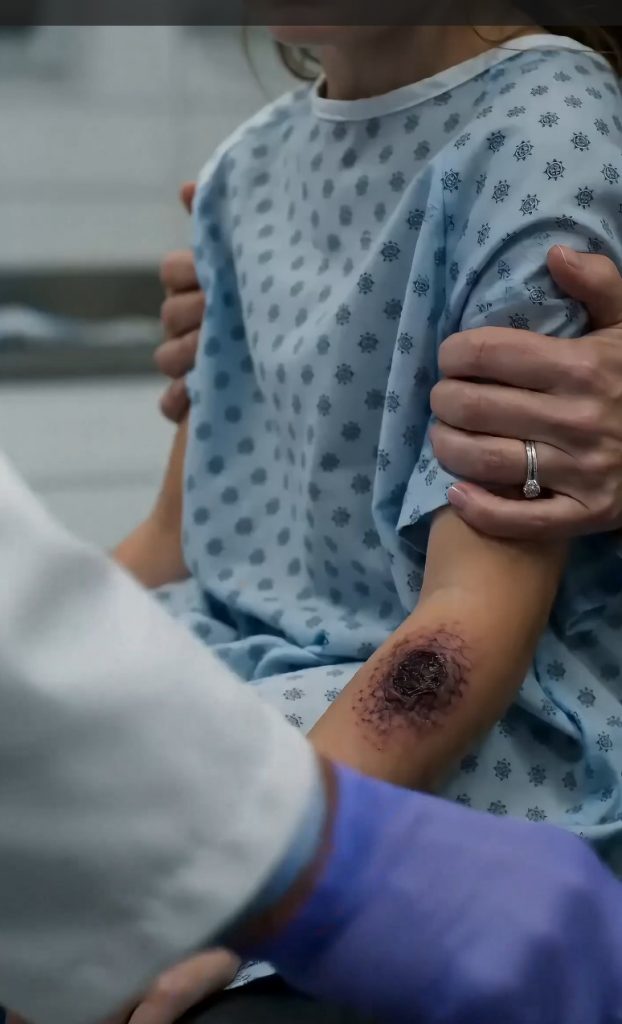
White tiles. Fluorescent lights. Stainless steel trays. A black examination table that made eight-year-old Ava Bennett look even smaller in her blue-and-white hospital gown.
Her mother stood behind her, both hands on Ava’s shoulders, holding on too tightly because letting go felt impossible.
Dr. Elias Ward did not speak at first.
He was elderly, gray-haired, and calm in the way old doctors become after a lifetime of frightening rooms. But his eyes kept returning to the dark mark on Ava’s left forearm.
It was round, raised slightly, and wrong.
Not like a bruise.
Not like a rash.
Not like anything Claire Bennett had ever seen on her daughter’s skin before.
Ava sniffled.
“Mom,” she whispered. “Can we go home?”
Claire pressed her lips to her daughter’s hair.
“Soon, baby.”
Dr. Ward picked up a magnifying glass with gloved fingers and lowered it over Ava’s arm.
The room seemed to hold its breath.
Through the glass, the mark looked stranger. Its edges were too neat, almost patterned, with faint lines beneath the surface that did not belong to any ordinary injury.
The doctor’s expression changed.
Just a flicker.
But Claire saw it.
“What is it?” she asked.
He did not answer.
He leaned closer.
Ava trembled, but she kept her arm still. Tears slid down her cheeks and fell silently onto the paper sheet beneath her.
Dr. Ward lowered the magnifying glass and touched one gloved fingertip gently near the center of the mark.
The reaction was immediate.
The surface tightened.
Ava gasped.
The doctor jerked back as if something had burned through the glove. His face drained of color. He stumbled away from the table, clutching his hand and staring at the tip of his blue nitrile glove, where the material had turned dark.
Then he screamed.
Not from pain.
From recognition.
Claire wrapped both arms around Ava.
“What is inside her?” she cried.
Dr. Ward staggered toward the door, slammed his palm against the metal panel beside it, and looked back at Ava’s arm with pure terror in his eyes.
“Isolation kit!” he shouted into the hallway. “Now!”
Ava began to sob.
Claire stared at the doctor, then at the mark on her daughter’s forearm.
And for the first time, she realized this had never been a wound.
It was a signature.
Act II
Three days earlier, Ava had come home from school with a sticker on her sleeve.
It was silver and shaped like a star.
Claire noticed it while making dinner, the kind of exhausted dinner single mothers make on weeknights when the laundry is still wet and the bills are stacked under a magnet on the fridge.
“What’s that?”
Ava looked down at her arm.
“Oh. The health people gave it to me.”
Claire froze.
“What health people?”
“At school,” Ava said. “They checked our breathing because of the air quality thing. They had a big white van.”
Claire called the school immediately.
The secretary said there had been no health screening.
No van.
No visitors.
No stickers.
By then, the silver star was already gone. Ava said it had fallen off in the bathroom. Beneath it was a small red spot, like a bug bite.
Claire watched it all night.
By morning, it had darkened.
By the second night, Ava woke crying that her arm felt “heavy.” By dawn, the mark had spread into a perfect circle.
Claire drove to urgent care before breakfast.
The first nurse called it an allergic reaction.
The second doctor called it unusual.
The third doctor stopped smiling, left the room, and came back with Dr. Elias Ward.
That was when Claire started to feel truly afraid.
She had known fear before.
Fear had lived with her since her husband Daniel died two years earlier on a rain-slicked highway outside Newark. He had been a journalist, stubborn and brilliant, the kind of man who treated every unanswered question like a locked door that deserved to be opened.
At the time of his death, he had been investigating a private medical company called LyraDyne.
Claire knew almost nothing about it then.
Only that Daniel had been nervous in the weeks before the crash. He checked the locks twice. He stopped answering calls near Ava. He hid a folder in the attic and told Claire, half-joking, that if anything happened to him, she should “trust paper more than people.”
After he died, the police called it an accident.
Claire believed them because grief made believing easier than fighting.
Then the folder disappeared.
She had searched the attic a month later and found only dust, a broken ornament, and the empty space where Daniel had once placed a yellow envelope.
Eventually, life swallowed the suspicion.
Rent came due. Ava needed school shoes. Claire took extra shifts. Daniel became a photograph on the mantle and a voice in Ava’s bedtime stories.
But now her daughter sat on a black examination table with a mark on her arm that made an old doctor scream for isolation.
And Claire remembered one detail she had buried because it had hurt too much.
The logo on Daniel’s missing folder.
A silver star.
Act III
The hallway outside the examination room erupted into motion.
Nurses ran past the frosted glass. Someone pulled a cart from a supply closet. Plastic packaging tore open. A voice ordered the clinic doors locked until further instruction.
Claire stood frozen behind Ava, watching adults become frightened in ways adults were not supposed to show children.
Dr. Ward returned wearing a face shield and a thicker pair of gloves over the first. Another nurse handed him a sealed kit, and he opened it with hands that shook only once before steadying.
“Is my daughter contagious?” Claire demanded.
The doctor looked at Ava.
His face softened.
“No. I don’t believe so.”
“You don’t believe so?”
“It is not a disease.”
Claire’s stomach dropped.
Dr. Ward glanced toward the dark mark on Ava’s arm.
“It’s a device.”
The words made no sense.
Ava looked up through tears.
“A device?”
Claire’s voice came out sharp. “There is nothing in her. She came home with a mark.”
“That is how it starts,” Dr. Ward said.
He pulled a small lamp over Ava’s forearm and shone the light at an angle. Beneath the surface of the mark, faint silver lines appeared for a heartbeat, like threads catching the light.
Claire covered her mouth.
Dr. Ward swallowed hard.
“It’s called a dermal carrier. At least, that was the old name.”
“The old name?”
He looked at her then, and Claire saw not only fear, but guilt.
“I worked for LyraDyne eighteen years ago.”
The room tilted.
Claire gripped the edge of the exam table.
Dr. Ward spoke quickly, as if every second mattered.
“They were developing adaptive medical patches for emergency treatment. Drug delivery, tracking vitals, wound sealing. It was supposed to help children in disaster zones when hospitals were overwhelmed.”
He looked at Ava’s arm with quiet horror.
“It was never approved for human use.”
Claire’s voice broke.
“Then why is it on my daughter?”
Dr. Ward said nothing.
That silence was an answer.
Claire leaned toward him, shaking.
“My husband investigated LyraDyne before he died.”
Dr. Ward’s eyes flicked sharply to hers.
“What was his name?”
“Daniel Bennett.”
The doctor went still.
For a moment, even the fluorescent hum seemed to fade.
Then he whispered, “He found the school program.”
Claire felt cold spread through her.
“What school program?”
Dr. Ward closed his eyes.
When he opened them, the guilt was worse.
“LyraDyne ran unauthorized pediatric trials through shell charities. Screenings, air-quality checks, free wellness clinics. Most of the children never knew they had been exposed to prototypes. Your husband was trying to prove it.”
Ava began crying harder.
Claire pulled her close.
“No,” she said, not because she disbelieved him, but because some truths are too large to enter the heart all at once.
Dr. Ward moved toward the door.
“I need to call the state health response team.”
Claire grabbed his sleeve.
“You knew about this?”
“I left before the trials.”
“That’s not what I asked.”
His face crumpled slightly.
“I suspected. I never proved it.”
Claire’s eyes filled with rage.
“My husband did.”
Dr. Ward did not defend himself.
“Yes,” he said. “And I think that is why they came for Ava.”
Act IV
The isolation room was smaller, quieter, and colder.
Ava sat inside a clear plastic barrier while Claire stayed beside her in protective gloves, refusing to leave even when the nurses begged her to step back. The mark on Ava’s arm had stopped reacting, but the silver lines beneath it appeared whenever the light shifted.
Dr. Ward stood outside the barrier speaking on the phone to someone from the state emergency medical unit.
Claire could hear only pieces.
“Dormant carrier.”
“Minor patient.”
“Possible LyraDyne signature.”
“No, not exposure. Placement.”
Placement.
The word made Claire sick.
Ava leaned against her.
“Am I in trouble?”
Claire’s heart broke.
“No, sweetheart. No. You did nothing wrong.”
“Then why is everyone scared?”
Claire looked through the plastic at Dr. Ward.
“Because grown-ups did something wrong, and now they’re trying not to be too late.”
Ava accepted that in the strange, serious way children accept answers when they are too tired to ask more.
The clinic doors opened twenty minutes later.
Two state medical responders entered first. Then a woman in a dark coat with a badge clipped to her belt. Behind her came a man carrying a locked silver case.
The woman introduced herself as Agent Mara Keene.
She asked Claire for permission to speak in front of Ava.
Claire almost laughed.
Permission had become meaningful only after someone stole it from them.
“Yes,” she said. “But you speak gently.”
Agent Keene nodded.
“We believe the mark on Ava’s arm contains an inactive LyraDyne prototype. The good news is that it has not fully integrated. That means it can likely be removed or neutralized safely by specialists.”
Claire held Ava tighter.
“And the bad news?”
Keene looked toward Dr. Ward.
The doctor answered.
“It was activated by contact. That is why my glove reacted. Someone expected the patch to be found.”
Claire’s skin prickled.
“What does that mean?”
Agent Keene opened a tablet and showed a paused security image from Ava’s school hallway. A woman in pale scrubs stood near a classroom door, smiling as children lined up.
Claire had never seen her before.
But in the woman’s hand was a sheet of silver star stickers.
Keene said, “We believe this person entered the school under false identification.”
Claire stared at the image.
“Why Ava?”
The agent hesitated.
Claire hated her for it.
Then Keene said, “Because of Daniel Bennett.”
The name landed like a second death.
Agent Keene continued.
“Your husband sent encrypted files to several agencies before he died. Most were corrupted. Last week, one file was recovered. It contained names connected to LyraDyne’s original pediatric trial network.”
Claire’s voice was barely audible.
“And they knew?”
“We believe someone inside LyraDyne knew the file had been recovered. They may have targeted Ava to frighten you, or to pressure anyone still holding Daniel’s evidence.”
Claire looked down at her daughter.
Ava was eight years old.
She liked pancakes shaped like moons. She slept with a stuffed rabbit named Captain. She still asked her father goodnight through the photo on the mantle.
And a company had reached into her classroom to turn her body into a warning.
Something inside Claire changed then.
Fear remained.
But it was no longer alone.
“Remove it,” she said.
Dr. Ward’s voice was quiet.
“We need to transfer her to the children’s hospital. They have the equipment.”
Claire looked at him through the barrier.
“And then?”
Agent Keene answered.
“Then we stop treating your husband’s investigation like a ghost story.”
Act V
The procedure took four hours.
Claire spent every minute in a chair outside the sealed treatment suite, wearing a paper gown over her clothes and holding Ava’s stuffed rabbit in both hands. Dr. Ward sat across from her, his own affected glove sealed in an evidence container beside Agent Keene.
He looked older now.
Not medically tired.
Morally tired.
Claire did not feel sorry for him.
Not yet.
“You could have come forward,” she said.
Dr. Ward stared at the floor.
“I know.”
“My husband might still be alive.”
He closed his eyes.
“I know.”
That was the only answer Claire could bear.
Anything else would have been an insult.
When the specialist finally came out, Claire stood so fast the chair skidded behind her.
“She’s stable,” the woman said.
Claire covered her mouth.
The specialist smiled gently.
“The carrier was neutralized. There may be a small scar, but she is going to recover.”
Claire nearly collapsed.
Agent Keene caught her elbow.
Behind the glass, Ava slept under a warm blanket, her left arm wrapped in clean white dressing. No wires. No silver lines. No dark mark staring back from her skin like a secret.
Just a child.
A living child.
Two weeks later, LyraDyne’s headquarters was raided.
It did not look dramatic on television. No explosions. No villains shouting into cameras. Just federal vehicles outside a glass building, boxes of files carried through revolving doors, executives hiding their faces beneath coats.
But to Claire, it felt like thunder.
Dr. Ward testified.
So did three nurses from old trial sites. So did two former LyraDyne engineers. So did a school secretary who admitted she had let the woman in scrubs through the side entrance because the visitor had official-looking documents and a calm smile.
The recovered file Daniel had sent became the center of the case.
It showed dates, locations, false charity names, internal memos, and warnings ignored because children without powerful parents were easy to study and easier to forget.
Ava had not been the first.
But because of Daniel, Claire, Dr. Ward’s fear, and one tiny reaction under a gloved fingertip, she became the last child they could hide.
The trial took months.
Claire hated most of it.
She hated the way lawyers said “adverse event” instead of child. She hated the way executives claimed they were saving future lives while refusing to look at the families in the courtroom. She hated seeing Daniel’s emails projected onto screens, his words alive while he was not.
But she went every day.
Ava stayed home with Claire’s sister and drew pictures for the nurses who had cared for her. In every picture, Dr. Ward appeared as a tall man with blue gloves and sad eyes.
One evening, Claire found Ava sitting at the kitchen table, coloring a silver star black.
Claire froze.
Ava looked up.
“It doesn’t scare me when I draw it.”
Claire sat beside her.
“Okay.”
Ava pushed the crayon back and forth.
“Did Daddy help?”
Claire’s throat tightened.
“Yes,” she said. “Daddy helped.”
“Even though he’s gone?”
Claire looked at the photo on the mantle.
“Especially because he’s gone.”
Ava thought about that.
Then she drew a yellow circle around the black star.
“What’s that?” Claire asked.
“A light,” Ava said. “So people can see it.”
That became the symbol of the foundation Claire started a year later.
Not a large foundation at first. Just a small legal fund for families whose children had been harmed by secret medical programs and buried paperwork. Then doctors joined. Then journalists. Then whistleblowers who had been waiting years for someone to prove silence could be broken.
They called it The Bennett Light.
At the first public event, Claire stood on a small stage holding Ava’s hand. Ava wore a blue dress and a bandage no longer covered her arm. A faint mark remained, pale and thin, but she did not hide it.
Dr. Ward sat in the back row.
Claire saw him.
After the event, he approached carefully, as if expecting her to turn away.
“I am sorry,” he said.
Claire looked at him for a long moment.
“I know.”
He nodded.
It was not forgiveness.
But it was more than he deserved, and they both understood that.
Ava stepped forward and held out a folded drawing.
Dr. Ward took it with trembling hands.
It showed a doctor, a girl, and a black star surrounded by yellow light.
At the bottom, Ava had written in careful letters:
Thank you for being scared enough to tell the truth.
The old doctor covered his mouth and wept.
Claire did not comfort him.
Ava did.
She touched his sleeve gently, and somehow that mercy hurt more than anger.
Years later, Claire would still remember the exam room.
The harsh lights.
The gloves stretching over old hands.
The magnifying glass lowering over Ava’s trembling arm.
The scream.
The words that turned a mother’s fear into a war.
Isolation kit.
At the time, Claire thought the doctor was trying to contain her daughter.
Now she understood.
He was trying to contain the lie before it escaped again.
But some truths are stronger than containment.
They move through locked rooms, missing folders, corrupted files, frightened witnesses, and mothers who refuse to sit quietly after someone turns their child into a message.
LyraDyne thought the mark on Ava’s arm would scare Claire into silence.
Instead, it gave Daniel’s evidence a pulse.
And when Claire looked at her daughter laughing in the kitchen years later, left sleeve rolled up, scar visible in the sunlight, she no longer saw the day everything almost broke.
She saw the day the hidden thing beneath the surface finally came to light.