Act I
The dog was trying to look dangerous because fear was the only weapon it had left.
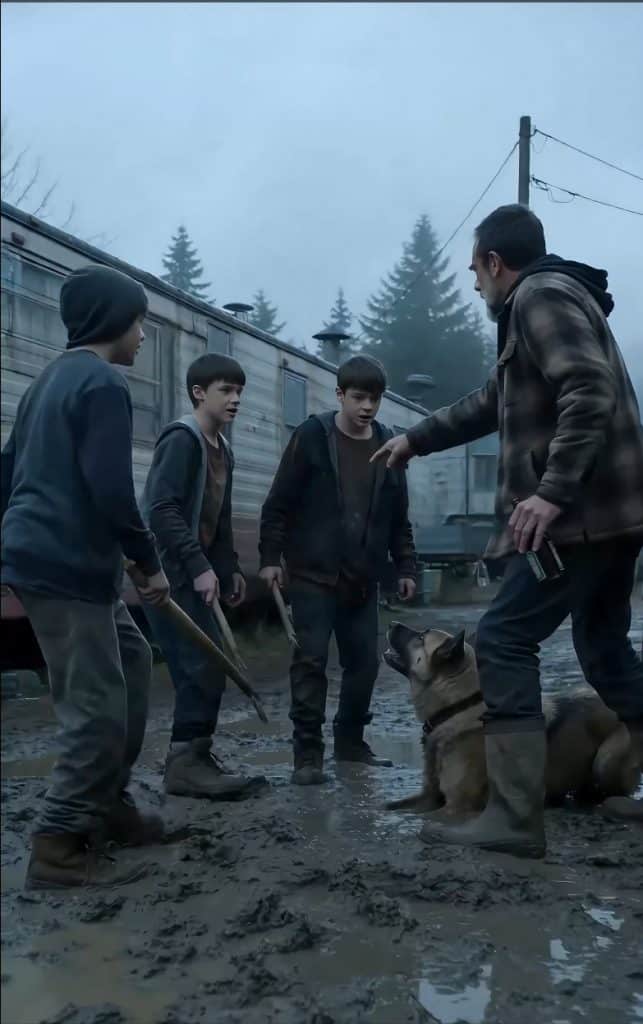
It stood ankle-deep in the mud, ribs shivering under matted brown-gray fur, its leash pulled tight in the hands of a boy who laughed every time it barked. Another boy swung a wooden stick through the wet air, not striking hard enough to leave a clear mark, just close enough to make the dog flinch and snarl.
The third boy clapped like it was a game.
“Look at him,” he said. “He thinks he’s tough.”
The dog lunged, then slipped, paws scraping through the mud.
Its left ear was marked dark from an injury, and every movement made it wince. Still, it kept barking. Still, it kept trying to pull toward the trees behind the trailer park, as if something there mattered more than its own pain.
The boys did not notice that.
They only noticed that they had power.
Then the door of the rusted old trailer creaked open.
A man stepped out.
He was broad-shouldered but tired-looking, with a salt-and-pepper beard, a brown-and-white plaid flannel shirt, blue jeans, and boots that sank immediately into the mud. A beer bottle hung loose in one hand.
At first, the boys did not stop.
Then he took one step toward them.
Then another.
The laughter thinned.
The boy with the stick lowered it slightly.
The man’s voice was low when he spoke.
“Put it down.”
No one mistook it for a request.
The boy with the leash swallowed. “It’s just a stray.”
The man looked at the dog trembling in the mud.
“No,” he said. “It’s scared.”
The boys backed away one by one, their courage draining into the puddles at their feet. The stick dropped. The leash went slack. They muttered something under their breath and disappeared toward the far side of the trailer park, glancing back only when they thought the man would not see.
The dog collapsed.
The man crouched, keeping distance.
“Easy,” he whispered.
The dog watched him with wild eyes, breathing hard, its muddy body shaking from pain and exhaustion.
For a moment, neither moved.
Then the dog pushed itself upright.
Its legs trembled. Its head dipped. But it stood.
The man frowned.
“You shouldn’t be walking.”
The dog barked once.
Weak.
Urgent.
Then it turned toward the forest trail.
The man did not understand until the dog limped forward, stopped, and looked back at him.
Like it was asking him to follow.
Act II
Clay Rourke had not planned on saving anything that morning.
Most days, he barely saved himself.
He had lived in the rusted trailer at the edge of Briar Hollow Park for seven months, though “lived” was too generous a word for it. He slept there. Ate there. Let the rain drum against the metal roof until it drowned out thoughts he did not want to hear.
People in town had a name for him.
The drunk in the railcar.
They were not entirely wrong.
Clay had once been a rescue mechanic for the county fire department. Not a hero, not the man running into burning buildings, but the one who kept rigs alive, pulled wrecked doors open, fixed engines in storms, and knew which tools to bring before anyone asked.
Then his wife died.
Then his daughter stopped calling.
Then Clay discovered grief did not always make a person noble. Sometimes it made him small. Sometimes it made him angry. Sometimes it put a bottle in his hand and told him the world could wait until tomorrow.
Tomorrow became months.
The trailer park sank deeper into mud, gossip, and neglect. Clay sank with it.
The boys had been trouble long before the dog appeared.
Three local teens who drifted through the park when school bored them and home offered nothing better. They broke windows, kicked over trash bins, stole copper wire from abandoned units, and ran whenever real adults stepped outside.
Clay had ignored them too many times.
That morning, the barking got through the walls.
Not because it was loud.
Because it was desperate.
Now he followed the injured dog into the forest with the beer bottle still in his hand, feeling suddenly ashamed of it. After a dozen steps, he stopped and set it on a rotting stump.
The dog looked back.
“I’m coming,” Clay said.
The trail was narrow and soaked from last night’s rain. Pine branches sagged over the path, dripping cold water down Clay’s neck. Mud clung to his boots. The dog limped ahead, never moving fast enough to vanish, never slowing enough to rest.
Every few yards, it barked.
Not at Clay.
Toward the trees.
Clay began to feel something he had not felt in a long time.
Purpose.
Not clean purpose. Not heroic. Just the hard pull of knowing something was wrong and that he was the only person close enough to reach it.
The dog led him past the old drainage ditch, past a fallen pine, past the place where kids used to build forts before the park emptied out. The deeper they went, the quieter the world became.
No traffic.
No trailer doors.
No boys laughing.
Only wet leaves, Clay’s breathing, and the dog’s stubborn, pained steps.
Then he saw the shed.
It stood in a small clearing, shingle-sided and half-swallowed by brush. The door was wrapped in a heavy chain secured with a padlock. No path led properly to it. No tools sat nearby. No reason existed for anyone to lock a shed that far into the woods.
The dog went straight to the door.
It pressed its muddy nose against the wood and whined.
Clay touched the chain.
It clanked softly.
Then a voice came from inside.
Small.
Muffled.
Terrified.
“Please,” the child whispered. “Please don’t go. Help me.”
Clay’s hand froze against the lock.
The forest seemed to tilt around him.
He leaned closer to the door, heart hammering.
“How?” he whispered. “Who are you?”
The child sobbed once behind the wood.
And Clay understood the dog had not been running from the boys.
It had been trying to get back here.
Act III
The child’s name was Ellie Shaw.
She told him through the door in broken pieces.
Eight years old. Pink backpack. Red rain boots. Dog named Rusty. They had been walking the back trail after school because Ellie liked seeing the creek before going home. Rusty had chased something into the trees. Ellie followed.
Then someone grabbed her.
Clay closed his eyes.
Not from fear.
From rage.
He kept his voice gentle.
“Ellie, listen to me. I’m Clay. The dog brought me here.”
A pause.
“Rusty?”
The dog whined loudly at the sound of his name.
Ellie began crying harder.
“He came back?”
“He came back,” Clay said. “He’s right here.”
Rusty pressed himself against the shed door as if trying to melt through it.
Clay took out his phone.
No service.
He lifted it higher, stepped into the clearing, turned in a slow circle.
Nothing.
Of course.
Briar Hollow Forest killed reception the way it killed hope.
Clay looked at the padlock, then at the dog, then back down the trail.
He had tools in the trailer.
Too far.
He had an old truck near the road.
Also too far.
And he had an eight-year-old child behind a locked door, sobbing like she had been taught not to make too much noise even while begging.
Clay forced himself to think.
That was what he used to be good at. Emergencies were never solved by panic. They were solved by the next right movement.
“Ellie,” he said. “Are you hurt?”
“I’m cold.”
“Anything else?”
“My wrist hurts. I’m scared.”
“You’re allowed to be scared,” Clay said. “But I need you to stay away from the door, okay?”
“Are you leaving?”
“No.”
The answer came fast.
So fast it surprised him.
“I’m not leaving you.”
Rusty barked suddenly toward the trail.
Clay turned.
For one awful second, he expected the boys.
Instead, he heard branches breaking.
Then a man’s voice somewhere in the woods.
“Rusty!”
Clay stepped back from the shed.
Another voice answered.
“Check by the creek!”
Searchers.
Clay cupped both hands around his mouth.
“Over here!”
The woods froze.
Then feet crashed through brush.
Two adults burst into the clearing first, both wearing orange search vests streaked with mud. Behind them came a sheriff’s deputy with his radio in one hand.
The woman in front saw the shed.
Then the chain.
Then Rusty.
Her face collapsed.
“Ellie?”
The child screamed from inside.
“Mom!”
The woman nearly fell running to the door.
Clay caught her arm before she grabbed the chain.
“She’s inside. She’s alive.”
The mother made a sound that did not belong in any forest.
The deputy called for backup, bolt cutters, medical response, and the rest of the search team. His words were sharp, professional, but his face betrayed him when Ellie cried again from behind the door.
“How did you find her?” he asked Clay.
Clay looked down at Rusty.
The injured dog stood swaying in the mud, barely able to keep his feet, eyes locked on the shed.
“He did,” Clay said.
And for the first time that morning, everyone looked at the dog like he was not a stray, not a problem, not something to chase with sticks.
They looked at him like a witness.
Act IV
The lock came off with a scream of metal.
The door swung open, and Ellie Shaw stumbled into her mother’s arms wearing one red boot, one sock, and a school sweater too thin for the damp cold. Her face was pale, her hair tangled with leaves, but she was alive.
Her mother dropped to the ground holding her.
Rusty pushed forward with the last of his strength.
Ellie saw him and reached out both hands.
“Rusty.”
The dog collapsed against her knees.
The deputy looked away for a second.
So did Clay.
Some reunions were too private for strangers, even when they happened in front of them.
Paramedics arrived through the trees minutes later. Ellie was wrapped in a thermal blanket and checked carefully. Rusty was lifted onto a folded tarp with more tenderness than Clay had seen anyone show him in a long while.
Ellie refused to let go of his paw until her mother promised he would ride to the clinic.
The boys were found before sunset.
They tried to lie.
They said Rusty had attacked them. They said they were only trying to scare him away. They said they knew nothing about the shed, nothing about Ellie, nothing about the man who had paid them twenty dollars to catch the dog if he came back through the trailer park.
That was when the case turned.
The man they described was not a stranger.
His name was Wade Harlan.
He owned three neglected trailers in Briar Hollow, collected rent in cash, and had spent years making himself useful to people who preferred not to ask where certain things came from. Scrap metal. Stolen tools. Missing bicycles. Unregistered trailers.
Ellie had seen something she was not supposed to see near the back trail.
That was what investigators pieced together later.
She saw Wade loading stolen equipment into an old shed on county land. Rusty barked. Wade panicked. Ellie ran. He caught her and locked her inside, planning to move her after dark, counting on fear and confusion to erase the trail.
But Rusty escaped.
Wounded, muddy, terrified, he made it back to the trailer park looking for help.
The boys found him first.
Then Clay came out of the rusted railcar with a bottle in his hand and one decent decision left in him.
By nightfall, deputies had surrounded Wade Harlan’s property. He was arrested trying to leave through the back road in a pickup loaded with tools, cash, and muddy boots.
Clay stood outside his trailer watching the patrol cars roll past, their lights flashing red and blue across puddles.
One deputy stopped beside him.
“Mr. Rourke?”
Clay almost corrected him.
No one had called him mister in a while.
The deputy held up a muddy backpack sealed in plastic.
“Ellie said there was a man with a beard who promised not to leave.”
Clay swallowed.
“I didn’t do much.”
The deputy looked toward the forest.
“You followed the dog.”
Clay nodded.
“That was the easy part.”
The deputy’s expression softened.
“No. It wasn’t.”
Clay did not answer.
Because the truth was, for seven months, he had not followed anything except grief downhill.
That day, an injured dog asked him to climb back up.
Act V
Rusty survived.
The veterinarian said he was bruised, exhausted, and underweight, but stubborn. Ellie laughed when she heard that word, then cried because laughing still felt strange after being afraid for so long.
Rusty’s ear healed slowly.
So did Ellie.
No one pretended otherwise.
There were interviews, medical visits, counselors, court dates, and nights when Ellie woke crying because she dreamed of the shed door closing again. Her mother slept on a mattress beside her bed for weeks. Rusty slept between them, lifting his head at every sound.
Clay visited once at the animal clinic.
Only once, he told himself.
He brought a bag of treats and stood awkwardly near the door, hat in both hands, unsure whether he belonged in a room so full of relief.
Ellie saw him first.
“That’s him,” she said.
Her mother turned.
For a moment, Clay thought she might thank him with words too heavy for him to carry.
Instead, she crossed the room and hugged him.
Clay stood stiffly, then slowly lifted one hand and patted her back.
“I’m sorry,” he muttered, though he did not know what for.
Ellie’s mother pulled away, eyes wet.
“You came.”
Clay looked at Ellie, then Rusty.
“He came first.”
Ellie smiled and scratched behind Rusty’s good ear.
“He always does.”
The story spread through the county, though it changed depending on who told it.
Some said a drunk saved a child.
Some said a dog solved a kidnapping.
Some said three cruel boys accidentally led to a rescue.
The truth was messier.
A dog refused to give up. A child stayed brave long enough to call through a door. A broken man heard barking and decided not to look away. A mother got her daughter back because one frightened animal had more loyalty than everyone who tried to bury the truth in the woods.
Clay did not like being called a hero.
He hated it, actually.
Heroes did not live in rusted trailers with empty bottles in the sink. Heroes did not ignore trouble until it barked loud enough to hurt. Heroes did not let their daughters go two years without a proper phone call.
But Ellie’s mother insisted on having his number.
So did the deputy.
So did the counselor who worked with the boys, because even cruelty that begins young has roots someone should dig up before it hardens.
The three boys faced consequences, but not all the same. The one with the stick cried during his interview and admitted Wade had been paying them to keep people away from the woods. Another insisted he thought it was “just a dog” until the deputy asked him why that made it acceptable.
He had no answer.
That question followed him longer than punishment did.
As for Wade Harlan, the shed finished him.
Inside, investigators found stolen goods, tools, old locks, food wrappers, and evidence tying him to a string of thefts around the county. More importantly, they found Ellie’s backpack and the marks on the door where she had tried to make noise.
Wade’s lawyer called it panic.
The judge called it a crime.
Clay attended one hearing near the end.
He sat in the back row wearing his cleanest flannel, hands folded, beard trimmed badly with kitchen scissors. Ellie sat up front with her mother and Rusty, who had been allowed inside for emotional support after a letter from her counselor.
When Ellie testified, her voice shook.
But she spoke.
She told the court about the trail, the shed, the dark, the dog barking outside before he vanished, and the moment she heard Clay’s voice through the door.
“He said he wasn’t leaving,” she said.
Clay looked down at his boots.
He did not want anyone to see what that did to him.
Afterward, outside the courthouse, Ellie walked over with Rusty at her side.
The dog leaned into Clay’s leg.
Clay crouched slowly.
“You’re a tough old thing,” he said.
Ellie tilted her head.
“He’s only six.”
Clay scratched Rusty’s neck.
“I wasn’t talking to him.”
Ellie did not understand, but her mother did.
That winter, Clay left the railcar trailer.
Not all at once. Not dramatically. He did not wake up healed because a child survived and a dog forgave him. Life was not that generous.
But he took the first step.
Then the next.
He called his daughter.
The first conversation lasted six minutes and hurt more than he expected. The second lasted twelve. By spring, she came to see him at the small apartment he had rented over the hardware store, and Clay apologized without making excuses.
His daughter cried.
So did he.
Rusty came to visit often after that, usually with Ellie holding the leash and her mother pretending the dog had “insisted.” Clay kept treats by the door. He also kept no beer in the fridge.
Some evenings, he walked the edge of Briar Hollow Forest with Rusty beside him.
The shed was gone now.
The county tore it down after the trial, leaving only a square patch of disturbed earth where ferns had begun to grow back. Clay stood there once and listened to the wind move through the pines.
He thought about locks.
Not only the kind on shed doors.
The kind people put on grief.
On shame.
On fear.
On the belief that they are too far gone to answer when something helpless cries out.
Rusty nosed his hand.
Clay looked down.
“You knew, didn’t you?” he said.
The dog wagged his tail once.
Maybe he had known. Maybe he had simply loved Ellie so fiercely that pain, mud, boys, sticks, and distance could not stop him from finding someone who would listen.
Either way, it had been enough.
The boys had laughed because they saw only a wounded dog in the mud.
Clay had followed because, for once, he saw the warning inside the wound.
And behind a locked shed door in the dark woods, a child lived long enough to hear footsteps coming closer instead of fading away.