Act I
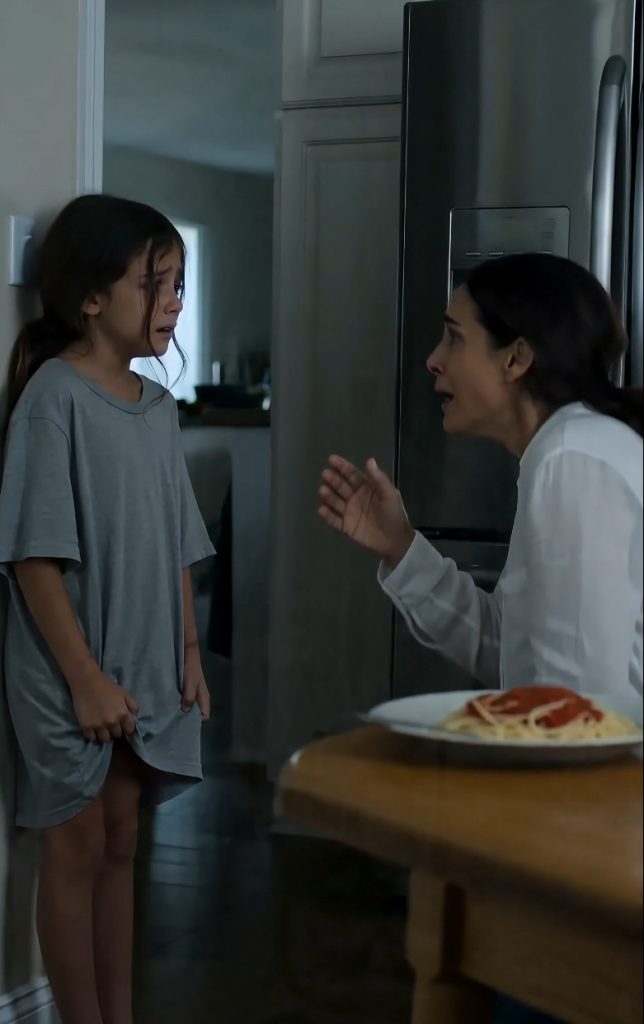
The plate of spaghetti sat untouched in the center of the table.
It was warm enough for steam to rise in soft curls above the red sauce. The kitchen smelled of garlic, tomato, and the kind of ordinary care that usually made children move closer without thinking.
But Ava did not move.
She stood against the wall in an oversized gray T-shirt that hung almost to her knees, bare feet flat against the cold kitchen floor. Her messy hair fell into her eyes. Both small hands clutched the hem of her shirt like she was holding herself together with fabric.
Claire Whitman slid the plate gently across the wooden table.
“Go ahead,” she said softly.
Ava’s eyes moved to the food.
Not with dislike.
With fear.
Claire noticed the way the child swallowed. The way her shoulders rose. The way she looked toward the hallway before looking back at the plate, as if someone might appear and punish her for wanting it.
The refrigerator hummed behind them.
The house felt too quiet.
Claire had taken Ava in only an hour earlier. Her brother-in-law, Mark, had dropped the child off on the porch with a small backpack and a sentence that made no sense.
“She’s being difficult. Keep her tonight.”
Then he drove away before Claire could ask why Ava looked so pale.
Now the girl stood in the kitchen, hungry enough to stare at spaghetti like it was a dream, terrified enough not to touch it.
Claire moved slowly, lowering herself into the chair nearest the table.
“You don’t have to finish it,” she said. “Just eat what you want.”
Ava’s fingers twisted tighter in the shirt.
The sleeve slipped back.
That was when Claire saw the marks around her wrists.
Five dark horizontal lines on one arm.
More on the other.
Not fresh chaos. Not a playground scrape. Something controlled. Something repeated.
Claire’s breath caught, but she forced her face not to change too quickly. Children who had learned fear watched adult faces like weather.
Ava looked up at her.
Her eyes were glossy with tears.
Then she asked the question in a trembling voice that split the room in half.
“Am I allowed to eat?”
Claire stopped breathing.
Ava swallowed.
“He said it’s fasting day.”
The words were small.
The horror behind them was not.
Claire pushed back from the chair and dropped to her knees so quickly the floor struck hard beneath her.
Ava flinched.
Claire lifted both hands, palms open.
“I’m not angry,” she whispered. “Ava, sweetheart, I am not angry.”
The child stared at her, shaking.
The spaghetti sat between them, untouched and cooling.
And Claire understood that whatever had happened in Mark’s house, it had turned hunger into a rule and kindness into something Ava believed she had to earn.
Act II
Claire had not seen her niece in six months.
Not because she did not try.
After her sister Jenna died, Mark had closed every door gently enough that most people did not hear the lock. He changed phone numbers. Moved Ava to a private homeschooling program. Told relatives the child needed “a quieter environment.”
At the funeral, Ava had clung to Claire so tightly that Mark had to peel her fingers from Claire’s sleeve.
“She’s confused,” he said, smiling at the mourners. “Grief does that.”
Claire remembered hating that smile.
Jenna had been the loud sister. The brave sister. The one who danced barefoot in kitchens, burned pancakes, forgot birthdays but never forgot when someone was sad. She had loved Ava with a ferocity that made the whole world feel warmer around them.
Then she got sick.
Fast.
Too fast.
Mark became the gatekeeper during the final months. He managed visits. Managed medication. Managed conversation. He always stood nearby when Jenna spoke, one hand resting on the back of her chair.
After the funeral, he told everyone Ava needed discipline and spiritual structure.
Claire thought it sounded strange.
But grief makes families hesitate.
Nobody wants to accuse a widower too soon. Nobody wants to become the dramatic relative. Nobody wants to admit that someone standing beside a casket might already be turning a child into a prisoner.
So Claire sent texts.
No answer.
She called.
Voicemail.
She mailed Ava a birthday gift.
Returned.
Then, that afternoon, Mark appeared at her door with Ava beside him.
The child was thinner than Claire remembered. Her face had lost the round softness of seven years old. Her eyes moved constantly, scanning corners, doorways, hands.
Mark gave Claire the backpack.
“She’s been disobedient,” he said. “Maybe you can remind her what gratitude looks like.”
Claire looked at Ava.
Ava stared at the porch boards.
“What happened?”
Mark’s smile tightened.
“She lies. She sneaks food. She resists correction.”
Ava’s face went white at the word correction.
Claire stepped closer, but Mark held up one hand.
“One night,” he said. “I’ll come tomorrow.”
Then he left.
No hug.
No goodbye.
No question about whether Ava had eaten.
For the first hour, Claire did everything carefully. She offered a bath. Ava shook her head. She offered clean clothes. Ava whispered, “If I’m allowed.” Claire told her yes.
Then Claire made spaghetti because Jenna used to say spaghetti could fix almost anything for at least ten minutes.
Ava did not sit.
Did not ask for water.
Did not touch the fork.
Now Claire knelt on the kitchen floor, looking at the red marks on her wrists and trying not to let the rage climb into her voice.
“Who told you it was fasting day?”
Ava looked toward the hallway again.
“He did.”
“Mark?”
The child nodded once.
“How long has it been fasting day?”
Ava’s lips trembled.
“I don’t know.”
Claire felt the room tilt.
She wanted to pull Ava into her arms. She wanted to scream. She wanted to run into the street and drag Mark back by his collar.
Instead, she did the hardest thing.
She stayed soft.
“Ava,” she said, “in this house, children are allowed to eat when they’re hungry.”
Ava stared at her.
“Even if they were bad?”
“You are not bad.”
Ava’s face crumpled.
That was the first time she cried.
Not loudly. Not dramatically. Just a silent collapse of tears, as if being told she was not bad hurt more than being punished ever had.
Claire reached out slowly.
“May I hold your hand?”
Ava looked at her open palm.
Then, after a long moment, she placed two tiny fingers in it.
Claire closed her hand gently around them.
And made a promise she did not yet know how to keep.
“He is not taking you back tomorrow.”
Act III
Claire called Denise first.
Not the police.
Not because she did not think police were needed, but because she knew one wrong move could send Ava into panic before protection arrived. Denise Morales was Claire’s neighbor, a retired child welfare investigator with a garden full of herbs and a habit of answering calls with, “Who needs help?”
Claire stepped into the hallway where she could still see Ava at the kitchen table.
The child had finally sat down.
She held the fork in both hands and took the smallest bite of spaghetti Claire had ever seen, eyes flicking up after she swallowed, waiting for consequence.
Claire turned away before she cried.
“Denise,” she whispered. “I need you.”
Denise arrived in twelve minutes.
She came through the back door without knocking, her gray cardigan buttoned wrong, her face calm in the practiced way of someone who knew panic made children smaller.
Ava froze when she saw her.
Claire immediately said, “This is my friend Denise. She’s kind.”
Denise did not approach too closely.
“Hi, Ava,” she said. “Your aunt says you like spaghetti.”
Ava looked at Claire.
Claire nodded.
Only then did Ava whisper, “A little.”
Denise smiled.
“A little counts.”
They did not ask everything at once.
They let Ava eat slowly. They let her drink water. They let her keep both feet on the floor and her back near the wall because that made her feel safer. Then Denise sat at the far end of the table and asked simple questions in a voice soft enough not to feel like an interrogation.
When did you last eat?
Where do you sleep?
What happens on fasting day?
Ava answered in fragments.
The pantry had a lock.
The fridge had tape.
There were rules written on the wall of Mark’s office.
No crying after correction.
No food without permission.
No telling family lies.
The wrist marks came from “prayer time,” but Ava could not explain why prayer needed anything that left marks. She only said, “He said stillness makes children pure.”
Claire gripped the edge of the counter until her knuckles went pale.
Denise’s eyes briefly met hers.
Not now, that look said.
Do not break in front of her.
So Claire did not.
Ava ate three more bites.
Then she whispered, “If I tell, he’ll say I made it up.”
Denise leaned forward slightly.
“Has he said that before?”
Ava nodded.
“He said grown-ups believe grown-ups.”
Claire crouched beside the table again.
“Not all of them.”
Ava looked at her, wanting to believe and afraid of what belief might cost.
That was when headlights swept across the kitchen window.
Claire stood.
A car door closed outside.
Ava slid off the chair so fast the fork clattered to the floor.
“He came back,” she whispered.
Claire moved between Ava and the front hall.
Denise took out her phone.
Mark’s knock came three times.
Firm.
Controlled.
Not the knock of a man checking on his child.
The knock of a man reclaiming property.
Claire did not open the door.
Mark’s voice came through the wood.
“Claire. I know she’s awake.”
Ava began shaking.
Claire looked at Denise.
Denise had already dialed.
Outside, Mark’s voice lowered.
“Do not make this harder than it needs to be.”
Claire placed one hand flat against the door and answered.
“It’s already harder than you can imagine.”
Act IV
Mark did not shout at first.
That was what made him dangerous.
He stood on Claire’s porch in a navy coat, hair neatly combed, expression calm enough to fool a stranger passing by. He held one hand in his pocket and the other around his car keys.
“I’ll take Ava now.”
Claire kept the chain lock on.
“No.”
His eyes narrowed by a fraction.
“She is my daughter.”
“She is my niece.”
“She is in my legal custody.”
“And she is afraid of food.”
The calm cracked.
Only for a second.
But Claire saw it.
Behind her, Ava made a tiny sound.
Mark heard it too.
“Ava,” he called, voice softening into something almost gentle. “Come out here.”
The child clutched Denise’s cardigan.
Claire’s anger rose like fire, but her voice stayed steady.
“She’s not coming out.”
Mark leaned closer to the door.
“You have no idea what you’re doing.”
Denise stepped into the hallway, phone in hand.
“I do.”
Mark’s expression changed when he saw her.
Recognition.
Not personal.
Professional.
He knew what kind of woman she was.
Denise looked through the gap.
“Mr. Harlan, emergency services are already on their way. You should wait where you are.”
He smiled once.
“You called authorities because a child skipped dinner?”
“No,” Denise said. “Because a child asked if she was allowed to eat.”
The porch went silent.
For the first time, Mark had no immediate answer.
Then he turned his head toward the window, trying to see past them into the kitchen.
Claire closed the curtain.
Sirens sounded in the distance.
Mark heard them.
His face hardened.
“You’re making a mistake,” he said.
Claire thought of Jenna’s laugh. Jenna’s hands tying Ava’s shoes. Jenna in the hospital bed, trying to speak while Mark answered questions for her.
“No,” Claire said. “I made it six months ago when I let you disappear with her.”
Police arrived with a child protection worker fifteen minutes later. Mark tried the grieving father routine first. He spoke calmly. He mentioned faith. He mentioned discipline. He mentioned Claire’s instability after losing her sister.
Then the caseworker saw Ava.
Not just the oversized shirt.
Not just the bare feet.
The way she hid behind Denise when Mark’s voice entered the room.
The way she whispered, “Is it still fasting day?” when someone offered her a granola bar.
The house grew quiet after that.
Mark was told to leave the porch.
He refused.
Then he was escorted to the sidewalk.
Ava watched from the kitchen doorway, one hand in Claire’s, the other holding the granola bar like it might vanish if she loosened her grip.
The caseworker asked Claire if Ava had any belongings.
Claire opened the backpack Mark had left.
Inside were two gray T-shirts, one pair of socks, and a notebook.
Ava saw it and started crying.
“Don’t read it.”
Claire froze.
The caseworker softened her voice.
“Ava, is it yours?”
The girl shook her head.
“His rules.”
The notebook was opened on the kitchen table.
The first pages were handwritten schedules.
Fasting days.
Silent days.
Correction logs.
Then, folded into the back cover, was a letter.
Jenna’s handwriting.
Claire knew it instantly.
Her hands began to shake.
To Claire, if you find this, I was wrong about Mark. I am scared for Ava. He says I am confused, but I am not. Please don’t let him raise her alone.
Claire covered her mouth.
Mark had not merely isolated Ava after Jenna died.
He had hidden Jenna’s warning.
Act V
Ava slept that night on Claire’s couch because she was too frightened to be alone in a bedroom.
Claire made a nest of blankets and left the kitchen light on.
Denise stayed until dawn.
Every few hours, Ava woke and asked the same question.
“Am I in trouble?”
Each time, Claire answered the same way.
“No, sweetheart. You are safe.”
It took many repetitions before Ava stopped flinching at the word safe.
Emergency custody was granted the next day.
Temporary, the court called it.
But temporary can feel like a miracle when yesterday had no exit.
Mark’s house was searched after the caseworker documented Ava’s statements and Jenna’s hidden letter was turned over. What investigators found matched too much of what Ava had whispered in Claire’s kitchen.
Locked cabinets.
Written rules.
Removed family photos.
Unsent letters.
A pantry with a child’s name written beside dates no child should have had to count.
The official language was careful.
Neglect.
Coercive control.
Emotional abuse.
Physical indicators consistent with restraint.
Claire hated every clinical phrase.
But she understood why they mattered.
Pain needed names that courts could recognize.
Mark fought.
Men like him often did.
He claimed religious persecution. He claimed family interference. He claimed Ava was manipulative, Claire was unstable, Denise was biased, and Jenna’s letter was grief-induced confusion.
Then the notebook was entered.
Then Ava’s pediatrician testified that her condition showed a pattern, not a misunderstanding.
Then the court-appointed therapist explained that Ava’s fear around food was learned survival, not disobedience.
Then Claire read Jenna’s letter aloud.
Her voice broke only once.
Please don’t let him raise her alone.
Mark did not get Ava back.
The first months were not easy.
Stories like Ava’s do not end when the door closes on the person who caused the harm. They continue at breakfast, when a child asks permission for toast. They continue at bedtime, when silence feels dangerous. They continue in grocery aisles, when too many choices make a small body freeze.
Claire learned to say things she had never imagined needing to say.
Food is not a reward.
You can ask for seconds.
Bathrooms don’t need permission in this house.
Closed doors can be opened.
No one will be angry if you cry.
At first, Ava ate like every bite had witnesses. She watched Claire’s face after swallowing. She hid crackers under her pillow. She apologized when her stomach growled.
Claire never scolded her for it.
She bought a clear snack bin and placed it on the lowest pantry shelf.
Ava’s shelf.
No locks.
No tape.
No fasting days.
The first time Ava opened it without asking, she looked back in terror.
Claire smiled from the sink.
“Good choice.”
Ava took one cracker.
Then, slowly, another.
That was how healing began.
Not with speeches.
With a cracker taken freely.
Spring came.
Ava started school again, half days at first. She wore bright leggings under dresses because she liked how colors looked when she ran. Her hair became less tangled. Her cheeks filled out. She still startled at male voices sometimes, and certain words made her disappear inward for a while.
But she came back.
Each time, a little faster.
One evening, Claire made spaghetti again.
The same wooden table.
The same stainless steel refrigerator humming.
The same white cabinets and warm red sauce.
But the kitchen was different now.
There were Ava’s drawings on the fridge. A purple toothbrush in the bathroom cup. Tiny sneakers by the back door. A calendar with therapy appointments, school events, and one day circled in Ava’s careful handwriting.
Pancake Saturday.
Claire placed the spaghetti on the table.
Ava climbed into her chair.
Then she paused.
For one heartbeat, Claire saw the old fear pass across her face.
The memory of that first night.
The question.
Am I allowed to eat?
Claire waited.
Ava looked at the plate.
Then at Claire.
Then she picked up her fork.
No permission.
No apology.
Just hunger meeting food without fear standing between them.
Claire turned toward the sink so Ava would not see her cry.
But Ava saw anyway.
“Are you sad?” she asked.
Claire wiped her cheek.
“A little.”
“Because of me?”
Claire turned back immediately.
“No. Never because of you.”
Ava studied her carefully, still learning which adult words could be trusted.
Then she nodded.
“Because of before.”
Claire sat beside her.
“Yes,” she said softly. “Because of before.”
Ava twirled spaghetti around her fork.
“It’s not fasting day,” she said.
“No.”
Ava took a bite.
Chewed.
Swallowed.
Then whispered, almost to herself, “There are no fasting days here.”
Claire reached across the table, palm open.
Ava placed her small hand in it.
The marks on her wrists had faded, but Claire knew some things faded on the skin long before they faded from memory.
Still, the child was warm.
Fed.
Here.
That mattered more than the darkness that had tried to claim her.
Mark had taught Ava that food came with permission, love came with rules, and hunger was something she had to endure quietly.
But in Claire’s kitchen, with spaghetti on the table and light spilling over the wooden floor, Ava learned a new truth one bite at a time.
She was allowed.
Allowed to eat.
Allowed to speak.
Allowed to be a child.
And no man’s rule would ever be stronger than the woman who got down on her knees, saw the fear behind one trembling question, and decided that night that Ava would never have to ask it again.