Act I
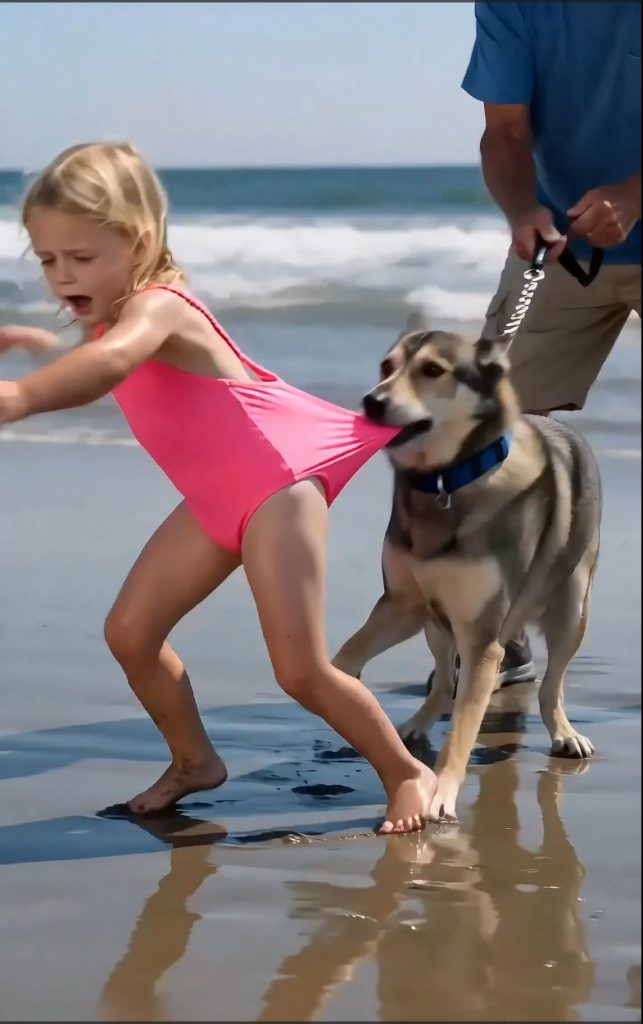
The dog grabbed Lily by the back of her pink swimsuit and pulled.
It happened so fast that nobody on the beach understood what they were seeing.
One second, the five-year-old girl was walking barefoot toward the wet shoreline, her blonde hair shining in the sun as small waves curled over the sand. The next, a large gray-and-tan dog lunged from the side, caught the fabric between his teeth, and dragged her backward with a low, muffled grunt.
Lily screamed.
Her little hands slapped against the wet sand as she fell forward, startled and crying, while the dog kept pulling just long enough to move her away from the waterline.
“Lily!”
Her mother, Jenna Harris, ran toward her with terror on her face.
The dog released the swimsuit immediately.
He did not bite again. He did not chase. He did not growl at the child.
He turned back toward the sand.
His name was Buster, and he was fourteen years old, though the way he stood between the girl and the water made him look younger for one breath. His blue collar tugged against the metal chain leash held by an elderly man in a blue T-shirt and tan shorts.
“Buster,” the old man whispered. “Easy.”
But the dog was not easy.
His body stayed rigid. His eyes fixed on the smooth patch of wet sand where Lily had been walking. The waves slid over it softly, leaving behind a shine so perfect it looked safe.
Jenna scooped Lily into her arms, pressing the crying child against her chest.
“You get that dog away from her!” she shouted.
A whistle blasted from the lifeguard tower.
A young lifeguard in a red long-sleeved shirt came sprinting across the beach with a clipboard clutched under one arm.
“Sir,” he shouted, pointing at the old man, “leash that dog right now and get him off this beach!”
“He is leashed,” the old man said, but his voice was low, distracted.
He was looking at the sand too.
Jenna turned on him, shaking with fury. “Your dog attacked my daughter!”
The old man knelt beside Buster and put one hand near his collar. His face was pale, not with embarrassment, but with fear.
“No,” he said quietly. “He didn’t.”
The lifeguard frowned. “Sir, I saw him pull the child down.”
The old man swallowed.
“Something’s wrong with that sand.”
Jenna clutched Lily tighter.
“I want that dog removed, now, before he does real damage!”
The dog let out one sharp bark.
Then the beach heard it.
A hollow, wet groan beneath the waves.
Everyone turned.
The patch of sand where Lily had been standing began to sink.
Act II
The beach at Cape Marlow had always looked harmless in summer.
Families came for the wide shoreline and soft waves. Children built castles near the tide pools. Retirees walked at dawn with thermoses of coffee and stories they had told too many times. The lifeguard tower stood near the dunes with an American flag snapping above it, red shirt visible from almost anywhere on the sand.
Jenna had chosen that beach because it felt safe.
She needed safe.
Her divorce had been finalized three months earlier. She had spent the winter teaching Lily how to sleep in a new apartment, how to understand why Daddy lived somewhere else now, and how to stop asking whether grown-ups could stop loving each other the way children stop liking vegetables.
The beach day was supposed to be simple.
Sun. Sandwiches. A pink swimsuit Lily picked herself. A bucket shaped like a turtle. No arguments. No court papers. No phone calls from lawyers.
Just one normal day.
Then Buster dragged her daughter across the sand.
Jenna did not see an old dog saving a child.
She saw teeth on fabric.
She saw Lily’s face in the sand.
She saw danger wearing fur.
The dog’s owner, Walter Briggs, understood why she screamed. He would have screamed too, years ago, before Buster taught him that fear did not always arrive from the direction people expected.
Buster had been a working dog once.
Not officially famous. Not the kind that appeared on calendars or in news stories. He had spent nine years with Walter on the coast guard volunteer search team, helping locate missing hikers in dunes, lost children near marshes, and once an elderly man who wandered into fog near the inlet.
Buster trusted scent, sound, vibration, and instinct more than human certainty.
Walter trusted Buster.
That trust had saved his life once.
Three years earlier, Walter ignored the dog’s refusal to cross an old wooden dock. He had laughed, called him stubborn, and stepped forward anyway. Buster barked until Walter stopped. Seconds later, part of the dock gave way beneath a fisherman’s cooler.
After that, Walter stopped laughing at warnings he did not understand.
But old age had crept into Buster’s bones. His muzzle grayed. His hips stiffened. His hearing faded. People began calling him sweet instead of useful, as if usefulness were the price of being allowed to stay.
Walter hated that.
Buster still knew things.
He knew when storms were coming before weather apps did. He knew when Walter’s blood pressure dropped because he pressed his head against his knee until the old man sat down. He knew which children were afraid of dogs and never approached them.
So when Buster stopped on the beach path that morning, nose lifted, body tight, Walter paid attention.
“What is it, boy?”
Buster looked toward the wet sand.
Not the waves.
The sand.
Then Lily skipped toward that exact spot.
Walter barely had time to tighten the leash before Buster moved.
Not like an old dog.
Like a promise remembering its purpose.
And by the time the lifeguard’s whistle cut through the air, Walter already knew the ugly truth.
Buster had not misunderstood the child.
The adults had misunderstood Buster.
Act III
The sand collapsed in a perfect circle.
It did not explode. It did not roar.
It simply fell inward, as if the beach had taken a breath and opened its mouth.
Water rushed into the hollow space with a churning sound that made Jenna stumble back. The smooth wet surface where Lily had been standing seconds earlier became a deep, swirling hole, its edges sliding down in sheets of sand and foam.
Lily stopped crying.
Her tiny arms locked around her mother’s neck.
The lifeguard froze with his whistle still between his fingers.
Walter’s hand tightened on Buster’s collar.
Nobody spoke.
The hole widened another foot before settling into a dark, unstable churn near the waterline.
Jenna’s face drained of color.
“That was where she was,” she whispered.
Walter looked at her, not with victory, not with anger, but with the tired sorrow of someone who knew how close tragedy had come.
“Yes.”
The lifeguard swallowed hard and stepped forward, then immediately stopped himself when more sand slumped near the edge.
“Everyone back,” he shouted, finally finding his voice. “Back from the shoreline!”
People began moving.
Not quickly at first.
Then faster.
Parents grabbed children. Beach chairs scraped. A man carrying a cooler nearly dropped it as he pulled his family toward the dry sand. The normal beach became a field of frightened motion.
The lifeguard blew his whistle again, longer this time.
“Clear the wet sand! Everybody behind the flags!”
Buster remained seated beside Walter, facing the hole.
He panted softly, tired now that his warning had become visible.
Jenna stared at him.
Her anger had nowhere to go.
That made it worse.
A minute earlier, she had wanted him removed. Punished. Blamed. She had looked at his old teeth and gray muzzle and seen only a threat.
Now the dog sat calmly in the sand, chain resting against his chest, while her daughter clung to her alive because of him.
The lifeguard glanced at Walter, then at Buster, then at the hole.
“I still have to write this up,” he said weakly.
Walter almost smiled.
Almost.
Then Jenna stepped toward him.
“I’m sorry,” she said.
The words came out small.
Walter nodded, but did not answer right away.
Jenna looked down at Buster. “I thought he was hurting her.”
“He knew you would,” Walter said gently.
That hurt more than accusation.
Because it was true.
Buster had accepted being misunderstood because the child had no time for explanations.
Lily lifted her head from Jenna’s shoulder and looked at the dog.
“He pulled me.”
Jenna pressed a kiss into her hair.
“Yes, baby.”
“Why?”
The hole gurgled behind them.
Jenna closed her eyes.
“Because he saw something we didn’t.”
And Walter, watching the water swirl inside the collapsed sand, realized the beach was not done revealing what it had hidden.
Act IV
By the time the rescue crew arrived, the hole had doubled in size.
The lifeguard, whose name was Ryan, had radioed the beach office and then the fire department. He kept the crowd back with orange cones, rope, and a voice that grew steadier with every order. His embarrassment had been replaced by focus.
That was the thing about real authority.
It could admit it was wrong and still do the job.
Jenna sat on a dry patch of sand with Lily wrapped in a towel against her lap. The little girl had stopped crying but kept staring at the sinkhole as if it might follow them.
Buster lay beside Walter, tired from the burst of force that had cost his old body more than anyone knew.
Every few seconds, Jenna glanced at him.
Walter noticed.
“He’s not offended,” he said.
Jenna gave a shaky laugh. “I think I am.”
Walter looked at her.
“By what?”
“How fast I blamed him.”
Walter was quiet for a moment.
Then he said, “Fear makes bad witnesses of us all.”
Jenna looked down at Lily’s sandy hair.
“My whole life now feels like reacting before I understand anything.”
Walter did not ask what she meant.
That kindness loosened something in her.
“I’m trying to start over,” she said. “For her. I keep thinking if I control every detail, nothing can hurt her.”
Walter nodded toward the hole.
“And then the ground opens.”
Jenna looked at him.
He gave a sad smile.
“My wife used to say control is what we call fear when we dress it nicely.”
Jenna almost laughed, but her eyes filled instead.
“She sounds wise.”
“She was. Annoyingly.”
Buster sighed, as if he agreed.
Ryan walked back toward them, clipboard tucked under his arm. His face was serious.
“Public works says this can happen after tidal erosion,” he said. “There may have been an old drainage pocket under the sand. It looked solid on top.”
Jenna stared at the hole.
“It looked normal.”
“That’s the problem,” Ryan said.
Then he crouched a few feet from Buster.
The dog opened one eye.
Ryan cleared his throat. “I owe him an apology too.”
Walter raised an eyebrow.
Ryan looked uncomfortable.
“Sorry, sir. To your dog.”
Walter nodded solemnly. “He accepts written statements and chicken.”
For the first time since the collapse, Lily smiled.
It was tiny.
But it was real.
Ryan looked relieved, then stood as another section of wet sand slumped inward with a soft rush. The crew shouted for everyone to move even farther back.
The hole had become a warning no one could ignore.
A photographer from the local paper arrived. Then a beach supervisor. Then two officers. Everyone asked questions. Everyone wanted the sequence.
The dog pulled her where?
How far?
Before the collapse?
Did he bark first?
Walter answered as best he could.
Jenna answered too.
Each time, she said the same thing.
“He saved my daughter.”
Not “the dog.”
Not “that animal.”
He.
Buster.
By name.
As the sun lowered and the tide shifted, Ryan finally closed the section of beach. Families began packing up, subdued and whispering. Children looked at Buster with awe. Adults looked at him with the kind of respect they usually reserved for things they understood too late.
Lily slipped from Jenna’s lap and stepped toward Walter.
Jenna tensed, then forced herself not to pull her back.
Lily stopped in front of Buster.
“Thank you,” she whispered.
The old dog lifted his head.
Then, very gently, he licked the back of her sandy hand.
Jenna covered her mouth.
Walter looked away toward the ocean.
Some rescues were too close to celebrate loudly.
Act V
The story made the evening news.
Senior Dog Saves Girl From Beach Sinkhole.
The headline sounded almost cheerful, as if the world needed danger softened before it could be shared. The video showed the collapse from a distance, the lifeguard rope, the crowd, and Buster sitting with quiet dignity beside Walter.
Jenna refused to let reporters film Lily.
But she agreed to speak for one reason.
“I want people to know he wasn’t attacking her,” she said into a microphone, voice trembling but clear. “He pulled her away because we didn’t see the danger. He took the blame for the few seconds it took the truth to show up.”
Walter watched from behind the camera with Buster leaning against his leg.
After the interview, Jenna walked over.
“I meant that,” she said.
“I know.”
She looked down at Buster. “Can I pet him?”
Walter glanced at the dog. “Ask him.”
Jenna crouched slowly.
“May I?”
Buster sniffed her hand. Then he leaned forward, pressing his gray muzzle gently into her palm.
Jenna began to cry.
Not dramatically. Not for the cameras. Just quietly, with one hand on the old dog’s head and the other wrapped around the towel still holding Lily’s damp swimsuit.
“I’m sorry,” she whispered.
Buster closed his eyes.
Dogs have a way of forgiving that makes humans look complicated.
In the weeks that followed, the beach installed new warning signs near erosion zones. Ryan led a safety review and included animal behavior in the incident report, which became a joke among the staff until they all admitted it might matter. The phrase “Buster protocol” appeared on the lifeguard office whiteboard.
If a leashed dog refuses to move from a shoreline zone, check the ground.
Walter pretended to find this ridiculous.
He was secretly proud.
Lily asked about Buster every morning for ten days.
“Is the beach dog okay?”
Jenna finally called Walter, using the number Ryan had passed along with permission. She expected awkwardness. Instead, Walter answered as if he had been waiting.
“Buster is sleeping like a retired general,” he said.
Lily drew him a picture.
It showed a big dog, a pink swimsuit, a blue ocean, and a giant brown circle in the sand. Above the dog, in shaky letters, Jenna helped her write:
Thank you for pulling me.
Walter framed it.
A month later, Jenna and Lily visited Walter’s small beach cottage.
Buster moved slowly to greet them, tail wagging with the careful rhythm of old hips. Lily hugged him around the neck, and Jenna almost stopped her out of habit before remembering trust was something she needed to practice too.
Walter served lemonade on the porch.
The ocean was visible beyond the dune grass, glittering under a peaceful sky.
Jenna watched Lily sit beside Buster with one hand resting on his back.
“I keep thinking about how close it was,” she said.
Walter nodded.
“That feeling stays.”
“How do you live with it?”
He was quiet for a while.
Then he said, “You let it make you grateful without letting it make you afraid of everything.”
Jenna looked at him.
“That sounds hard.”
“It is.”
Buster rested his chin on Lily’s knee.
Walter smiled faintly.
“But sometimes a good dog helps.”
Summer moved on.
The beach reopened. The sinkhole was filled and marked. People returned with umbrellas, coolers, sunscreen, and the stubborn human ability to believe a place is safe again once danger is hidden from sight.
But Jenna never saw the shoreline the same way.
She watched the sand. She watched the tide. She listened when Lily said something felt strange. She learned that protecting a child did not mean controlling every step.
Sometimes it meant staying humble enough to accept warnings from unexpected places.
Even from an old dog with gray fur and tired legs.
By late August, Walter invited them for one last beach walk before school started. Ryan was on duty that day, whistle around his neck, clipboard under his arm. When he saw Buster, he raised two fingers in a salute.
Buster ignored him completely.
Lily giggled.
They walked far above the waterline, where the sand was dry and warm. Jenna carried Lily’s sandals. Walter held Buster’s chain leash loosely, letting the old dog set the pace.
Near the spot where the collapse had happened, they stopped.
The beach looked ordinary.
That was the unsettling part.
No dark hole. No swirling water. No visible sign of the place where Lily’s life had narrowed to a matter of seconds.
Jenna took a slow breath.
Lily slipped her small hand into hers.
“I’m not scared,” Lily said.
Jenna looked down. “No?”
Lily shook her head.
“Buster’s here.”
Walter smiled, but his eyes shone.
Buster stood facing the waves, calm and steady, the breeze moving through his gray-and-tan coat. He no longer looked like a dramatic hero. He looked like what he had always been.
Old.
Loyal.
Attentive.
Ready.
Jenna crouched beside him and touched his collar.
“Thank you,” she said again.
The dog leaned into her hand.
This time, Jenna did not cry.
She smiled.
Behind them, the lifeguard tower stood beneath the flag. Beachgoers laughed in the distance. Waves rolled in, smooth and bright, hiding and revealing the world one breath at a time.
And Jenna finally understood the lesson Buster had taught without words.
Not every rescue arrives gently.
Sometimes it knocks you down.
Sometimes it terrifies you first.
Sometimes it looks, for one awful second, like the danger itself.
But love does not always wait to be understood before it acts.
Buster had seen the sand give way before anyone else did.
He had pulled Lily from the edge.
He had accepted the screams, the blame, the whistle, the anger.
And when the ground opened, the truth opened with it.
The dog was never the threat.
He was the warning.