Act I
The first thing people heard was the sound of paws.
Fast.
Heavy.
Purposeful.
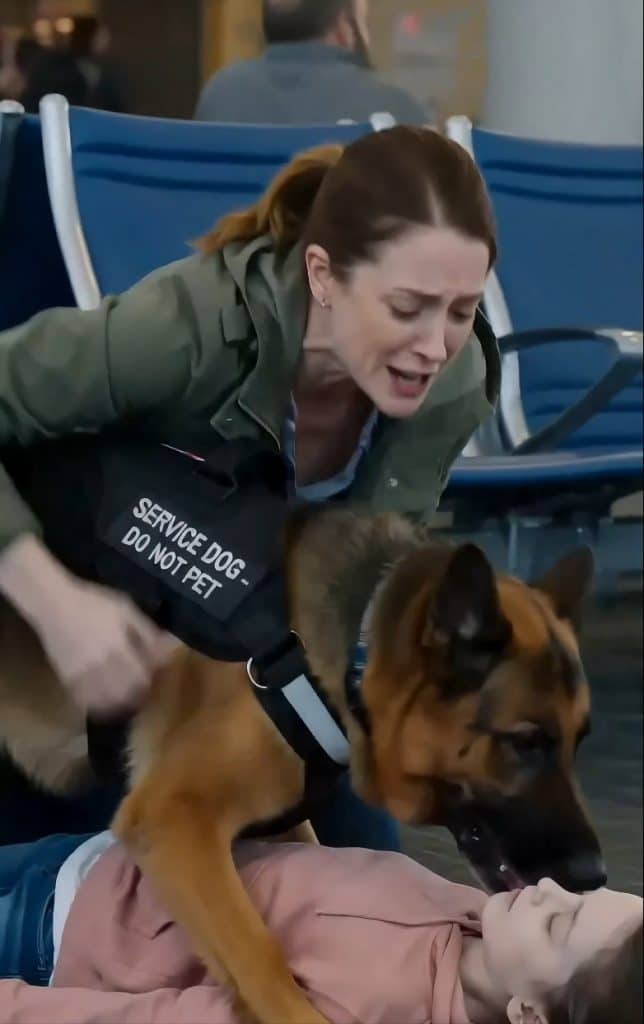
A German Shepherd sprinted through the airport terminal, cutting between rolling suitcases and rows of blue waiting seats, its black vest flashing beneath the overhead lights.
SERVICE DOG — DO NOT PET.
Travelers turned in alarm as the dog ran past them, focused on something no one else had noticed yet.
Then they saw the little girl on the floor.
Lily Harper lay beside Gate C14 in a pink hoodie and blue jeans, one shoe half off, her small body tense against the carpet. Her face had gone pale, her eyes unfocused, her breathing sharp and uneven.
Her mother dropped to her knees beside her.
“Lily! Lily, baby, look at me!”
Before she could pull her daughter into her arms, the German Shepherd reached them.
The dog did not bark.
It did not bite.
It did not snarl.
It lowered itself over Lily with astonishing control, placing steady pressure across her torso and legs, pinning her safely against the carpet as her body began to jerk.
The mother screamed.
“Get that dog off my daughter right now!”
She grabbed at the vest, yanking frantically, but the dog held its position. Its ears were forward, its breathing steady, its gaze fixed with the calm discipline of something trained for chaos.
Around them, the terminal erupted.
Travelers stepped back. Someone shouted for security. Someone else lifted a phone. A woman near the window gasped, “It’s on top of her!”
Lily’s movements grew stronger for a moment, then uneven. Her little hands trembled against the carpet. The dog shifted only enough to keep her from rolling into the row of metal seat legs nearby.
Then a man pushed through the crowd.
He was in his thirties, bearded, wearing a green bomber jacket, moving quickly despite the mechanical prosthetic leg beneath his left pant leg.
“Stop!” he shouted. “He’s not hurting her!”
The mother turned on him, tears streaming down her face.
“He’s crushing her!”
“No,” the man said, breathless but firm. “He’s keeping her safe.”
An airport police officer arrived a second later, hand raised, voice sharp.
“Sir! Step back from the animal right now!”
The man did not step back.
He pointed to the vest. Then to Lily’s pale face.
“He’s a service dog. He’s trained for this.”
The officer’s eyes narrowed.
“Trained for what?”
The dog looked up, still holding its position, calm while everyone else panicked.
The man’s answer cut through the terminal like a bell.
“Seizures.”
And suddenly, the thing everyone thought was an attack became the only reason Lily was still breathing.
Act II
The dog’s name was Ranger.
He belonged to Evan Cross, the man with the prosthetic leg and the green bomber jacket. For four years, Ranger had traveled beside him through airports, hospitals, train stations, and crowded sidewalks, never distracted by strangers, never startled by noise, never forgetting the invisible job beneath the vest.
People saw the prosthetic and assumed Ranger was a mobility dog.
They were only half right.
Evan had lost his leg in a roadside blast overseas, but the injury everyone could see was not the one that frightened him most. The worst part came later: sudden episodes, stress-triggered collapses, and seizures that left him waking on tile floors with strangers staring down at him.
Ranger had been trained to recognize the smallest changes.
A shift in breathing.
A change in posture.
The strange stillness before the body lost command of itself.
When the warning came, Ranger knew what to do. Press close. Create space. Block impact. Stay until help arrived.
Evan trusted the dog more than he trusted his own knees.
That morning, they were flying from Denver to Boston for the anniversary of the program that had paired them together. Evan was supposed to speak at the event, though he hated stages and microphones. Ranger was supposed to sit beside him, bored and dignified, while people applauded the kind of story that sounded cleaner after it was over.
Then Ranger stopped walking.
They were near Gate C10 when the dog’s body changed.
His head lifted.
His ears locked forward.
Evan knew that look.
“Ranger?”
The dog gave one low huff, not quite a bark. Then he pulled away, not wildly, not disobediently, but with the urgent certainty of a trained animal that had detected danger.
Evan followed as fast as he could.
By the time he saw Lily, Ranger had already reached her.
The little girl’s mother, Claire Harper, had been buying a bottle of water when Lily dropped.
It happened in the time it took to unzip a purse.
Lily had complained about feeling “sparkly” behind her eyes. Claire thought she was tired. Their flight had been delayed twice, and Lily had barely eaten breakfast. She had been pale all morning, leaning against her mother’s side as they moved through security.
Claire promised they would sit soon.
Then Lily slipped from the blue seat to the carpet.
At first, Claire thought she had fainted.
Then Lily’s body stiffened.
Then Ranger arrived.
Claire did not see a trained response.
She saw seventy pounds of German Shepherd covering her daughter, and fear erased everything else.
“Get him off!” she screamed.
But Evan had seen this before.
Not with Lily. Not in this airport. But with himself. In hotel rooms, parking lots, hospital corridors, and once in the middle of a grocery store while Ranger stood over him until someone called an ambulance.
The dog was not attacking.
The dog was working.
And if the crowd pulled him away too soon, Lily could hit the seat frame, roll awkwardly, or lose the pressure keeping her body stable through the episode.
Evan raised both hands, trying to calm the officer, the mother, the travelers, everyone at once.
“Give her space,” he said. “Someone call airport medical. Keep people back.”
The officer hesitated.
Protocol told him to control the animal.
But Ranger’s vest told another story.
And Evan’s voice carried the certainty of a man who knew what it felt like to wake up alive because a dog refused to move.
Act III
Claire stopped pulling at the vest only when Lily went still.
That terrified her more than the movement had.
“My baby,” she whispered. “Why is she so pale?”
Evan lowered himself carefully to one knee, keeping enough distance not to crowd Lily or Ranger.
“Can she breathe?”
Claire leaned closer, shaking.
“Yes. I think so. It’s faint, but yes.”
“Good,” Evan said. “Medical is coming.”
The officer turned to the crowd.
“Back up. Now.”
This time, people listened.
The loose circle widened. Phones lowered. A few passengers looked ashamed of how quickly they had turned a child’s emergency into a spectacle.
Ranger remained exactly where he was, steady and alert, his body forming a barrier between Lily and the chaos around her.
Claire stared at him through tears.
“He knew,” she said, almost to herself.
Evan nodded.
“Before most people would.”
“How?”
“Training. Scent changes. Body movement. Breathing. Some dogs pick up patterns faster than humans do.”
Claire swallowed hard.
“She’s never had one like this.”
Evan looked at Lily’s face.
“Has she had smaller episodes? Spacing out? Sudden confusion? Complaining about lights or strange feelings?”
Claire’s expression shifted.
Not into understanding.
Into memory.
“She said colors were buzzing last week,” she whispered. “I thought she was trying to get out of school.”
Evan said nothing.
That silence was kinder than reassurance.
Claire covered her mouth with one hand.
“Oh God.”
The officer’s radio crackled. Airport medical was on the way. Gate agents were holding boarding. An announcement continued somewhere overhead, cheerful and meaningless against the small emergency unfolding on the carpet.
Then a man in a gray suit pushed through the edge of the crowd.
“Claire?”
Her face changed instantly.
Evan saw it.
The fear in her eyes did not leave. It rearranged itself.
The man was tall, clean-shaven, with an expensive carry-on and impatience already tightening his mouth. He looked from Lily to Ranger, then to the surrounding travelers.
“What happened?”
Claire wiped her face quickly.
“She collapsed.”
The man’s eyes went to the dog.
“Why is that animal on her?”
Evan answered before Claire could.
“He’s stabilizing her after a seizure-like episode.”
The man frowned.
“She doesn’t have seizures.”
Claire looked at him.
“Mark, she’s on the floor.”
“She fainted,” he said sharply. “She gets dramatic when she’s tired.”
Evan’s jaw tightened.
The officer noticed.
Claire’s shoulders drew inward, the way people do when they have been corrected in public too many times.
“She was shaking,” Claire said quietly.
Mark leaned down, voice low but hard.
“You’re making a scene.”
Lily, pale beneath Ranger’s steady protection, gave the faintest breathy sound.
Claire turned back to her instantly.
Evan did not take his eyes off Mark.
Because suddenly the medical emergency was not the only thing wrong.
Act IV
Airport medical arrived with a stretcher and equipment.
The paramedic in front, a woman named Ruiz, assessed the scene in seconds.
“Whose service dog?”
“Mine,” Evan said.
“Trained response?”
“Yes. Seizure response and pressure stabilization.”
Ruiz nodded once.
“Good. Keep him there until I say.”
The officer looked relieved to have someone with medical authority confirm what Evan had been saying.
Mark did not.
He stepped closer.
“Is this really necessary? We have a flight.”
Claire stared at him.
The words seemed impossible to her.
Their daughter was unconscious on airport carpet, and he was thinking about boarding.
Ruiz looked up sharply.
“Sir, step back.”
Mark’s face hardened.
“I’m her father.”
“Then step back faster.”
A few travelers murmured.
Claire’s lips trembled, but she did not defend him.
That was the first small break in an old pattern.
Ruiz checked Lily’s breathing, pulse, and responsiveness. She spoke gently to the child even though Lily could not answer yet. Ranger stayed calm as medical hands moved around him, adjusting only when Ruiz gave a clear cue.
Finally, Lily’s eyelids fluttered.
Claire sobbed.
“Lily?”
The girl made a tiny confused sound.
Ranger lifted his head but did not move off until Ruiz touched Evan’s arm.
“Okay. Ease him back.”
Evan gave a soft command.
Ranger rose carefully and stepped away, then sat beside Lily’s feet like a soldier at attention.
Claire stared at him.
The same dog she had tried to drag away had just obeyed with more restraint than most adults in the terminal.
“I’m sorry,” she whispered.
Evan thought she was speaking to him.
Then he realized she was looking at Ranger.
The dog blinked once, calm and forgiving in the way dogs often are when humans are late to understanding.
Lily’s eyes opened partway.
“Mom?”
Claire bent over her, crying harder now.
“I’m here. I’m right here.”
Mark moved closer again.
“Lily, honey, you’re okay. You just scared everyone.”
Lily’s face tightened at the sound of his voice.
Small.
Almost invisible.
But Evan saw it.
So did Ranger.
The dog’s ears shifted.
Claire looked from her daughter to Mark, then back again.
“Lily,” she said softly. “Did you feel this coming?”
Lily blinked slowly.
“The lights got loud.”
Mark sighed.
“She says things like that. She’s imaginative.”
Ruiz looked at him.
“Sir, stop minimizing symptoms.”
The officer stepped beside Mark now, no longer focused on the dog.
Claire straightened.
For the first time, her panic became something sharper.
“She told me about the lights before,” she said. “You said not to encourage her.”
Mark’s face tightened.
“This isn’t the time.”
“No,” Claire said, voice shaking. “Maybe it should have been the time weeks ago.”
Mark’s eyes flashed.
“Claire.”
Just her name.
But there was warning inside it.
Evan heard it.
The officer heard it.
Ranger stood.
Not lunging.
Not barking.
Just rising to his feet and placing himself between Lily’s stretcher and Mark.
The terminal went quiet again.
Mark stared at the dog.
Evan’s voice was low.
“He doesn’t like your tone.”
Mark scoffed.
“It’s a dog.”
“No,” Claire said, looking at Ranger through fresh tears. “He’s the first one here who listened to her body.”
That sentence changed everything.
Act V
Lily was taken to the airport medical suite first, then transported to a hospital for evaluation.
Claire rode with her.
Mark was not allowed in the ambulance after arguing with the officer, the paramedics, and finally Claire herself. He stood outside the terminal doors with his suitcase beside him, furious and alone, while the ambulance pulled away.
For once, Claire did not look back.
Evan stayed at the airport long enough to give a statement. Ranger sat beside him, calm again, accepting water from a paper cup and ignoring every traveler who whispered about him from a respectful distance.
The officer, whose name was Daniels, approached after the crowd thinned.
“I owe you an apology,” he said.
Evan looked up.
“You were doing your job.”
“I nearly did it wrong.”
Evan glanced at Ranger.
“He’s used to being misunderstood.”
Daniels looked at the dog’s vest.
“Still shouldn’t happen.”
“No,” Evan said. “It shouldn’t.”
By that evening, a short clip of the scene had spread online. Not the full medical moment. Daniels made sure airport staff requested people take down the most invasive recordings of Lily. But one video remained, filmed from behind the rows of blue seats.
It showed Ranger sprinting through the terminal.
It showed Claire trying to pull him away.
It showed Evan stepping forward.
And it captured the single word that reframed the entire emergency.
Seizures.
The comments came fast.
Some people apologized for assuming the worst.
Some shared stories of service dogs saving lives in ways strangers did not understand.
Some asked why a little girl’s symptoms had been dismissed until an animal took them seriously.
Claire read none of it for two days.
She sat beside Lily’s hospital bed instead, watching monitors, listening to doctors, and replaying every complaint she had brushed aside because Mark told her she was “feeding drama.”
The lights are buzzing.
My stomach feels floaty.
I don’t remember walking here.
Mom, I feel weird.
Claire had loved her daughter fiercely, but love had not protected Lily from being dismissed. Not when Claire had learned to doubt herself inside her own marriage. Not when Mark’s confidence filled every room before her questions could.
The diagnosis did not come instantly.
Real medicine rarely works like a dramatic reveal. There were tests, consultations, cautious language, and follow-up plans. But the doctors agreed on one thing: Lily’s episode was serious, and her earlier symptoms mattered.
Claire cried in the hospital bathroom after hearing that.
Not because she wanted to be right.
Because her daughter had been.
On the third day, Evan visited.
He brought a stuffed German Shepherd wearing a tiny homemade vest that said DO NOT PET, I AM VERY IMPORTANT. Lily laughed for the first time since the airport.
Ranger was allowed in after hospital approval.
The moment he entered, Lily’s face softened.
“Hi,” she whispered.
Ranger approached slowly, then rested his chin near the edge of her blanket.
Claire covered her mouth.
“I don’t know how to thank him.”
Evan smiled faintly.
“He prefers snacks, but gratitude works.”
Lily looked at Evan’s prosthetic leg, then quickly looked away, embarrassed.
“It’s okay,” he said. “You can ask.”
“Does he help you too?”
“Every day.”
“Were you scared the first time?”
Evan thought for a moment.
“Terrified.”
Lily nodded seriously.
“Me too.”
Ranger gave a soft huff.
Evan touched the dog’s head.
“He’s good at sitting with scared people.”
That was true.
For the next fifteen minutes, Ranger did nothing heroic. He did not sprint, press, block, or alert. He simply sat beside the bed while Lily’s small hand rested on his shoulder.
Sometimes rescue looked like running through an airport.
Sometimes it looked like staying.
Weeks passed.
Claire postponed the trip they had been taking and filed for separation from Mark after a hospital social worker gently asked questions Claire finally answered honestly. Mark called it an overreaction. Claire called it the first clear decision she had made in years.
Lily began treatment and learned words for what had happened to her body. She learned that symptoms were not imagination. She learned that asking for help was not making a scene.
And Claire learned to listen before fear became an emergency.
Evan and Ranger made it to Boston eventually, though late. At the foundation event, Evan changed his speech.
He had planned to talk about independence.
Instead, he talked about misunderstanding.
“People think a service dog’s vest is the proof,” he told the audience. “It isn’t. The proof is the work. The calm in the panic. The task performed when everyone else is guessing.”
Ranger slept through most of it.
The audience loved him anyway.
Months later, Claire and Lily returned to the same airport for a new trip. This one had no Mark, no rushed boarding, no ignored symptoms. Lily wore noise-reducing headphones around her neck and carried a small medical card in her backpack. Claire checked in early, packed snacks, and chose seats away from the brightest lights.
Near Gate C14, Lily stopped.
The blue seats were the same.
The carpet was the same.
For a second, Claire saw the old image: her daughter pale on the floor, Ranger over her, strangers shouting.
Then Lily pointed.
A poster had been installed near the seating area.
Service animals at work may perform tasks that look unfamiliar. Do not interfere. Alert staff and give space.
Below it was a photo of a German Shepherd in a black vest.
Not Ranger’s exact picture.
But close enough.
Lily smiled.
“He has a sign now.”
Claire squeezed her hand.
“He earned it.”
A voice behind them said, “He’s going to act unbearable when I tell him.”
They turned.
Evan stood a few feet away with Ranger at his side, both of them waiting for a different flight. Ranger saw Lily and gave one restrained wag of his tail, professional enough to stay seated but honest enough to show he remembered.
Lily crouched a little, careful not to touch without permission.
“Hi, Ranger.”
Evan nodded.
“You can say hello.”
Ranger stepped forward gently, and Lily wrapped her arms around his neck.
Claire watched them and felt the airport around her move as usual: announcements, rolling bags, footsteps, strangers rushing toward gates.
The same public place.
A different kind of safety.
The crowd that day had thought the dog was hurting her because they did not understand what help looked like when it arrived on four legs.
They saw pressure and called it danger.
They saw discipline and called it aggression.
They saw a vest and still doubted the work.
But Ranger never needed them to understand before doing his job.
He heard what Lily’s body was saying when the adults around her had missed it.
He ran toward the emergency when everyone else froze.
And when the world finally asked what he had been trained for, the answer was simple enough to silence an airport.
Seizures.
One word.
One dog.
One little girl breathing beneath him.
And a terminal full of strangers learning that sometimes protection does not look gentle until you understand what it is saving.