Act I
The shovel went into the ground with the same rhythm every time.
Scrape.
Lift.
Throw.
Scrape.
Lift.
Throw.
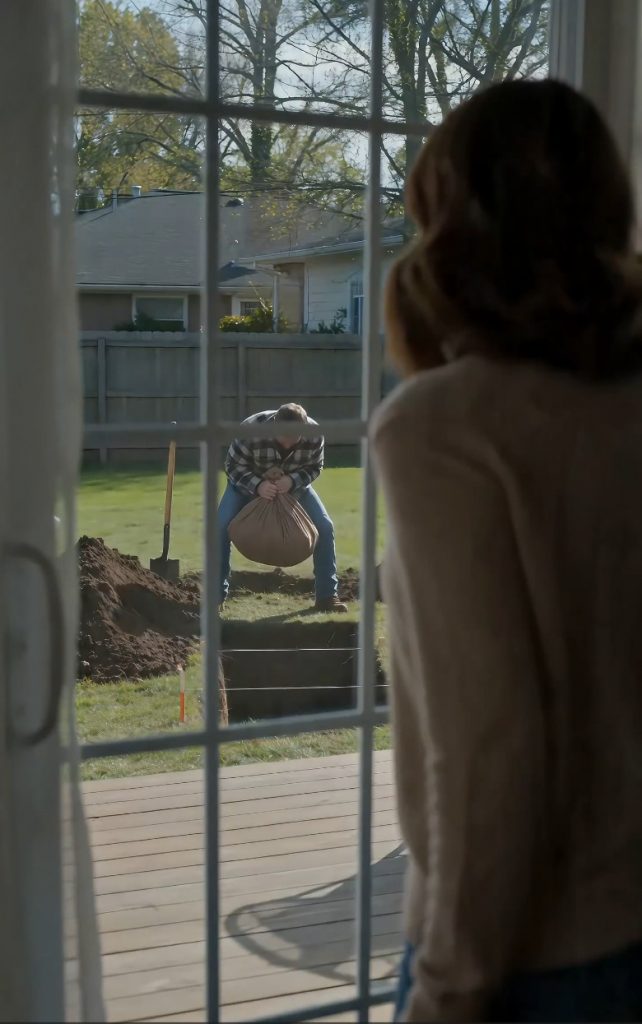
From inside her quiet living room, Rachel Voss stood inches from the glass door and watched the man in the neighboring yard dig a square hole into his perfect green lawn.
At first, she told herself it was nothing.
People dug holes. People planted trees. People repaired irrigation lines. People did strange little projects on bright Saturday afternoons when the rest of the street was busy pretending suburbia was peaceful.
But this hole was too deep for flowers.
Too clean for repairs.
Too careful.
The man wore a black-and-white plaid flannel shirt and blue jeans. His back was mostly turned toward her, but Rachel knew him by his shoulders, by the way he planted his feet before lifting the shovel, by the calm patience that had always made him seem harmless.
His name was Martin Hale.
He lived next door with a white porch, trimmed hedges, and a habit of waving every morning as if nothing in the world had ever gone wrong.
Rachel had never liked him.
She could not explain why.
Her husband used to call it paranoia.
“You watch too many crime shows,” Ethan would tease.
But Ethan had been gone for eight months now, and the house had become too quiet for jokes. Since his death, Rachel heard every noise. Saw every shadow. Noticed every light left on too late in other people’s windows.
And now she was noticing the brown fabric bundle lying on Martin Hale’s lawn.
It was several feet from the pit, wrapped tightly in some kind of heavy cloth. Not a tarp. Not a blanket exactly. Something rough, dark brown, tied at the middle.
Rachel’s fingers pressed against the glass.
Martin stopped digging.
He stood over the square hole, chest rising and falling, then drove the shovel into the dirt pile and turned toward the bundle.
“No,” Rachel whispered.
He bent down.
Wrapped both arms around it.
Lifted.
The bundle sagged heavily in his grip.
Rachel’s breath caught as he carried it toward the pit and lowered it to the edge with the slow care of a man who did not want to drop what he was trying to hide.
Then the fabric moved.
Not from the wind.
Not from his hands.
From inside.
A small, desperate twitch.
The cloth tightened, shifted, then went still.
Rachel’s mouth opened, but no sound came out.
Martin froze for half a second.
Then he reached for the shovel.
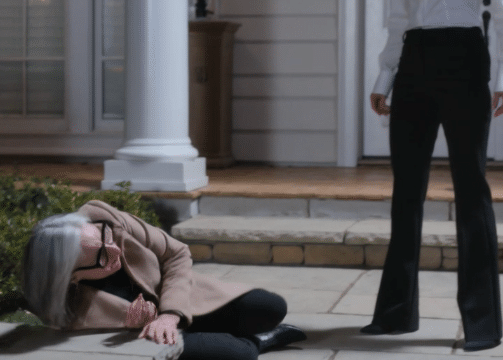
Rachel stumbled back from the glass, one hand flying to her throat. The room tilted. The low hum in her ears became a roar.
She tried to grab the table.
Missed.
And collapsed onto the floor as the bright backyard disappeared into black.
Act II
Rachel woke to the taste of dust and panic.
For several seconds, she did not know where she was. The ceiling above her swam in soft gray light. Her shoulder ached where she had hit the floor. Somewhere in the distance, a lawn mower buzzed like the world had not just cracked open.
Then she remembered.
The pit.
The bundle.
The movement.
She rolled onto her side with a sharp breath and crawled toward the glass door.
Martin was gone.
The shovel was gone too.
The square hole remained in the grass, partly filled now, the dark soil freshly disturbed beneath the sun.
Rachel pressed one trembling hand to her mouth.
She had fainted.
She had fainted while something inside that bundle had moved.
Her phone lay on the coffee table three feet away. She grabbed it and dialed 911 with fingers that barely worked.
“What is your emergency?”
Rachel stared through the glass at the mound of new dirt.
“My neighbor,” she said, voice shaking. “I think he buried something in his yard.”
The dispatcher went quiet in the way trained people go quiet when they stop assuming fear is confusion.
“Ma’am, are you safe inside your home?”
Rachel looked toward the fence.
Martin’s back door was closed.
“I think so.”
“Did you see a person?”
“I don’t know.” Her voice broke. “It was wrapped in fabric. It moved.”
The words sounded impossible when spoken aloud.
But she had seen it.
She knew she had.
The dispatcher told her to stay inside, lock her doors, and avoid confronting him. Rachel obeyed, but as she moved through the house checking each lock, old memories rose in fragments.
Martin carrying groceries for Mrs. Delaney across the street.
Martin watering his lawn at 6:00 every morning.
Martin smiling at the neighborhood barbecue while his wife, Julia, stood beside him with a tight expression and long sleeves despite the heat.
Julia.
Rachel stopped in the hallway.
She had not seen Julia Hale in nearly two weeks.
At first, everyone said she was visiting her sister. Then Martin said she had gone to a wellness retreat. Then, at the mailbox four days earlier, he told Rachel she was “resting somewhere quiet.”
Somewhere quiet.
Rachel felt cold spread beneath her skin.
She and Julia had not been close. Not really. Suburban closeness was often built from borrowed sugar and polite lies. But after Ethan died, Julia was the only neighbor who brought food without asking questions.
A casserole.
A handwritten note.
A small pot of lavender because, as Julia said softly, “Some houses need help remembering how to breathe.”
One night, Rachel found Julia standing by the fence in the rain, staring at her own back door.
“Are you okay?” Rachel had asked.
Julia smiled too quickly.
“Just needed air.”
There had been a mark near her wrist. Rachel saw it before Julia pulled her sleeve down.
Rachel had said nothing.
That silence now sat inside her like a stone.
Outside, tires rolled slowly along the street.
Rachel ran to the front window and saw a police cruiser pull up without sirens. Then another car. Then a county SUV.
A woman in a dark blazer stepped out with two officers. She looked toward Rachel’s house first, then toward Martin’s.
Rachel’s phone buzzed.
The dispatcher said, “Officers are outside. Stay where you are unless they come to you.”
But Martin’s front door opened before anyone could reach it.
He stepped onto the porch in the same plaid flannel, wiping his hands on a towel.
He smiled.
Even from across the room, Rachel could see how practiced it was.
Act III
Detective Lena Ortiz did not smile back.
Rachel watched through a crack in her curtain as the detective spoke to Martin on his porch. Martin kept his posture open, almost relaxed. He gestured toward the yard once and laughed lightly, as if the whole thing were a neighborly misunderstanding.
Rachel hated that laugh.
It was too easy.
One officer walked to the side gate. Another stayed near the porch. Detective Ortiz listened without interrupting.
Then Martin’s smile faltered.
Just slightly.
Rachel pressed closer to the window.
The detective had shown him something on her phone.
Martin looked from the screen to Rachel’s house.
For the first time, his face changed.
He knew.
He knew she had seen.
Rachel stepped back from the curtain, heart hammering. A second later, there was a knock at her front door.
“Mrs. Voss? Detective Ortiz.”
Rachel opened it with the chain still on.
The detective stood alone, calm but alert.
“I need to ask you a few questions.”
Rachel let her in.
Up close, Detective Ortiz had tired eyes and a voice that did not waste movement. She asked Rachel to describe exactly what she had seen, where she stood, when she fainted, and how long she believed she was unconscious.
Rachel told her everything.
The shovel.
The square pit.
The brown fabric.
The movement from inside.
The detective’s expression remained controlled, but something behind her eyes sharpened when Rachel mentioned Julia.
“You haven’t seen Mrs. Hale recently?”
“No,” Rachel said. “Have you?”
Ortiz did not answer directly.
“Mrs. Hale’s sister reported her missing this morning.”
Rachel sat down hard on the edge of the sofa.
The room seemed to tilt again.
“She’s missing?”
“Mr. Hale told family she was staying with a friend. The friend says she never arrived.”
Rachel looked toward the backyard.
“He said she was resting somewhere quiet.”
Ortiz’s jaw tightened.
Through the glass, they could see officers now standing near the disturbed patch of earth. One of them held a long-handled tool. Another took photographs.
Martin was no longer smiling.
He stood between two officers, talking fast.
Rachel’s hands trembled in her lap.
“I should have said something before,” she whispered.
The detective looked at her.
“Before when?”
Rachel told her about Julia in the rain. The sleeve. The fear behind the smile.
Ortiz listened.
No judgment.
Somehow, that made Rachel feel worse.
Then a shout came from outside.
Not loud enough to understand.
But urgent.
Rachel and Ortiz turned toward the glass.
One officer near the pit had dropped to his knees.
Another was waving for the detective.
Ortiz moved fast.
“Stay inside.”
Rachel did not.
She followed to the back door and stopped just beyond the threshold.
The lawn smelled like fresh dirt and cut grass. The afternoon sun was bright enough to make the scene feel obscene. Officers had cleared away part of the soil. The brown fabric was visible again.
And it moved.
This time, everyone saw it.
A small shift beneath the cloth.
A muffled sound.
Not a scream.
Not a word.
But life.
Detective Ortiz knelt beside the pit.
“Cut it open carefully,” she ordered.
Martin shouted from near the fence, “Don’t touch that!”
The entire yard went still.
Ortiz looked up at him.
“Why not?”
Martin’s face went gray.
And Rachel knew, before the fabric was opened, that his answer would never be enough.
Act IV
It was not Julia in the bundle.
It was her dog.
A golden retriever named Samson, old and gentle, wrapped in a brown moving blanket with his paws bound loosely enough to hide him but tightly enough to keep him from escaping. He was weak, frightened, and trembling, but alive.
Rachel burst into tears the moment she saw his face.
Samson had been Julia’s shadow.
He followed her to the mailbox, slept beneath her kitchen window, and leaned against her hip whenever Martin stood too close. More than once, Rachel had seen Julia rest her hand on the dog’s head like she was reminding herself she was not completely alone.
Now Samson lay in the dirt, blinking beneath sunlight, trying to lift his head.
An officer carried him gently onto the grass while another cut the fabric away. Detective Ortiz called for animal emergency services, then turned to Martin.
“Why were you burying your wife’s dog?”
Martin’s face twisted.
“He was dead.”
The dog gave a faint whine.
No one spoke for a moment.
The lie had answered itself.
Martin tried again.
“He attacked me. He’s dangerous.”
Samson was too weak to stand.
Rachel heard herself say, “He’s never hurt anyone.”
Martin snapped his gaze toward her.
For the first time, the pleasant neighbor vanished completely.
“You should have stayed out of this.”
Detective Ortiz stepped between them.
“That sounds like a threat.”
Martin’s mouth closed.
One officer moved closer to him.
Ortiz crouched near Samson and looked at his collar. A small metal tag hung beneath his name.
There was also a plastic capsule attached to the ring.
Rachel recognized it.
Julia had told her about it once, smiling faintly as Samson nosed through fallen leaves.
“Emergency note,” Julia had said. “Silly, maybe. But it makes me feel safer.”
Ortiz opened the capsule.
Inside was a tightly rolled strip of paper.
She unfolded it carefully.
Her face changed as she read.
Then she looked at Martin.
“Where is your wife?”
Martin said nothing.
Ortiz handed the note to the officer beside her, then read aloud.
If Samson is found without me, call my sister and Detective Lena Ortiz. Martin has been threatening to make both of us disappear. I hid copies in the garden shed.
The yard fell silent except for Samson’s breathing.
Rachel felt the world narrow around that one sentence.
I hid copies in the garden shed.
Martin lunged.
Not far.
Not successfully.
The officers caught him before he reached the shed door, and the perfect lawn finally became what it had always been beneath the surface: a crime scene wearing sunlight.
The shed held a locked metal box behind stacked fertilizer bags.
Inside were photographs, financial records, medical notes, and a flash drive wrapped in plastic. There were also letters from Julia to her sister, never mailed, each one documenting what she had been too afraid to say out loud.
Samson had been the final witness.
Martin had not buried him because the dog was dead.
He had buried him because the dog carried the note.
Because Julia had trusted the one loyal creature in that house more than the man she was married to.
Rachel stood barefoot at the edge of her patio, arms wrapped around herself.
Detective Ortiz approached her, holding one of the sealed bags.
“Mrs. Voss,” she said gently. “You may have saved a life today.”
Rachel looked at Samson being lifted onto a stretcher.
“Not the one I thought.”
Ortiz’s eyes softened.
“Maybe more than one.”
Then, from the front of the house, another officer called out.
“We found her.”
Rachel stopped breathing.
Ortiz turned sharply.
The officer appeared near the side gate, radio in hand.
“Mrs. Hale is alive.”
Act V
Julia Hale was found in a roadside motel six miles away, locked in a room registered under a false name.
She was frightened, dehydrated, and shaken, but alive. Martin had hidden her there two days earlier after she tried to leave him. He had returned home to destroy what tied him to the abuse, the threats, and the financial control he had kept wrapped around her life for years.
He almost succeeded.
Almost.
But he underestimated three things.
A woman at a window.
A dog in a collar.
And the fact that buried truth can still move.
Julia returned to the street three days later in the passenger seat of Detective Ortiz’s car. Rachel watched from her porch as the vehicle stopped in front of the Hale house.
For a long moment, Julia did not get out.
The house looked the same. White porch. Trimmed hedges. Perfect lawn, except for the patch of raw earth near the pit. From a distance, it still resembled a peaceful suburban home.
Rachel understood then how dangerous appearances could be.
A neat yard could hide terror.
A smiling neighbor could hide cruelty.
A silent wife could be screaming in every way except sound.
Finally, Julia opened the car door.
Rachel crossed the lawn before she could talk herself out of it.
Julia looked thinner than before. Her face was pale. Her eyes moved too quickly, checking windows, corners, shadows.
Then she saw Rachel.
For a second, neither woman spoke.
Rachel started crying first.
“I’m sorry,” she said. “I saw things before. I should have—”
Julia shook her head.
“No.”
“But I should have helped sooner.”
Julia’s eyes filled.
“You looked.”
Rachel did not understand.
Julia took a trembling breath.
“Most people don’t even look.”
That sentence broke something open between them.
Rachel stepped forward, and Julia let herself be hugged.
Not tightly.
Not with drama.
Just enough to remind them both that they were standing in daylight.
Samson survived.
The veterinarian said he was old, exhausted, and shaken, but stubborn. Julia laughed when she heard that, then cried into her hands for ten minutes. When she was finally allowed to visit him, Samson lifted his head at the sound of her voice and tried to wag his tail.
Julia dropped to her knees beside him.
“My good boy,” she whispered.
Samson pressed his nose into her palm.
Detective Ortiz gave them space.
So did Rachel.
The case against Martin Hale unfolded slowly, as real consequences often do. There were charges related to unlawful restraint, animal cruelty, coercive control, financial exploitation, and obstruction. There were hearings. Protective orders. Statements. Lawyers using careful words for ugly things.
But the evidence Julia hid in the shed made silence impossible.
The letters showed a pattern.
The records showed control.
The note in Samson’s collar showed intent.
And Rachel’s 911 call gave the timeline a witness Martin could not explain away.
The neighborhood changed after that.
At first, people whispered. They brought casseroles because casseroles were easier than apologies. They said things like, “We had no idea,” even when some of them had heard arguments through open windows or noticed Julia disappearing from gatherings.
Rachel said it too.
Then she stopped.
Not knowing was not always innocence.
Sometimes it was comfort.
A month later, Julia sold the house.
She did not step inside again after collecting what mattered: her mother’s ring, a box of photographs, Samson’s blanket, and the lavender plant she had once given Rachel. The rest could be handled by movers and lawyers.
Before leaving, Julia stood beside the patch of repaired lawn.
The pit had been filled.
Grass seed had been scattered.
From a distance, it was already beginning to disappear.
Rachel stood beside her.
“I hate that it looks normal again,” Rachel said.
Julia nodded.
“Me too.”
Then she bent down and placed a small stone at the edge of the patch. Not a memorial. Not exactly. Just a marker only they would understand.
For what almost disappeared.
For what didn’t.
Julia moved in with her sister two towns over. Samson went with her, wearing a new collar with a bright metal tag and no hidden note, because Julia said she wanted him to carry nothing now but his name.
Rachel visited the next week.
Then again the week after.
Their friendship grew slowly, carefully, without forcing either woman to pretend healing was simple. Sometimes they talked about ordinary things: grocery prices, bad coffee, old movies. Sometimes Julia spoke about fear. Sometimes Rachel spoke about grief.
Both were forms of survival.
Months later, Rachel stood at her own glass door again, looking out at the neighboring yard. New people had moved in. A young couple with a toddler and too many patio chairs. The lawn had grown back. The square patch was almost invisible now.
Almost.
Rachel still looked.
She looked when she heard raised voices.
She looked when someone disappeared from routine.
She looked when her instincts whispered that polite explanations did not fit what her eyes had seen.
Not because she wanted to spy.
Because she had learned that looking away was not neutral.
That afternoon, her phone buzzed.
A message from Julia.
A photo came through first: Samson asleep on a sunlit porch, gray around the muzzle, one paw resting over a stuffed rabbit.
Then the words.
He barked at the mailman today. Very proud of himself.
Rachel smiled.
For the first time in a long while, the quiet house did not feel empty.
It felt awake.
She glanced again at the yard next door, at the place where a man had tried to bury what could expose him.
He had chosen daylight because he thought daylight made him safe.
He had chosen a perfect lawn because he thought beauty could hide violence.
He had chosen a brown fabric bundle because he thought nobody would understand what moved inside it.
But Rachel had seen.
She had gasped.
She had fallen.
Then she had gotten back up.
And because she did, the secret Martin Hale tried to put into the ground came back breathing.