Act I
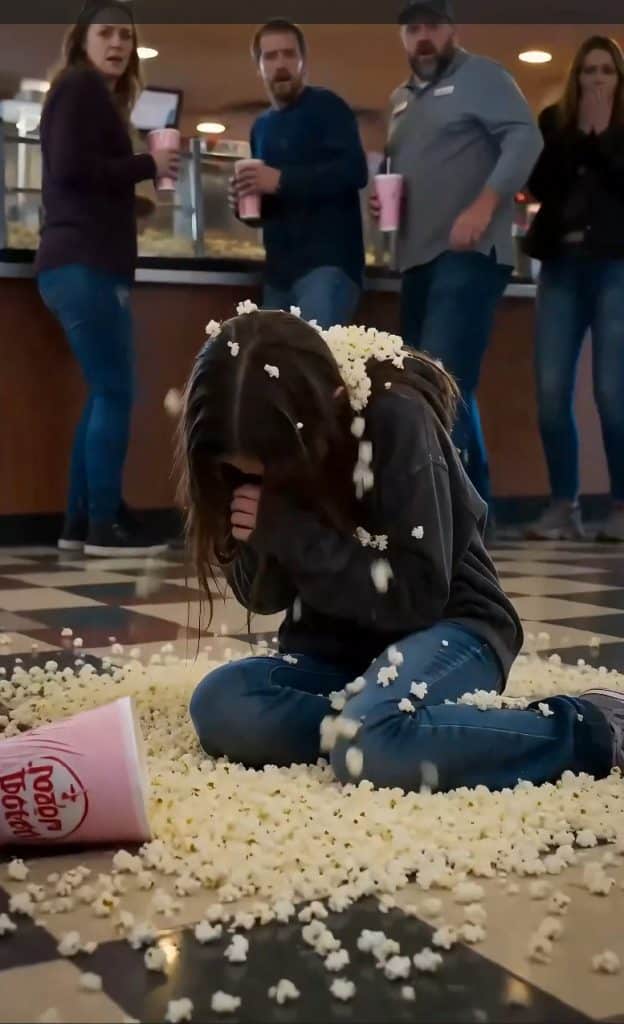
The popcorn hit the floor before anyone understood why the girl had fallen.
One moment, she was standing beside the industrial popcorn machine in a dark gray hoodie and jeans, hands trembling around an oversized tub. The next, her knees struck the checkered tile, the tub tipped, and a storm of popcorn spilled over her shoulders, her lap, her hair, and the floor around her.
The theater lobby went quiet in patches.
A few customers turned from the menu boards. A cashier froze behind the counter. Pink drink cups stood in neat rows near the soda machine, bright and cheerful against the mess spreading at the girl’s knees.
The girl did not get up.
She stayed crouched in the popcorn, head bowed, long brown hair hanging forward as if she could hide inside it.
Behind the counter, Dale Morris slammed both hands down.
He was a heavy man in a red baseball cap and red apron, his gray polo already stained from a long shift. His name tag flashed under the warm lobby lights as he leaned over the counter, face red with rage.
“Look what you did!”
The girl flinched so hard the nearest bystander noticed.
That was the first warning.
Not the spilled popcorn.
Not the crash.
The flinch.
Dale grabbed a large soda cup from the counter.
“Every time,” he shouted. “Every time I give you one simple job!”
The girl lifted her head just enough to whisper, “I’m sorry.”
It came out like a reflex.
Like she had said it too many times before.
Dale stepped around the counter, drink in hand. The cashier beside him took one step backward but said nothing. Customers stood still, caught between shock and the old public cowardice of hoping someone else would act first.
Dale looked down at the girl.
Then he tipped the cup.
Dark soda poured over her head and shoulders.
The girl curled inward, one arm rising to shield her face. Liquid ran through her hair and soaked the front of her hoodie. Popcorn clung to the wet fabric. Her sob caught in her throat, small and broken.
A child near the candy display started crying.
Nobody laughed.
Even Dale seemed to expect laughter and found only silence.
Then heavy boots struck the tile.
Slow.
Deliberate.
A tall man in a tan sheriff’s uniform stepped into the concession area from the side hall, brown department jacket hanging from his shoulders, gold badge catching the lobby light.
Sheriff Nathan Cole stopped ten feet from Dale.
His eyes moved from the soda cup to the girl on the floor.
Then the girl pulled at her wet hoodie collar, shaking, trying to breathe.
The movement exposed the side of her neck.
The Sheriff’s face changed.
Not loudly.
Not dramatically.
But completely.
“Dale,” he said, voice low enough to make the lobby colder. “What are you doing?”
Dale’s mouth opened.
For the first time, no sound came out.
Act II
The girl’s name was Hannah Price.
Sixteen years old.
Quiet in school. Good at English. Bad at asking for help. The kind of girl teachers described as “no trouble,” which often meant no one looked closely enough to see trouble had already found her.
Her mother had died when Hannah was twelve.
After that, the world began dividing itself into before and after.
Before, there had been pancakes on Saturday mornings, library books stacked beside the couch, and an old denim jacket her mother wore whenever she took Hannah to the movies. After, there was Dale.
Dale had not started as a villain in the story.
He had been her mother’s boyfriend near the end, a man who brought groceries when hospital bills swallowed everything, a man who fixed the broken porch light and told Hannah to call him if she ever needed anything.
When her mother passed, he became the adult who stayed.
That was how people explained it.
At first, Hannah was grateful.
Grief makes children easy to convince. If someone remains when everyone else goes home, you mistake presence for love.
Dale moved them into the small apartment above the theater where he worked as manager. He said it was practical. He said rent was expensive. He said Hannah could help out after school and learn responsibility.
Then “helping out” became closing shifts.
Closing shifts became unpaid work.
Unpaid work became missed homework, missed meals, missed calls from school counselors.
By sophomore year, Hannah had learned Dale’s rules.
Do not embarrass him.
Do not question him in public.
Do not talk about home.
Do not let anyone see too much.
The marks on her neck were explained away as clumsiness. Her exhaustion was blamed on teenage attitude. Her silence became part of her reputation, and reputation is one of the easiest places to bury a cry for help.
But Sheriff Nathan Cole had not forgotten her.
He knew Hannah’s mother, Rachel Price. Years ago, before the uniform, before the badge, before the patrol car, Nathan had worked security at this same theater. Rachel had sold tickets at the front counter and saved him black coffee during late shows.
They were never romantic.
They were something simpler.
Friends from a hard season.
When Rachel got sick, Nathan visited once at the hospital. She had taken his hand with fingers already too thin and asked him to promise something.
“If anything happens,” she whispered, “make sure Hannah doesn’t disappear into somebody else’s house.”
Nathan promised.
Then life did what life does.
Paperwork shifted. Guardianship was granted. Dale looked responsible on forms. Hannah stopped answering when Nathan checked in. School officials said they were monitoring. Dale said the girl needed space.
Nathan hated that he let the promise grow quiet.
Then, two weeks before the concession stand incident, an envelope arrived at the sheriff’s office with no return address.
Inside were three things.
A crumpled theater schedule.
A photo of Hannah cleaning the lobby after midnight on a school night.
And a note written in shaky handwriting.
I don’t know who to tell.
Nathan had been watching the theater ever since.
Dale did not know that.
He did not know the sheriff had already spoken to Hannah’s school counselor. He did not know a social worker was preparing an emergency review. He did not know Nathan had come to the theater that evening because the note mentioned Friday nights were the worst.
Most of all, Dale did not know that pouring soda over the girl in front of witnesses would turn suspicion into proof.
Now Hannah sat in the popcorn and soda, trembling beneath bright lobby lights, while the man her mother once trusted walked toward her with a badge on his chest and a fury he was forcing himself to control.
Dale tried to recover.
“She dropped inventory,” he snapped. “You know how much waste costs?”
Nathan looked at him.
“She’s a child on the floor.”
“She works here.”
“She goes to school.”
Dale’s face tightened.
“That’s none of your business.”
Nathan stepped closer.
“When someone hurts a minor in public, Dale, it becomes my business real fast.”
The lobby held its breath.
Dale glanced at the bystanders, suddenly aware of every phone, every witness, every eye that had not looked away quickly enough.
Nathan pointed toward the back corridor.
“You’re done here today. Go in the back.”
Dale laughed once, but it cracked halfway through.
“You can’t order me around in my own theater.”
Nathan’s voice stayed calm.
“Try me.”
And Dale finally understood that the badge had not come to ask questions.
It had come to take control.
Act III
Hannah expected Dale to win.
That was how her world worked.
He got angry. People got uncomfortable. Then people left. Later, behind closed doors, he would explain why it was her fault that everyone looked at him badly.
But this time, the Sheriff did not leave.
He crouched in front of her, careful not to crowd her.
“Hannah,” he said softly. “Can you stand?”
She stared at him through wet hair.
The sound of her own name seemed to frighten her.
Dale’s head snapped toward them.
“You know her?”
Nathan did not look away from Hannah.
“Yes.”
Hannah’s lips trembled.
She remembered him in fragments. A uniform at her mother’s hospital door. A deep voice telling Rachel he would check in. A badge beside a paper cup of coffee. A man who had looked sad when he thought no one was watching.
“You promised Mom,” she whispered.
Nathan’s eyes filled with something that looked too much like guilt.
“I did.”
Dale stepped forward.
“Don’t fill her head with nonsense. She’s dramatic.”
Nathan rose slowly.
The word dramatic had done too much damage in that lobby already.
“She is soaked,” Nathan said. “She is shaking. She has visible injuries. And you poured a drink on her in front of witnesses.”
Dale’s face hardened.
“She fell.”
“She flinched before you touched the cup.”
That sentence moved through the bystanders like an alarm.
Someone near the snack shelves lowered their phone and said, “I saw that.”
Another voice said, “Me too.”
The cashier behind the counter began to cry.
Dale turned on her.
“Don’t start.”
Nathan’s hand lifted just slightly.
“Dale.”
One word.
The warning inside it was enough.
The cashier wiped her face with the heel of her hand.
“He makes her close alone,” she said. “She’s here past midnight. He says she’s family, so it doesn’t count as payroll.”
Dale’s face went pale.
“That’s a lie.”
The cashier shook her head.
“It’s not.”
A man in line spoke next.
“I recorded the soda.”
Dale spun toward him.
“Delete it.”
Nathan turned.
“Don’t.”
The man nodded quickly.
Hannah’s breathing became uneven. The room was too bright, too loud, too full of strangers seeing the truth all at once. She hugged herself, shrinking under the weight of being witnessed.
Nathan removed his brown sheriff’s jacket.
He shook it open and draped it gently over her shoulders, covering her soaked hoodie and giving her back a small piece of privacy.
The jacket was too large.
That made her look younger.
Dale watched the gesture with a kind of panic that had nothing to do with compassion.
“You don’t know what she’s like,” he said. “She lies. She steals. She breaks things. I took her in when nobody else wanted her.”
Hannah flinched again.
Nathan saw it.
So did the crowd.
Nathan looked at Dale with controlled disgust.
“You don’t get credit for sheltering someone you terrorize.”
The word landed hard.
Terrorize.
Not discipline.
Not frustration.
Not family trouble.
Terrorize.
Dale’s mouth opened and closed.
Nathan turned back to Hannah.
“We’re going to walk out of this concession area,” he said quietly. “You stay beside me. Nobody is going to stop you.”
Hannah’s hands clutched the jacket closed.
“What if he gets mad?”
Nathan looked over his shoulder at Dale.
“He already is.”
Then he softened his voice.
“But that doesn’t mean he gets to decide what happens next.”
Act IV
The lobby parted for them.
Not dramatically, not with applause, but with the stunned silence of people realizing they had watched harm happen in real time and almost let it pass as workplace anger.
Nathan kept one hand near Hannah’s shoulder without gripping her. He moved slowly enough for her to keep pace, shielding her from the crowd as they crossed the checkered floor.
Popcorn crunched beneath his boots.
Behind them, Dale backed toward the counter, face slick with fear now.
The Sheriff stopped beside the ticket podium.
“Call Deputy Marquez,” he told the usher. “Tell her to come through the front.”
The usher nodded fast.
Dale shouted, “You can’t just take her!”
Hannah froze.
Nathan turned.
“She is not your property.”
The sentence cut through the lobby cleanly.
Dale’s eyes shifted toward the office hallway.
Nathan noticed.
So did Hannah.
Her fingers dug into the jacket.
“There’s a drawer,” she whispered.
Nathan bent slightly.
“What drawer?”
“In his office.”
Dale’s expression changed.
That was the answer before Hannah found the words.
“He keeps Mom’s papers there,” she said. “My birth certificate. Her letters. The bank card. He said I couldn’t leave without them.”
Nathan’s jaw tightened.
“Anything else?”
Hannah swallowed.
“The note I wrote. The first one.”
The first one.
Nathan understood.
The anonymous envelope had not been her first attempt.
Dale had found one before it left the building.
He looked at Dale.
“You intercepted a request for help?”
Dale pointed at Hannah.
“She’s confused.”
“She sounds very clear to me.”
Deputy Marquez arrived through the front entrance with two officers behind her. Nathan gave instructions quietly but firmly. Secure the office. Speak to the cashier. Preserve the footage. Notify child protective services. No one touches the manager’s computer.
Dale tried to push past the counter.
An officer blocked him.
“I have rights,” Dale snapped.
“Yes,” Nathan said. “And she has them too.”
That was the part Dale never expected.
The girl he had trained to apologize suddenly existed in language stronger than his anger.
Rights.
Witnesses.
Evidence.
Protection.
Hannah stood beneath the oversized sheriff’s jacket, watching adults move because of her words. It scared her. It also warmed something she thought had gone cold forever.
A few minutes later, Deputy Marquez returned from the office holding a clear evidence bag.
Inside were documents.
Hannah saw the corner of her mother’s handwriting first.
Her knees weakened.
Nathan steadied her before she fell.
“Mom wrote those,” she whispered.
Dale’s face hardened, but the fear beneath it stayed visible.
Marquez handed Nathan a folded letter sealed in plastic.
“It was in the drawer,” she said. “Addressed to Hannah.”
Hannah looked up sharply.
Nathan did not open it.
He held it out to her through the bag.
“This belongs to you.”
Tears filled her eyes all over again, but these were different.
Not the tears from the floor.
Not the tears of soda and popcorn and shame.
These came from the shock of being given something back.
Dale’s voice turned sharp.
“She was never supposed to have that.”
The lobby went silent.
Dale realized too late what he had said.
Nathan turned toward him.
“Thank you,” he said coldly. “That clears up intent.”
Act V
Hannah did not sleep that night.
She sat in a quiet room at the county family services center with Nathan’s jacket still around her shoulders, though someone had brought her clean clothes and a blanket. A caseworker named Elise stayed nearby with tea Hannah did not drink.
Nathan sat across from her, not rushing, not filling the silence just because it hurt.
The letter lay on the table between them.
Her mother’s letter.
For hours, Hannah could not open it.
“What if it says she wanted me to stay with him?” she whispered.
Nathan shook his head.
“Your mother loved you.”
“But what if she trusted him?”
“She trusted people too easily when she was scared,” Nathan said. “That’s not the same thing.”
Hannah looked at him.
“Did you?”
The question was fair.
It hurt because it was fair.
Nathan lowered his eyes.
“Yes,” he said. “For too long.”
Hannah expected excuses.
He gave her none.
“I should have checked harder. I should have pushed when he stopped letting me see you. I’m sorry.”
The apology did not fix anything.
But unlike Dale’s apologies, it did not ask Hannah to carry the blame.
So she believed it.
At dawn, she opened the letter.
Her mother’s handwriting was shaky but familiar, each word leaning slightly to the right.
My Hannah,
If you are reading this, then I did not get enough time to say everything out loud. I need you to know this first: you are not a burden. Not to me. Not to this world. Not to anyone who truly loves you.
Hannah covered her mouth.
Nathan looked away to give her privacy, but he stayed close enough that she was not alone.
The letter continued.
Dale has helped us, but help is not the same as ownership. If he ever makes you feel trapped, find Sheriff Cole. I trust him. I should have asked sooner, but I was afraid. Do not let my fear become your future.
Hannah read that line three times.
Do not let my fear become your future.
By noon, Dale Morris was suspended from the theater. By evening, he was under investigation for abuse, unlawful labor practices, financial exploitation, and obstruction of a minor’s attempt to seek help. The theater’s corporate office issued a clean statement full of careful words, but the town had already seen the video.
Not the letter.
Not Hannah’s private pain.
Just enough.
A man in a red apron pouring soda over a crying teenage girl on the floor.
A sheriff stepping in.
A jacket around her shoulders.
That was enough for people to understand what they should have understood earlier.
Dale had hidden cruelty in plain sight because plain sight often protects the cruel. People assume public harm must be explainable. They assume someone else knows more. They assume the girl apologizing must have done something wrong.
Hannah had done nothing wrong.
It took her time to believe that.
She moved in temporarily with Elise, the caseworker, while the court sorted guardianship. Her school arranged counseling and tutoring. The cashier from the theater sent a note that simply said, I’m sorry I waited.
Hannah kept it.
Not because it healed the waiting.
Because it proved someone finally stopped.
Weeks later, Nathan drove her back to the theater after closing hours. Not inside at first. Just the parking lot.
The marquee lights blinked above them. Posters glowed in glass cases. Through the front windows, the concession stand looked normal again. Fresh popcorn. Clean floor. Pink cups lined up near the soda fountain.
Hannah stared at the place where she had fallen.
“I hate that people saw me like that,” she said.
Nathan stood beside her.
“They saw what he did.”
“It felt like they saw me.”
“I know.”
She pulled her sleeves over her hands.
“Will that feeling go away?”
Nathan answered honestly.
“Not all at once.”
Hannah nodded.
Then she reached into the pocket of his jacket, which he had told her she could keep until she felt ready to return it. Her fingers brushed the folded copy of her mother’s letter.
“I want to go in.”
Nathan looked at her.
“You sure?”
“No.”
He waited.
Hannah took a breath.
“But I want to go in anyway.”
They entered through the front doors.
No crowd. No Dale. No shouting.
Just the soft hum of lobby lights and the smell of popcorn that made Hannah’s chest tighten before it loosened.
The new manager, a woman named Carla, came out from behind the counter. She did not apologize too much. She did not stare at Hannah’s neck. She simply offered her a sealed cup of water and said, “You are welcome here whenever you want to be.”
Hannah’s eyes filled.
“Thank you.”
On the wall near the staff entrance, a new sign had been posted.
No employee or customer will be humiliated, threatened, or denied help in this building. Report concerns directly. Silence protects harm.
Hannah read it twice.
Nathan watched her.
Her shoulders were still tense. Her hands still shook. Healing had not arrived like a movie ending with soft music and perfect courage.
But she was standing.
Not kneeling.
Not apologizing.
Standing in the place where someone tried to make her small and failed because, at last, somebody with power used it correctly.
Before they left, Hannah turned toward the concession counter.
Popcorn machine. Soda fountain. Pink cups. Warm lights.
The same room.
A different truth.
Dale had thought public humiliation would teach her obedience.
Instead, it gave the world witnesses.
And when Sheriff Cole wrapped his jacket around her shoulders, he did more than cover what Dale had exposed.
He showed everyone in that lobby what protection was supposed to look like.