Act I
“EVERYBODY ON THE GROUND!”
The man’s voice tore through the bank lobby like a siren.
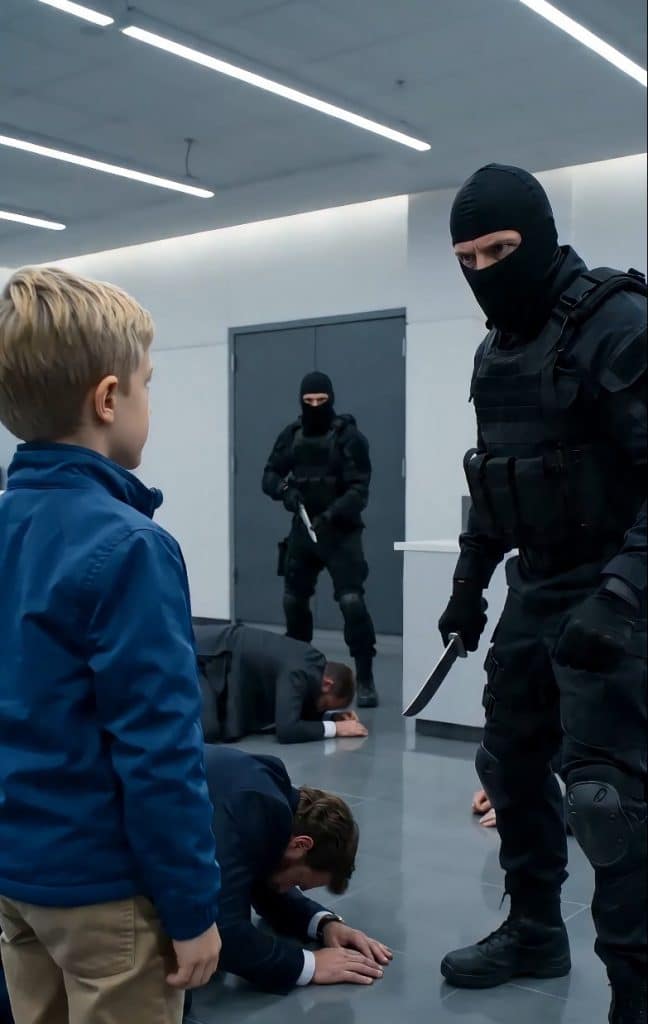
Polished gray floors reflected the ceiling lights, the marble counters, the glowing EXIT sign above the rear hallway, and the terrified bodies of men in expensive suits pressed flat against the floor. Phones lay abandoned beside trembling hands. A leather briefcase sat open near the customer desk, papers spilled across the tile like white flags.
Two masked men controlled the room.
Both wore black. Both had gloves. Both carried knives low enough for everyone to see.
The first robber moved like he owned the fear around him. Heavy boots struck the floor as he pointed from one hostage to another.
“KEEP YOUR HEADS DOWN!”
No one argued.
Not the bank manager.
Not the clients.
Not the security guard lying facedown near the glass doors, his radio kicked several feet away.
And then, in the middle of all that fear, a little boy stood up.
He was small, maybe seven years old, with blonde hair, blue eyes, a blue jacket, and tan khakis wrinkled from the floor. He rose slowly, not like he was panicking, not like he was confused.
Like he had been waiting for the right moment.
A man beside him hissed, “Kid, get down.”
But the boy did not move.
The first robber stopped.
For three seconds, the only sound was breathing.
The boy stood alone among the scattered hostages, his small shoes planted on the polished floor, his hands loose at his sides. Behind him, adults stared in horror, afraid that one wrong word would turn the room into something no one could undo.
The robber stepped toward him.
His knife stayed low, but his eyes sharpened through the black mask.
“You lost?” he growled.
The boy looked straight at him.
No tears.
No trembling.
No begging.
“You guys have to leave now,” he said. “I’m giving you a last warning.”
The words were so calm that they felt more frightening than a scream.
The second robber shifted near the counter. One hostage lifted his head just enough to stare. The bank manager’s face went pale.
The first robber gave a short, ugly laugh.
“A last warning?”
He leaned closer, towering over the boy.
“You think this is a game?”
The boy’s blue eyes did not leave his.
“No,” he said. “I think you came for Box 319.”
The robber froze.
The knife in his hand dipped half an inch.
The boy lowered his voice.
“And I think your name is Marcus Vane.”
That was when the entire room understood this was not a robbery.
It was an unfinished crime returning for the last witness.
Act II
Six hours earlier, Oliver Reed had asked his mother if banks were supposed to smell like rain.
His mother, Julia, had been too nervous to answer properly.
She had smoothed his blonde hair outside the glass doors of Meridian Trust and told him to stay close, hold her hand, and not speak unless someone spoke to him first. She said it gently, but Oliver heard the tightness behind her voice.
He always heard things adults tried to hide.
Meridian Trust was not a normal neighborhood bank. It handled private accounts, family estates, sealed trusts, and quiet inheritances belonging to people who did not like standing in line. Its lobby looked more like a museum than a place where money lived.
White walls. Gray floors. Soft chairs nobody sat in.
Everything clean enough to make a child feel guilty for breathing too loudly.
Julia Reed had not come for money.
She had come for a box.
Box 319.
For five years, she had fought for the right to open it. She had written letters, hired attorneys she could barely afford, and sat through meetings with men who smiled at her as if poverty made her confused.
They always said the same thing.
There was no box under her late husband’s name.
There were no remaining assets.
There was no evidence of wrongdoing.
Her husband, Caleb Reed, had been the head compliance officer at Meridian Trust. He was the kind of man who read bedtime stories with different voices and left notes in Oliver’s lunchbox even before Oliver knew how to read them.
Then he discovered something hidden inside the bank’s private accounts.
Within two weeks, he was accused of stealing client funds.
Within a month, he was dead.
The official story was simple. Caleb had been under pressure. Caleb had made bad choices. Caleb had run out of ways to hide them.
Julia never believed it.
Neither did Oliver.
He had been only two when his father died, but memory was strange with him. He remembered smells, sounds, fragments of voices. He remembered his father’s hand tapping three times on the kitchen table while he whispered to Julia, “If anything happens, look for the red folder.”
And he remembered another voice.
A man’s voice.
Smooth when it wanted to be.
Cruel when it forgot to pretend.
Marcus Vane.
Back then, Marcus had been Meridian Trust’s head of security operations. He was the man who appeared on television after Caleb’s death and called him “a troubled employee who betrayed the institution’s trust.”
He looked sorry when he said it.
Julia threw a mug at the screen.
For five years, the Reeds lived under the shadow of a lie. Julia cleaned offices at night, answered phones during the day, and kept Caleb’s photo on the kitchen shelf where Oliver could see it every morning.
Then, two months before the robbery, a retired bank clerk mailed Julia a key.
No return address.
No explanation.
Just a brass key, a faded access card, and a handwritten note:
Your husband told the truth. Box 319.
That was why Julia stood inside Meridian Trust that morning with Oliver beside her and a court order folded inside her purse.
The bank manager tried to delay them.
He said there had been a scheduling mistake. He said the vault records were old. He said senior authorization was required.
Julia did not raise her voice.
She simply placed the court order on his desk and said, “Then call someone senior.”
Oliver sat in the lobby and watched the EXIT sign glow red above the hallway.
He watched men in suits arrive.
He watched the manager whisper into a phone.
He watched one security camera swivel slightly toward his mother, then back toward the room.
And then he saw a man in a black mask step through the side entrance before the alarm ever sounded.
That was how Oliver knew.
They had not come to rob the bank.
They had come because his mother was finally close to opening the box.
And the boy had one more secret no one in that lobby knew.
Act III
The robbers moved too quickly for ordinary thieves.
They did not ask for wallets.
They did not demand account numbers.
They did not rush toward the teller drawers or the cash office.
The first one controlled the hostages while the second went straight behind the counter and forced the manager toward the private access hall. Every movement had purpose. Every command sounded rehearsed.
That was what terrified Julia most.
She was on the floor near a column, one hand stretched toward Oliver but not close enough to touch him. Her face was turned sideways against the cold tile, her eyes pleading with him to stay down.
Oliver saw her.
But he also saw Marcus Vane.
Not his face. The mask covered that.
His eyes.
Adults often forgot children noticed eyes.
Marcus had pale gray eyes with a small brown mark in the left one. Oliver remembered those eyes from a photograph his mother kept in a folder labeled Never Forget. He remembered them from the news. He remembered them from a nightmare he had before he knew what nightmares were.
The robber’s voice finished it.
“Keep your heads down.”
Same rhythm.
Same cold edge.
Same man.
So Oliver stood.
Not because he was brave in the way people later said he was.
He stood because all his life adults had told him to be quiet while men like Marcus spoke over the truth.
And he was tired.
When he said Box 319, Marcus forgot to breathe.
Only for a second.
But Oliver saw it.
“You don’t know what you’re talking about,” Marcus said.
His voice was lower now.
That frightened the room more than his shouting.
Oliver reached into the pocket of his blue jacket and pulled out a small folded photograph.
It had been tucked there since morning.
Julia had given it to him in the car because she said, “Your father should be with us today.”
In the picture, Caleb Reed stood in their old kitchen with baby Oliver in his arms. Behind him, reflected faintly in the dark window, was another man.
Marcus Vane.
Most people would not have noticed.
Caleb had.
On the back of the photo, in his father’s handwriting, were three words:
He was there.
Oliver held up the photograph with both hands.
“You came to our house the night before my dad died,” he said.
The second robber cursed under his breath.
Marcus did not turn around, but his shoulders tightened.
Julia squeezed her eyes shut, grief cutting across her face.
The bank manager whispered, “Dear God.”
That whisper told Oliver something important.
The manager knew too.
A man in a charcoal suit lying near the reception desk raised his head slightly. He had not screamed once. He had not begged. He had watched everything too carefully, like fear had not quite reached him.
Marcus noticed.
“Head down,” he snapped.
The man lowered his head again, but not before Oliver saw the small silver pin on his lapel.
His mother had pointed it out earlier.
Federal witness liaison.
That was the second secret.
Julia had not come to Meridian Trust alone. Not really.
The men in suits scattered across the lobby were not all clients. Some were attorneys. Some were investigators. Some were there because the court order for Box 319 had finally triggered a sealed inquiry into Caleb Reed’s death.
The box was bait.
But not the kind Marcus thought.
Oliver looked back at him.
“You’re too late,” he said.
Marcus’s eyes narrowed.
“What did you say?”
Oliver swallowed.
For the first time, his voice trembled.
“My dad made copies.”
The room went still.
The second robber stepped forward from the counter. “Marcus.”
The name slipped out before he could stop it.
Every hostage heard it.
Every hidden fear became fact.
Marcus turned his head slowly toward his partner, and that one mistake changed everything.
Because once the room heard the name, the mask stopped mattering.
Act IV
Marcus moved first.
Not toward the vault.
Toward Oliver.
Julia screamed his name, but the sound broke halfway out of her throat.
The man in the charcoal suit lifted himself from the floor just enough to speak.
“Vane. Stop.”
Marcus froze again.
It was not the voice of a hostage.
It was the voice of a man who had waited a long time to say those words.
The charcoal-suited man rose slowly with his hands visible, calm but firm. Two other men across the lobby shifted, no longer looking like helpless bankers but like people trained to survive the worst moment in a room.
Marcus looked from one face to another.
His plan was collapsing.
The bank manager began crying quietly.
“Please,” he whispered. “I did what you told me. I stalled her. I called the number. I did everything.”
Julia stared at him.
“You called them?”
The manager could not meet her eyes.
Marcus snarled, “Shut up.”
But the damage had already been done.
Oliver’s warning had not been a threat.
It had been an ending.
The man in the charcoal suit spoke again.
“The contents of Box 319 were removed under court supervision this morning before Mrs. Reed arrived. What you came for is already in federal custody.”
The second robber backed away from the counter.
“No,” Marcus said.
His voice cracked on the word.
For years, he had lived behind locked doors, legal language, and expensive suits. He had turned Caleb Reed into a cautionary tale. He had made Julia look unstable. He had built a life on the assumption that truth was helpless without money.
But truth had survived in a brass key.
In a court order.
In a photograph.
In a seven-year-old boy who remembered the sound of his voice.
The man in the charcoal suit reached into his jacket slowly and removed an envelope. He held it where everyone could see.
“Caleb Reed recorded everything,” he said. “The laundering. The forged reports. The threats. The transfer orders. Your name is on all of it.”
Marcus stared at the envelope like it was a weapon stronger than the knife in his hand.
Oliver looked at his mother.
She was crying now, but not the way she cried at home when she thought he was asleep. This was different. This was pain mixed with oxygen.
The kind a person breathes after being buried too long.
“You blamed him,” Julia said.
Her voice shook, but she lifted herself to her knees.
“You stood at my husband’s memorial and hugged me.”
Marcus said nothing.
The second robber dropped his knife first.
It struck the polished floor with a small, sharp sound.
That sound broke the spell.
The lobby doors opened. Officers entered with controlled urgency. The hostages were guided back, voices low, movements careful. No one rushed the boy. No one needed to.
Marcus remained still.
His eyes stayed locked on Oliver, and for one terrible second, everyone saw what he was most afraid of.
Not prison.
Not exposure.
A child who knew exactly what he had done.
Oliver lowered the photograph.
“My dad said bad men count on kids forgetting,” he said.
Marcus’s hands loosened.
The knife slipped from his grip and fell to the floor.
Oliver looked up at him one last time.
“I didn’t forget.”
And that was the moment Marcus Vane finally understood Caleb Reed had never been the only witness.
Act V
The story exploded by evening.
Not because of the robbery.
Because of the box.
Box 319 contained bank records, private account transfers, audio files, signed memos, and a red folder full of Caleb Reed’s handwritten notes. The evidence revealed that Meridian Trust had hidden illegal transactions for years through shell accounts belonging to clients powerful enough to expect silence.
Caleb discovered it.
Marcus Vane helped bury it.
The bank manager delayed Julia that morning because Marcus had ordered him to. The robbery was supposed to look desperate and random. The evidence was supposed to disappear in the confusion.
Instead, Marcus walked into a trap built by the man he had destroyed.
Caleb had known he might not live long enough to clear his name. So he hid the truth where the bank would never look honestly: inside its own vault, under an account linked to Oliver’s birth certificate.
He had not left his son money.
He had left him proof.
Weeks later, Julia stood in a federal courthouse holding Oliver’s hand while a judge formally cleared Caleb Reed’s name.
The words were dry and legal.
The effect was not.
Julia broke down before the judge finished speaking.
For five years, she had carried shame that did not belong to her. She had watched neighbors grow quiet when she passed. She had watched job offers disappear after background checks. She had watched her son come home from school asking why someone’s father had called Caleb a thief.
Now the record was corrected.
But grief did not vanish just because the truth arrived.
Oliver sat beside her in the hallway afterward, swinging his feet above the marble floor.
“You okay, Mom?” he asked.
Julia laughed through tears.
“I’m supposed to ask you that.”
He looked down at the photograph in his hands.
Caleb smiling.
Baby Oliver sleeping.
Marcus reflected in the window, trapped forever in the background of the lie.
“I was scared,” Oliver admitted.
Julia pulled him close immediately.
“I know.”
“Everyone keeps saying I was brave.”
“You were.”
He shook his head.
“I just wanted them to stop saying Dad did it.”
Julia held him tighter.
That was the part the news stories missed.
They called him the boy who faced the robbers. They played the lobby footage again and again, blurring faces, replaying the moment he stood up in his blue jacket as if courage were something clean and simple.
But Julia knew better.
A child should not have to stand in front of dangerous men to defend his father’s name.
A child should not have to carry the last honest memory in a room full of adults who lied.
So when reporters asked Oliver how he knew what to do, Julia ended the interview.
“He’s seven,” she said. “He doesn’t owe anyone a performance.”
The lawsuits followed.
The arrests followed.
Meridian Trust removed its name from the building within a month, as if changing the letters on the wall could erase what happened beneath them. It could not.
The lobby remained in the public memory exactly as it had been that day.
Bright lights.
Gray floors.
Men in suits lying still.
Two masked robbers.
And a boy standing upright beneath the EXIT sign, giving the guilty one last chance to run before the truth reached him.
Six months later, Julia took Oliver back to the old building.
It was no longer Meridian Trust. A new sign hung outside. The floors had been polished again. The counters had been replaced. The EXIT sign still glowed above the rear hallway.
Oliver stood in the center of the lobby and looked around.
No hostages.
No shouting.
No boots striking the floor.
Just quiet.
Julia knelt beside him.
“We don’t have to stay.”
Oliver reached into his jacket pocket and took out the photograph.
The corners were worn now.
He looked at his father’s face for a long time.
Then he walked to the wall near the entrance, where a small bronze plaque had been installed.
In memory of Caleb Reed, whose courage brought the truth to light.
Oliver touched the letters with two fingers.
“He would’ve liked that,” Julia said softly.
Oliver nodded.
Then, after a moment, he said, “They forgot something.”
Julia looked at him.
“What?”
Oliver slipped the photograph back into his pocket.
“He didn’t just bring the truth to light,” he said. “He left it for us.”
Julia could not speak.
Outside, traffic moved past the glass doors. People hurried through their ordinary lives, carrying coffee cups, phones, briefcases, and secrets of their own.
Inside, a boy in a blue jacket stood where fear had once tried to push him down.
He was not powerful because he had faced a robber.
He was powerful because he remembered what everyone else wanted buried.
And in the end, that was what Marcus Vane had never understood.
The truth did not need to shout.
Sometimes it waited quietly in a vault.
Sometimes it hid on the back of a photograph.
And sometimes it stood up in the middle of a bank robbery, looked a masked man in the eyes, and gave him one last warning before the whole room learned his name.