Act I
The first crack sounded like a gunshot.
Dust fell from the rafters in a pale cloud, drifting through the thin slice of daylight from the barn window. The old wooden floor bowed beneath the black-and-white dog’s paws, the boards bending as if the whole building had been waiting years for one final mistake.
“No,” the boy whispered.
Then the floor gave way.
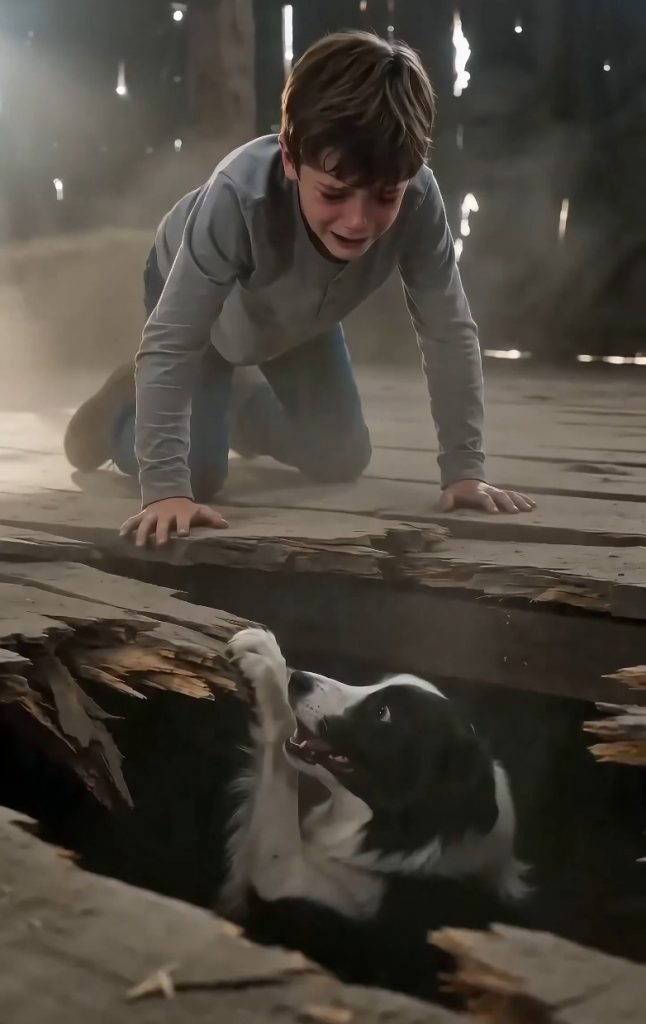
The Border Collie mix dropped hard through the broken planks, her back legs vanishing into the darkness beneath the barn. Her front paws caught the jagged edge, claws scraping desperately against splintered wood.
She yelped.
The boy lunged forward on his hands and knees.
“No!”
His name was Mason Reed, and at eleven years old, he had never known fear like this. Not when thunderstorms shook the windows. Not when his father raised his voice. Not even when his mother left and took only one suitcase, promising she would call when she was settled.
This was worse.
Because the dog was slipping.
And she was pregnant.
Her swollen belly pressed against the broken floorboards as she struggled to pull herself up. Her ears pinned back. Her eyes locked on Mason’s, wide and terrified, as if she understood he was the only one who cared whether she lived.
“Hold on!” Mason sobbed. “Don’t let go!”
He stretched his arm toward her.
His fingers reached across the gap, trembling, but the edge cracked beneath his weight. A thin plank snapped loose and tumbled into the black space below.
Mason froze.
The hole was deeper than he thought.
Too deep.
The dog whimpered, claws skidding.
“Molly, please,” he cried. “Please.”
He had found her three weeks earlier behind the feed store, soaked from rain and too tired to run. Everyone told him not to name her. His father said stray dogs brought trouble. The neighbors said a pregnant dog meant vet bills and mess and pups nobody wanted.
But Mason had named her anyway.
Molly.
Because she looked at him like she still believed someone might be kind.
Now the barn shuddered around them.
Another board groaned.
The dog slipped half an inch lower.
Then heavy boots struck the floor behind Mason.
A deep voice shouted, “Hold on. I’ve got you both.”
Mason turned through tears.
A man rushed into the dusty light, his face hidden above the frame of Mason’s fear. All Mason saw were worn brown work boots, olive-drab pants, and weathered hands already reaching toward the broken floor.
Hope hit the boy so hard he almost collapsed.
But when the man stepped closer, the board beneath his boot split.
He stopped dead.
And the hole widened.
Act II
The barn had been unsafe long before Mason entered it.
Everyone knew that.
The old Granger barn sat at the edge of a field no one planted anymore, gray and leaning, with missing shingles and doors that hung crooked in the wind. Kids from town said it was haunted. Adults said it should have been torn down years ago.
Mason knew he was not supposed to go there.
But Molly had run inside.
That morning, his father had found her curled beneath the back porch.
For three weeks, Mason had hidden food in his coat pockets and slipped out before school to feed her. He made a bed for her out of old towels behind the shed. He whispered to her when the house felt too quiet.
Molly was the first living thing in months that seemed happier when Mason came near.
Then his father saw her.
“Absolutely not,” Frank Reed said, standing in the yard with a coffee mug in one hand and work keys in the other. “We are not keeping a stray.”
“She doesn’t have anywhere to go.”
“That is not our problem.”
Mason hated that sentence.
Adults used it when they wanted to sound practical instead of cruel.
“She’s having puppies,” Mason said.
Frank looked at the dog’s swollen belly and sighed, already exhausted by the cost of compassion. “Then she needs a shelter.”
“There isn’t room. I called.”
“You called?”
Mason looked down.
Frank rubbed his forehead. “Mason, you can’t just decide things like this.”
But Mason had already decided.
Because Molly was not the only one who had been left behind.
After his mother left, people spoke around him like he was furniture. They said words like separation, custody, financial pressure, better in the long run. They never said lonely. They never said abandoned.
Molly understood lonely.
That was enough.
When Frank stepped toward her with a rope leash, Molly panicked. She darted past the shed, across the yard, through the broken fence, and toward the abandoned field.
Mason ran after her.
“Molly! Wait!”
The dog did not stop until she reached the Granger barn.
She slipped through the half-open door.
Mason followed without thinking.
Inside, everything smelled of old hay, dust, and rot. Light cut through holes in the walls. The floor shifted under every step.
Mason found Molly near the center of the barn, panting hard, scared by her own mistake.
“It’s okay,” he whispered. “I’m not letting him take you.”
He stepped closer.
Molly took one frightened step back.
The board beneath her cracked.
Then everything broke.
Act III
The rescuer did not rush again.
That terrified Mason more than anything.
The man had run in like he could fix the world with his hands, but now he stood perfectly still, looking at the floor the way people look at thin ice.
“Don’t move,” he said.
Mason sobbed. “She’s falling!”
“I know.”
“Then help her!”
“I will,” the man said, voice steady. “But if I step wrong, all three of us go down.”
The words hit Mason like cold water.
All three of us.
Until then, he had only feared for Molly.
Now he felt the floor beneath his own knees shifting, bowing, complaining. The broken edge was not stable. It was a mouth, chewing through the boards one splinter at a time.
Molly whimpered again.
Mason turned back to her. “I’m here. I’m here.”
The man lowered himself slowly, spreading his weight across two stronger beams. His hands were large and scarred, the hands of someone who had fixed fences, hauled lumber, carried things too heavy for most people.
“Boy,” he said, “what’s your name?”
“Mason.”
“Mason, I need you to listen to me exactly.”
Mason nodded, crying too hard to speak.
“Do not grab her paws. If you pull wrong, the edge will break. I need something long. Rope, chain, board, anything.”
Mason looked around wildly.
The barn was full of useless things. Rusted tools. Old buckets. A broken ladder hanging from hooks. A coil of rope near the wall.
“There!” Mason shouted.
The man followed his gaze.
The rope was fifteen feet away.
Across unstable floor.
The rescuer’s jaw tightened.
Then another voice called from the barn door.
“Mason!”
Frank Reed stood in the entrance, breathless, face pale.
For a second, Mason felt relief.
Then shame.
Then anger.
If Frank had not tried to take Molly away, she would never have run.
Frank stepped forward.
The floor groaned under his boot.
“Stop!” the rescuer shouted.
Frank froze.
His eyes dropped to the hole, then to the dog hanging over it, then to his son kneeling too close to the edge.
“Mason,” he said, voice breaking. “Back away.”
“I can’t!”
“Yes, you can.”
“No!” Mason screamed. “She’ll fall!”
Frank looked helplessly toward the rescuer.
The man pointed to the rope. “Get that. Stay on the side beams. Do not cross the center boards.”
Frank moved carefully, every step slow now. The barn creaked around him like it resented being trusted.
Mason watched his father reach the wall and grab the coil.
Then Molly slipped lower.
Her front legs shook.
Her claws left thin white scars in the wood.
Mason forgot every warning.
He lunged.
The floor beneath him split.
Act IV
The rescuer caught Mason by the back of his shirt just before the boy slid into the hole.
Mason screamed, not from pain, but from terror.
The broken plank under his chest tilted downward. Dust burst into the air. Somewhere below, wood struck something deep and echoed.
Frank shouted his son’s name.
The rescuer hauled Mason back with one arm, dragging him onto a safer board.
“Do not do that again,” he said, voice harsh now.
Mason shook uncontrollably. “I almost had her.”
“You almost went with her.”
The words silenced him.
Frank crawled closer with the rope, keeping low, his face wet with sweat and fear.
“Mason,” he said, “I’m sorry.”
Mason looked at him through tears.
Not now, he wanted to say.
Not when Molly was hanging over nothing.
But Frank’s apology came out like something had cracked in him too.
“I thought I was being responsible,” Frank said. “I didn’t see what she meant to you.”
Mason’s lips trembled.
“She needs us.”
Frank looked at Molly.
For the first time, he did not see trouble.
He saw a frightened animal carrying life inside her, clinging to a broken edge because a boy had cared enough to follow.
“Yes,” Frank said quietly. “She does.”
The rescuer took the rope and tied a quick loop with practiced hands.
Mason stared. “Can you get it around her?”
“I can try.”
Molly’s whimper turned weaker.
The rescuer stretched out on his stomach, distributing his weight across the boards. Frank held the back of his belt with both hands. Mason crawled beside them, staying where the rescuer pointed.
“Talk to her,” the man said.
Mason wiped his face with his sleeve. “Molly. Hey, Molly. Look at me.”
The dog’s eyes found him.
“That’s it,” Mason whispered. “You’re a good girl. You’re so good. Just hold on a little longer.”
The rescuer reached down with the rope loop.
The first attempt missed.
Molly panicked, paws scraping, belly pressing harder against the edge.
“Easy,” the rescuer murmured. “Easy.”
The second attempt caught under one front leg but slipped free.
The floor cracked again.
Frank cursed under his breath.
Mason began to sob harder.
The rescuer did not look away from the dog.
“One more,” he said.
He reached farther than before.
Too far.
The board beneath his shoulder snapped.
Frank pulled back with everything he had, keeping the man from dropping forward. Mason grabbed the rescuer’s coat, small hands useless but determined.
The loop slid over Molly’s chest.
“Got her,” the rescuer said.
Then the edge broke.
Act V
For one terrible second, Molly vanished.
Mason screamed.
Frank shouted.
The rope snapped tight, burning through the rescuer’s gloves as the dog’s full weight dropped into the darkness. The barn shook with the force of it.
But the rope held.
Molly swung against the side of the opening, yelping and scrambling.
“Pull!” the rescuer shouted.
Frank pulled.
Mason pulled too, wrapping the rope around both fists even though it hurt. The rescuer braced his boots against a beam and hauled with slow, brutal effort.
Inch by inch, Molly rose.
First her head.
Then her shoulders.
Then her swollen belly, scraping carefully over the broken edge as the rescuer reached down and guided her up.
At last, she collapsed onto the floorboards, shaking and panting.
Mason threw himself toward her, but the rescuer grabbed him again.
“Careful,” he warned. “Back. Everyone back.”
They moved together, dragging and guiding Molly across the safer beams toward the barn door.
The moment they reached solid ground outside, Mason fell beside her in the grass.
Molly laid her head in his lap.
She was trembling.
So was he.
Frank dropped to his knees nearby and covered his face with both hands.
The rescuer stepped into the daylight last.
For the first time, Mason saw him clearly.
He was older than Mason expected, with gray in his beard and dust in every crease of his face. His left sleeve was torn. His hands were scraped raw from the rope.
Frank looked up at him. “You saved my son.”
The man shook his head. “Your son saved the dog first. I just got there before the barn finished falling.”
Mason stroked Molly’s damp fur. “Is she going to be okay?”
The rescuer knelt and checked her gently.
“She needs a vet. Soon.”
Frank stood immediately. “My truck.”
Mason looked up, startled.
Frank met his eyes.
“We’re taking her.”
“To the shelter?” Mason asked, voice small.
Frank swallowed.
“No. To the vet.”
Mason stared at him.
“And after?”
Frank looked at Molly, then at his son, and something in his face softened in a way Mason had not seen for a long time.
“After, we bring her home.”
Mason broke.
He leaned over Molly and cried into her fur, one hand pressed carefully against her side as if he could protect every tiny heartbeat hidden there.
The vet said Molly was bruised and exhausted, but safe.
The puppies were safe too.
Six of them arrived nine days later in a clean bed in the Reed laundry room, while Mason sat on the floor with a flashlight and whispered encouragement like a boy who had already learned that love was not proven by easy moments.
Frank stayed beside him the whole night.
He brought towels. He called the vet twice. He made coffee and forgot to drink it. Once, when he thought Mason was not looking, he touched Molly’s head and whispered, “You scared us, girl.”
Us.
Mason heard that word and held it close.
The old Granger barn was torn down two weeks later.
Before the demolition crew arrived, Frank drove Mason out to the field. Together, they stood at the edge of the property and looked at the sagging gray structure.
Mason shivered.
“I thought she was gone,” he said.
Frank put a hand on his shoulder.
“I thought I was going to lose you.”
Mason looked down.
Frank’s voice roughened. “I’ve been so busy trying to keep life under control that I forgot you were hurting too.”
The wind moved through the tall grass.
Mason leaned against him.
Frank wrapped an arm around his son and held on.
No speech fixed everything. No apology erased the loneliness of the past year. But something had shifted in the dust and danger of that barn.
Frank had seen Mason’s heart clearly.
Mason had seen his father afraid enough to change.
Months later, the Reeds had seven dogs.
Only three puppies stayed, technically.
The rest went to families Mason personally inspected with the seriousness of a judge. But Molly remained, sleeping by Mason’s bed, following him to the mailbox, watching Frank from the porch as if still deciding whether he deserved forgiveness.
Frank worked for it.
He built a fenced run behind the house. He learned the puppies’ names. He stopped saying things were “not our problem” when Mason brought home wounded birds, lost cats, or classmates who needed a place to wait after school.
One evening, as the sun set over the field, the rescuer came by to check on Molly.
His name was Caleb Mercer. He owned the next farm over and had heard Mason screaming that day while repairing a fence.
Mason brought out the smallest puppy, a black-and-white female with one brown ear.
Caleb held her gently in his weathered hands.
“What’s this one called?” he asked.
Mason smiled.
“Hope.”
Caleb looked toward Frank, then back at Mason.
“Good name.”
Behind them, Molly lay on the porch with her head on her paws, watching her puppies tumble through the grass.
The barn was gone now.
The hole was filled.
But Mason never forgot the sound of that floor breaking, or the sight of Molly’s paws clinging to the edge, or the moment help arrived in worn brown boots and refused to give up.
Because sometimes a rescue is not just about pulling someone out of the dark.
Sometimes it is about what happens after.
The hands that learn to hold softer.
The home that opens wider.
The boy who discovers his love was never foolish.
And the father who finally understands that saving one frightened dog can save a family too.