Act I
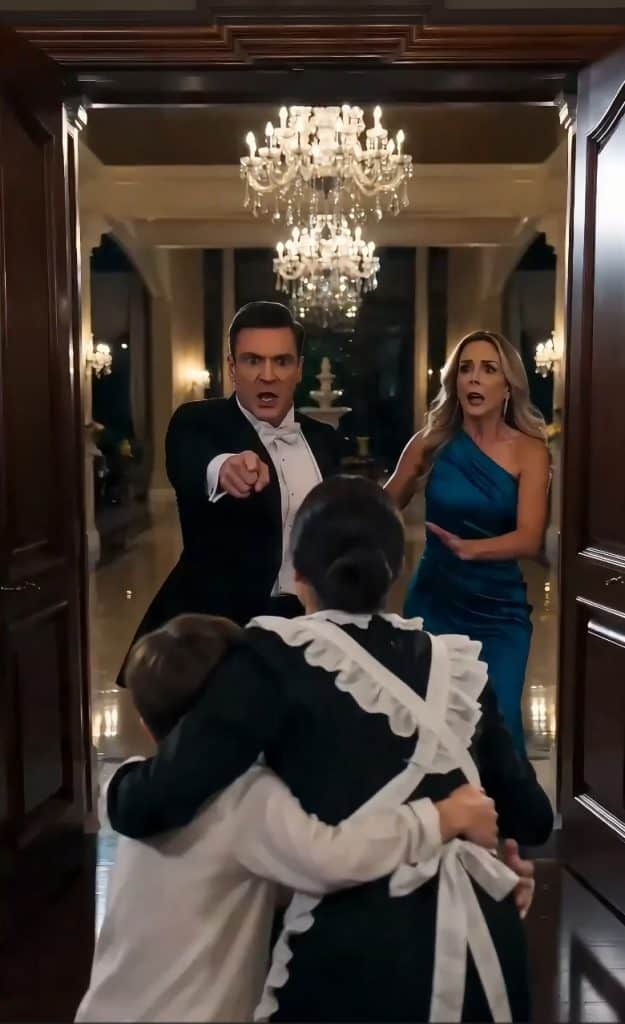
The first sound Andrew heard was not the chandelier humming above the grand hallway.
It was his sons crying.
Not whining. Not fussing. Crying the way children cry when something inside them has cracked open and they no longer care who sees it.
Andrew Blackwell came through the polished wooden double doors in a tuxedo, his jaw clenched, his footsteps hard enough to echo beneath the crystal lights. He had left a charity dinner downstairs after one of the house staff whispered that the boys were missing from the nursery.
He expected a tantrum.
He expected spilled juice, broken toys, maybe another fight over bedtime.
He did not expect to find his six-year-old twin sons clinging to the maid like she was the only safe thing left in the world.
They were pressed against her chest in matching white pajamas, their small bodies shaking. One boy had buried his face in her shoulder. The other had both fists wrapped in the edge of her apron, refusing to let go.
And the maid was crying too.
Her dark hair had loosened from its neat bun. Her black uniform was wrinkled where the boys clutched her. Tears streaked down her flushed face as she held them with a desperation Andrew had never seen from an employee.
Not polite comfort.
Not professional concern.
Maternal grief.
Something cold moved through him.
“Why are my sons calling you mommy?!” Andrew’s voice tore through the hallway.
The maid froze.
The boys screamed harder.
Behind Andrew, Celeste Vale swept in wearing a cobalt blue silk gown, one hand lightly gripping his arm as if she already knew where the scene might go and intended to pull it back under control.
“Andrew, please,” she said quickly. “She’s been filling their heads with nonsense. She’s just a maid.”
The words hit the young woman like a slap.
She lowered her eyes, but she did not release the children.
One of the twins turned his tear-wet face toward Andrew. His little mouth trembled as he tried to speak over his sobs.
“No!” he cried. “She’s more like mommy! She sings us the same song!”
Andrew went still.
Celeste’s fingers tightened around his sleeve.
The maid’s hand trembled near the boy’s cheek, gentle and protective, as if she wanted to silence him and comfort him at the same time.
Andrew stared at her.
“What song?”
The maid’s lips parted.
Her face folded with guilt, fear, and something older than both.
“I shouldn’t have come inside,” she whispered. “I only wanted…”
She stopped.
But the unfinished sentence was enough to change the air.
Because Andrew knew that look.
He had seen it once before, six years ago, outside a hospital room where someone had told him his wife was gone.
And suddenly, the maid did not look like a stranger anymore.
Act II
Before the mansion became a place of locked doors and polished silence, it had been loud with music.
Andrew’s first wife, Elise, had loved that hallway. She used to walk barefoot across the wooden floor at midnight, humming to herself while the chandelier threw soft light over her dark hair. She hated formal things, hated the cold way wealth made people speak, hated how Andrew’s family treated every feeling like an inconvenience.
“You live in a museum,” she once told him, standing beneath that same chandelier with paint on her sleeve from decorating the nursery. “I’m going to make it a home whether your ancestors like it or not.”
Andrew had loved her for that.
Elise was not from his world. She was a music teacher’s daughter, warm and stubborn and brave enough to laugh at people who expected her to be intimidated. She brought wildflowers into silver vases. She sang while cooking. She learned the staff’s birthdays and wrote thank-you notes by hand.
Then she became pregnant with twins.
For a few months, the mansion truly changed.
Andrew remembered Elise sitting near the nursery window, one hand on her stomach, singing the same lullaby every night. It was an old melody her mother had taught her, soft and haunting, with words in a language Andrew never learned properly.
He only knew the sound.
The boys seemed to know it too before they were born. Whenever Elise sang, they settled.
Then came the storm.
A winter night. A dangerous delivery. Doctors moving too quickly. Andrew in a waiting room with his tuxedo shirt half untucked because he had rushed from a board event without changing.
Celeste had been there.
Back then, she was Elise’s closest friend.
Beautiful, composed, useful in every crisis. She handled the calls. She spoke with the doctors. She told Andrew to sit down when his legs failed him. She was the one who eventually came into the waiting room with tears in her eyes and said the sentence that ended his world.
“Elise didn’t make it.”
The twins survived.
Elise did not.
Andrew barely remembered the weeks that followed. The funeral. The condolences. The babies crying in separate bassinets. The house sinking back into silence without the one person who knew how to fill it.
Celeste stayed.
At first, Andrew was grateful. She helped with the boys. She organized nurses. She managed the household when grief made him useless. She became indispensable so slowly that no one noticed when kindness turned into control.
By the time the twins were three, she had moved into the east wing.
By the time they were five, society pages were calling her Andrew’s inevitable second wife.
Andrew did not love her the way he had loved Elise.
But he was tired.
And tired men often mistake order for peace.
Celeste gave him order.
The boys gave him distance.
That was the part no one said aloud.
Oliver and Noah loved their father, but they did not run to him when frightened. They did not climb into his lap unless invited. They had learned early that their father’s grief lived behind glass, visible but unreachable.
Then the new maid arrived.
Her name was Mara.
At least, that was the name on the agency file.
She was quiet, efficient, and almost painfully careful. She kept her dark hair pinned low, her eyes down, her answers respectful. Celeste disliked her immediately.
“She watches the boys too closely,” Celeste said after the first week.
Andrew barely looked up from his papers. “She’s assigned to the nursery floor.”
“I mean emotionally.”
That made him glance up.
Celeste gave a thin smile. “Some women see rich children and start imagining themselves part of the family.”
Andrew dismissed it as snobbery.
But the boys changed.
They stopped waking from nightmares as often. They began eating breakfast without arguments. They hummed in the garden. Noah, who had refused to sleep unless every closet door was shut, started asking if Mara could say goodnight.
Then, one evening, Andrew passed the nursery and heard singing.
He stopped.
The melody drifted through the half-open door, soft as breath.
An old lullaby.
Elise’s lullaby.
Andrew stood frozen in the hallway until Celeste appeared behind him and quietly shut the door.
“She must have heard it from the boys,” Celeste said.
But the boys had been infants when Elise died.
And Andrew had never sung it once.
Act III
The night of the charity dinner was supposed to announce Andrew and Celeste’s engagement.
The mansion was full of guests downstairs, champagne glasses, string music, and women in satin gowns speaking in polished voices. Celeste had chosen everything, from the flowers to the photographers to the exact moment Andrew would make the announcement.
But upstairs, Oliver had found something in Mara’s room.
A small silver locket.
Inside was a faded photograph of a young woman with dark hair, laughing beneath a tree. Beside her stood Elise.
The boys knew their mother from portraits. They knew her face from the painting in Andrew’s study, from framed photographs Celeste rarely allowed them to touch.
So when Oliver saw the picture, he ran to Noah.
Noah ran to Mara.
And Mara broke.
She tried to take the locket back gently, but the boys demanded answers with the terrible innocence of children who do not understand why adults build walls around truth.
“You knew Mommy?” Oliver asked.
Mara covered her mouth.
Noah looked at the photograph again. “Daddy said Mommy had no family.”
That was when Mara began to cry.
Because Elise had family.
A younger sister.
One Andrew had been told was unstable, estranged, and too bitter to attend the funeral.
Her name was Mariana Reyes.
Mara.
She had not been at the funeral because Celeste had kept her away.
Six years earlier, Mariana had been twenty-four, working two jobs and living in a rented room across town. Elise had called her every week during the pregnancy. They had fought sometimes, the way sisters do, but they loved each other fiercely.
The night Elise went into labor, Mariana arrived at the hospital soaked from the rain, only to be stopped by Celeste in the corridor.
“You can’t see her,” Celeste said.
“She’s my sister.”
“She doesn’t need chaos right now.”
Mariana pushed past her anyway.
What happened after that became a blur of security guards, hospital staff, and Celeste’s voice turning cold.
By morning, Elise was dead.
By afternoon, Celeste told Andrew that Mariana had caused a scene, tried to exploit the tragedy, and disappeared after being removed.
Then she told Mariana a different story.
Andrew blamed her. Andrew never wanted her near the children. Andrew had signed instructions barring her from the estate.
Mariana, grieving and poor and terrified of powerful people, believed enough of it to stay away.
Until she received the letter.
It came six years later, with no return address.
Inside was a copy of a hospital visitor log and one sentence written on plain white paper.
Ask Celeste why your sister’s final letter was never delivered.
Mariana spent two months trying to uncover the truth.
Then she applied to work at Blackwell House under the shortened name Mara.
She did not come for money.
She did not come for revenge.
She came because she wanted to see Elise’s children once before Celeste became their legal mother.
That was all.
One glimpse.
One goodbye.
But children have a way of recognizing love before adults recognize truth.
The boys found her gentleness before they knew her name. They found safety in the way she tucked blankets beneath their chins, the way she remembered which twin hated peas, the way she never confused Oliver’s quiet fear with Noah’s louder anger.
And one night, when Noah cried for a mother he did not remember, Mara made the mistake that led them all to this hallway.
She sang Elise’s song.
The same song.
The one their mother had sung before they were born.
Now Andrew stood beneath the chandelier with his sons crying, his fiancée shaking with rage, and a maid who was no maid at all trembling in front of him.
“I only wanted to know them,” Mara whispered.
Celeste’s face went white.
Andrew turned toward her.
And for the first time in six years, Celeste looked afraid.
Act IV
“Who is she?” Andrew asked.
Celeste’s mouth tightened. “A liar.”
Mara flinched, but Oliver clung harder to her apron.
Andrew did not look away from Celeste. “I asked who she is.”
Celeste laughed once, brittle and sharp. “This is exactly what I warned you about. She has manipulated the children. She found an old song, some photograph, and now she’s performing grief in a uniform.”
Mara shook her head. “No.”
“Be quiet,” Celeste snapped.
The boys recoiled.
Andrew saw it.
That small movement did more than any confession could have.
His sons were not shocked by Celeste’s tone. They were used to it.
His voice dropped. “Do not speak to her like that.”
Celeste stared at him, stunned. “Andrew.”
He held out his hand toward Mara. “The locket.”
Mara hesitated, then placed it in his palm.
The silver was worn at the edges. Inside, Elise smiled from a life before the mansion swallowed her. Beside her was the same woman standing in front of him, younger in the photo, but unmistakable.
Andrew felt the floor tilt.
“Elise told me she had a sister named Mariana,” he said slowly. “Celeste said you refused to come to the funeral.”
Mara’s face crumpled. “I stood outside the gates for two hours. Security said I was on a restricted list.”
Andrew turned his head.
Celeste’s breathing changed.
“Restricted by whom?” he asked.
No answer.
The silence was loud enough.
Mara wiped her cheeks with shaking fingers. “I have Elise’s emails. The ones she sent me before the birth. She said she wanted me in the room if anything went wrong. She said…” Her voice broke. “She said if she didn’t make it, the boys should know my voice.”
Andrew closed his eyes.
The lullaby.
The song was not an accident.
It was inheritance.
Celeste moved quickly now, desperation sharpening her elegance into something ugly.
“She was unstable,” she said. “Elise pitied her. You were grieving. I protected you.”
“From my wife’s sister?”
“From a woman who would have used the children to get into this house.”
Mara looked at her through tears. “You mean like you did?”
The hallway went dead silent.
Celeste’s face twisted. “You little servant—”
“I said enough,” Andrew thundered.
The chandelier seemed to tremble with the force of his voice.
Downstairs, faint music continued for people who had no idea the future of the household was collapsing above them.
Andrew stepped closer to Celeste.
“Did Elise write me a letter?”
Celeste’s eyes flickered.
There it was.
The answer before the lie.
Andrew’s voice became dangerously calm. “Did my wife leave me something that you hid?”
Celeste’s mask cracked.
“She was dying,” she whispered. “She was emotional. She didn’t know what she was asking.”
“What did she ask?”
Celeste’s jaw worked.
“What did she ask?” Andrew demanded.
Celeste looked toward the boys, then at Mara, then finally at Andrew.
“She asked you to bring Mariana home,” she said, the words bitter with six years of resentment. “She asked you to raise those boys with her sister in their lives. She said Mariana would know the songs, the stories, the pieces of her that you wouldn’t.”
Mara covered her mouth.
Andrew went pale.
Celeste’s eyes filled, but there was no softness in them. Only fury at a plan failing after years of careful work.
“I was there,” she hissed. “I was the one holding everything together while you fell apart. I managed the nurses, the household, the funeral, the babies. And in her final minutes, Elise still chose her. A girl with nothing.”
Andrew stared at the woman he had nearly married.
The woman who had stood beside him at his wife’s funeral.
The woman who had built herself into the empty space grief left behind.
“You erased her,” he said.
Celeste lifted her chin. “I protected this family.”
“No,” Andrew said. “You stole it.”
The words struck like a verdict.
Mara began to sob quietly, one hand over her mouth, the boys pressed to her sides. Andrew looked at them, really looked, and finally saw what he had ignored for too long.
His sons had not been confused.
They had been starving for the part of their mother that someone had locked outside the gates.
Act V
Andrew canceled the announcement before midnight.
He did it in the ballroom, in front of donors, board members, old family friends, and every person Celeste had invited to witness her triumph.
There was no dramatic speech.
No public disgrace for entertainment.
Only Andrew standing at the foot of the grand staircase, his tuxedo still perfect, his face changed forever.
“The engagement will not take place,” he said. “Thank you for coming. My staff will see you out.”
Celeste did not appear beside him.
She was upstairs in the blue gown she had chosen for victory, watching two security guards remove her personal files from the east wing under Andrew’s orders. By morning, his lawyers would begin reviewing every document she had touched since Elise’s death.
By morning, the hospital records would be requested.
By morning, the lie would finally have enemies.
But that night belonged to two little boys and the woman who had lost six years to someone else’s ambition.
Mara sat in the nursery on the edge of the rug while Oliver and Noah leaned against her, exhausted from crying. Andrew stood in the doorway for a long time before stepping inside.
He had been afraid to enter.
Not because of Mara.
Because of himself.
The room was filled with evidence of all the years he had missed while standing in the same house. Tiny books on shelves. Two wooden horses by the window. A nightlight shaped like a moon. Drawings taped near the bed, some of him, many of Celeste, and one new one of Mara with yellow lines around her like sunlight.
Andrew looked at it until his vision blurred.
“I didn’t know,” he said.
Mara did not answer right away.
That hurt more than anger.
Finally, she looked up. “I know.”
He almost wished she had accused him.
Instead, she gave him the mercy he did not deserve.
Andrew knelt on the rug, still in his tuxedo, bringing himself down to his sons’ level.
Oliver watched him warily.
Noah held Mara’s hand.
Andrew swallowed hard. “Did Miss Mara make you feel safe?”
Noah nodded.
Oliver whispered, “She sings Mommy’s song.”
Andrew’s chest tightened.
“I know,” he said. “I should have known sooner.”
Mara’s eyes filled again. “Elise wanted them to have it.”
Andrew looked at her. “Then they will.”
The boys glanced between them, too young to understand legal battles, forged decisions, withheld letters, and adult grief. But they understood tone. They understood safety. They understood that no one was trying to pull them away anymore.
Andrew drew a breath.
“Mariana,” he said, using her full name carefully, like returning something stolen. “I can’t give you back the years.”
Mara lowered her gaze.
“But I can stop taking more from you.”
Her face trembled.
“You don’t have to stay as staff,” he continued. “You never should have had to enter this house that way. You are their aunt. You are Elise’s sister. If you want a place in their lives, it will be as family.”
The room went quiet.
Mara looked at the boys.
Oliver whispered, “Can she stay?”
Andrew’s answer came immediately.
“Yes.”
Noah’s little face crumpled with relief.
He climbed into Andrew’s arms for the first time in months without being asked. Oliver followed a second later, still holding Mara’s hand, forcing the four of them into an awkward, tearful circle on the nursery rug.
Andrew held his sons and looked over their heads at Mara.
For the first time, he understood that Elise had not left him only grief.
She had left a map.
He had simply trusted the wrong person to read it.
Later, when the boys were tucked into bed, Mara stood near the door and began the lullaby softly.
Andrew stayed in the chair by the window.
He did not understand every word.
But he understood the ache of it now.
He understood why the boys had heard that song and reached for her. He understood why their little hearts had called her mommy before their minds had language for aunt, memory, blood, or grief.
It was not betrayal.
It was recognition.
Down the hall, Celeste’s rooms were dark for the first time in years.
The mansion felt different without her footsteps controlling its silence.
Near midnight, Andrew went to his study and opened the portrait of Elise that had hung above the fireplace since the funeral. Behind it, tucked into the frame where no one had thought to look, he found a sealed envelope.
His name was written across the front in Elise’s hand.
Andrew sat down before opening it.
He read only the first line before tears blurred the ink.
If you are reading this, love, then I need you to be braver than grief.
For six years, the mansion had been full of ghosts.
That night, for the first time, one of them sounded like a lullaby.