Act I
Richard Vale had hosted senators, investors, ambassadors, and men who believed money made them untouchable.
But nothing had ever made his house feel as cold as the sight of his daughter staring at a small bottle in a woman’s coat pocket.
The mansion foyer was bright with morning light. White marble pillars rose to the ceiling. The floor shone so cleanly it reflected the three of them like ghosts. Behind them, a round table waited beneath a white cloth, arranged with fine china, silver serving tongs, pastries, and untouched tea.
It should have looked elegant.
Instead, it looked like a stage built around a secret.
Richard knelt beside his daughter’s wheelchair and held her hand. His black suit was still crisp from the charity breakfast upstairs, but his face had hardened into something no guest had ever seen.
Across the marble floor stood Vanessa Cross.
Tall. Beautiful. Perfectly dressed.
Her olive-green trench coat fell smoothly over a black dress, and her long brown hair framed a face that had fooled half the city for two years. She had one hand buried in her pocket, but the shape inside the fabric had already betrayed her.
A small bottle.
Richard pointed toward it without taking his eyes off his daughter.
“Don’t move,” he said quietly.
Vanessa froze.
The words were not loud. They did not need to be. Richard’s voice had the calm of a man holding himself together for the sake of a child.
He turned slightly toward the little girl in the wheelchair.
“Sweetheart,” he said, softer now, “look at that little bottle in her pocket. Have you seen it before?”
His daughter’s name was Sophie.
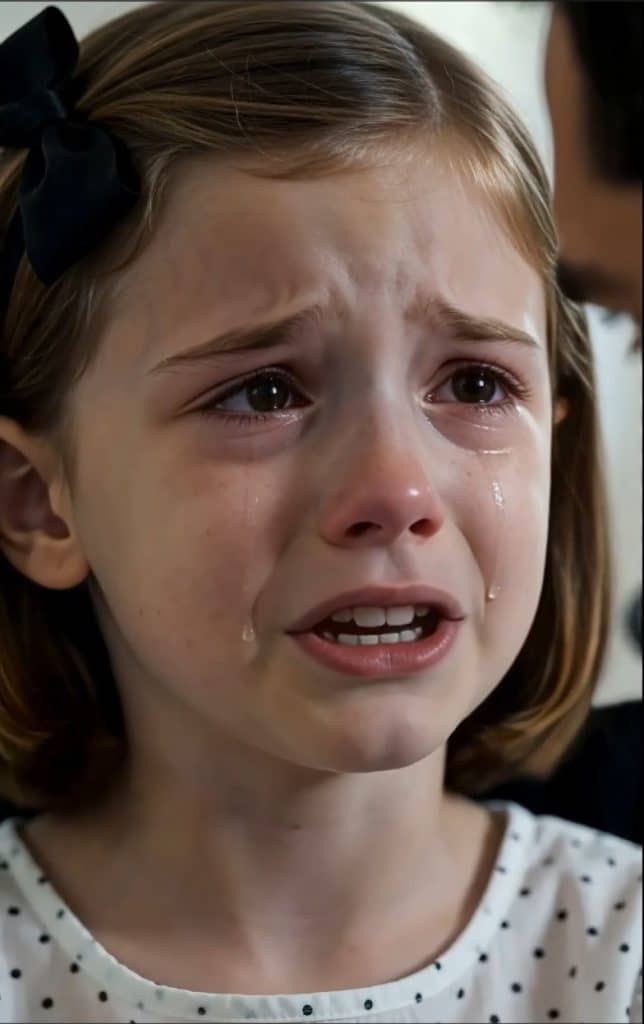
She was eight years old, with short brown hair clipped back by a black bow and a white dress covered in tiny black polka dots. Her legs rested under a soft blanket. Her hands were curled against the wheelchair armrests, small knuckles pale from fear.
For months, doctors had used words Richard hated.
Unexplained weakness.
Stress response.
Possible neurological decline.
Sophie had stopped walking after a fall down the rear staircase. Vanessa had been the only adult nearby when it happened. She said Sophie slipped. She said she had screamed for help. She said Richard should be grateful she was there.
And he had been.
God help him, he had been.
Sophie looked at the pocket.
Her lip trembled.
Vanessa spoke too fast. “Richard, she’s tired. You’re upsetting her.”
Richard did not look away from Sophie.
“Answer me, honey.”
The foyer seemed to grow larger around them.
Sophie lowered her head.
“She told me it was a secret game.”
Richard’s jaw tightened.
Vanessa inhaled sharply.
“What game?” Richard asked.
Sophie’s eyes filled with tears. She looked not at Vanessa, but at her father, as if the truth might hurt him more than it hurt her.
“She said if I didn’t drink it,” Sophie whispered, “you would never love me again.”
For one second, Richard did not move.
Then he stood.
Slowly.
The movement changed the room. The kneeling father became the man everyone feared disappointing. The man who could close companies with one call. The man who had spent months blaming himself for not seeing what was happening inside his own home.
Vanessa turned fully toward him.
“Richard, please,” she said, raising both hands. “It’s not what it looks like.”
Richard stepped closer.
The marble gave one sharp sound under his shoe.
Vanessa’s eyes darted toward the staircase, then toward the front doors, then back to him.
That was when Richard understood she was not shocked.
She was calculating exits.
He looked at the woman who had slept under his roof, eaten at his table, kissed his daughter’s forehead in front of guests, and whispered fear into a child when no one was watching.
His voice dropped.
“You’re done.”
Vanessa went still.
But Richard had not yet seen what was hidden beneath the label on the bottle.
Act II
Six months earlier, Richard believed he had found mercy in Vanessa Cross.
He had not been looking for love. Not really.
After his wife, Elise, died, the mansion became too large for two people. Rooms stayed closed. Piano keys gathered dust. Sophie stopped wearing bright colors. Richard filled the silence with work because work had rules, and grief did not.
Vanessa entered their lives through the foundation.
She was a pediatric rehabilitation consultant, or so she said. Warm voice. Impeccable references. A talent for making donors feel noble and mothers feel seen. She met Richard at a hospital fundraiser, where Sophie had sat quietly beside him, bored by speeches and too polite to complain.
Vanessa crouched to Sophie’s height and asked about the black bow in her hair.
Not the wheelchair.
Not the dead mother everyone whispered about.
The bow.
Sophie smiled for the first time that night.
Richard remembered that.
When Vanessa began visiting the house to help coordinate a children’s wellness gala, Sophie looked forward to her. Vanessa brought puzzles, silk ribbons, tiny cakes from French bakeries, and stories about girls who were “special enough to have secrets.”
At first, Richard thought she was healing something.
He did not realize she was studying it.
Sophie was Elise’s daughter in every way that mattered. Same quiet stubbornness. Same habit of tapping her finger when she was thinking. Same brown eyes that could make Richard feel seen and accused at the same time.
She was also the primary beneficiary of Elise’s family trust.
Richard had never cared about that money. It was old money, tied up in land, art, and shares passed down through generations. Elise had made one thing clear in her will: the trust belonged to Sophie, protected until adulthood, and could not be accessed by any spouse Richard might one day marry.
Unless Sophie became permanently incapacitated.
Then the court could appoint a medical guardian to manage certain decisions.
Richard had read that clause once.
Vanessa had read it more carefully.
After the staircase fall, everything changed.
Sophie said she did not remember exactly what happened. Vanessa said she heard a cry and found her at the bottom of the stairs, trembling and unable to stand. The doctors were cautious. Tests were inconclusive. Vanessa became indispensable.
She knew the specialists.
She knew the language.
She knew when to place a hand on Richard’s arm and say, “Let me handle this. You need to be her father, not her case manager.”
So he did.
That was the guilt that would follow him longest.
He trusted her because he was tired.
He trusted her because he wanted someone in the house who did not flinch at sadness.
He trusted her because Sophie trusted her.
Then Sophie began to change.
She became quieter. Sleepier. Afraid of upsetting Vanessa. She stopped asking for ballet music. She stopped correcting adults who called her “brave.” Sometimes Richard would enter a room and find Sophie staring at her water glass, not drinking until Vanessa nodded.
Once, when Richard asked about it, Vanessa laughed.
“She’s just being dramatic,” she said. “Children like rituals.”
The word stayed with him.
Rituals.
Two nights before the charity breakfast, Richard found Sophie awake at midnight, sitting in her wheelchair by the nursery window.
She was crying without sound.
When he knelt beside her, she whispered, “Daddy, if I’m bad, will you send me away?”
The question cut through him.
“Never,” he said.
She searched his face like she needed proof.
“Even if I tell?”
Richard went cold.
“Tell what?”
But before Sophie could answer, Vanessa appeared in the doorway.
In a silk robe.
Smiling.
“Sophie,” she said gently, “you promised.”
The child stopped speaking.
That was the moment Richard finally began to see the shape of the thing.
Not all of it.
Just enough to become afraid.
And Richard Vale, when afraid for his daughter, became very, very patient.
Act III
The bottle in Vanessa’s pocket was not the first bottle Richard had noticed.
It was only the first one she failed to hide.
After the midnight conversation, Richard called Dr. Miriam Cole, Elise’s oldest friend and the one physician Vanessa had consistently discouraged him from involving.
“She’s too emotionally attached,” Vanessa had said. “We need objectivity.”
Richard had believed that once.
He no longer did.
Dr. Cole came the next morning under the excuse of attending the charity breakfast. She examined Sophie privately while Richard kept Vanessa occupied with donors in the atrium.
What she found did not make sense.
Sophie’s reflexes were weak, but not consistently. Her muscle response changed depending on time of day. Her exhaustion spiked after meals or drinks prepared by Vanessa. And her fear was not medical at all.
It was learned.
Dr. Cole asked Richard one question in the library, away from the guests.
“Who controls what she eats and drinks?”
Richard did not answer.
He did not need to.
That night, he checked the security system.
Vanessa had turned off cameras near the private staircase after Sophie’s fall, claiming it protected the child’s dignity. But she had forgotten the reflection camera in the west hallway, installed not for security, but for an art insurance appraisal years before.
The angle was poor.
But it showed enough.
Vanessa standing behind Sophie near the staircase.
Vanessa bending down.
Sophie shaking her head.
Vanessa taking something from her pocket.
Then the image blurred as Sophie stumbled back and fell out of frame.
Richard watched the footage three times.
By the fourth, his hands were no longer shaking.
They were steady.
That frightened him more.
He could have confronted Vanessa immediately. He wanted to. Every instinct in him demanded he throw open her door, drag the truth into the hall, and make her explain herself under the chandelier light.
But Dr. Cole stopped him.
“If she’s been manipulating Sophie,” she said, “your anger will scare the child into silence. We need Sophie safe first. Then we need proof Vanessa can’t talk her way out of.”
So Richard waited until morning.
The charity breakfast was already scheduled. Donors would be in the house. Staff would be present. Vanessa would perform confidence because public attention made her feel protected.
Richard used that.
He stood at the top of the staircase and watched Vanessa move through his home like she owned it. She smiled at trustees. Corrected the placement of teacups. Touched Sophie’s shoulder whenever the child looked too alert.
Then Richard saw the pocket.
A slight bulge beneath the trench coat.
He moved before she reached Sophie’s glass.
That was how they ended up in the foyer, with sunlight pouring through the windows and the pastry table sitting untouched behind them like a cruel joke.
Now Vanessa stood under Richard’s stare, still trying to breathe her way back into control.
“It was vitamins,” she said.
Richard said nothing.
“She’s fragile. I was helping her.”
Sophie made a small sound.
Richard turned.
His daughter’s eyes were fixed on Vanessa’s hands.
“She said it would make my legs forget,” Sophie whispered.
The foyer died into silence.
Vanessa snapped, “She doesn’t know what she’s saying.”
Richard looked back at her.
“She knows exactly what you taught her to fear.”
Vanessa’s face twisted.
For one brief second, the beautiful mask slipped, and something resentful looked out from behind it.
“You have no idea what I’ve done for this family,” she said.
“No,” Richard replied. “But I’m about to.”
He reached into his jacket and removed his phone.
On the screen was the hallway footage.
Vanessa saw herself standing behind Sophie on the stairs.
Her mouth opened.
But this time, no lie came out fast enough.
Act IV
The first person to move was Sophie.
Not far. Not dramatically.
She simply lifted one trembling hand toward her father.
Richard crossed to her at once.
He knelt again, blocking Vanessa from view with his body, and placed the phone facedown on the marble floor. “You’re safe,” he told Sophie. “You are safe right now.”
Sophie gripped his sleeve.
“I didn’t want to play,” she said.
“I know.”
“She said if I told you, you’d be sad and leave.”
Richard closed his eyes for half a second.
When he opened them, the anger was still there, but it had changed shape. It was no longer wild. It was focused.
“I’m not leaving,” he said.
Behind him, Vanessa tried one more time.
“Richard, listen to me. She was getting worse before I came. I stabilized everything. I made sure the doctors saw what they needed to see.”
Richard turned slowly.
“What they needed to see?”
Vanessa realized her mistake.
Dr. Cole stepped out from behind one of the white pillars.
Vanessa’s face drained.
She had not known the doctor was there.
Neither had the guests gathering quietly at the upper balcony, drawn by the tension below. Trustees. Staff. A lawyer from the foundation board. Richard’s house manager with a phone in her hand and tears in her eyes.
Dr. Cole walked forward.
“You gave them a story,” she said. “Then you shaped the child to fit it.”
Vanessa lifted her chin.
“You can’t prove anything.”
The front doors opened.
Two officers entered with Richard’s attorney, Daniel Price, and a woman from child protective services. Richard had not called them after Sophie spoke.
He had called them before.
Vanessa looked at the doors, then at Richard.
The calculation returned to her eyes, but the exits were gone.
Daniel Price held a folder in one hand.
“We obtained an emergency order this morning,” he said. “Ms. Cross is to have no contact with Sophie Vale.”
Vanessa let out a sharp laugh.
“This is insane.”
“No,” Richard said. “Insane was letting you convince my daughter that love was something she could lose by refusing a secret.”
The words struck harder than shouting would have.
Sophie began to cry.
Not the silent fear-cry from before, but the broken kind that comes when a child finally understands someone is standing between her and the threat.
Richard stayed beside her.
The officers asked Vanessa to remove the bottle from her pocket and set it on the table. She refused at first, then complied when one of them stepped closer. The bottle looked small against the white tablecloth. Harmless, almost.
That made Richard hate it more.
Dr. Cole placed it in a sealed evidence bag without naming what was inside. The truth would be tested properly. No guesses. No drama. No giving Vanessa any crack to slip through.
But Sophie had already given the most important evidence.
Her voice.
Vanessa looked at the child then.
For the first time, not with pretend tenderness.
With fury.
“You ungrateful little girl,” she hissed.
Richard stood so fast Vanessa flinched.
The entire foyer changed again.
“Say one more word to her,” he said, “and the police will hear the least of what I do next through my lawyer.”
Vanessa shut her mouth.
That was the first honest thing she had done all morning.
As they led her toward the doors, she looked back at Richard.
“You’ll regret this,” she said. “You need me.”
Richard looked down at Sophie, whose small hand was still wrapped in his.
“No,” he said. “I needed to remember who I was before you taught this house to whisper.”
Vanessa was taken out through the front entrance beneath the bright morning sun.
The door closed behind her.
And for the first time in months, Sophie exhaled like a child instead of a prisoner.
Act V
The mansion did not heal in one day.
Beautiful houses can hide ugly things for a long time, and after the police cars left, the silence felt almost worse than the confrontation. Staff moved softly. Guests were escorted out. The pastry table was cleared without anyone tasting a single thing.
Richard carried Sophie upstairs himself.
She was too old to be carried easily and too proud to ask, but when he bent and said, “Let me,” she wrapped her arms around his neck the way she had when she was four.
Halfway up the stairs, she whispered, “Am I in trouble?”
Richard stopped on the landing.
“No.”
“For keeping the secret?”
His throat tightened.
“Secrets adults force children to keep are not children’s fault.”
Sophie pressed her face into his shoulder.
He stood there beneath Elise’s portrait, holding their daughter, and finally let himself understand how close he had come to losing her while standing in the same rooms every day.
The medical review took weeks.
Dr. Cole and a team of specialists found that Sophie’s condition was far more hopeful than Richard had been led to believe. Her weakness was real, but much of it had been made worse by fear, stress, and whatever Vanessa had been giving her under the disguise of care.
Recovery would take time.
Trust would take longer.
Vanessa’s scheme unraveled with humiliating precision.
She had forged emails. Manipulated appointment notes. Pushed for legal guardianship language. Quietly contacted trustees about “protecting Sophie’s interests” if Richard became overwhelmed. She had prepared herself to become the indispensable woman in a house full of money and grief.
But she had miscalculated one thing.
Sophie was frightened.
She was not broken.
The trial months later was closed to protect Sophie’s privacy, but Richard testified. So did Dr. Cole. So did the house manager, who admitted through tears that she had once heard Vanessa tell Sophie, “Good girls don’t make fathers choose.”
When Sophie’s recorded statement was played, Richard sat motionless.
He had heard the words before.
They still hurt.
She told me it was a secret game.
She said if I didn’t drink it, Daddy would never love me again.
In the end, Vanessa’s elegance did not save her. Neither did her references, her speeches about devotion, or the tears she produced only when the judge looked at her.
She was convicted on charges tied to child endangerment, fraud, and attempted control of the trust. Her name vanished from the foundation website before the ink dried on the sentencing paperwork.
But Richard did not celebrate.
There are victories that feel more like cleaning blood from glass.
He took Sophie home.
That was enough.
Spring came slowly.
At first, Sophie would not drink anything unless Richard opened it in front of her. Then she began helping pour her own juice. Then she asked if they could eat breakfast outside instead of in the formal dining room.
Richard said yes to almost everything that year.
Not out of guilt, though guilt was there.
Out of devotion.
The wheelchair stayed, but it became less of a symbol and more of a tool. Some days Sophie used it. Some days she practiced standing with Dr. Cole’s team. Some days she got angry and threw a cushion across the therapy room.
Richard learned not to fix every feeling.
Sometimes he simply sat on the floor beside her until the storm passed.
One afternoon, nearly a year after Vanessa was taken from the foyer, Sophie asked to go downstairs by herself.
Richard walked behind her, one hand near but not touching the wheelchair.
“Don’t hover,” she said.
He lifted both hands.
“I’m several feet away.”
“You’re breathing like a security guard.”
“I am a concerned father.”
“You’re a hoverer.”
He smiled.
She wheeled herself into the foyer and stopped near the place where Vanessa had stood. Sunlight poured across the marble. The white pillars rose around them. The house looked grand again, but not cold.
On the round table, there were no formal pastries. No china meant to impress strangers.
Just a messy plate of cookies Sophie had decorated with too much frosting.
She looked at the floor for a long moment.
Then she reached into the pocket of her dress and pulled out a black ribbon.
Her old bow.
The one she had worn that day.
“I don’t want this anymore,” she said.
Richard nodded.
“What would you like to do with it?”
Sophie looked toward the fireplace.
“Burn it?”
Richard hesitated just long enough for her to sigh.
“Safely, Dad.”
So they did.
Together, in the marble hearth beneath Elise’s portrait, they watched the ribbon curl and darken until it became ash. There was nothing dramatic about it. No grand music. No perfect speech.
Just a child letting go of one small object that had held too much fear.
Afterward, Sophie asked for something else.
“Can we make this room yellow?”
Richard blinked.
“The foyer?”
“It’s too white.”
He looked around at the pillars, the marble, the grand cold beauty Vanessa had once used as camouflage.
Then he looked at his daughter.
“What shade of yellow?”
Sophie thought seriously.
“Lemon cake.”
Richard nodded.
“Lemon cake it is.”
Months later, visitors to the Vale mansion no longer entered a cold ceremonial atrium. They stepped into a warm, sunlit foyer with yellow walls, flowers on the table, and a small ramp built so smoothly into the marble that Sophie called it her runway.
At the bottom of the staircase, Richard placed a framed photograph of Elise holding Sophie as a baby.
Beside it, a new photograph appeared.
Sophie, standing between Richard and Dr. Cole, one hand gripping a walker, laughing so hard her eyes were closed.
People noticed that picture first.
Not the art.
Not the chandelier.
Not the wealth.
The laughter.
One evening, Richard found Sophie in the foyer after dinner, practicing a few careful steps with her therapist nearby. She moved slowly, stubbornly, angrily, beautifully. Three steps. Then four.
On the fifth, she reached for him.
He caught her hands.
Not because she was falling.
Because she had arrived.
Sophie looked up at him.
“You still love me?”
Richard sank to his knees in front of her, the way he had that day on the marble floor.
“Always.”
“Even if I get scared?”
“Always.”
“Even if I tell secrets?”
He took her face gently in both hands.
“Especially then.”
Sophie smiled.
Small at first.
Then real.
And in the foyer where a woman once tried to turn love into a weapon, a father and daughter stood together in the light, proving that the truth had done what fear never could.
It brought the house back to life.