Act I
The hallway went quiet before Officer Julia Aguirre said a word.
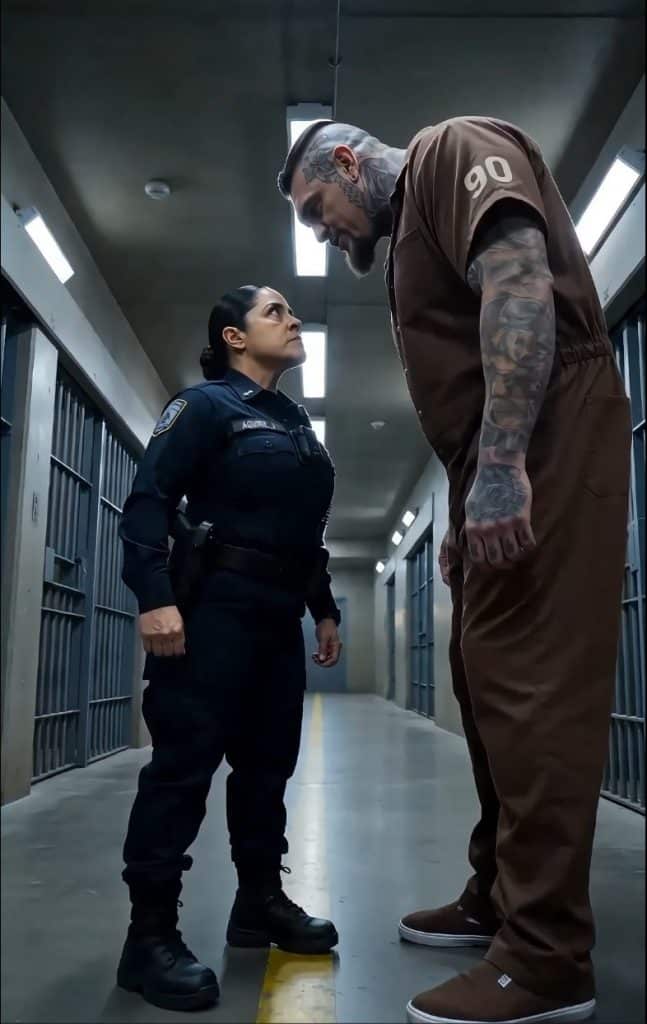
Her boots stopped on the yellow line, perfectly aligned, toes forward, shoulders squared. Around her, the prison corridor stretched like a concrete throat, narrow and cold under fluorescent lights that made every face look harder than it was.
On her left, metal bars ran down the wall in a long grey rhythm. On her right, eight inmates slowed behind the largest man in the unit.
His name was Darius Kane.
Everyone called him King.
He was tall enough to make the hallway feel smaller. Tattoos climbed his arms, disappeared under the brown prison sleeves, and rose again along his neck like dark vines. The number 90 was stitched into one sleeve, but inside Blackridge Correctional, numbers mattered less than reputation.
And Darius had built his like a weapon.
He stepped directly into Aguirre’s path.
Then he looked down at her and smiled.
“Hey, dwarf,” he said, loud enough for the whole tier to hear. “Who do you think you are to order us around?”
The inmates behind him laughed.
Not because it was funny.
Because Darius expected them to.
Officer Aguirre did not blink.
She was short. No one could miss that. Her uniform fit neatly, her dark hair was pulled into a tight bun, and her name tag read AGUIRRE, J. Her duty belt looked heavier against her frame than it did on most officers.
But there was something in her stillness that made the laughter start to thin around the edges.
She did not reach for her radio.
She did not call for backup.
She did not step back.
Darius threw his head back and laughed harder, feeding the performance. He turned slightly toward the men behind him, one tattooed hand gesturing at her as if she were part of the entertainment.
The group laughed again, but this time a little less cleanly.
Aguirre waited.
That was her first move.
She let the hallway hear itself. The boots shifting. The metal bar rattling somewhere down the tier. The stale air humming under the lights. The way fake courage sounded when it had to echo off concrete.
Then she lifted her chin just enough to meet Darius’s eyes.
“Get back in line.”
She did not raise her voice.
That made it worse for him.
Darius’s smile tightened. The men behind him stopped laughing one by one, as if someone had lowered the volume on the entire corridor.
He leaned down into her space.
“Oh,” he said, voice dropping. “What are you gonna do?”
Aguirre looked up at him.
Nothing on her face moved.
Behind Darius, one inmate shifted backward.
Then another.
Then another.
Boots scraped softly over concrete as the group began forming a line along the wall. Not because Darius told them to. Because she had.
Darius heard it before he saw it.
The sound of his power leaving him.
His jaw tightened. He kept staring at Aguirre, trying to hold the pose, but the hallway had already changed. The men who had laughed behind him were now silent, hands controlled, eyes forward.
Aguirre remained exactly where she was.
Small in the frame.
Unmoved.
And for the first time since Darius Kane entered Blackridge, he was standing alone.
But what he did not know was that Aguirre had not come to Block C to win a staring contest.
She had come because of the letter hidden under his mattress.
Act II
Three months earlier, Officer Aguirre had almost quit.
Not because she was afraid of inmates. Fear had never been the problem. She had grown up in a neighborhood where fear knocked before breakfast and waited on the porch after dark. By the time she joined corrections, she already knew the difference between danger and noise.
Noise was men like Darius Kane.
Danger was quieter.
Danger signed reports.
Danger lost evidence.
Danger moved people from one cell to another at the wrong time and then acted surprised when something terrible happened.
Aguirre had been at Blackridge for nine years. She knew the rhythms of the place better than the administrators did. She knew which vents rattled in winter, which doors stuck after rain, which inmates acted tough because they were scared, and which officers smiled too much when cameras stopped recording.
She had learned to be calm because calm kept people alive.
Then Marcus Bell died.
Marcus was twenty-two, thin, anxious, and six months into a sentence for stealing cars. He was no saint, but he was not what Blackridge tried to make him. He wrote letters to his little sister every Sunday. He asked Aguirre once if prison libraries kept GED books past 1999. He said he wanted to leave better than he came in.
Then he became a witness.
Marcus had seen something he was not supposed to see: a late-night exchange between Darius Kane and two officers near the laundry corridor. Packages. Cash. A phone hidden inside a legal folder.
The next morning, Marcus asked Aguirre whether internal affairs actually protected people.
She told him the truth.
“Sometimes.”
That was not enough.
Two days later, Marcus was transferred to Block C.
Aguirre never signed the transfer.
His counselor did not request it.
The unit captain claimed it had been “administrative movement.”
By nightfall, Marcus was badly hurt in a staged fight. By sunrise, he was gone.
The report called it inmate violence.
Aguirre called it murder dressed as paperwork.
She filed a complaint.
Nothing happened.
She filed another.
Then her locker was searched. Her schedule changed. Her overtime disappeared. A senior officer told her quietly that some storms were bigger than one person.
Aguirre went home that night and sat in her kitchen until dawn, staring at her father’s old badge.
Javier Aguirre had been a corrections officer too. He used to tell her that a uniform did not give a person authority. It only revealed whether they deserved any.
When Julia was thirteen, he came home with a split lip and told her he had stopped three officers from beating a handcuffed inmate. He lost friends for it. Lost promotion chances too.
But he slept at night.
That mattered to him.
So Aguirre stayed.
She stopped complaining in the open. She started watching.
She learned that Darius Kane’s power was not just violence. It was access. He knew which officers would look away. He knew which managers cared more about clean statistics than clean consciences. He knew how to make frightened men laugh at the right time.
That was what the hallway confrontation was about.
Not height.
Not respect.
Control.
Darius had heard rumors that Aguirre had been asking questions again. He wanted to break her in front of the block. Turn her into a joke. Make every inmate see that she could be challenged.
But rumors travel both ways in prison.
The men behind Darius had heard something too.
They had heard Aguirre had found Marcus Bell’s last letter.
They had heard she had sent copies outside Blackridge.
They had heard federal investigators were asking questions.
And they had heard one more thing.
Darius Kane’s protection was gone.
That was why the inmates stepped back.
Not because they suddenly became brave.
Because they knew the king was standing on a floor that had already cracked.
And Aguirre was the only person in the hallway who knew how deep the crack went.
Act III
The letter had been written on lined paper in small, careful handwriting.
Officer Aguirre found it inside an old GED workbook that Marcus Bell had left in the library cart before his transfer. It was addressed to his sister, but he had never mailed it.
At first, it read like an apology.
He told her he was sorry for missing her school play. Sorry for making their mother cry. Sorry for being the kind of brother people whispered about.
Then, halfway down the second page, the handwriting changed.
It got tighter.
Faster.
If something happens to me, ask for Officer Aguirre. She listens.
Below that, Marcus had written names.
Darius Kane.
Officer Glen Porter.
Captain Ellis Rowe.
And a third name Aguirre had not expected.
Warden Thomas Reeve.
She read it twice, then a third time, feeling the room narrow around her.
Marcus had described the exchange in the laundry corridor. He had seen Darius handing a phone to Porter. He had seen Captain Rowe waiting by the blind spot near the camera. And he had heard Warden Reeve’s voice from the office nearby, saying, “Keep Kane comfortable until the transfer clears.”
At the bottom of the page, Marcus wrote one sentence that made Aguirre sit very still.
They’re moving someone through Block C next month, and Kane says the warden gets paid when the paperwork stays clean.
Aguirre made copies.
Three physical. Two digital.
One went to a state investigator she trusted. One went to a retired judge her father had once protected during a prison inquiry. One went into a sealed envelope with instructions to open if Aguirre was suspended, arrested, or found suddenly “unfit for duty.”
Then she waited.
The state moved slowly.
Blackridge moved faster.
Two weeks later, Darius Kane received a new privilege assignment. Laundry access. Same corridor. Same blind spot.
The difference was that this time, the blind spot was not blind.
Aguirre had persuaded a maintenance technician named Luis Ortega to inspect the camera wiring under the excuse of a flickering feed. Luis had two sons, a quiet conscience, and no love for Captain Rowe.
He found the tampered cable.
Then he found the hidden recorder.
Not prison equipment.
Private.
Someone had been filming the corridor for leverage.
When investigators finally reviewed the footage, they saw what Marcus had seen.
Packages. Phones. Officers looking away. Darius smiling like a man with keys he was not supposed to have.
But the footage revealed something worse.
Warden Reeve was not just allowing corruption.
He was selling transfers.
Certain inmates, mostly those with outside enemies or pending testimony, were being moved into dangerous units under fake administrative reasons. Payments came through shell vendors. Reports were sanitized. Injuries were explained as “mutual combat.”
Marcus Bell had not died because a fight got out of control.
He died because he saw the machine and tried to name it.
By the morning of Aguirre’s confrontation with Darius, the investigation had already begun outside the prison walls. Warrants were pending. Phones were being traced. Bank accounts were being frozen.
But Darius did not know that.
All he knew was that Aguirre had entered Block C alone.
So he stepped into her path and made the fatal mistake of thinking silence meant weakness.
Now, in the hallway, he stared down at her while his men stood lined up behind him.
“What are you gonna do?” he repeated, but his voice had lost its shine.
Aguirre’s radio crackled once.
She did not answer it.
Instead, she looked past Darius toward the end of the corridor.
The secure door opened.
Two state investigators stepped through.
Behind them came Deputy Commissioner Elaine Mercer, a woman in a charcoal suit with a badge clipped at her waist and four officers who were not from Blackridge.
Darius turned.
For the first time, confusion crossed his face.
Captain Rowe appeared behind them in handcuffs.
That was when Darius Kane stopped smiling completely.
Act IV
No one moved.
Not the inmates.
Not the officers.
Not even the men in the cells, who had drifted toward their bars to watch the impossible happen.
Captain Rowe’s face was grey. His uniform shirt was wrinkled. He looked smaller without his authority, smaller than any person Darius had ever mocked.
Darius stared at him, then at Aguirre.
“What is this?” he demanded.
Aguirre did not answer.
Deputy Commissioner Mercer did.
“Darius Kane, step back from Officer Aguirre and place your hands where they can be seen.”
Darius laughed once.
It was ugly and forced.
“You think you can scare me with suits?”
No one laughed with him.
That silence struck harder than any command.
Darius glanced back at the inmates lined against the wall. Men who had followed him for years stared straight ahead. One of them, an older inmate named Harlan Price, would not look at him at all.
Darius’s anger flashed.
“You all scared now?”
Harlan finally turned his head.
“No,” he said quietly. “We’re tired.”
The words moved down the hallway like a match touching paper.
Tired.
Tired of being used as shields.
Tired of punishments arranged to look random.
Tired of kings who ate better because everyone else stayed hungry.
Darius took a step toward Harlan.
Aguirre moved before anyone else did.
Not dramatically. Not violently.
She simply stepped between them.
Again.
The smaller body blocking the larger one.
“Back in line,” she said.
This time, Darius heard the command differently.
So did everyone else.
His face tightened with humiliation. He wanted to lunge. Wanted to shout. Wanted to perform strength until the hallway believed in him again.
But the hallway had changed owners.
The investigators moved forward. Outside officers secured the corridor. Mercer nodded to Aguirre, and only then did Aguirre touch her radio.
“Block C secure,” she said.
Four words.
After months of whispers, threats, and buried reports, that was all it took.
Darius was escorted away without the grand fight he wanted. That, more than anything, seemed to enrage him. He had built his life on spectacle. On making people flinch.
Aguirre denied him the performance.
As he passed her, he leaned close enough to whisper.
“You think this makes you brave?”
Aguirre looked at him.
“No,” she said. “It means Marcus Bell wasn’t alone.”
Darius’s eyes flickered.
Just once.
Enough.
The arrests that followed shook Blackridge to its foundation.
Warden Reeve was taken from his office while preparing a public statement about institutional safety. Captain Rowe’s computer was seized. Officer Porter tried to resign before investigators reached him, but resignation did not make evidence disappear.
The transfer logs told their own story.
The bank records told another.
And Marcus Bell’s letter gave both a human voice.
For weeks, news vans gathered outside the prison gates. Officials held careful press conferences. Attorneys used phrases like systemic failure and ongoing investigation. Families of inmates called hotlines that had not existed before.
Inside Blackridge, things changed more slowly.
Prisons do not transform because one bad man is arrested.
But something had shifted.
The inmates on Block C lined up when Aguirre entered. Not out of love. Not out of sudden trust. Trust was not that cheap.
They lined up because she had stood where everyone else had stepped aside.
One afternoon, Harlan Price approached her near the library cart.
He kept his hands visible.
“Bell’s sister know?” he asked.
Aguirre looked at him.
“She knows he tried to tell the truth.”
Harlan nodded.
Then he placed a folded sheet of paper on the cart.
“Names,” he said. “Not all. Enough to start.”
Aguirre looked at the paper but did not touch it yet.
“Why now?”
Harlan’s face was tired.
“Because you didn’t laugh when he died.”
That sentence stayed with her longer than the insults ever had.
Because sometimes power does not begin with command.
Sometimes it begins with refusing to join the cruelty.
Act V
Marcus Bell’s sister came to Blackridge six weeks later.
Her name was Tasha. She was nineteen, wearing a yellow cardigan too bright for the visiting room and a face too young for the grief she carried. She sat across from Officer Aguirre with Marcus’s letter folded between them.
For a while, neither of them spoke.
Through the glass partition, the prison hummed in the background. Doors buzzed. Voices rose and fell. Somewhere far down the corridor, boots struck concrete in steady rhythm.
Finally, Tasha touched the letter.
“He always wrote like he was trying to sound older,” she said.
Aguirre smiled faintly.
“He asked for GED books.”
“He wanted to be a mechanic,” Tasha said. “Said he was good with things that looked broken.”
Her voice trembled on the last word.
Aguirre did not offer the easy lie that Marcus had died for a reason. Death does not become fair because truth follows it. Pain does not become noble because someone later files the right report.
Instead, she said the only thing she could say honestly.
“He deserved more people protecting him.”
Tasha nodded, tears spilling silently.
“Did he suffer?”
Aguirre’s chest tightened.
She chose her words carefully, gently.
“He was not forgotten,” she said. “And he was not ignored. Not at the end. Not now.”
Tasha closed her eyes.
Sometimes mercy is not in the full detail.
Sometimes mercy is in giving the living something they can carry.
Months passed.
Trials began.
Darius Kane took a deal only after learning that the men he once controlled were willing to testify without him. Captain Rowe blamed the warden. Officer Porter blamed Rowe. Warden Reeve blamed institutional pressure, budget cuts, outdated systems, and every invisible thing except his own choices.
The jury did not believe him.
Aguirre testified for two days.
The defense tried to make her seem emotional. Personal. Too invested.
She answered every question in the same calm voice she had used in the hallway.
Yes, she had filed complaints.
Yes, she had copied the letter.
Yes, she had continued working after being warned to stop asking questions.
No, she did not regret it.
At one point, a defense attorney leaned forward and asked, “Officer Aguirre, do you consider yourself fearless?”
Aguirre looked at the jury.
“No,” she said.
The courtroom waited.
“I consider fear useful,” she continued. “It tells you when something matters. The mistake is letting it give orders.”
The line appeared in newspapers the next morning.
But Aguirre hated seeing her name there.
She did not want to become a symbol. Symbols are easier to praise than follow. People clap for them, then return to old habits.
What she wanted was simpler.
Cameras that worked.
Transfers that could be audited.
Officers who knew silence was also a decision.
And inmates who understood that dignity was not a reward for innocence. It was a rule for everyone, or it meant nothing.
A year after the hallway confrontation, Block C was repainted.
The walls were still concrete. The lights were still too bright. The yellow line still ran down the floor like a boundary no one was supposed to cross.
But the corridor felt different.
Not softer.
Just less owned by fear.
Officer Aguirre walked it on a rainy Thursday morning, clipboard in hand, radio quiet against her shoulder. Inmates stood along the wall for count. Some watched her. Some looked away. One nodded.
Near the end of the row stood a new inmate, young and nervous, trying hard to look tougher than he felt.
He stared at Aguirre’s height and smirked.
A man beside him, older and wiser, spoke under his breath.
“Don’t.”
The young inmate frowned. “What?”
The older man kept his eyes forward.
“That one doesn’t move.”
Aguirre heard it.
She did not smile.
She continued down the yellow line until she reached the same spot where Darius Kane had once blocked her path. For a second, memory stood there with him: the laughter, the insult, the bodies leaning in, the silence turning.
Then the memory passed.
From the far cell, someone asked, “Officer Aguirre?”
She turned.
It was Harlan Price, standing behind the bars with a library form in his hand.
“You still got those GED books?”
Aguirre walked over and took the paper.
“What subject?”
He looked embarrassed.
“Math.”
She checked the form. “I’ll see what’s available.”
Harlan nodded.
“Thank you.”
It was not redemption.
Not yet.
But it was a beginning.
That evening, Aguirre stopped by her father’s old grave before going home. Rain dotted the stone. She stood there in uniform, hands in her jacket pockets, city lights glowing beyond the cemetery fence.
“I stayed,” she said softly.
The wind moved through the trees.
For years, she had believed strength meant standing firm when someone tried to push you back.
Now she knew it was more than that.
Strength was keeping the door open after the confrontation ended. It was carrying the letter. Saying the name. Walking the same corridor again the next morning, not because fear was gone, but because fear no longer got to decide who belonged there.
Back at Blackridge, the hallway lights buzzed through the night.
The yellow line remained.
The cells remained.
The concrete remained.
But the laughter that once followed Darius Kane had vanished.
And every time Officer Aguirre’s boots echoed down Block C, men who had once mistaken size for power remembered the day the shortest person in the corridor became the one no one dared ignore.