Act I
The golden retriever walked alone through the snow like it knew exactly where grief lived.
Rows of white marble headstones stretched into the gray distance, each one marked with a small American flag half-buried in fresh powder. Snowflakes clung to the dog’s ears, its back, its pale golden muzzle, but it did not shake them away.
It moved slowly down the central path, paws sinking into the white silence.
No one called to it.
No leash dragged behind it.
No owner followed.
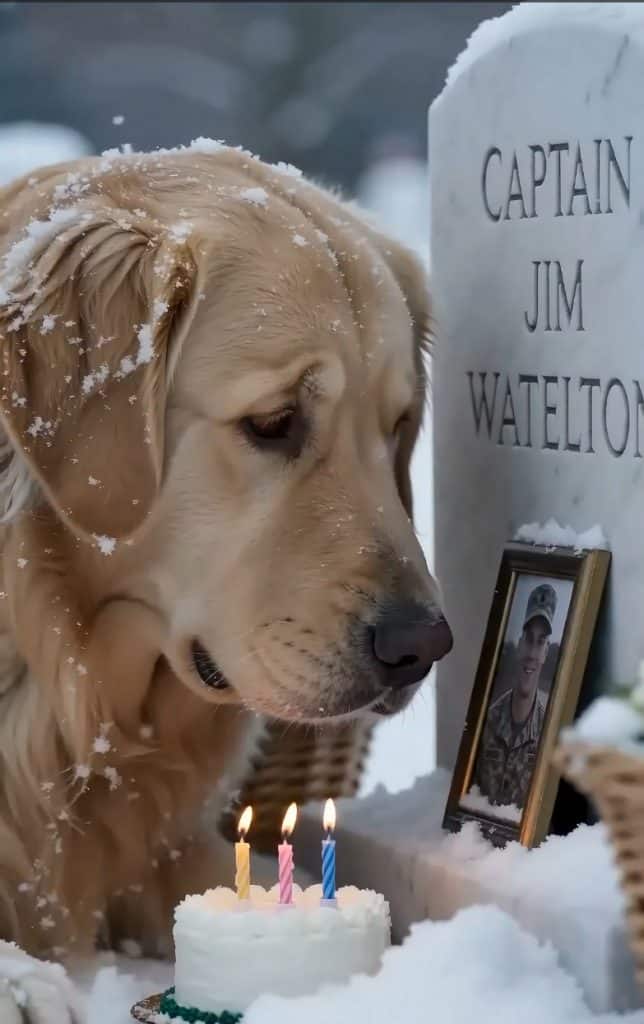
The dog passed grave after grave until it reached one headstone near a leafless maple tree. There, it stopped.
CAPTAIN JIM WATERTON.
The name was carved cleanly into the stone.
Beneath it, fixed inside a small frame, was a color photograph of a young soldier with short-cropped hair and a smile so alive it almost hurt to look at. Beside the grave sat a wicker basket, a small white cake, and three candles burning in the winter air.
Yellow. Blue. Pink.
The flames trembled, but somehow they stayed lit.
The dog sat down in front of the headstone.
Then, with heartbreaking care, it lifted one paw and placed it over the photograph.
Its nose touched the stone.
A soft breath left its chest, almost like a sigh.
For a moment, the cemetery seemed to hold its own breath too.
Then the dog lowered itself into the snow and curled around the base of the grave, guarding it like the soldier might still need protection.
That was how Emma Waterton found it.
She came walking slowly between the rows of headstones, a bouquet of white lilies and pale yellow roses trembling in her gloved hands. Her dark winter coat was dusted with snow, her gray scarf pulled close around her face, but nothing could soften the grief in her eyes.
She had come prepared for silence.
She had come prepared for cold stone.
She had not come prepared for the dog.
Emma stopped so suddenly that the flowers crushed against her chest.
Her lips parted.
The dog lifted its head.
For three endless seconds, neither of them moved.
Then Emma whispered the name she had not allowed herself to say aloud for almost a year.
“Buddy…”
The dog’s ears twitched.
Emma’s eyes filled before she could take another breath.
“Buddy,” she said again, broken now. “How?”
The golden retriever tried to rise, but its body was too tired. It only stretched its neck toward her, snow sliding from its fur, eyes wet and searching.
Emma dropped to her knees in the snow.
The flowers fell beside her.
Buddy pressed his head into her gloved hands, and she folded over him with a sob that had been trapped inside her since the day the army chaplain came to her door.
But when her fingers slipped beneath his collar, she felt something that did not belong there.
A small metal capsule.
Cold. Sealed. Hidden.
And tied to it was a strip of faded blue ribbon Emma recognized instantly.
It had come from her wedding bouquet.
Act II
Before Jim Waterton belonged to the army, he belonged to Buddy.
That was what Emma used to say.
The dog had arrived in their lives as a muddy, underfed puppy with paws too big for his body and no understanding of furniture rules. Jim found him near a gas station two weeks before their wedding, sitting in the rain beside a trash can as if waiting for someone decent to notice him.
Jim noticed.
He brought the puppy home wrapped in his army jacket, grinning like a boy who had stolen treasure.
Emma pretended to be annoyed for six minutes.
By dinner, she was feeding the puppy scraps of chicken from her hand.
By midnight, Buddy was asleep between them on the couch, and Jim was whispering, “He’s family now.”
That was Jim.
He could make a promise sound casual, but he meant it with his whole life.
When he deployed, Buddy waited by the door every evening. When Jim called, the dog pressed his nose to the phone and whined at the sound of his voice. When Jim came home on leave, Buddy did not bark at first. He simply froze, trembling, then threw his whole body into Jim’s arms.
Emma used to laugh at them from the kitchen doorway.
“My two dramatic soldiers,” she would say.
Jim would look up from the floor with Buddy sprawled across his chest and answer, “He outranks me.”
There were photographs of them everywhere.
Jim in uniform with Buddy’s paws on his shoulders. Jim asleep on the living room rug with Buddy’s head tucked under his chin. Jim crouched beside the dog on Christmas morning, both of them wearing ridiculous red bows because Emma had insisted.
Those memories became unbearable after the notification.
The officers came in dress uniforms.
Emma knew before they spoke.
People always said there was a moment before grief when the world stopped, but that was not true. The world kept moving. The clock kept ticking. A neighbor’s lawn mower kept running two houses down. Somewhere, a child laughed.
And Emma’s life split in half.
Jim had been killed during a mission overseas, they told her. He had served with honor. He had saved lives. He had not been alone.
None of those words reached the place inside her that was already collapsing.
Buddy knew too.
He stood at the foot of the stairs the entire afternoon, not barking, not moving, watching strangers carry folded fabric and polished phrases into the house where Jim’s boots still sat by the door.
At the funeral, Buddy lay beside Emma’s chair.
When the rifle salute cracked across the cemetery, his whole body flinched, but he did not run. He pressed harder against Emma’s leg, as if keeping her upright by force.
Then, three days later, he disappeared.
The gate had been open when Emma came home from signing paperwork at the base office. Buddy was gone. No paw prints. No barking. No torn leash. Nothing.
Emma searched until her voice failed.
She printed flyers. She called shelters. She drove through freezing rain with Jim’s old hoodie in the passenger seat, hoping Buddy might smell it from somewhere.
No one found him.
Jim’s father, Colonel Thomas Waterton, said the words that finished breaking her.
“First my son,” he told her in front of half the family, “and now his dog. You never knew how to hold on to what mattered.”
Emma did not answer.
She had no strength left for cruelty.
The Watertons had never accepted her fully. She was not old military family. She did not come from rank, wealth, or polished tradition. She was a school counselor from a small town who had met Jim at a charity 5K and loved him before she understood the weight of his last name.
Thomas had always believed Emma made Jim soft.
Jim had always said she made him human.
After Buddy vanished, the whispers followed.
Some said Emma gave the dog away because grief was inconvenient. Some said she had been careless. Some said the dog had run because animals knew when a house had become too sad.
Emma stopped defending herself.
What could she say?
That losing Buddy had felt like losing the last living piece of Jim?
That every night she woke reaching for the sound of paws in the hallway?
That she kept Buddy’s bowl by the kitchen door for 318 days because moving it felt like betrayal?
No one wanted that kind of truth.
So Emma carried it alone.
Until the snowy morning she found Buddy curled against Jim’s grave, with her wedding ribbon tied beneath his collar.
And when she opened the capsule, the past began to speak.
Act III
Emma’s hands shook so badly she could barely twist the capsule open.
Buddy watched her, his brown eyes fixed on her face. Snow gathered along his lashes. His breathing came soft and uneven, but he did not look away.
Inside the capsule was a folded piece of paper, sealed in plastic.
The handwriting on the outside made Emma cover her mouth.
For Em.
Jim’s handwriting.
She made a sound so small the wind almost took it.
Her first instinct was to close the capsule again, to hold the impossible thing against her heart and refuse to risk whatever waited inside. A final letter could be a gift. It could also be a second funeral.
But Buddy nudged her wrist.
Gently.
Insistently.
Emma unfolded the letter.
My Em,
If you are reading this, it means Buddy found you. Or someone finally did what I asked.
The cemetery blurred.
Emma pressed one gloved hand into the snow to steady herself.
Jim wrote the way he had spoken, direct and tender, with small jokes tucked into impossible places because he hated leaving pain unchallenged. He said he had written the letter before his last mission, not because he expected to die, but because every soldier knew love deserved instructions in case the world went wrong.
He asked that Buddy be brought home to Emma immediately if anything happened to him.
Not to his father.
Not to the Waterton estate.
To Emma.
He wrote that Buddy was not a symbol, not property, not a military souvenir for anyone to pose beside at memorial dinners.
Buddy was family.
And family belonged with her.
Emma read faster, tears slipping down her face and freezing cold at her chin.
Then she reached the paragraph that made her stop breathing.
Dad will try to take charge. He always does when he’s scared. Don’t let him turn grief into command. He loved me the only way he knew how, but Em, you are my home. Buddy knows that. So do I.
Her fingers tightened around the paper.
A voice behind her said, “He made me promise.”
Emma turned.
An older man stood a few steps away between the headstones. He wore a dark coat over a worn army uniform, his beard silver, his posture stiff in the way of someone whose body still remembered orders even after years of sorrow.
In one hand, he held a lighter.
That was when Emma understood.
The candles.
“You left the cake,” she whispered.
The man nodded.
“My name is Caleb Ross. I served with Jim.”
Emma stared at him.
Jim had mentioned Caleb in stories. The medic with the terrible singing voice. The man who could find coffee anywhere. The friend who once carried Buddy around the backyard after the dog stepped on a bee and refused to walk dramatically.
Caleb stepped closer, slowly, as if approaching grief required permission.
“Jim gave me the letter before his last patrol,” he said. “Told me if anything happened, I was to make sure Buddy got back to you.”
Emma’s voice cracked.
“Then why didn’t he?”
Caleb looked down.
The answer was written in his silence before he spoke it.
“Colonel Waterton took him.”
Snow fell between them.
Buddy lowered his head.
Caleb explained that after Jim’s service, Thomas Waterton had arrived with papers, rank, and authority sharp enough to cut through everyone’s hesitation. He said Buddy was part of Jim’s military legacy. He said Emma was unstable. He said the dog would be placed somewhere proper until the family decided what was best.
“I argued,” Caleb said. “Not enough. I’ll live with that.”
Emma could barely hear him over the blood rushing in her ears.
Thomas had known.
When he stood in her living room and blamed her for losing Buddy, he had known exactly where the dog was.
“He sent Buddy to a private veterans’ facility two states away,” Caleb said. “I found out months later. By then, they said the transfer records were sealed by family request.”
Emma looked at Buddy.
The dog who had slept by Jim’s boots. The dog who had licked tears from her face after the funeral. The dog she had mourned while people called her careless.
“He was alive,” she whispered. “All this time.”
Caleb’s face twisted with regret.
“I got him out three weeks ago.”
Emma looked back at him.
“He was supposed to be driven to you yesterday,” Caleb said. “But the transport van stopped near the cemetery. Buddy saw the gates and went wild. Broke free, ran straight through the snow.”
A faint smile trembled through his grief.
“He remembered the way.”
Emma turned back to the grave.
The cake sat beside Jim’s headstone, the three candles still fighting the wind.
Caleb followed her gaze.
“Jim told me once that every birthday should have three candles,” he said softly. “One for what you survived. One for what you loved. One for what you still hoped would come home.”
Emma closed her eyes.
Buddy rested his paw on Jim’s photograph again.
That was when a black car rolled slowly along the cemetery road behind them.
And Colonel Thomas Waterton stepped out.
Act IV
Thomas Waterton looked older than Emma remembered.
Not gentler.
Just older.
He wore a long black coat, leather gloves, and the same expression he had worn at Jim’s funeral, as if grief were a ceremony he intended to control better than everyone else.
His eyes moved from Emma to Caleb, then to Buddy.
The moment he saw the dog, something like panic broke through his face.
Only for a second.
Then command returned.
“What is this?” Thomas said.
Emma stood.
The letter was still in her hand.
Buddy rose with difficulty and moved beside her, pressing against her leg the way he had at the funeral.
Thomas saw it.
His jaw tightened.
“That dog belongs with the Waterton family.”
Emma’s voice was quiet.
“He is with the Waterton family.”
Thomas glanced at Jim’s grave.
“You don’t understand what that name means.”
For almost a year, those words would have made Emma shrink. They carried the whole weight of his world, his medals, his portraits, his history of men standing straight and women staying silent beside them.
But grief had changed her.
So had the letter.
“I understand exactly what it means,” Emma said. “It means you used your son’s death to steal the last thing he left in my care.”
Thomas’s face hardened.
Caleb stepped forward.
“I have copies of the transfer request,” he said. “Your signature. The facility release. The order to withhold contact from Mrs. Waterton.”
Thomas turned on him.
“You had no right.”
“No,” Caleb said. “You didn’t.”
The words landed cleanly in the falling snow.
There were no guests here, no ballroom, no microphone, no crowd to impress. Only white headstones, small flags, and the name of a dead son carved into stone between them.
Thomas looked at Emma.
For the first time, she saw not power, but fear wearing power’s coat.
“Buddy was all I had left of him,” he said.
Emma’s anger faltered, but it did not disappear.
“So you took him from me?”
Thomas swallowed.
“He was my son.”
“He was my husband.”
Her voice broke on the last word, but she did not step back.
“And Buddy was not a trophy for the person who hurt loudest.”
The colonel flinched.
Buddy gave a soft whine and lowered himself against Emma’s boots.
The sound undid something.
Thomas looked at the dog, then at Jim’s photograph, then at the candles burning beside the cake. His face twisted with an old man’s ruin, the kind that comes when pride finally runs out of places to hide.
“I thought if I kept him,” Thomas said, barely above the wind, “I could keep Jim in the house.”
Emma’s eyes filled again.
“You didn’t keep Jim,” she said. “You kept Buddy in a place where neither of us could love him.”
No one spoke after that.
The snow fell harder.
Caleb reached into his coat and pulled out another envelope.
“Jim left one more document,” he said.
Thomas looked up sharply.
Caleb handed it to Emma.
Inside was a notarized care directive, signed by Jim before deployment. In the event of his death, all personal letters, domestic effects, and the golden retriever named Buddy were to be released to Emma Waterton.
There was no ambiguity.
No family debate.
No room for command.
Thomas read the copy Caleb gave him, and his hand began to shake.
For once, the law and love were saying the same thing.
Buddy belonged to Emma.
Jim had made sure of it.
And Thomas, who had spent a lifetime giving orders, finally had none left to give.
Act V
Thomas did not apologize in a way that fixed anything.
Some apologies come too late to repair the first wound.
He stood beside Jim’s grave for a long time, the document hanging from one hand, snow settling on his shoulders. When he finally spoke, his voice sounded as if it had traveled through years of locked rooms.
“I told myself I was protecting what was left.”
Emma looked down at Buddy.
The dog leaned into her, tired and warm and real.
“No,” she said. “You were deciding that your grief mattered more than mine.”
Thomas closed his eyes.
There was no argument for that.
Before he left, he reached one gloved hand toward Buddy, then stopped short, waiting.
Buddy watched him.
Then, slowly, the dog stepped forward and touched his nose to Thomas’s fingers.
It was not forgiveness.
Animals were kinder than people, but they were not foolish. Buddy’s touch lasted only a second before he returned to Emma’s side.
Still, Thomas’s face crumpled.
He turned away before anyone could see too much.
Caleb drove him back toward the cemetery road, leaving Emma alone with Buddy and Jim beneath the gray winter sky.
For a while, she did nothing.
She simply sat in the snow beside the grave, one arm around the dog, Jim’s letter open in her lap. The flowers lay nearby, their pale petals dusted white. The cake candles had burned low, but the flames remained.
Emma read the final lines again.
Live, Em. Not because I’m gone, but because I loved you while I was here. Take Buddy home. Let him sleep on my side of the bed if he wants. He always thought it was his anyway.
A broken laugh escaped her.
It turned into a sob.
Buddy lifted his head and licked the tear from her cheek.
For the first time in almost a year, Emma did not feel alone at Jim’s grave.
She felt accompanied.
Not healed. Not whole.
But accompanied.
That mattered.
When she finally stood, Buddy rose with her. Slowly, stiffly, but without hesitation. Emma picked up the bouquet and laid it against the headstone. Then she took one candle from the cake, cupped the flame against the wind, and whispered the words Jim had once said at every birthday.
“For what survived.”
She touched the second candle.
“For what we loved.”
Then the third.
Her voice broke.
“For what came home.”
Buddy leaned against her leg.
Emma smiled through tears.
Three days later, Buddy slept on Jim’s side of the bed.
He climbed up with the careful entitlement of a dog who had never believed furniture rules applied to him, circled twice, and rested his chin on Jim’s old pillow.
Emma stood in the doorway for a long time watching him.
The house did not feel less empty.
But it felt less abandoned.
Buddy’s bowl returned to the kitchen floor. His leash hung by the door again. His paws clicked through the hallway in the mornings. Sometimes Emma woke before dawn and heard him breathing in the dark, and the sound kept her from falling back into the worst memories.
Caleb visited once a week.
At first, only to check on Buddy. Then for coffee. Then because grief, when shared by people who loved the same person, can become a bridge instead of a wall.
Thomas wrote a letter.
Emma did not open it for two weeks.
When she finally did, it was short. No excuses. No polished speech. Just a confession that he had failed Jim by mistaking control for love, and failed Emma by punishing her for a loss they both had to carry.
At the bottom, he wrote one line that stayed with her.
I do not ask to be forgiven. I ask only to stop making my son’s memory smaller than his heart.
Emma folded the letter and placed it in a drawer.
Not thrown away.
Not answered.
Not yet.
Spring came slowly to the cemetery.
The snow melted first from the tops of the headstones, then from the paths, then from the flags. Grass returned in pale green strips between the rows.
On Jim’s birthday, Emma came back with Buddy beside her.
This time, she carried the wicker basket.
Inside was a small white cake and three candles.
Yellow. Blue. Pink.
Caleb was already there, standing quietly near the maple tree. A few minutes later, Thomas arrived too, stopping at a respectful distance until Emma gave one small nod.
No one pretended things were simple.
No one pretended the past had not happened.
But they stood together.
For Jim.
For Buddy.
For the love that had outlived silence, pride, and all the locked doors people had placed between them.
Emma lit the candles.
Buddy sat in front of the headstone and placed his paw gently over Jim’s photograph, just as he had that snowy morning.
The wind moved through the flags.
The flames trembled.
This time, Emma did not ask how Buddy had found his way back.
She knew.
Love had its own map.
It remembered doors. It remembered voices. It remembered the people who had once been home.
And when everything else failed, when papers were hidden and promises were broken and grief tried to bury the truth, love still walked through snow, past rows of white stone, until it reached the name it had never stopped searching for.
Captain Jim Waterton had come home in the only way he still could.
Through a letter.
Through a loyal dog.
Through the widow who finally understood that she had not been left with nothing.
She had been left with proof.
Proof that Jim had chosen her.
Proof that Buddy had remembered her.
And proof that even in the coldest place on earth, devotion could still find its way back and lay one gentle paw against the stone.