Act I
The nurse knew fear when she saw it.
Not panic. Not pain. Fear.
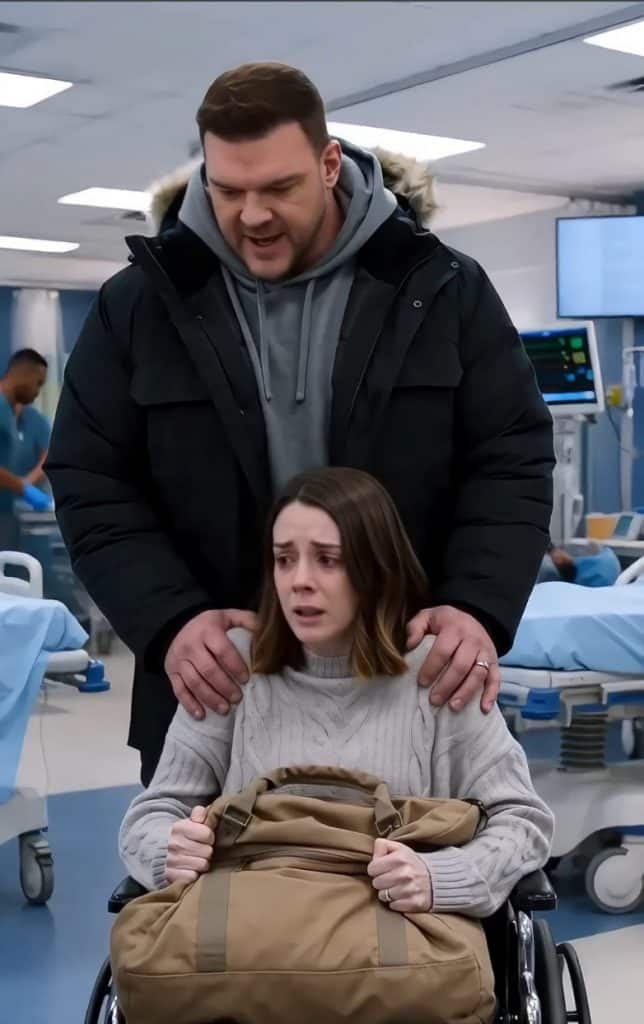
The pregnant woman sat rigid in the wheelchair under the bright emergency room lights, both arms wrapped around a tan duffle bag as if it were the last thing in the world she still controlled. Her face was pale, her lips dry, and every breath came shallow and uneven.
Behind her stood her husband.
Large. Calm. Too calm.
His hands rested on her shoulders like a loving gesture, but Nurse Denise Carter saw how firmly his fingers pressed down.
“It’s just a panic attack,” he said smoothly.
The woman flinched at his voice.
Denise lowered herself in front of the wheelchair.
“What’s your name, sweetheart?”
The woman’s mouth opened.
Her husband answered first.
“Emily.”
Denise looked up at him.
“I’d like her to answer.”
The man smiled, but something tightened behind his eyes.
Emily swallowed.
“Emily,” she whispered.
The husband leaned down and reached for the duffle bag.
“Let me take that.”
Emily clutched it tighter.
For one brief second, her fear sharpened into terror.
Then he pulled the bag from her arms.
The fabric scraped against her sweater. Her hands stayed lifted in the empty space where the bag had been, trembling.
Denise saw it.
She saw the way Emily looked at the bag as if it contained proof.
She saw the way the husband stepped back with it, close enough to watch, far enough to control what Emily could reach.
Denise wrapped a blood pressure cuff gently around Emily’s arm.
“Are you alright?”
Emily’s eyes flicked toward her husband.
Then back to Denise.
Her breathing broke.
Suddenly, she grabbed the front of Denise’s navy scrub top with both hands and pulled her close.
Her whisper was barely sound.
“He changed my vitamins.”
Denise froze.
Emily’s fingers dug into the fabric.
“He said I was crazy,” she breathed. “But I kept the bottle. It’s in my bag.”
Denise’s blood ran cold.
Behind them, the husband turned.
Denise stood so fast the cuff slipped loose from Emily’s arm.
“We need a doctor!” she shouted.
The husband’s calm vanished.
He stepped forward.
“Why?”
His voice was low now.
Not confused.
Angry.
Emily shrank into the wheelchair, hands gripping the armrests.
Denise moved in front of her.
Then the man’s right hand slid into the pocket of his black parka.
The ER noise seemed to fall away.
Monitor beeps. Rolling carts. Distant voices.
All of it became muffled beneath one small sound.
Fabric scraping.
Metal shifting.
Denise looked down.
Only the handle was visible at first.
But it was enough.
Act II
Emily had not arrived at the hospital because of pain.
She had arrived because she had finally believed herself.
For months, her husband, Grant Whitaker, had been telling her she was fragile. Emotional. Confused. Unstable because of the pregnancy.
At first, he said it gently.
“You’re overwhelmed, Em.”
Then with concern.
“You’re scaring me.”
Then with warning.
“People will think you’re not fit to be a mother if you keep acting like this.”
Grant was good at sounding reasonable.
That was what made him dangerous.
He worked in commercial real estate, wore expensive watches, remembered people’s birthdays, and spoke softly in public. He opened doors for Emily, held her coat, answered questions for her before she could look foolish.
Everyone called him devoted.
Emily used to call him safe.
Then the small things began.
Her phone went missing and reappeared with deleted messages.
Her car keys were “accidentally” moved.
Her doctor appointments became joint appointments because Grant said he “just wanted to be involved.”
When Emily tried to visit her sister alone, Grant suddenly had a migraine and needed her home.
When she cried, he recorded her.
When she got angry, he played the recordings back.
“Listen to yourself,” he would say. “Would you trust someone like that with a baby?”
The vitamins were the first thing she could hold in her hand.
They had changed color.
Not enough for anyone else to notice. Enough for Emily.
The label looked the same. The bottle looked the same. But the tablets inside were slightly different, and after she took them, her body felt wrong in a way she could not explain.
Grant told her she was imagining it.
So she stopped taking them.
Quietly.
She hid the bottle in her duffle bag, beneath a sweater and a folder of prenatal papers.
That morning, when dizziness struck hard enough that she had to grip the bathroom sink, Grant insisted on driving her to the hospital.
He stayed gentle the entire way.
Too gentle.
At a red light, he said, “Remember, Emily, don’t embarrass us.”
That was when she decided she would tell someone.
Anyone.
The first nurse who looked at her long enough to see she was not just sick.
That nurse was Denise Carter.
Denise had been working ER triage for twenty-two years. She had seen people lie from fear, from shame, from addiction, from pride. She had also seen abusers hide in plain sight, wearing wedding rings and worried expressions.
Grant’s hands on Emily’s shoulders told her one story.
Emily’s eyes told her another.
And when Emily whispered about the vitamins, Denise understood that the emergency was not only medical.
It was human.
She shouted for a doctor.
Grant reached into his coat.
And the whole ER shifted around them.
Act III
Denise did not scream.
That saved them.
She raised one hand, palm outward, and kept her body between Grant and Emily.
“Sir,” she said, loud enough for nearby staff to hear, “take your hand out of your pocket.”
Grant’s jaw tightened.
“Move.”
Two orderlies looked over.
A doctor at the nurses’ station turned.
Emily began shaking in the wheelchair.
“Grant, please,” she whispered.
His eyes cut to her.
“You did this.”
Denise saw his fingers tighten around the hidden handle.
“Security!” she shouted.
Grant lunged one step forward.
He did not get farther.
A hospital security officer hit him from the side, wrapping both arms around him before he could fully pull the weapon free. Another guard grabbed his wrist. The knife clattered to the floor, half-open, skidding beneath a rolling cart.
Emily screamed once and folded protectively over her belly.
Denise dropped beside her.
“Look at me. Breathe with me. You’re safe. You’re in the hospital.”
Emily sobbed, “My bag. Please. The bottle.”
Denise looked toward the tan duffle bag lying near the wall where Grant had dropped it during the struggle.
“Don’t touch that,” she called to a tech. “Get police. Preserve the bag.”
Grant fought until three people held him down.
Then he stopped, breathing hard, face red with rage.
“She’s unstable,” he snapped. “She makes things up.”
Emily lifted her head.
For the first time, her voice rose above a whisper.
“No.”
One word.
Small, shaking, but clear.
Grant turned toward her.
Denise stepped closer to Emily, blocking his view.
The ER doctor arrived, followed by two nurses and another security officer. Emily was moved quickly into a curtained exam bay. Denise stayed with her the entire time.
Blood pressure. Fetal monitoring. Labs. Questions asked gently, away from Grant.
The baby’s heartbeat filled the small space a few minutes later.
Fast.
Steady.
Alive.
Emily covered her mouth and cried silently.
Denise squeezed her hand.
“That’s your baby,” she said. “Strong.”
Emily’s eyes closed.
“I thought he was going to make everyone believe I was crazy.”
Denise looked toward the curtain, where police officers were now speaking in low voices outside.
“Not everyone.”
A detective came in later with the duffle bag sealed in evidence packaging. The vitamin bottle was inside.
Emily stared at it from the bed.
It looked so ordinary.
That was what broke her.
All those months of fear had lived inside something small enough to fit in her palm.
Act IV
Grant was arrested before sunset.
Not quietly.
He demanded a lawyer. He demanded hospital administration. He demanded that Emily be evaluated because she was “clearly distressed.”
The detective listened without expression.
Then he asked, “Why did you bring a knife into an emergency room?”
Grant stopped talking.
Emily heard about that later from Denise.
By then, she was admitted for monitoring overnight. A social worker sat with her. A domestic violence advocate came too, speaking softly, offering choices instead of commands.
That alone felt unfamiliar.
Choices.
Emily called her sister, Rachel, for the first time in three weeks.
Rachel answered on the second ring.
“Em?”
Emily could not speak at first.
Rachel’s voice broke immediately.
“Where are you?”
“The hospital.”
“I’m coming.”
“Grant’s not here.”
There was a pause.
Then Rachel said, “Good.”
She arrived with wet hair, no makeup, and a face full of grief and fury. When she saw Emily in the bed, she crossed the room and held her so carefully, as if Emily were made of glass and fire at the same time.
“I knew something was wrong,” Rachel cried. “I knew it.”
Emily sobbed into her shoulder.
“I thought I was losing my mind.”
“No,” Rachel whispered. “He was taking it from you piece by piece.”
The lab results would take time. The investigation would take longer. But the hospital treated Emily’s statement as serious from the beginning. The vitamin bottle was sent for testing. Her medical team documented everything.
Grant’s careful world began to crack.
Police found more in the apartment.
Not dramatic things. Not obvious things.
Worse.
Records.
Printed articles about custody disputes. Notes about Emily’s moods. A hidden folder of videos where he had recorded her crying without context. Draft emails to her doctor suggesting she was irrational and unsafe.
A plan, dressed up as concern.
When Emily learned that, she stopped blaming herself for not noticing sooner.
He had not snapped.
He had prepared.
That realization hurt, but it also gave her strength. If his control had been built deliberately, then her escape could be built deliberately too.
A protective order was filed.
Rachel took emergency leave from work.
Emily’s father drove through the night from Ohio and arrived at the hospital lobby with a duffle bag of his own, filled with baby blankets, legal documents, and the old stubborn silence of a man trying not to cry.
When he entered Emily’s room, he looked at his daughter, then at her belly.
“I’m sorry I didn’t see it,” he said.
Emily reached for his hand.
“I didn’t either. Not at first.”
Denise checked on her before the end of shift.
“You did the hardest part,” the nurse said.
Emily shook her head.
“I only whispered.”
Denise smiled sadly.
“Sometimes that’s the loudest sound in the room.”
Act V
Emily did not go home to Grant.
She went home with Rachel.
For three months, she lived in a small guest room painted pale yellow, with a borrowed crib against one wall and a chair by the window where she sat at night feeling the baby move.
Some nights she still woke in panic, certain Grant was standing in the doorway.
He never was.
Some mornings she still reached for her phone expecting to find messages deleted, calls monitored, location tracked.
They were not.
Freedom did not feel like joy right away.
At first, it felt like silence.
Huge, unfamiliar silence.
Then slowly, it became peace.
The case against Grant moved forward. The hospital footage showed his hand in the coat pocket. Security statements confirmed the knife. The lab report confirmed that the bottle Emily had saved did not contain what the label claimed.
That bottle became the center of everything.
The proof he had tried to take from her was the proof that finally spoke for her.
Grant accepted a plea before trial, not out of remorse, but because his lawyer knew the evidence was stronger than his image.
Emily did not attend the hearing alone.
Rachel sat on one side.
Her father sat on the other.
Denise came too, not as a nurse that day, but as a witness.
When Grant turned once and looked toward Emily, she felt the old fear rise in her throat.
Then her baby kicked.
Hard.
As if reminding her she was not the woman in the wheelchair anymore.
Emily lifted her chin and did not look away.
Two months later, she gave birth to a daughter.
A tiny girl with a fierce cry and one hand always curled into a fist.
Emily named her Nora Denise Whitaker.
Then, after the legal paperwork was complete, Nora Denise Hale, using Emily’s maiden name.
Denise cried when she found out.
“You didn’t have to do that,” she said during a visit to the maternity ward.
Emily held Nora against her chest.
“Yes,” she said softly. “I did.”
The ER looked different to Emily when she returned months later to bring flowers to the staff.
Same bright lights.
Same rolling beds.
Same monitors beeping.
But the place no longer felt like the room where she nearly died inside her own fear.
It felt like the place where one person believed her fast enough.
Denise met her near the nurses’ station.
Nora slept in a carrier against Emily’s chest, cheeks round and peaceful.
Denise looked at the baby, then at Emily.
“You look well.”
Emily smiled.
“I’m getting there.”
Denise touched Nora’s tiny socked foot.
“So is she.”
Emily looked across the ER to the spot where the wheelchair had been that night. She could almost see herself there: pale, shaking, clutching the bag, certain that no one would hear her over Grant’s calm voice.
“I thought I needed proof before I deserved help,” Emily said.
Denise shook her head.
“You deserved help the moment you were afraid.”
That sentence stayed with Emily.
Years later, when Nora was old enough to ask why her middle name was Denise, Emily told her a softer version first.
A nurse helped Mommy when she was scared.
When Nora was older, Emily told her more.
Not everything at once.
Never more than a child could carry.
But enough for Nora to understand that love should never feel like surveillance, that concern should never silence you, and that fear is a signal worth listening to.
On Nora’s fifth birthday, Emily found a small folded note tucked under her daughter’s pillow.
It was written in purple crayon.
Mommy is brave.
Emily sat on the edge of the bed and cried quietly, not from pain this time, but from the strange tenderness of surviving long enough to be seen differently.
That night, after Nora fell asleep, Emily stood in the doorway and watched her daughter breathe.
Safe.
Warm.
Unwatched by anyone cruel.
The house was quiet.
Not the old quiet filled with dread.
A new quiet.
The kind that lets a child dream.
Emily touched the small silver bracelet on her wrist, the one Rachel had given her after Nora was born. Inside it were three tiny engraved words:
You were right.
She had been.
About the vitamins.
About the fear.
About the man everyone else had called devoted.
And about the whisper that saved them.
Because on the night Grant reached into his coat, Emily had already done the most dangerous thing he could imagine.
She had told the truth.
And someone had believed her.