Act I
The woman in the short black dress smiled as she walked past the casket.
In a church full of bowed heads, folded hands, and muffled sobs, Vanessa Vale moved like she had arrived at a private celebration. Her high heels clicked softly against the dark green aisle runner. Her red lipstick shone beneath the candlelight. Her silver earrings brushed her jaw every time she turned to share a quiet laugh with the man beside her.
Adrian Ellis laughed too.
Not loudly.
He was too polished for that.
He wore a perfect black tuxedo, his dark hair styled, his jaw clean, his posture smooth and arrogant. His grief, if it existed at all, had not reached his face.
At the front of the Gothic church, a dark wood casket rested beneath the stained-glass windows.
White lilies surrounded it.
Inside lay Margaret Ellis.
Young. Still. Dressed in white.
The sight had broken half the room.
It had not touched Vanessa.
She walked down the aisle with her arm looped through Adrian’s as if she were entering a ballroom, not passing the body of the woman whose name was printed on the funeral program.
Mourners watched in quiet disgust.
Some knew the rumors. Others had only heard pieces. Adrian and Vanessa. Secret dinners. A hotel room in Boston. Margaret discovering the affair three weeks before the accident. A marriage already rotting behind polished doors.
But no one expected Vanessa to come to the funeral.
No one expected her to sit in the family pew.
No one expected what she did next.
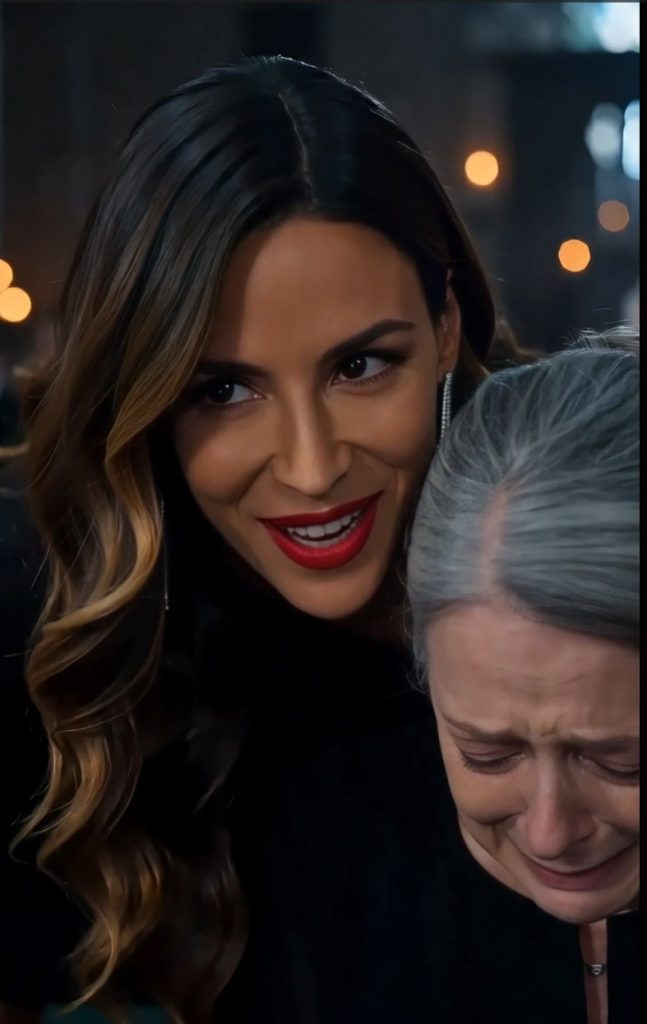
Margaret’s mother, Eleanor Ellis, sat in the front row with her gray hair pulled into a low bun, her black dress severe and simple. She held a handkerchief in both hands, trembling so badly the lace edges fluttered.
Vanessa leaned down beside her ear.
“Looks like I win,” she whispered.
Eleanor closed her eyes.
For a moment, she seemed to shrink inside her grief.
Vanessa straightened, satisfied, and sat beside Adrian like a queen claiming a throne no one had offered her.
Then the lawyer rose near the altar.
Arthur Bell, gray-haired and formal in a dark suit, held a tan envelope against his chest. He adjusted his glasses, looked once toward the casket, and then toward the gathered mourners.
“Before the burial,” he said, voice echoing beneath the arches, “the will must be read.”
Vanessa’s smile did not falter.
Adrian’s did.
The lawyer unfolded the document.
“My mother, Margaret Ellis,” he began, reading carefully, “asked that this letter be opened only in the event of my death.”
The church went utterly still.
Because Margaret had no children.
And Adrian’s face turned white before the lawyer reached the next line.
Act II
Margaret Ellis had spent her life being underestimated because she was kind.
People saw her quiet voice and mistook it for weakness. They saw her charity boards, her handwritten thank-you notes, her habit of remembering birthdays and thought she was soft enough to manipulate.
Adrian had believed that too.
He met Margaret at a museum fundraiser six years earlier. He was charming then. Attentive. Handsome in that expensive, practiced way that made older donors trust him and younger women notice him. He knew how to listen with his eyes. He knew when to touch her hand. He knew how to make loneliness feel chosen.
Margaret had inherited Ellis House, a fortune in old property, and a name that still opened doors in half the city.
Adrian arrived with ambition wrapped in romance.
Eleanor saw it.
She warned her daughter gently at first.
“He watches the room more than he watches you.”
Margaret smiled sadly. “Maybe he’s just not used to belonging.”
That was Margaret.
Always translating hunger into hope.
For a while, she was happy enough to quiet everyone.
She brought Adrian into the family business. Put his name on committees. Introduced him to people who would never have taken his call before. She gave him respect, access, and the one thing he wanted most: proximity to power that looked like love.
Then Vanessa appeared.
She was hired to coordinate a charity gala for the Ellis Foundation. Beautiful, sharp, hungry. She understood instantly what Adrian wanted and what Margaret refused to become.
Vanessa did not want to be loved.
She wanted to win.
The affair began in secret, but secrets are rarely as invisible as guilty people believe. Margaret noticed the late calls. The changed passwords. The small smiles Adrian brought home from places she had not been invited.
When she confronted him, he denied it.
When she showed him proof, he apologized.
When she asked for time, he blamed Eleanor.
“Your mother poisoned you against me,” he said. “She never wanted us happy.”
Margaret did not shout.
That frightened him more.
She simply looked at him as if a veil had lifted.
“No,” she said. “She wanted me safe.”
Two weeks later, Margaret changed her estate plans.
Not dramatically. Not publicly.
Quietly.
She met Arthur Bell in his office with a folder of documents, a pale face, and hands that did not shake until she mentioned her husband’s name.
“If anything happens to me,” she told the lawyer, “I don’t want grief to become a weapon.”
Arthur asked if she believed she was in danger.
Margaret stared out the window for a long time.
“I believe people show you who they are before they do the worst thing they are capable of.”
She also brought a second envelope.
A letter.
Not part of the public will. Not exactly.
A statement written in Margaret’s own hand, sealed and witnessed by two clerks, to be read if her death came before the divorce proceedings were complete.
Arthur did not ask all the questions he wanted to ask.
He had been a lawyer long enough to recognize fear dressed as dignity.
Three days later, Margaret’s car went off the bridge road in heavy rain.
The official report called it a tragic accident.
Adrian arrived at the hospital too late to say goodbye.
Vanessa arrived at his house the next morning.
Eleanor saw her through the window, standing on the porch in oversized sunglasses, one hand on Adrian’s chest.
After that, Eleanor stopped sleeping.
She begged the police to look again. Begged Arthur to tell her whether Margaret had left anything, anything at all, that might explain why her daughter had sounded so strange on the phone the night before she died.
Arthur said only, “Mrs. Ellis, come to the funeral.”
So Eleanor came.
She sat in the front pew, shattered and obedient, while Vanessa whispered victory into her ear.
But Margaret, even in death, had not left her mother defenseless.
And Vanessa was about to learn that kindness is not the same as blindness.
Act III
Arthur Bell lowered his eyes to the page.
The church seemed to lean toward him.
“My mother, Margaret Ellis,” he read again, “asked that this letter be opened only in the event of my death because she believed the truth should be spoken where lies hoped to be rewarded.”
A murmur moved through the pews.
Vanessa looked at Adrian.
His face had gone tight, the smugness draining from it drop by drop.
Eleanor lifted her head.
Arthur continued.
“If this is being read, then I did not have time to finish what I began. To my mother, Eleanor: I am sorry. You were right. I was too ashamed to admit how wrong I had been.”
Eleanor pressed the handkerchief to her mouth.
“I was afraid Adrian would try to use my death to take control of the Ellis Foundation, Ellis House, and everything my father built. I was afraid he would stand beside my casket and pretend to mourn me while waiting for the keys.”
Adrian stood abruptly.
“This is inappropriate,” he said.
Arthur did not look up.
“It is legally witnessed and incorporated by reference into the testamentary instructions.”
“This is my wife’s funeral.”
Arthur finally raised his eyes.
“Yes,” he said. “I recommend you sit down.”
The room went silent again.
Adrian sat.
Vanessa’s fingers closed around the edge of the pew.
Arthur resumed.
“To Adrian: by the time you hear this, you will already know that the old will you encouraged me to sign is void. You will receive nothing from my estate except the wedding ring I wore while you lied to me. I hope it weighs more in your hand than it ever did on mine.”
A gasp rose from the mourners.
Vanessa’s lips parted.
Eleanor began to cry soundlessly.
Adrian whispered, “No.”
Arthur turned the page.
“To Vanessa Vale, who has likely come dressed as if she has won: you were never competing with me. You were competing with what you believed I did not know.”
The entire church turned toward Vanessa.
Her face hardened.
But her cheeks flushed bright beneath the makeup.
Arthur did not slow.
“On February 11, I received copies of messages between you and my husband discussing my medication, my car, and the timing of my divorce filing. Those materials have been placed with my attorney and delivered to Detective Harold Price in the event of my death.”
Adrian lunged to his feet again.
“That’s a lie.”
Arthur closed the letter.
“It is not the end of the document.”
A side door opened near the vestry.
Two uniformed officers stepped into the church.
Vanessa’s confidence broke so visibly that even the mourners in the back row saw it happen.
One moment, she was still performing outrage.
The next, she was looking for exits.
Eleanor stood slowly.
Her grief was still there.
But something had risen inside it.
“My daughter knew,” she whispered.
Arthur looked at her with gentle sadness.
“Yes, Mrs. Ellis. She knew enough.”
Vanessa laughed suddenly, brittle and sharp.
“This is insane. You’re all insane. She was paranoid. Everyone knew she was unstable.”
The words had barely left her mouth when Arthur pulled a second envelope from the folder.
“This,” he said, “is the amended trust directive Margaret signed five days before her death.”
Adrian’s hands curled into fists.
Vanessa went very still.
Because that was the moment she understood there was more than accusation in the room.
There was consequence.
Act IV
The trust directive did what Margaret had not lived long enough to do herself.
It removed Adrian from every foundation board.
Revoked his access to all Ellis accounts.
Transferred voting control to Eleanor and an independent council of trustees.
Protected Ellis House from sale, transfer, mortgage, or occupancy claim by Adrian or any person acting through him.
Arthur read each sentence with professional calm.
Every word landed like a door closing.
Vanessa sat rigid beside Adrian, her lips pressed together, her hand gripping his sleeve with less affection than fear.
The man she had linked arms with minutes earlier no longer looked powerful.
He looked trapped.
Arthur continued.
“There is one final instruction.”
Adrian shook his head. “Enough.”
But no one listened to him now.
Not the mourners.
Not the officers.
Not Eleanor.
Arthur read:
“My mother is to remain in Ellis House for the rest of her life. The house was my father’s gift to her as much as mine. No one is to remove her, pressure her, or diminish her place in the family home.”
Eleanor broke then.
She bent forward in the pew, one hand to her chest, the other covering her mouth as if trying to hold in a sound too painful for church walls.
A woman behind her reached forward and held her shoulder.
Arthur’s voice softened, but did not fail.
“If my death is found to be caused by criminal conduct, all personal assets that would have passed through marital claim are to be redirected to the Margaret Ellis Shelter Fund for women seeking safety from coercive partners.”
A deep silence followed.
It was no longer only a will.
It was a final act of protection.
Vanessa stood.
“This is theatrical nonsense,” she said. “You can’t prove anything.”
Detective Price, who had entered quietly behind the officers, stepped into the aisle.
“Ms. Vale,” he said, “we can discuss proof outside.”
Her face turned toward him.
Then toward Adrian.
“Say something,” she hissed.
Adrian did not.
That was his confession in miniature.
He had always been brave only when someone else paid the price.
Vanessa stared at him, realizing too late that their partnership had been built entirely on greed. There was no loyalty beneath it. No love. No shared courage. Only appetite.
The detective looked at Adrian.
“You too, Mr. Ellis.”
A low murmur moved through the church as the officers approached.
Vanessa’s eyes flashed.
“This is her fault,” she snapped, pointing at Eleanor. “That bitter old woman turned Margaret against us.”
Eleanor stood.
Not quickly.
Not dramatically.
Her knees seemed almost too weak to hold her, but she stood anyway.
For the first time since Vanessa had leaned into her ear, Eleanor looked directly at her.
“No,” she said. “You did.”
The words were quiet.
They destroyed the last of Vanessa’s performance.
Her face twisted.
“You don’t know what she was like.”
Eleanor’s voice trembled. “I know exactly what she was like. She was my child.”
The church seemed to hold that sentence.
Even Arthur removed his glasses and lowered his eyes.
The officers led Vanessa into the aisle. Her heels clicked on the same runner she had walked down smiling. But now no one mistook the sound for confidence.
Adrian followed seconds later, pale and silent.
As he passed the casket, he did not look at Margaret.
Eleanor noticed.
So did everyone else.
Arthur waited until they were gone.
Then he turned back to the mourners.
“There is one final personal letter,” he said softly. “For Mrs. Eleanor Ellis alone.”
Eleanor looked toward him.
Her face crumpled.
Arthur stepped down from the podium and handed her the sealed envelope.
On the front, in Margaret’s handwriting, were four words:
For Mom. Be brave.
Eleanor held it against her heart.
And the church, which had begun as a place of death, became something else.
A witness stand.
Act V
The burial happened under gray skies.
Vanessa and Adrian were not there.
No one spoke of them at the graveside. Not directly. Their absence hung in the air, but Margaret’s mother refused to let them become the center of the final goodbye.
The priest read softly.
Wind moved through the cemetery trees.
White lilies trembled beside the casket.
Eleanor stood with Arthur on one side and her sister on the other. She held Margaret’s final letter in both hands, unopened until the last prayer ended.
Only then did she step away from the mourners.
She walked to the old stone bench beneath an oak tree and opened the envelope.
The handwriting blurred immediately.
Mom,
If you are reading this, then I am so sorry. I know you will blame yourself. Please don’t. You warned me because you loved me. I stayed because I was ashamed. Those are different burdens. Mine was never yours to carry.
Eleanor pressed the paper to her lips.
Then she kept reading.
I need you to do something hard. I need you to live in the house. Not like a ghost. Not like a caretaker of memories. Live there. Open the curtains. Plant the roses back by the south wall. Make tea in the blue kitchen. Let children from the shelter come at Christmas if you want. Fill it with noise again.
Eleanor laughed once through her tears.
Margaret had always hated a silent house.
The letter continued.
If they came to my funeral smiling, let them. Let them believe they won for one perfect minute. Then let Mr. Bell read everything.
Eleanor looked up toward Arthur.
He stood at a respectful distance, pretending not to watch her cry.
She returned to the letter.
You used to tell me that truth is patient. I used to think that meant it was weak. Now I know patience is how truth survives until the right door opens.
I love you.
I am not afraid anymore.
Please don’t spend the rest of your life being afraid for me.
Your Margaret.
Eleanor folded the letter carefully.
Not because she was done with it.
Because she would read it a thousand times.
The investigation that followed was quieter than the funeral, but far more devastating.
Messages surfaced. Financial transfers. Search histories. A mechanic who admitted Adrian had asked strange questions about Margaret’s car. A pharmacist who remembered Vanessa trying to obtain information she had no right to request. The “accident” no longer looked clean beneath scrutiny.
Wealth had hidden the truth for a while.
It had not buried it.
Adrian’s friends vanished first.
Vanessa’s came next.
People who had laughed with them at private dinners now described themselves as “distant acquaintances.” Donors who had courted Adrian returned calls from Eleanor instead. The foundation board met under emergency session and confirmed Margaret’s final directives unanimously.
Ellis House remained Eleanor’s.
But she did not keep it only for herself.
By winter, the east wing became temporary housing for women leaving dangerous marriages. The old music room became a counseling office. Margaret’s bedroom remained untouched for months, until Eleanor finally opened the curtains, washed the linens, and placed fresh roses on the nightstand.
Not white ones.
Yellow.
Margaret had loved yellow roses.
At Christmas, children ran through the foyer for the first time in years. Their laughter rang up the staircase. Eleanor stood in the doorway with a tray of cookies, crying quietly because grief had not left her, but it had made room.
Arthur visited once a week to help with foundation papers.
On the first anniversary of the funeral, Eleanor returned to the church alone.
The same stained-glass windows glowed above her.
The same aisle stretched toward the altar.
She walked slowly to the front pew where Vanessa had leaned down and whispered, Looks like I win.
Eleanor sat there for a long time.
Then she looked toward the altar and said softly, “You did, darling.”
Not Vanessa.
Margaret.
Margaret, who had seen the truth coming and still found a way to protect her mother.
Margaret, who had turned a will into a shield.
Margaret, who had let arrogance walk smiling down the aisle before pulling the floor from beneath it.
Eleanor stayed until the candles burned low.
When she finally rose, she did not look defeated.
She looked old, yes.
Wounded, yes.
But not broken.
Outside, the church bells began to ring.
Their sound rolled over the stone steps, into the cold air, across the street where cars passed and life continued with its careless insistence.
Eleanor held her daughter’s letter inside her coat pocket.
Then she walked home to Ellis House, where lights glowed in the windows, soup warmed on the stove, and a shelter child had taped a crooked paper angel to the front door.
Vanessa had whispered that she had won.
But in the end, all she had done was stand in a church full of witnesses while Margaret Ellis spoke from a sealed envelope and took everything back.