Act I
The first slam echoed all the way down the hallway.
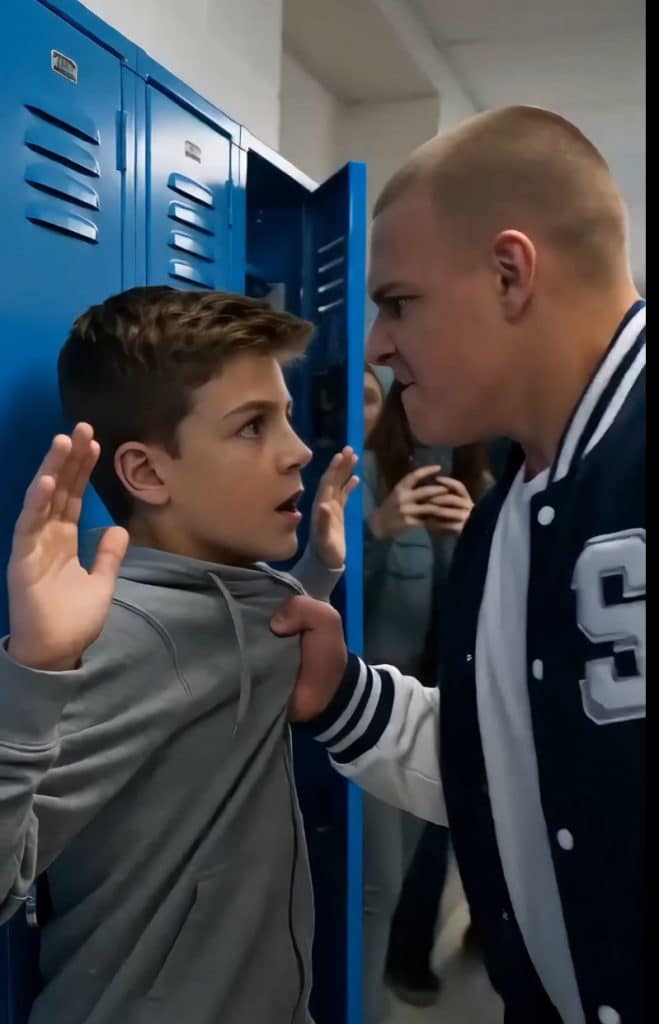
Metal lockers rattled like a row of alarms as Noah Reed hit them shoulder-first, his gray hoodie bunching at the collar. His backpack slipped off one arm. Someone laughed. Someone else shouted, “Yo, record this!”
Within seconds, the hallway was no longer a hallway.
It was a circle.
Blue lockers on one side. Students packed tight on the other. White tile underfoot. Fluorescent lights buzzing overhead. Phones rising in every direction like little glass eyes.
And in the center of it all stood Tyler Vance.
The principal’s son.
He was bigger than Noah by almost a full head, with a buzz cut, a varsity jacket, and the kind of confidence that came from never having to wonder who would believe him. His father’s office was upstairs. His last name was on plaques near the gym. Teachers smiled at him even when he walked in late.
Tyler grabbed Noah by the collar and yanked him forward.
“You’re a dead boy,” he said.
Noah’s hands shot up.
Not fists.
Open palms.
“Tyler, stop.”
That only made the crowd louder.
A girl in a maroon shirt leaned in with her phone. A boy by the water fountain shouted for Tyler to “end him.” A dozen students watched with the hungry excitement of people who knew they were not the ones being hurt.
Noah glanced past Tyler.
At the end of the hall stood Mr. Harlan, a bald history teacher in a light blue short-sleeved shirt and khaki pants. He saw everything.
The shove.
The collar grab.
The raised fist.
For one second, Noah thought the teacher would step in.
But Mr. Harlan only shifted his weight and looked away.
Something changed in Noah’s face then.
Fear was still there, but it hardened into something quieter.
Tyler drew his fist back.
Noah moved first.
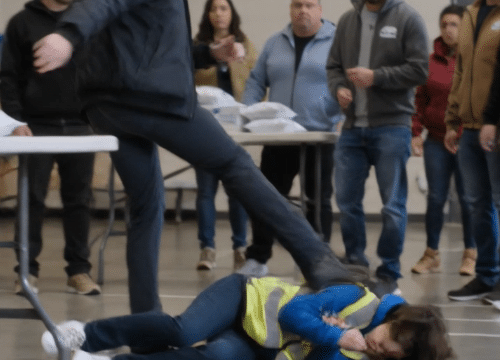
He caught Tyler’s arm, stepped sideways, and used the bigger boy’s momentum against him. It was quick. Controlled. Almost clean. Tyler’s feet slid on the tile, his body twisted, and then he hit the floor hard enough to silence the hallway.
The phones stayed raised.
But the cheering died.
Tyler lay on his back, stunned, propped on his elbows with his mouth open.
Noah stepped back immediately.
Hands down.
Breathing hard.
Not attacking.
Not celebrating.
Just standing.
Then Mr. Harlan turned around.
Now he moved fast.
He stormed toward Noah with one finger already pointed at him.
“How dare you hit the principal’s son!” he shouted. “You’re done.”
Noah looked at him.
Then slowly, he raised one finger and pointed toward the ceiling.
“Check the cameras.”
Mr. Harlan froze.
And for the first time that day, Tyler Vance looked scared.
Act II
Noah Reed had learned early that quiet kids were easier to blame.
He did not dress loud. He did not talk loud. He did not take up space he was not invited to occupy. His teachers called him “responsible,” which usually meant they forgot to notice when responsibility became loneliness.
His mother worked nights at a hospital laundry service. His older brother had joined the Marines the year before. At home, Noah made dinner three nights a week, kept his grades high, and fixed the loose chain on his bike with videos he watched online.
At school, he tried to stay invisible.
Tyler Vance made that impossible.
It started with small things.
A shoulder bump near the cafeteria. A pencil snapped in half during English. A photo of Noah’s old sneakers posted in a group chat with laughing emojis. Tyler never did anything big enough to become a headline. He did things small enough to deny.
That was his gift.
He knew where the cameras were.
He knew which teachers looked away.
He knew which students would laugh first and ask questions never.
And he knew his last name worked like armor.
His father, Principal Vance, was the kind of man who shook hands with parents at football games and talked about “school culture” at assemblies. He wore expensive ties and used phrases like accountability, leadership, and family values.
But Tyler understood the real lesson better than anyone.
Rules were for students whose parents did not run the building.
The week before the hallway fight, Noah had reported him.
Not dramatically.
Not with tears.
He walked into the guidance office with screenshots, dates, and the calm voice of someone who knew emotion could be used against him. The counselor listened, nodded, and said she would “look into it.”
The next day, Tyler shoved Noah’s lunch tray off the table.
“Snitch,” he said softly.
Nobody helped clean it up.
Mr. Harlan had been in the cafeteria that day too.
He saw enough.
He always saw enough.
But Mr. Harlan owed Principal Vance. Everyone knew it, though no one said it out loud. Years earlier, after a complaint from a parent nearly ended his teaching career, Principal Vance had protected him. Since then, Mr. Harlan had become the kind of teacher who understood which students mattered and which students were safer to ignore.
Noah noticed.
He noticed everything.
That was what people underestimated about quiet kids.
They assumed silence meant weakness.
Sometimes silence was evidence gathering.
Noah knew about the camera above the east hallway. He knew the one near the trophy case had been replaced after a senior prank. He knew the blind spot near the stairwell, because Tyler loved using it.
So when Tyler cornered him that afternoon, Noah also knew one thing Tyler had forgotten.
They were not in the blind spot.
They were directly beneath the new security camera.
And Noah had been waiting for someone to make the truth visible.
He just had not expected the whole hallway to watch him bleed for it first.
Act III
The silence after Noah said “Check the cameras” was different from the silence after Tyler hit the floor.
The first silence had been shock.
This one was fear.
Mr. Harlan’s pointing hand lowered an inch.
Noah could see the calculation in his face. The teacher was replaying what he had ignored. Tyler slamming Noah into the lockers. Tyler grabbing his collar. Tyler threatening him. The crowd cheering.
And himself.
Standing there.
Watching.
Doing nothing.
Tyler pushed himself up from the floor, face flushed with humiliation.
“He attacked me,” he snapped.
Noah did not look at him.
He kept his eyes on Mr. Harlan.
“Check the cameras,” he repeated.
A murmur moved through the students.
Some phones lowered. Others stayed up, capturing the moment the story began changing shape.
Mr. Harlan swallowed.
“You’re coming with me.”
“Fine,” Noah said. “Call my mom too.”
That made Tyler glance at him.
Noah’s mother, Mara Reed, was not rich. She was not powerful. She did not sit on school boards or donate to booster clubs. But she had one thing adults like Mr. Harlan hated.
She wrote everything down.
Every call. Every meeting. Every name. Every excuse.
And she had already warned the school two days earlier: If my son gets hurt after reporting this, I want the footage preserved.
Noah walked to the office with Mr. Harlan on one side and Tyler on the other.
Behind them, the crowd followed at a distance until another teacher shouted for everyone to get to class. The hallway cleared slowly, but the videos were already moving through phones faster than any adult could stop them.
In the main office, Principal Vance appeared within minutes.
He did not look at Noah first.
He went straight to Tyler.
“What happened?”
Tyler pointed at Noah. “He threw me.”
Principal Vance turned.
His face had already chosen a verdict.
“Noah, this is serious.”
Noah nodded. “Yes, sir. It is.”
The principal’s expression tightened.
Mr. Harlan stood near the door, suddenly very interested in the floor.
“I was assaulted,” Tyler said. “Everybody saw it.”
Noah looked through the office window toward the hallway camera monitor mounted near the receptionist desk.
“Then everybody saw what happened before it too.”
Principal Vance followed his gaze.
For half a second, he looked annoyed.
Then uncertain.
The secretary, Mrs. Bell, cleared her throat.
“Mr. Vance,” she said carefully, “Mrs. Reed is on line two.”
The principal’s jaw tightened.
Noah almost smiled, but did not.
His mother had not waited to be called.
Someone had sent her the video.
Or at least enough of it.
Principal Vance picked up the phone with the slow dread of a man realizing the room had more witnesses than he wanted.
“Mara,” he said smoothly. “We’re just sorting out an incident.”
The sound of Mrs. Reed’s voice carried faintly through the receiver.
“Sort it with the camera footage preserved.”
The office went still.
Tyler shifted.
Mr. Harlan looked up.
Noah stood quietly in the middle of the room, hoodie collar stretched, shoulder aching, and understood something important.
Power was loud when it thought no one was recording.
But truth did not need to shout once it had footage.
Act IV
They tried to separate the story.
That was the first tactic.
Principal Vance wanted to talk about “Noah’s physical response” as if it had happened in an empty hallway, unattached to everything before it. Mr. Harlan used words like escalation and disproportionate. Tyler kept saying, “He threw me,” louder each time, as if repetition could erase the locker impact from history.
Then Mrs. Reed arrived.
She came straight from work in navy scrubs, her hair pulled back, eyes tired but sharp. She did not hug Noah first, though he knew she wanted to. She looked at his collar, his shoulder, the red mark near his neck where Tyler had grabbed him.
Then she turned to Principal Vance.
“I want the footage.”
“Mara, we have procedures.”
“Good,” she said. “Follow them.”
He folded his hands on the desk. “I understand you’re upset.”
“No,” she said. “You understand I’m prepared.”
That ended the polite part.
She pulled a folder from her bag and placed it on his desk. Inside were printed screenshots, emails, notes from previous meetings, dates of reported incidents, and one written statement Noah had made after Tyler threatened him in the cafeteria.
Principal Vance stared at the folder.
His face darkened.
“You’ve been documenting my son?”
“I’ve been documenting the school’s failure to protect mine.”
Mr. Harlan shifted near the wall.
Mrs. Reed turned to him.
“And you were in the hall?”
He opened his mouth.
Noah spoke before the teacher could shape a lie.
“He saw Tyler shove me.”
Mr. Harlan’s face flushed. “I was managing the crowd.”
“You were looking away,” Noah said.
His voice was not angry.
That made it worse.
Mrs. Reed looked back at Principal Vance.
“Footage. Now.”
The principal tried one last move.
“Security footage is internal property.”
“So is liability,” she replied.
Ten minutes later, they were in the security office.
The vice principal, Ms. Lawson, joined them after hearing enough to realize the situation had become too serious to leave inside Principal Vance’s hands. She was quiet, precise, and difficult to intimidate.
She asked the technician to pull the east hallway feed.
The video appeared.
No audio.
It did not need any.
There was Tyler stepping into Noah’s path.
Tyler shoving him into the lockers.
Students gathering.
Mr. Harlan visible near the far side of the hallway.
Tyler grabbing Noah’s collar.
Tyler drawing back his fist.
Noah’s hands raised, open.
The pivot.
The fall.
Noah stepping away immediately.
Mr. Harlan rushing in only after Tyler hit the floor.
Nobody spoke.
The truth looked smaller on a screen.
Cleaner.
Crueler.
Principal Vance leaned forward, jaw locked.
“Play it again,” Ms. Lawson said.
They did.
This time, she watched Mr. Harlan.
He looked away while Noah was trapped.
Then turned back when Tyler fell.
Ms. Lawson’s expression changed.
Not shock.
Confirmation.
The kind that suggested this was not the first complaint she had heard.
Tyler’s confidence cracked first.
“He made me look bad,” he muttered.
Mrs. Reed turned toward him.
“No,” she said. “You did that yourself.”
Tyler looked at his father for rescue.
But Principal Vance was staring at the screen, and for the first time, he did not look like a principal.
He looked like a father who had run out of ways to protect the wrong child from consequences.
Ms. Lawson closed the laptop.
“Noah acted in self-defense,” she said.
Principal Vance’s head snapped toward her.
She continued calmly. “This incident will be reported to the district. Mr. Harlan’s failure to intervene will also be reviewed. Tyler will be removed from campus pending investigation.”
Tyler stood up. “What?”
Ms. Lawson looked at him.
“You heard me.”
Noah felt his mother’s hand finally touch his shoulder.
Just lightly.
Just enough.
And for the first time all day, he let himself breathe.
Act V
By morning, everyone knew.
Not the official report.
That would take longer, wrapped in district language and careful wording.
But the hallway knew.
The students knew.
The teachers knew.
The video had spread before the school could contain it, but not in the way Tyler expected. The first clip showed the takedown. The second, longer clip showed the shove, the threat, the teacher looking away, and Noah pointing toward the camera.
That was the one people replayed.
Check the cameras.
Three words became the school’s new dividing line.
Some students acted embarrassed because they had cheered. Others pretended they had always known Noah was in the right. A few apologized badly in the hallway, looking at their shoes while saying things like, “That was messed up” and “I didn’t know it was that bad.”
Noah accepted some apologies.
Not all.
Forgiveness, his mother told him, was not a school assignment.
Tyler did not return that week.
Mr. Harlan disappeared for “administrative review.”
Principal Vance sent an email to families about safety, respect, and the importance of not sharing student videos. Nobody missed what he did not mention.
Ms. Lawson called Noah and his mother into her office two days later.
“I’m sorry,” she said.
Adults rarely said that plainly.
Noah looked at her carefully.
“For what?”
“For the school making you prove you deserved protection.”
Mrs. Reed’s face softened, but her voice stayed firm.
“What changes?”
Ms. Lawson slid a paper across the desk.
Hallway supervision policy. Bullying report escalation. Mandatory camera review after physical incidents. Staff accountability measures. Student bystander training.
It was not perfect.
It was not enough to undo what happened.
But it was something with signatures and dates.
Mrs. Reed read every line.
Then she nodded once.
Noah returned to class the next day.
The hallway felt different, though the lockers were the same bright blue and the floor still shone under fluorescent lights. Students still moved in noisy waves. Phones still came out too easily. But when Noah passed the spot where Tyler had slammed him into the lockers, a freshman he did not know stepped aside and gave him room.
Not fearfully.
Respectfully.
That mattered.
At lunch, Noah sat alone at first.
Then a girl from his English class, Maya, walked over with her tray.
“Can I sit?”
He shrugged. “Sure.”
She sat across from him, quiet for a moment.
“I was recording,” she said.
Noah looked up.
She swallowed. “At first, I thought it was funny. Then I watched it later and realized I sounded awful.”
He did not rescue her from the discomfort.
She pushed her fries around.
“I’m sorry.”
This time, he believed it.
“Okay,” he said.
It was not friendship yet.
But it was a beginning.
Weeks later, Noah joined the school’s peer safety committee after Ms. Lawson asked him twice and his mother told him he had the right to say no. He almost did.
Then he thought about the next quiet kid.
The next blind spot.
The next teacher pretending not to see.
So he said yes.
At the first meeting, someone suggested posters.
Noah stared at the table.
“Posters don’t stop anything,” he said.
The room went quiet.
He looked up.
“Adults do. Cameras help. Students help if they stop treating pain like entertainment. But posters don’t stop a fist.”
Nobody argued.
By spring, the school had changed in small visible ways.
Teachers stood in the hallways instead of doorways. Reports were logged digitally. Security footage was reviewed automatically after physical confrontations. Students caught filming fights were required to attend restorative sessions with counselors and, when appropriate, the people harmed by the videos.
It did not make the school perfect.
But it made looking away harder.
Noah’s shoulder healed.
His hoodie collar stayed stretched.
He kept wearing it anyway.
One afternoon, near the end of the year, he saw Tyler across the parking lot with his father. Tyler looked smaller out of uniform, stripped of the hallway crowd and the varsity jacket performance. Principal Vance spoke to him in a low voice, one hand on the car door.
Tyler looked over.
For a second, their eyes met.
Noah expected anger.
Instead, he saw humiliation.
Maybe even fear.
Noah did not wave.
Did not glare.
Did not give him anything.
He simply turned and walked toward his mother’s car.
Mrs. Reed watched him climb in.
“You okay?”
Noah buckled his seatbelt.
“Yeah.”
She studied him.
Then smiled faintly. “You know, when you were little, you used to hide behind me whenever anyone raised their voice.”
He looked out the window.
“I still wanted to.”
“But you didn’t.”
Noah thought about the lockers. The crowd. Mr. Harlan’s face. The moment Tyler hit the floor. The camera above them, cold and silent, holding what people tried to twist.
“I was scared,” he said.
His mother started the car.
“Bravery usually is.”
As they pulled away, Noah looked back at the school.
The blue lockers were hidden inside now. The hallway was quiet from this distance. Just a building. Brick, glass, doors, cameras, adults, students, secrets.
For months, Tyler Vance had counted on silence.
On status.
On teachers who looked away.
On crowds that laughed before they thought.
But that day, in a packed hallway under fluorescent lights, he forgot one thing.
The truth was watching from the ceiling.
And the quiet boy he chose to break had finally learned how to point at it.